-
-
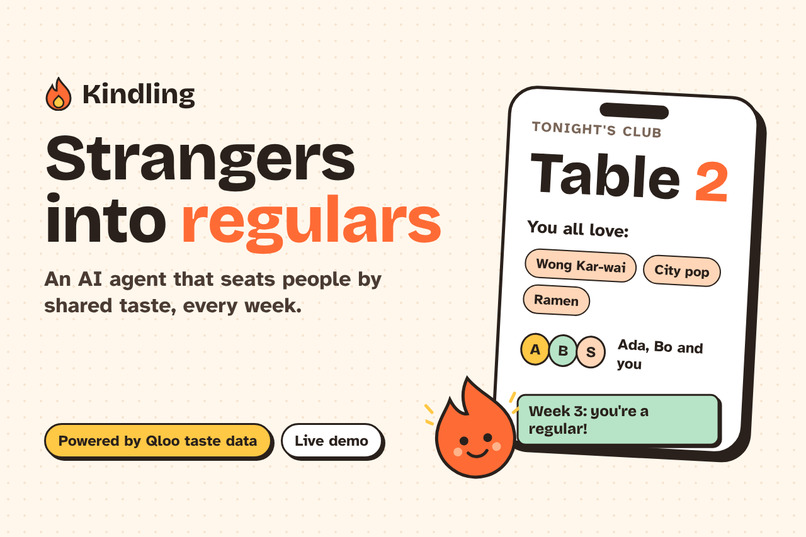
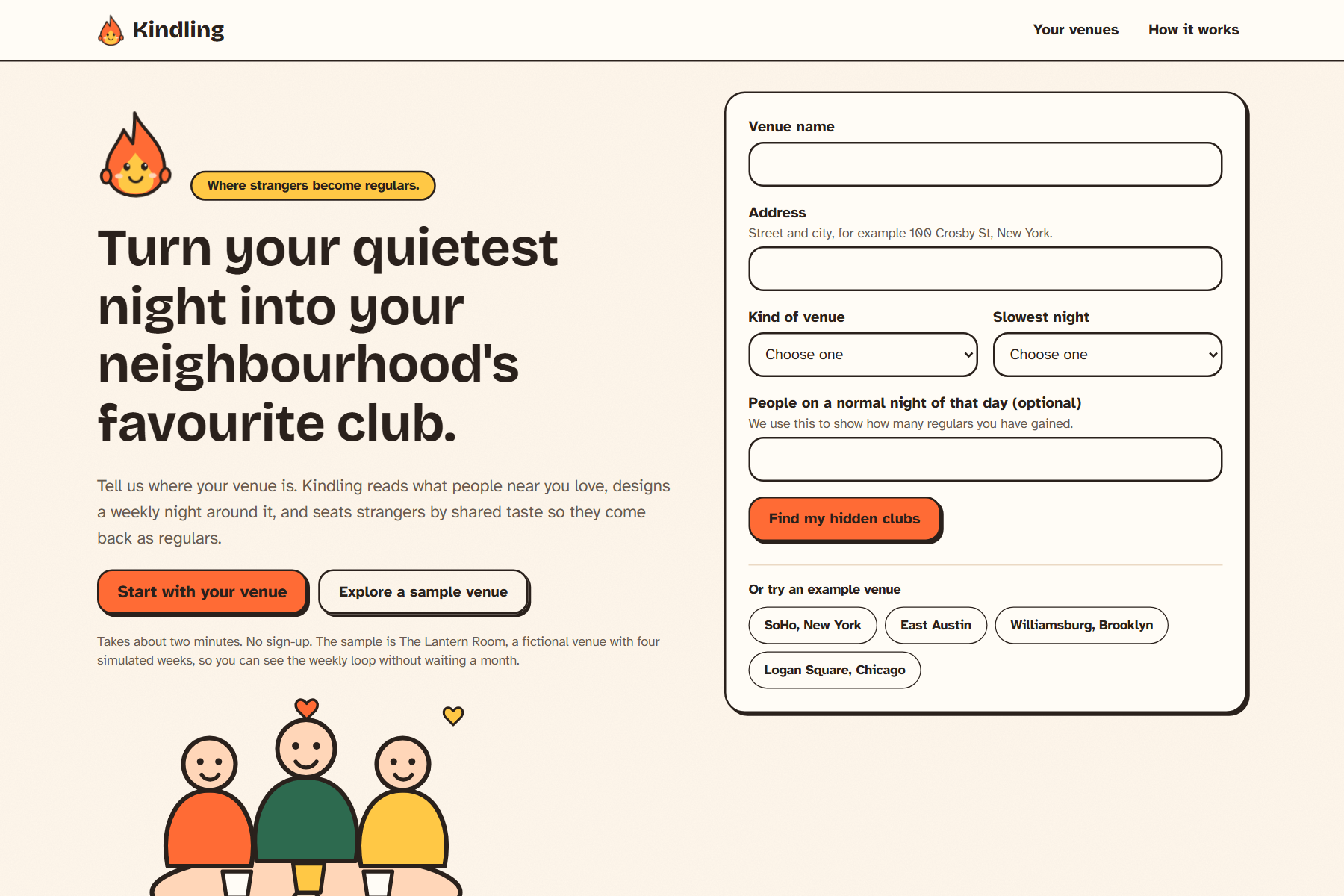
Kindling turns a venue’s quietest night into a weekly club of regulars.
-
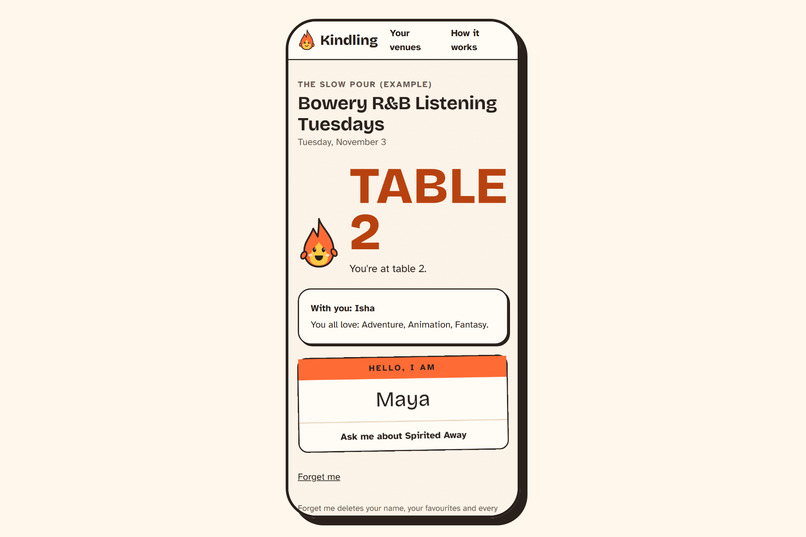
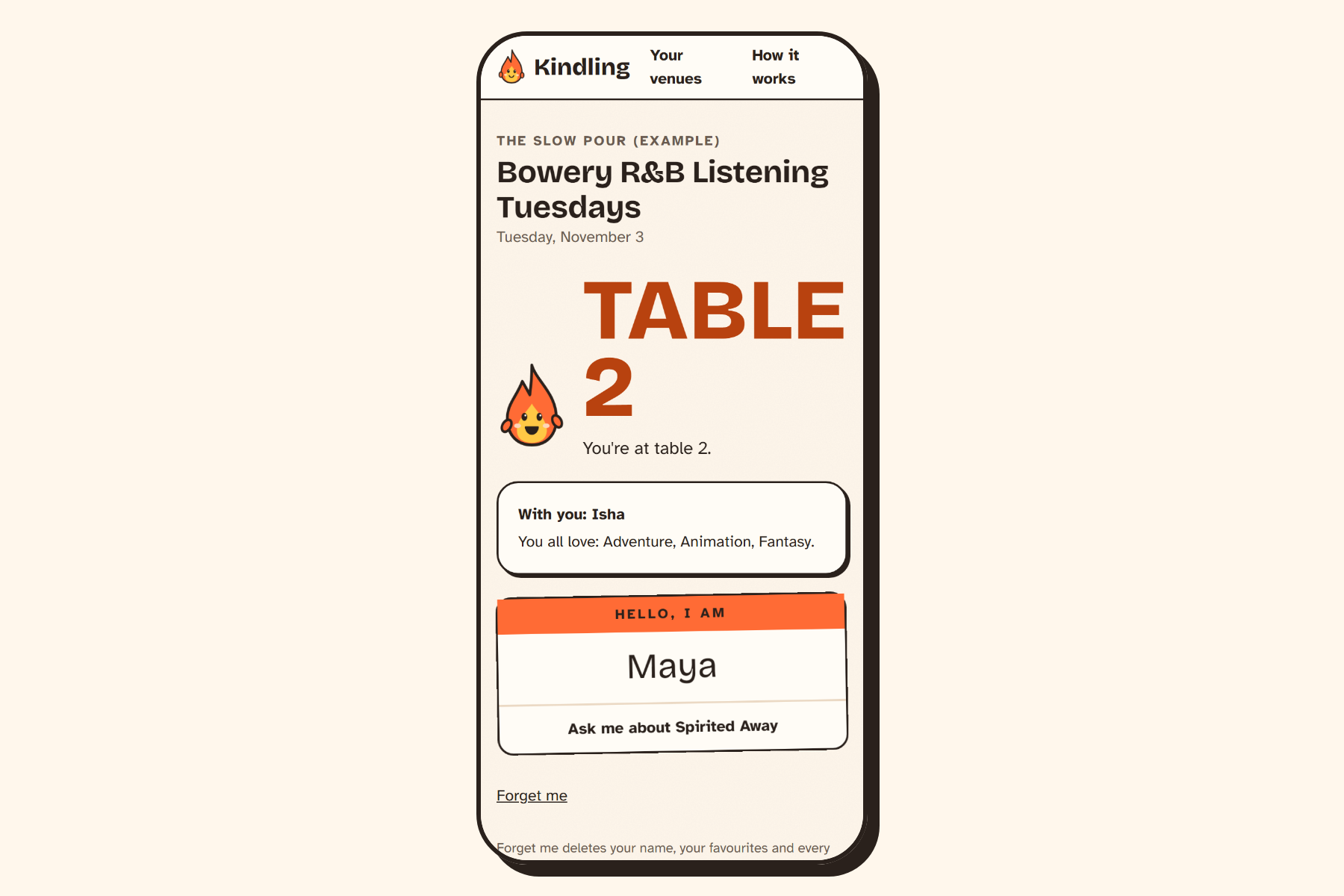
The moment it’s built for: a guest taps three favourites and Kindling seats them with people who share their taste.
-
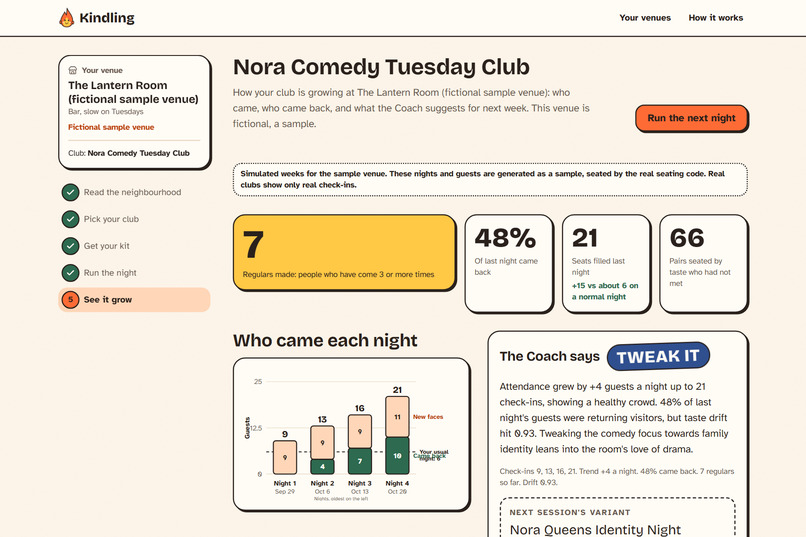
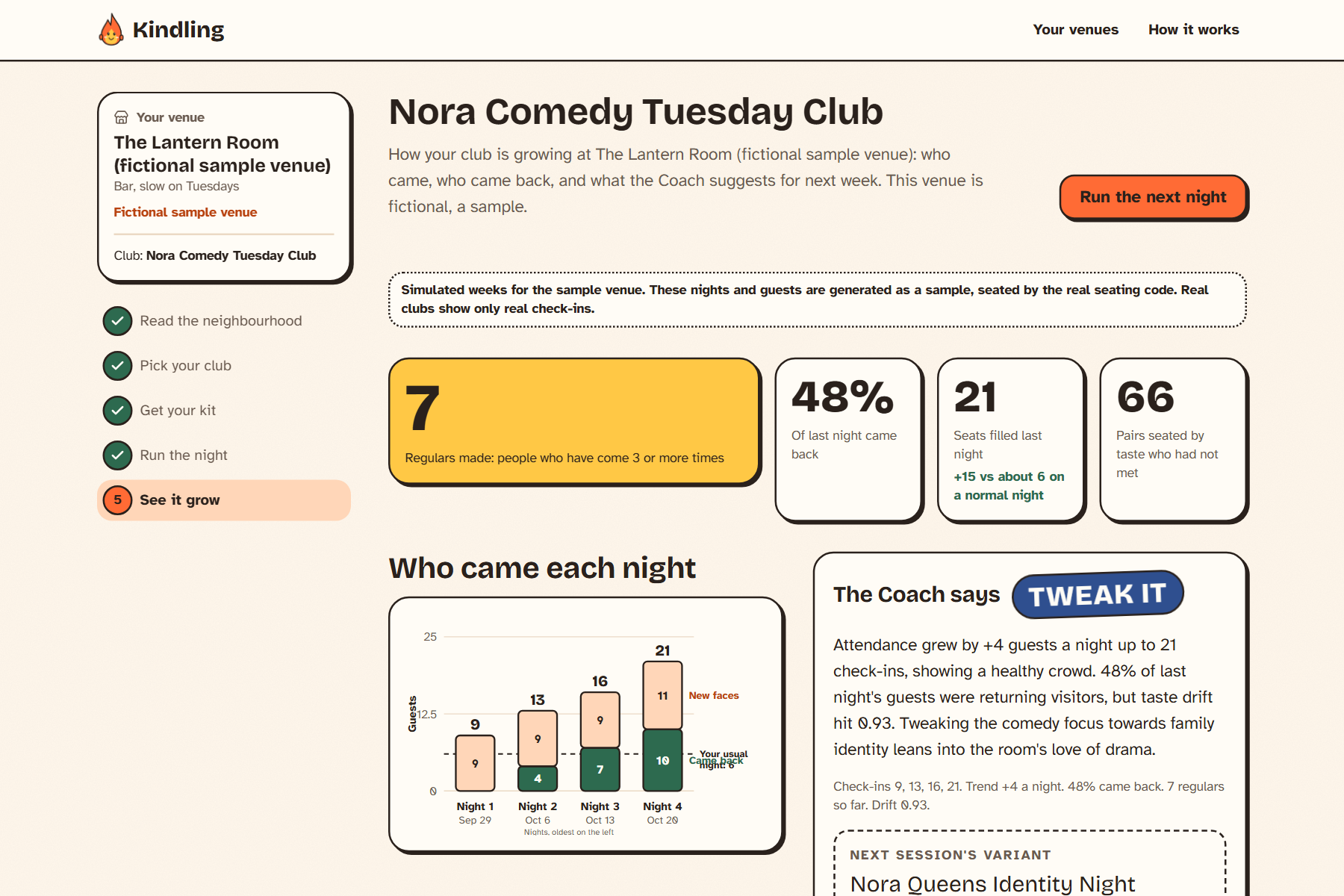
The weekly loop: the Coach reads who came back, counts regulars made and says keep, tweak or switch. (Sample venue, simulated weeks.)
-
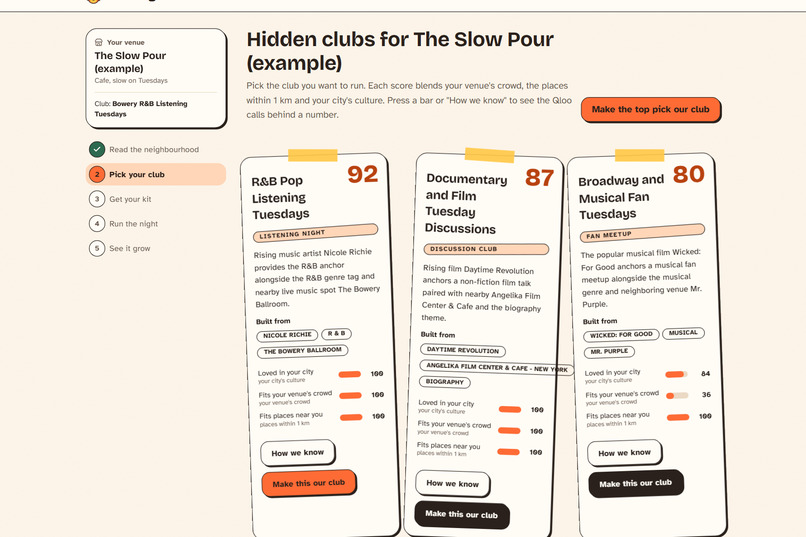
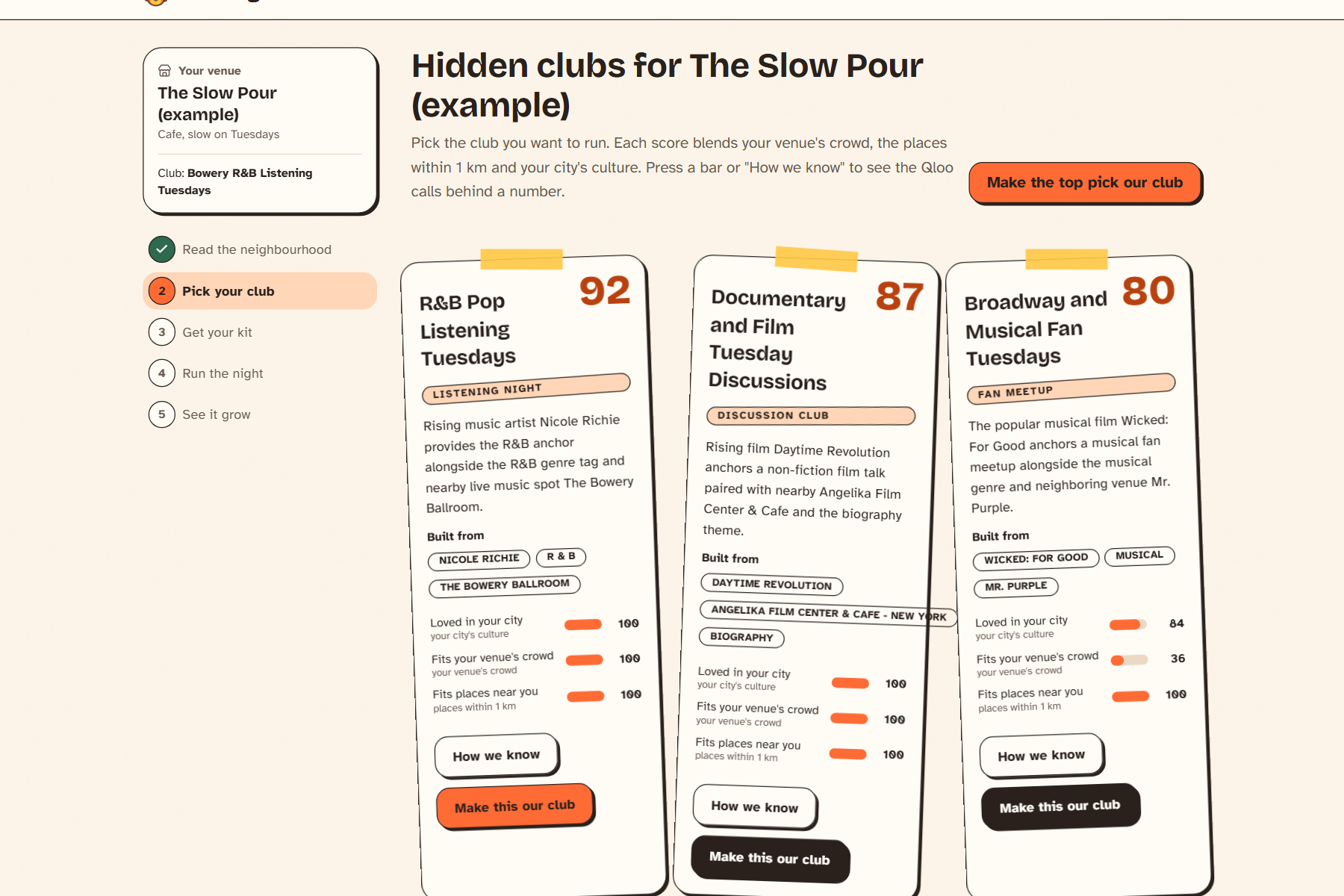
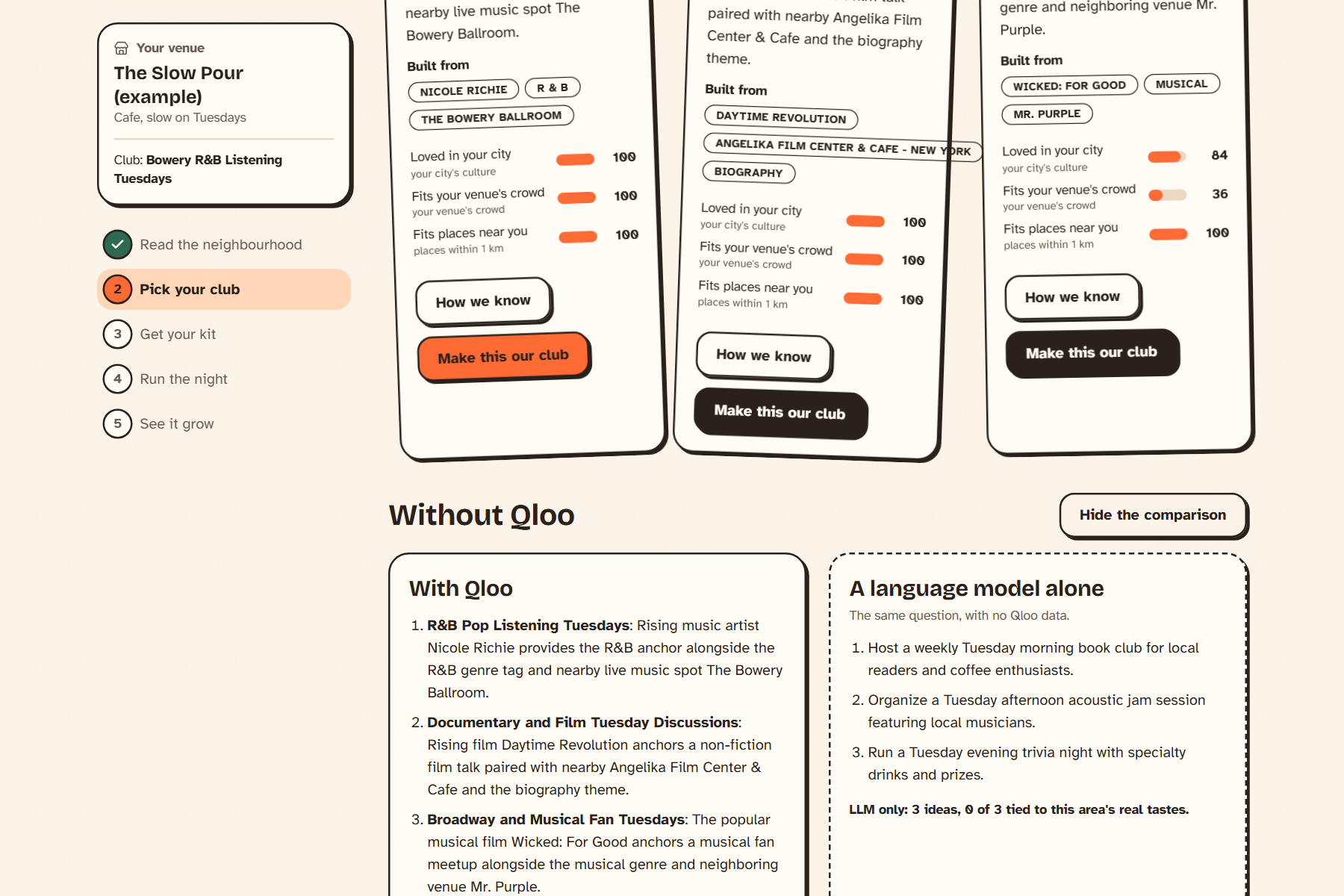
Hidden clubs designed from real Qloo taste data, each scored by your venue’s crowd, places within 1 km and your city’s culture.
-
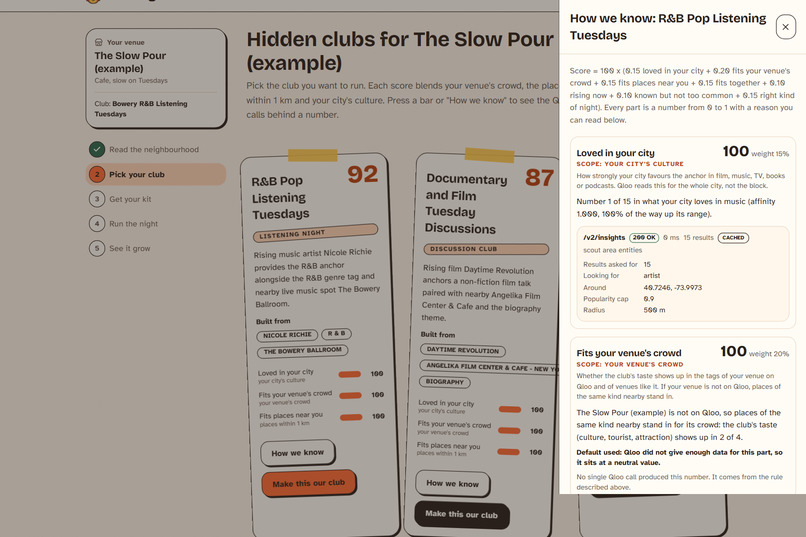
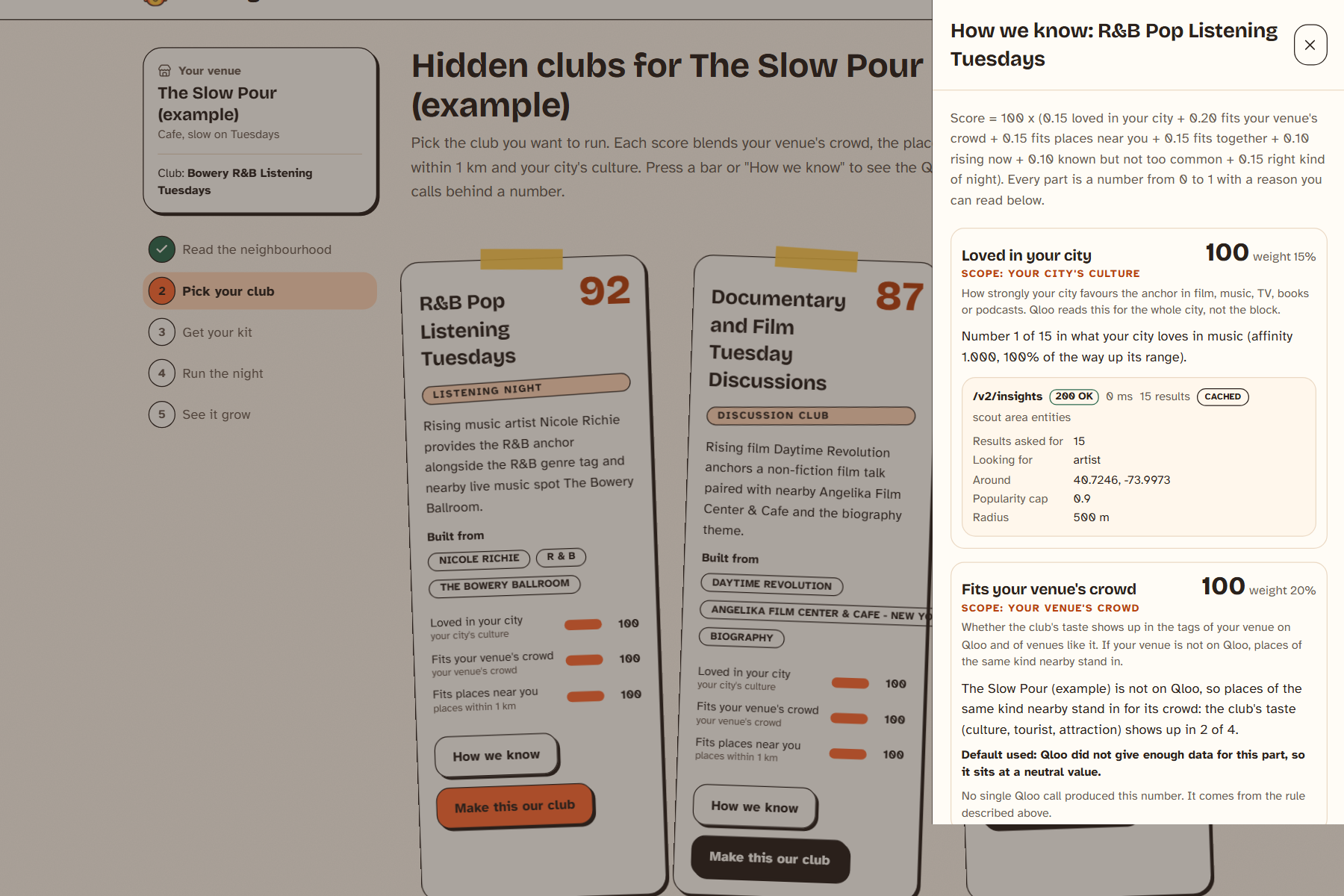
Every score links to the exact Qloo calls behind it. No guesswork.
-
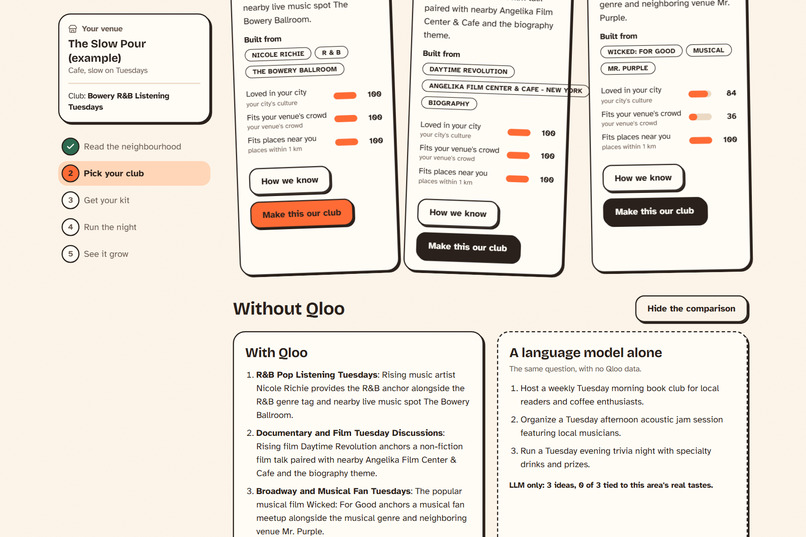
The same question asked to a plain language model: generic ideas with nothing to back them up.
-
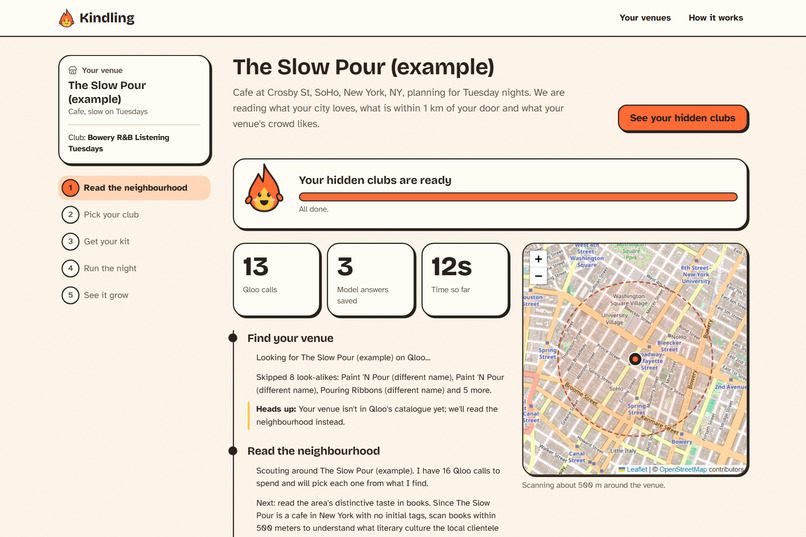
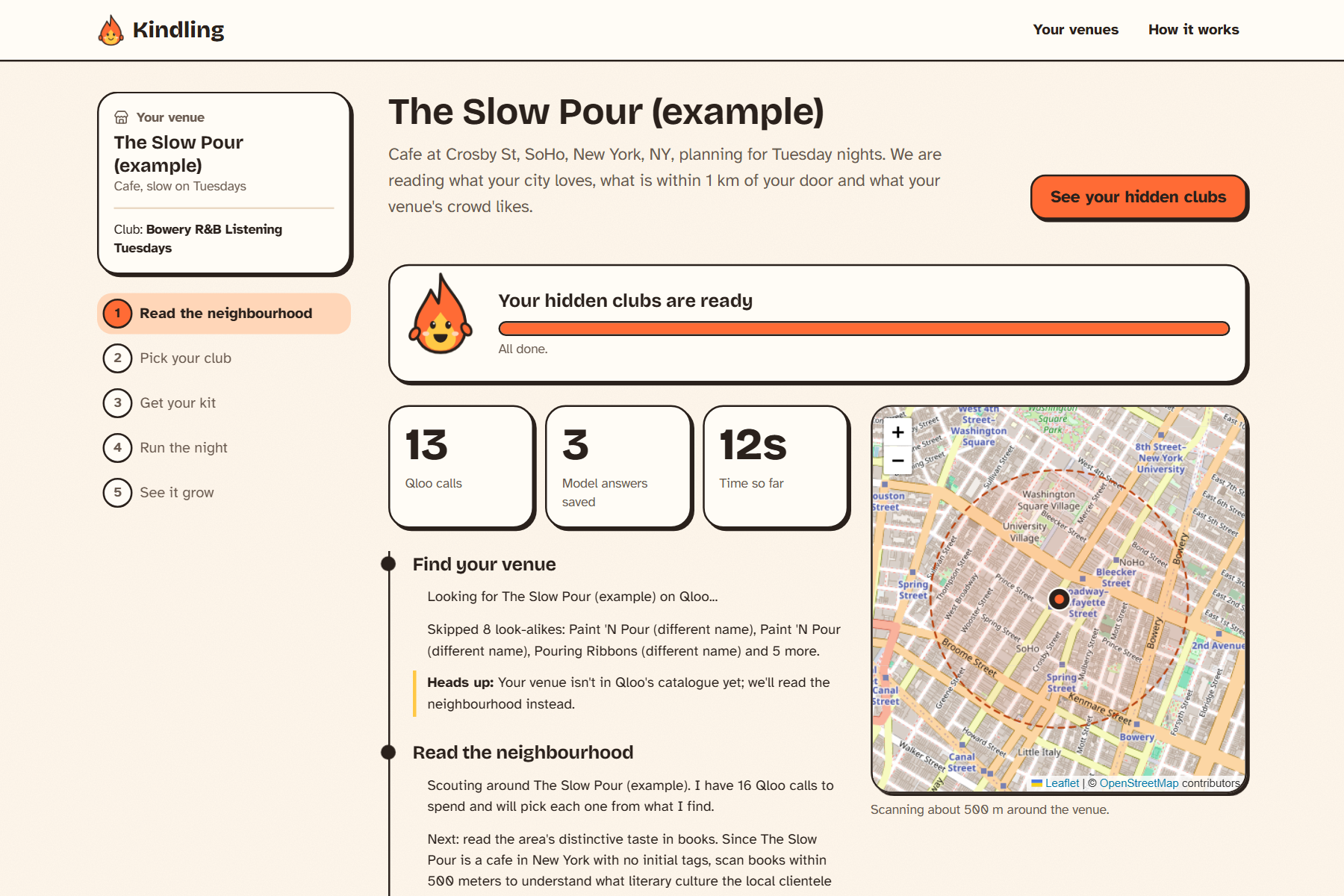
The Scout agent decides which Qloo scans to run and explains each step as it reads the city.
-
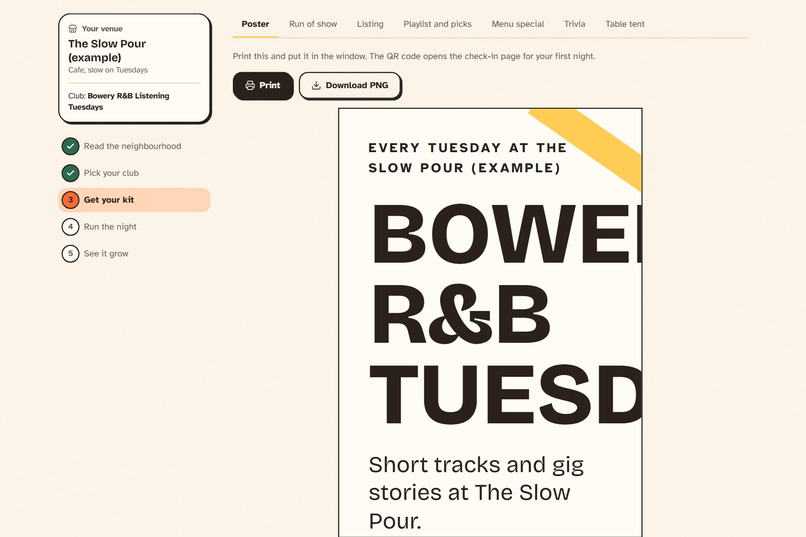
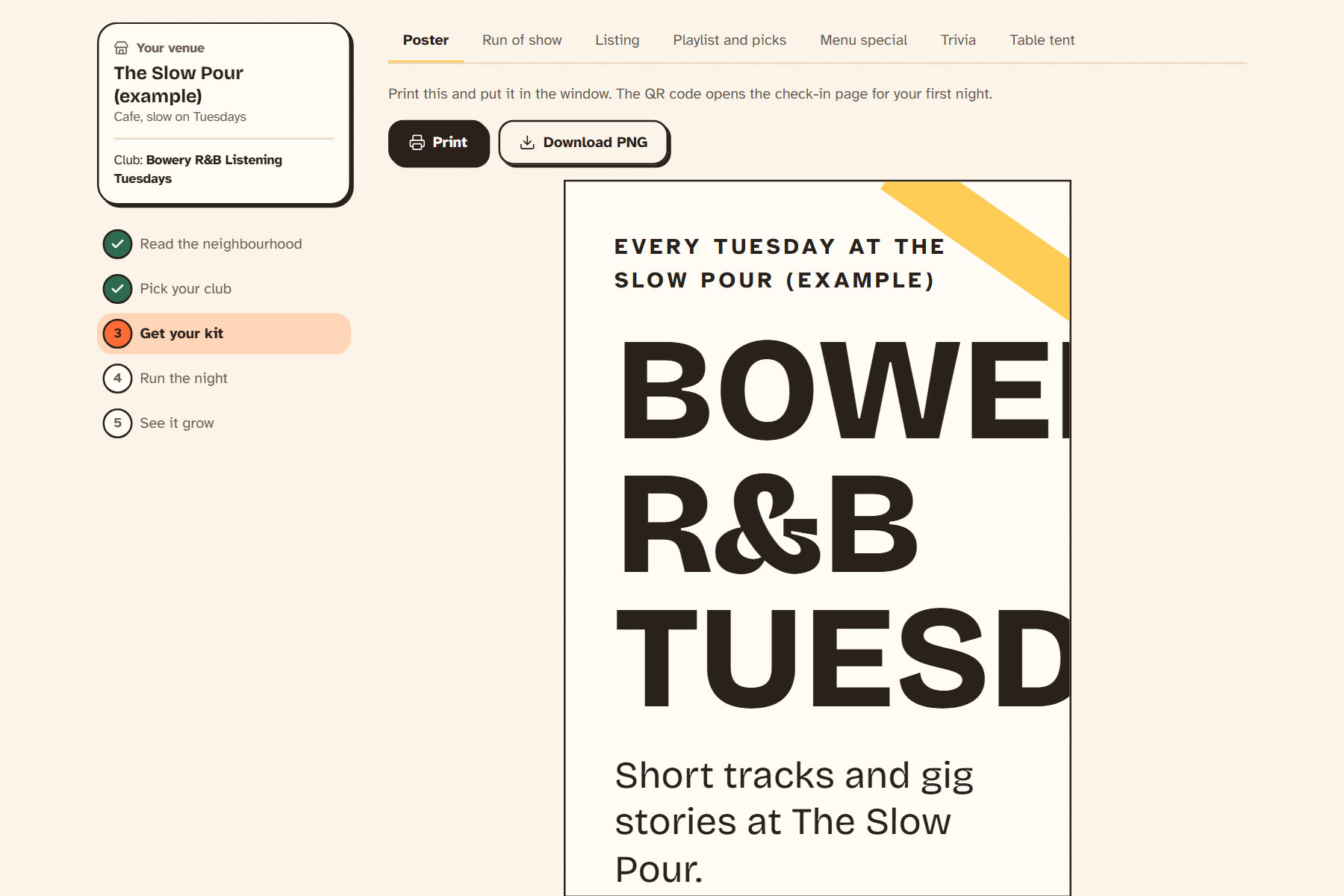
A ready-to-run kit: printable poster with a check-in QR, run of the night, listing and playlist.
-
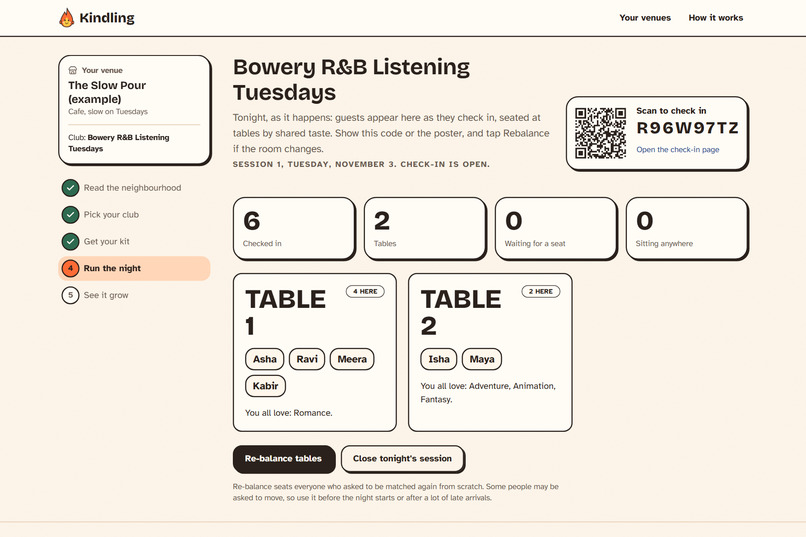
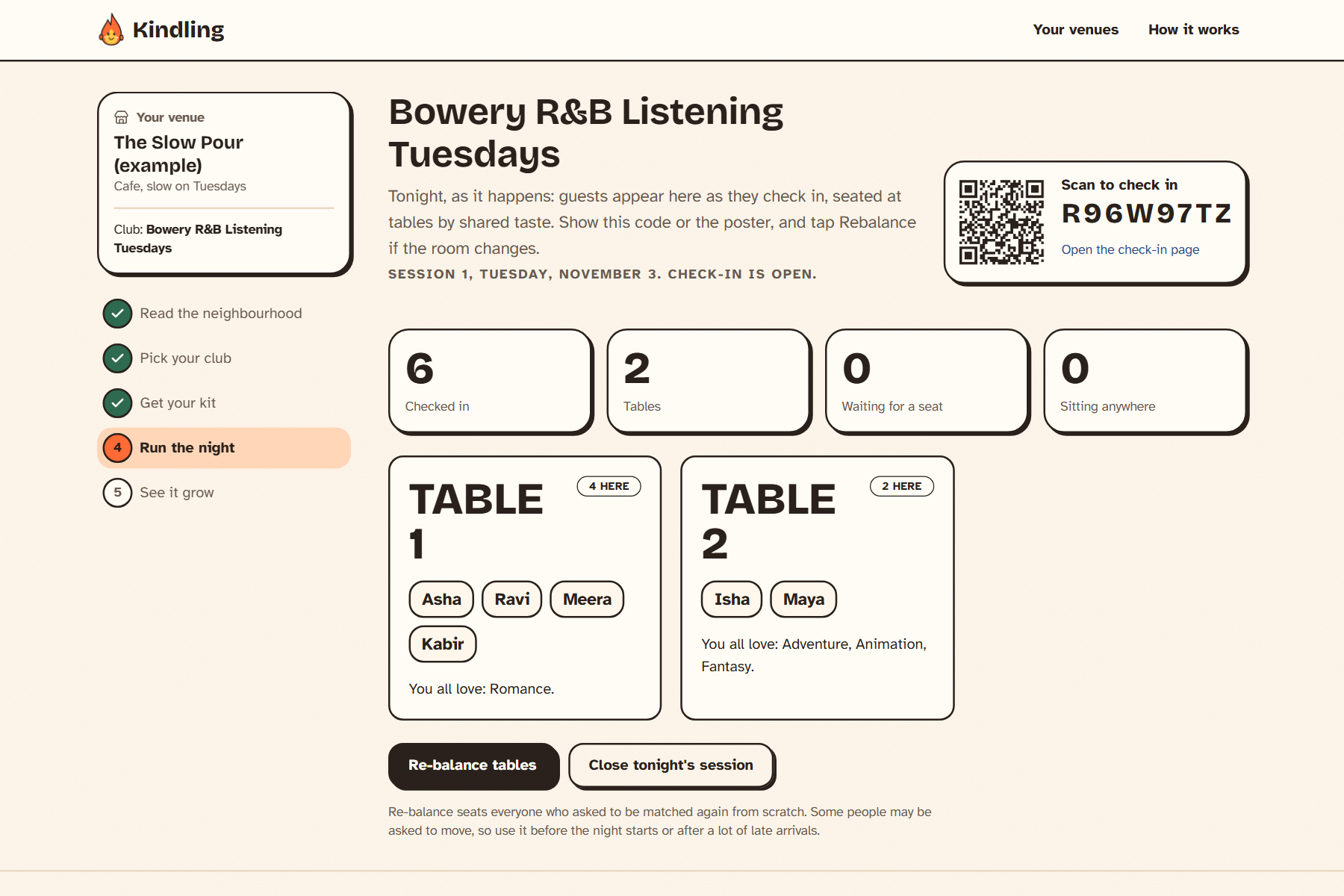
On the night, the host watches tables fill in, each with its shared-taste line.
-
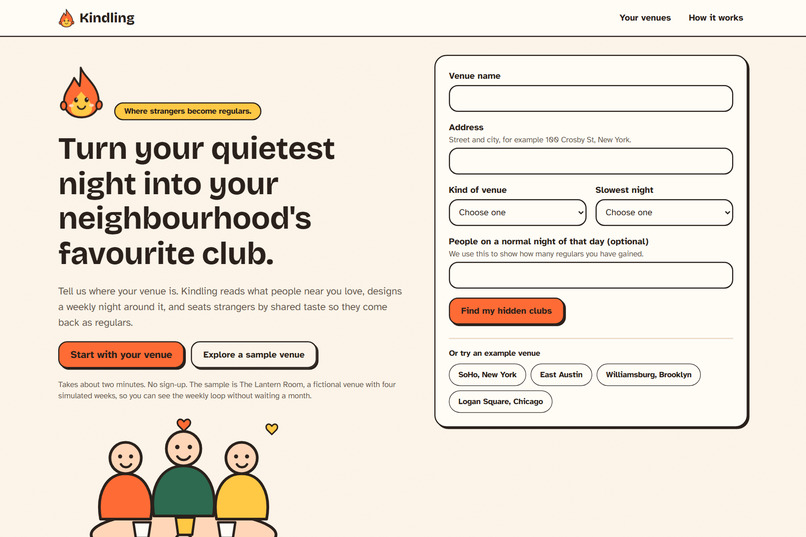
Start with your venue’s address and slowest night. No login needed.
-
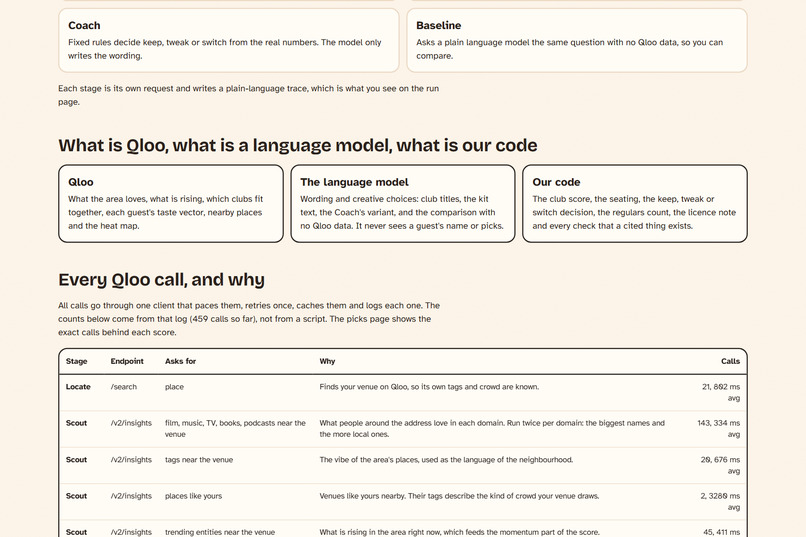
Kindling uses Qloo in 12 distinct ways, from city taste to guest taste vectors.
Inspiration
Every neighbourhood has a club that doesn't exist yet: the people nearby who all love the same niche film, sound or food, and have never met. Meanwhile most cafes and bars sit half empty early in the week. Only 6% of restaurant reservations fall on Monday nights and 8% on Tuesdays.
The people side is worse. The WHO says 1 in 6 people worldwide is lonely. Research by Jeffrey Hall at the University of Kansas found a casual friendship takes about 50 hours together. A one-off dinner with strangers can't get there. The same people, at the same place, every week, can.
So we asked one question: which shared interest would bring a street's people back every Tuesday? Answering it needs real taste data, which is exactly what Qloo has.
What it does
Kindling is an agent that turns strangers into regulars.
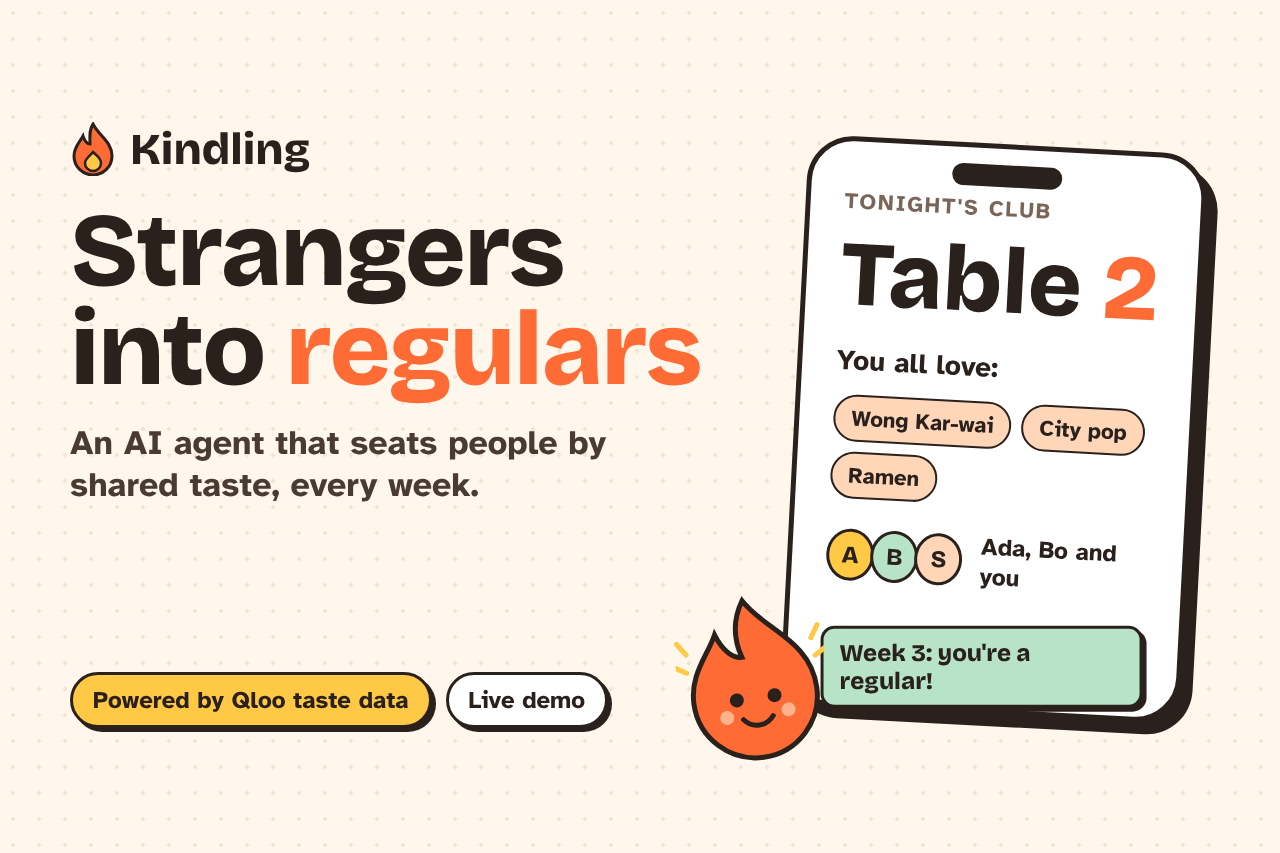
A guest scans a QR code at a venue, types a first name and taps three things they love. A few seconds later their phone says:
You're at table 2. You all love Wong Kar-wai and city pop.
No personality quiz. Kindling used Qloo to find what their favourites share with everyone else in the room, and seated them together. Now they have a first thing to say to each other.
Behind that moment is a weekly loop that most AI tools don't have:
- Scout. A venue enters its address and slowest night. The agent chooses which Qloo scans to run, explains each choice, and widens its search when data is thin. It reads what the city loves across film, music, TV, books and podcasts, what's rising, the places within 1 km, and venues like this one.
- Design and verify. It proposes clubs built only from what Qloo returned, then checks each one with more Qloo calls and scores it with a transparent formula. Every score links to the exact Qloo calls behind it ("How we know").
- Produce. It writes a ready-to-run kit: poster with a check-in QR, run of the night, host script, listing, playlist and a themed menu special.
- Run the night. Check-in, taste-based seating, and a live view where the host watches tables fill in.
- Coach. After each night it reads attendance, return rate and how far the room's taste has drifted from the theme, then says keep, tweak or switch for next week, with the numbers. The headline metric is regulars made: people who came three or more times.
Every run also shows a "Without Qloo" panel: the same question put to a plain language model. It suggests trivia and open mic nights with nothing behind them. That gap is why Qloo matters here.
How we built it
- Next.js and TypeScript on Vercel, Postgres on Neon with Drizzle.
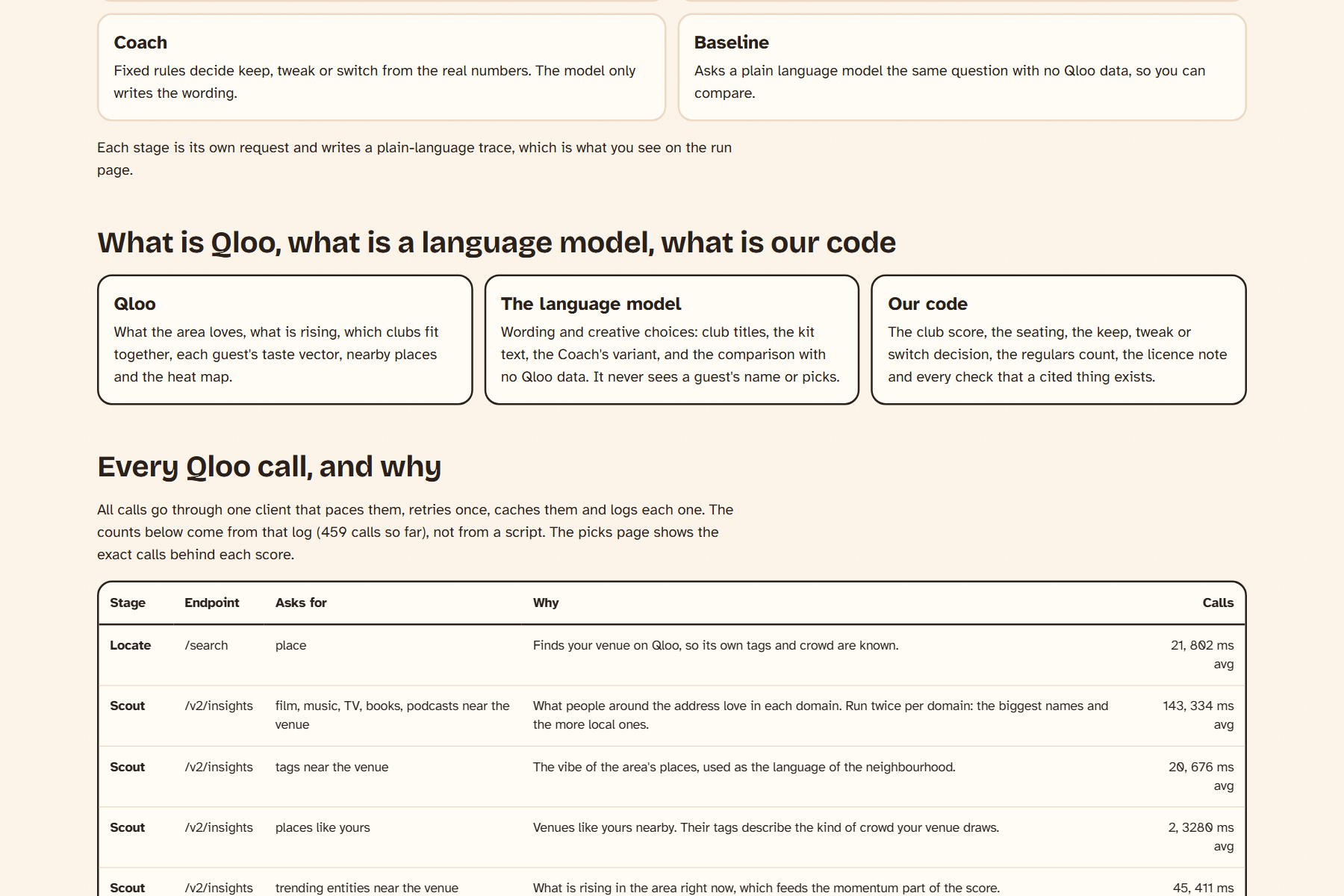
- One Qloo client for every request: pacing under the rate limit, one retry on 429, timeouts, a cache, and a log of every call that powers the evidence drawers.
- Qloo used 12 distinct ways:
/searchfor the venue and guest favourites,/entitiesfor guest taste vectors and the Coach's drift check, and/v2/insightsfor city taste per domain, area tags, nearby places, similar venues, trends (bias.trends), cross-domain coherence (filter.results.entities) and a heatmap. - Language model layer (Gemini with a fallback chain) for planning, naming clubs and writing the kit. Everything it cites must exist in Qloo's results, or code drops it.
- Scoring, seating and the Coach's decisions are plain code, covered by about 600 tests.
Challenges we ran into
- Qloo's media taste turned out to be city-wide, not street-level. We didn't hide it. We rebuilt scoring to weight the most local signals (places within 1 km and the venue's own crowd) more heavily, and every score now says how far its signal reaches.
- A multi-step agent on free model tiers is slow. We run Qloo scans in parallel, cache every stage, and give each step a fallback so a busy model never breaks a run. Loading screens show the real stages, not a fake spinner.
- Seating is a real optimisation problem. Spread regulars so newcomers meet them, never leave anyone alone, and keep tables explainable in one line.
Accomplishments we're proud of
- The whole loop works live, from reading a city to seating real people at real tables.
- Every number on screen can be traced back to a Qloo call.
- It feels like a product, not a demo: warm design, a printable poster, mobile check-in and a little ember mascot.
What we learned
Taste is a better icebreaker than a personality test. Telling strangers what they have in common gives them their first sentence. And for loneliness, the fix isn't one great event. It's the same table, every week.
What's next
Pilots with real venues; publishing club nights to event platforms; then a "find your club nearby" app for guests, launched with clubs already running. Venues already pay around $150 a night for hosted trivia, so a weekly club that proves itself with regulars made has a clear buyer.
Privacy and honesty
Guests give a first name only. Qloo receives entity ids and coordinates, never names. Every check-in has a "forget me" link. The sample venue is fictional and its simulated weeks are labelled on every page.
Built With
- drizzle
- gemini
- leaflet.js
- neon
- nextjs
- nominatim
- openstreetmap
- playwright
- postgresql
- qloo
- react
- tailwindcss
- typescript
- vercel
- vercel-ai-sdk
- vitest
- zod

Log in or sign up for Devpost to join the conversation.