-
-
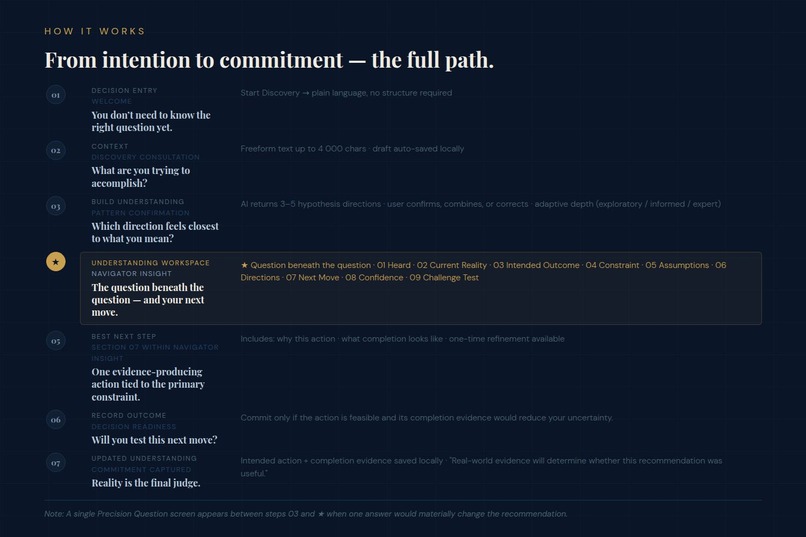
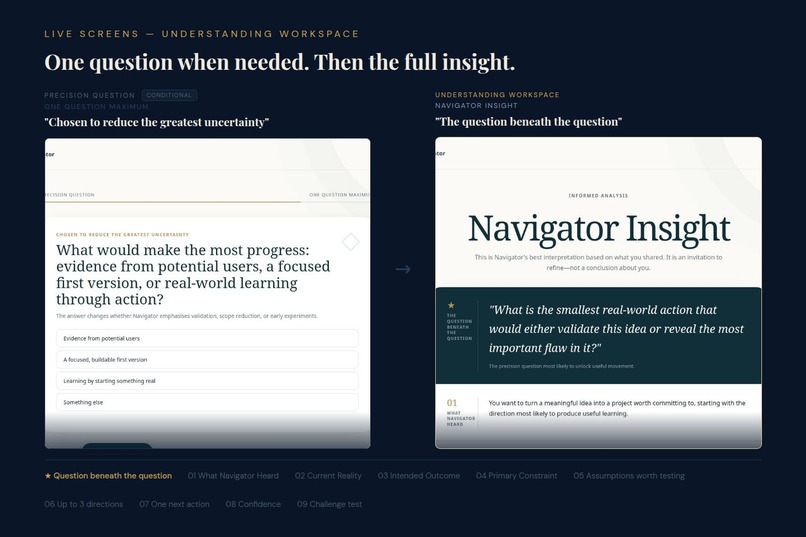
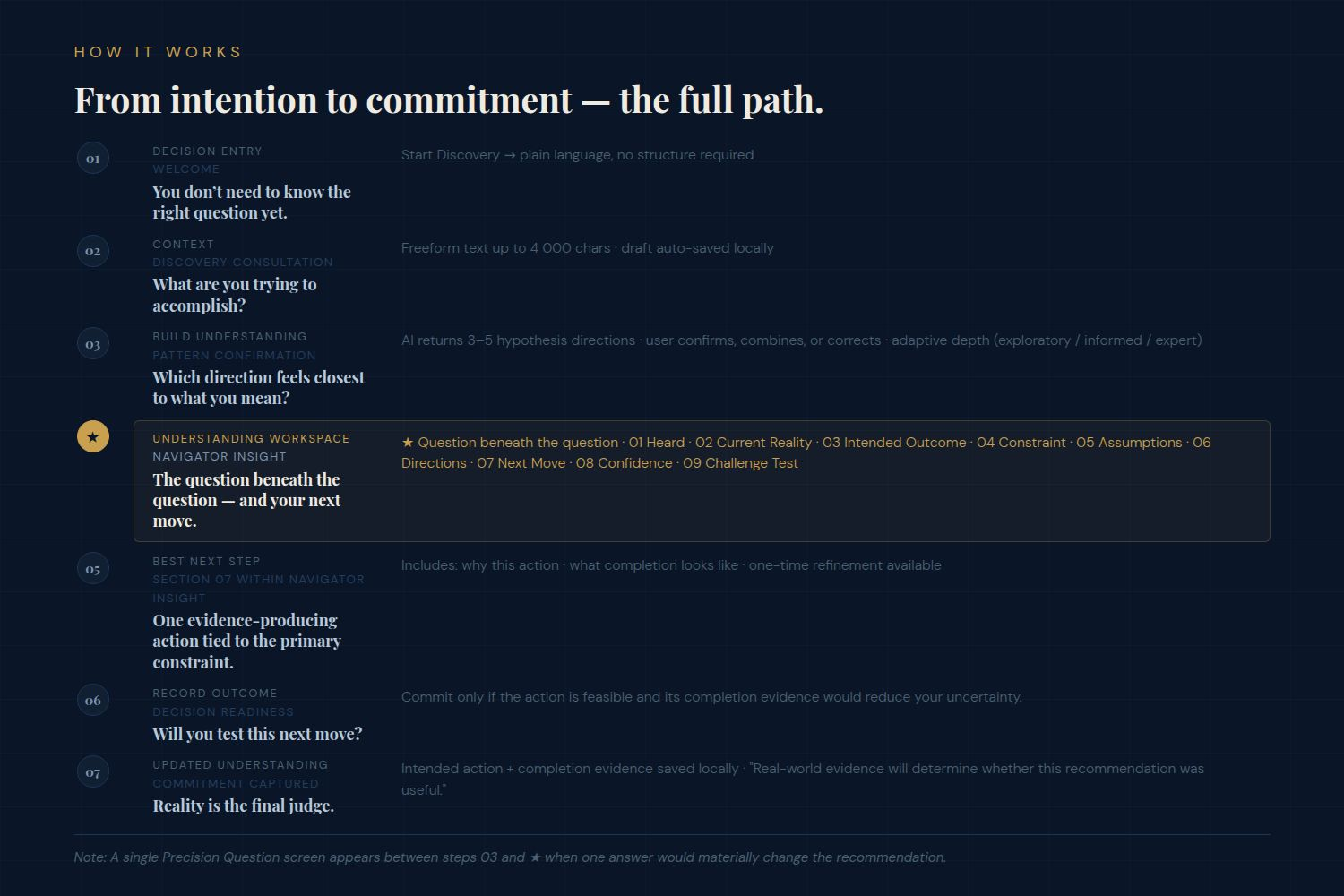
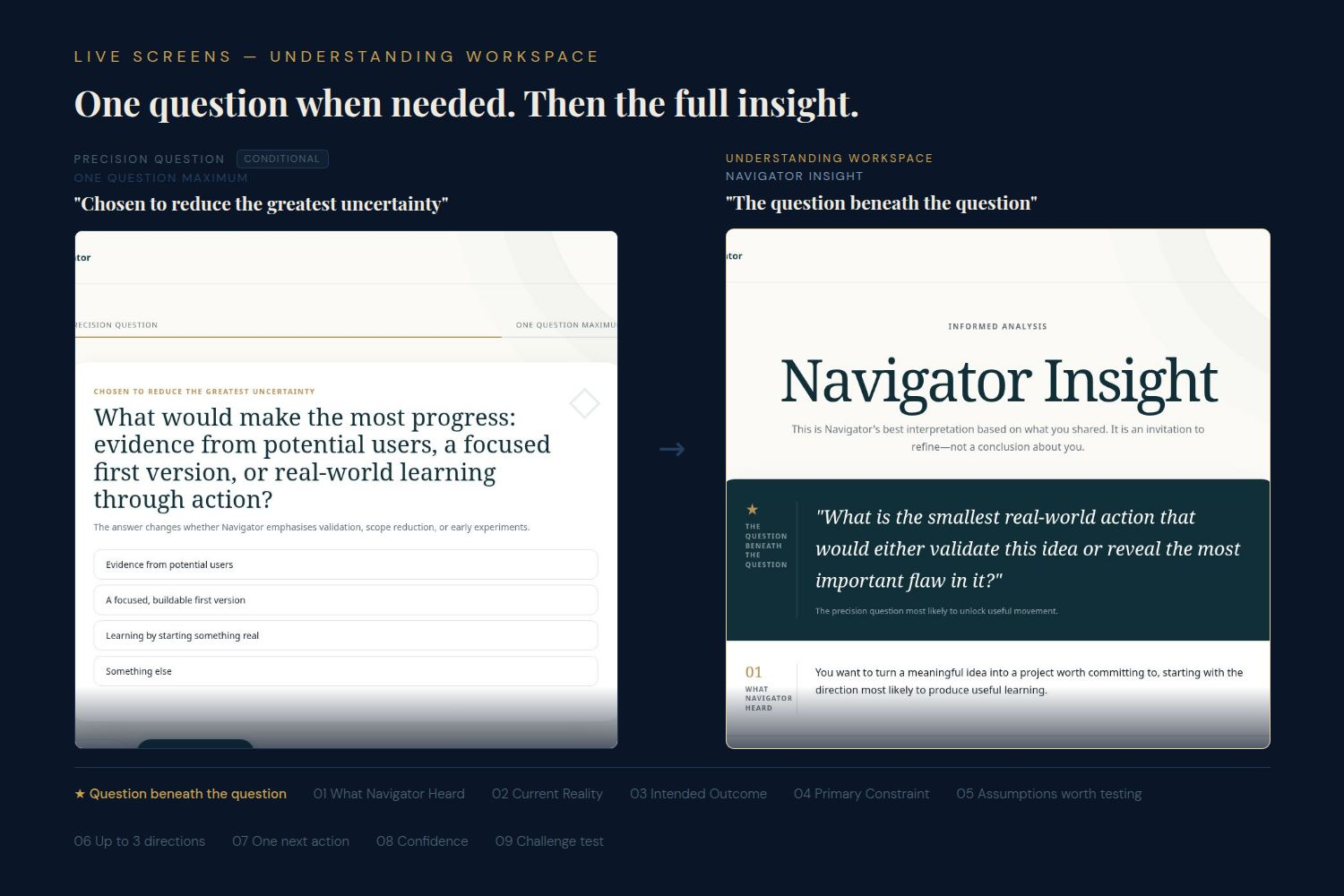
Best Next Step When needed, Navigator asks one clarifying question, then delivers a structured recommendation.
-
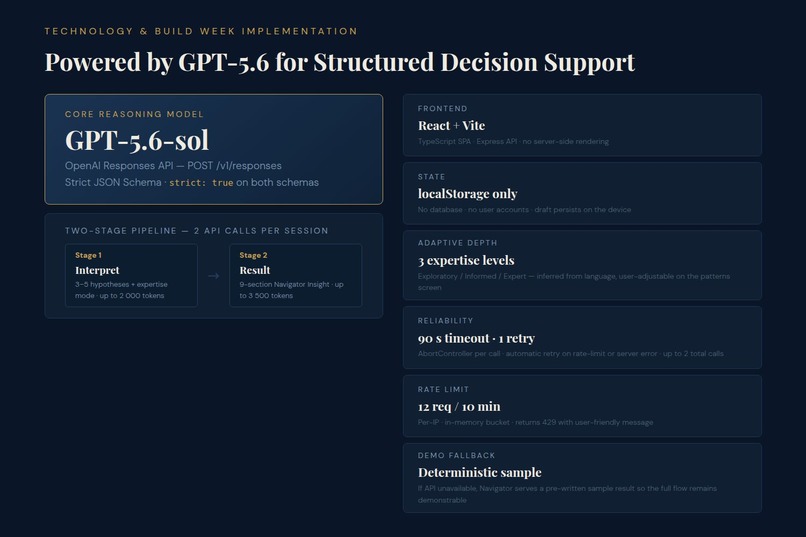
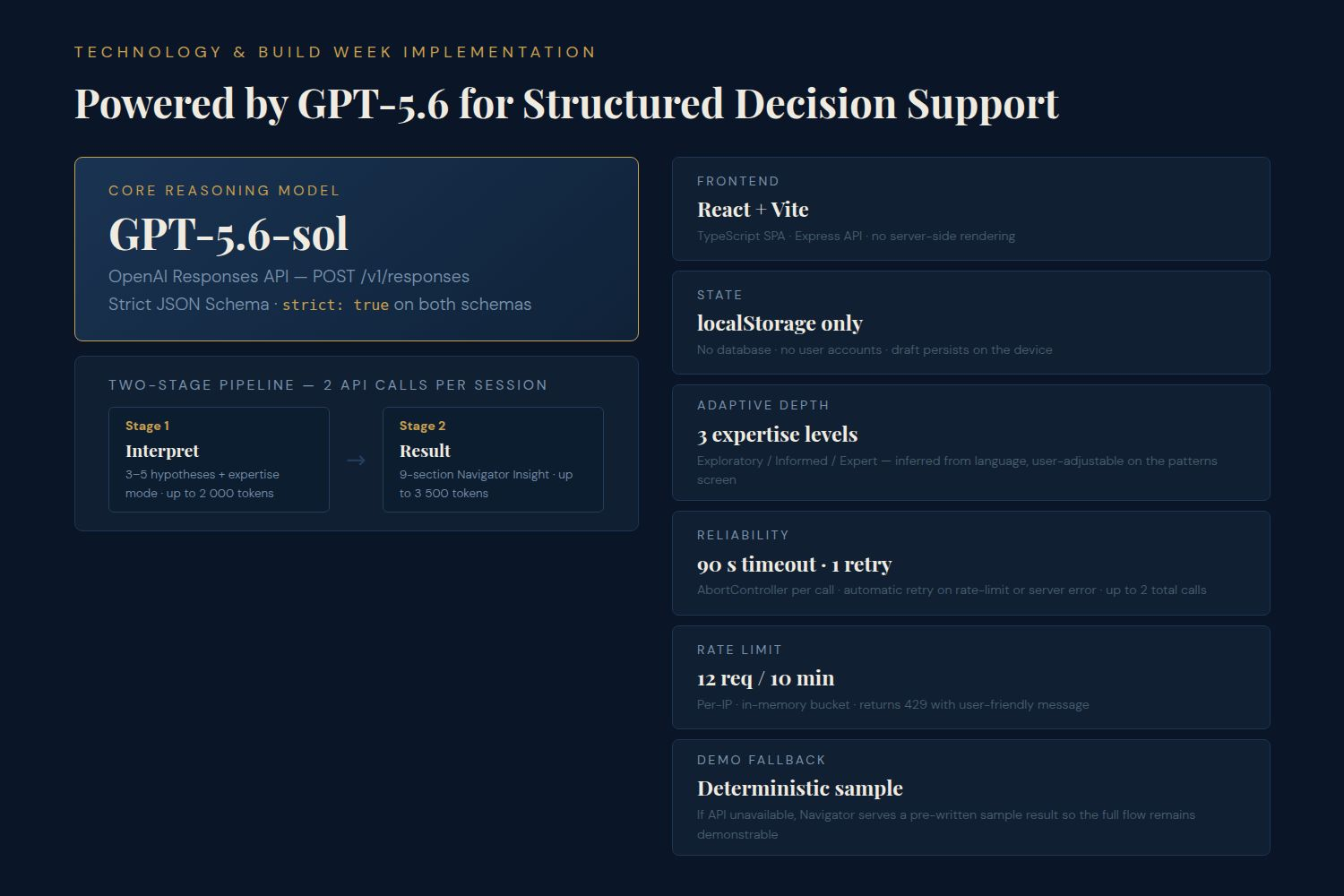
Technology Powered by GPT-5.6, the OpenAI Responses API, and structured JSON validation for reliable reasoning.
-
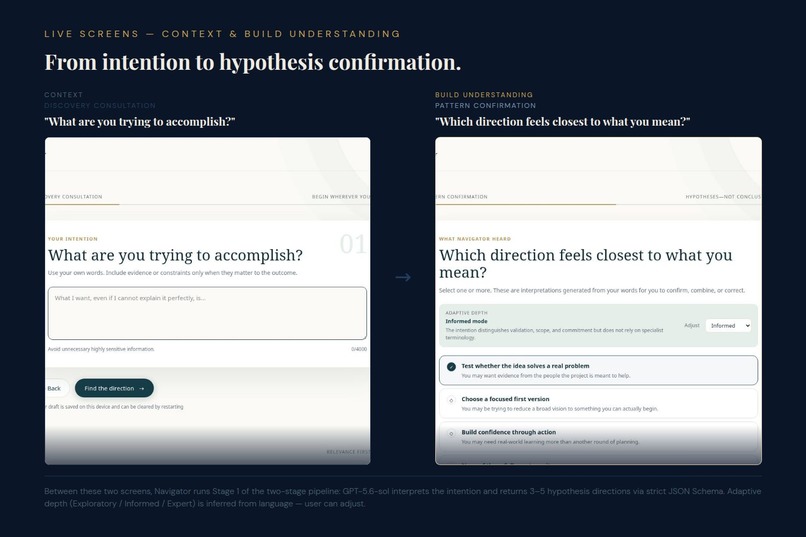
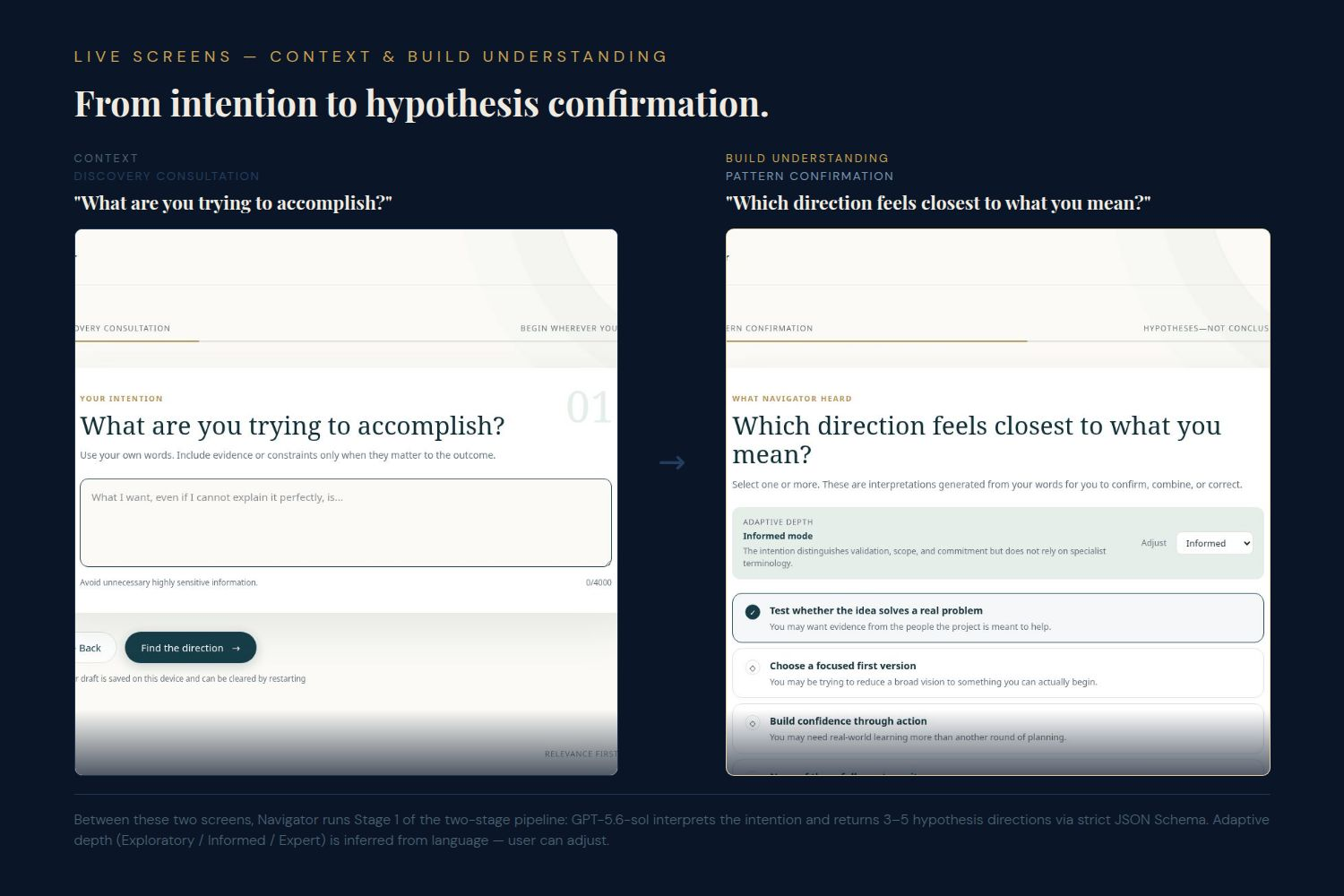
Pattern Confirmation GPT-5.6 interprets intent and presents competing directions for the user to confirm or refine.
-
Understanding Workspace Navigator separates facts, assumptions, uncertainty, and evidence before recommending action.
-
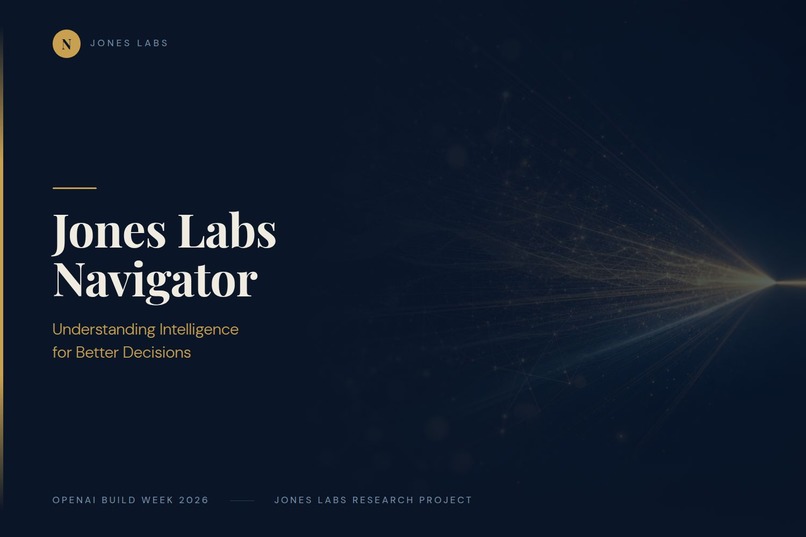
Cover Jones Labs Navigator transforms uncertainty into understanding, helping people make better decisions with GPT-5.6.
-
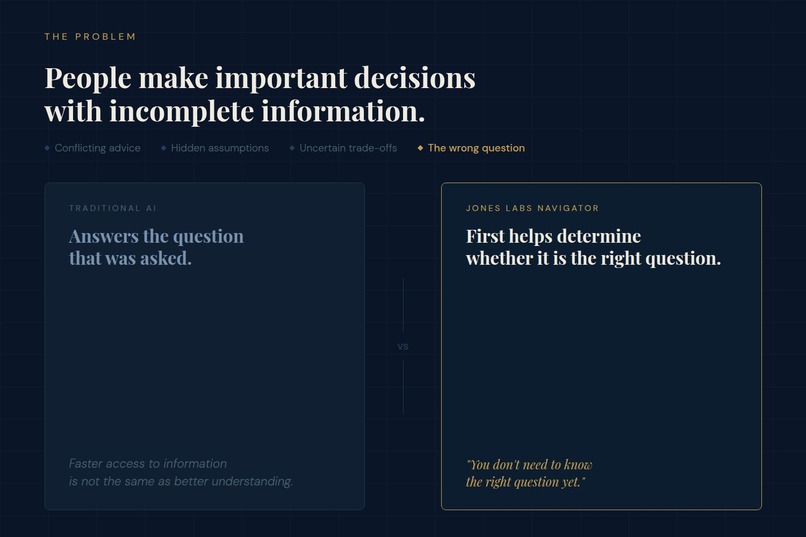
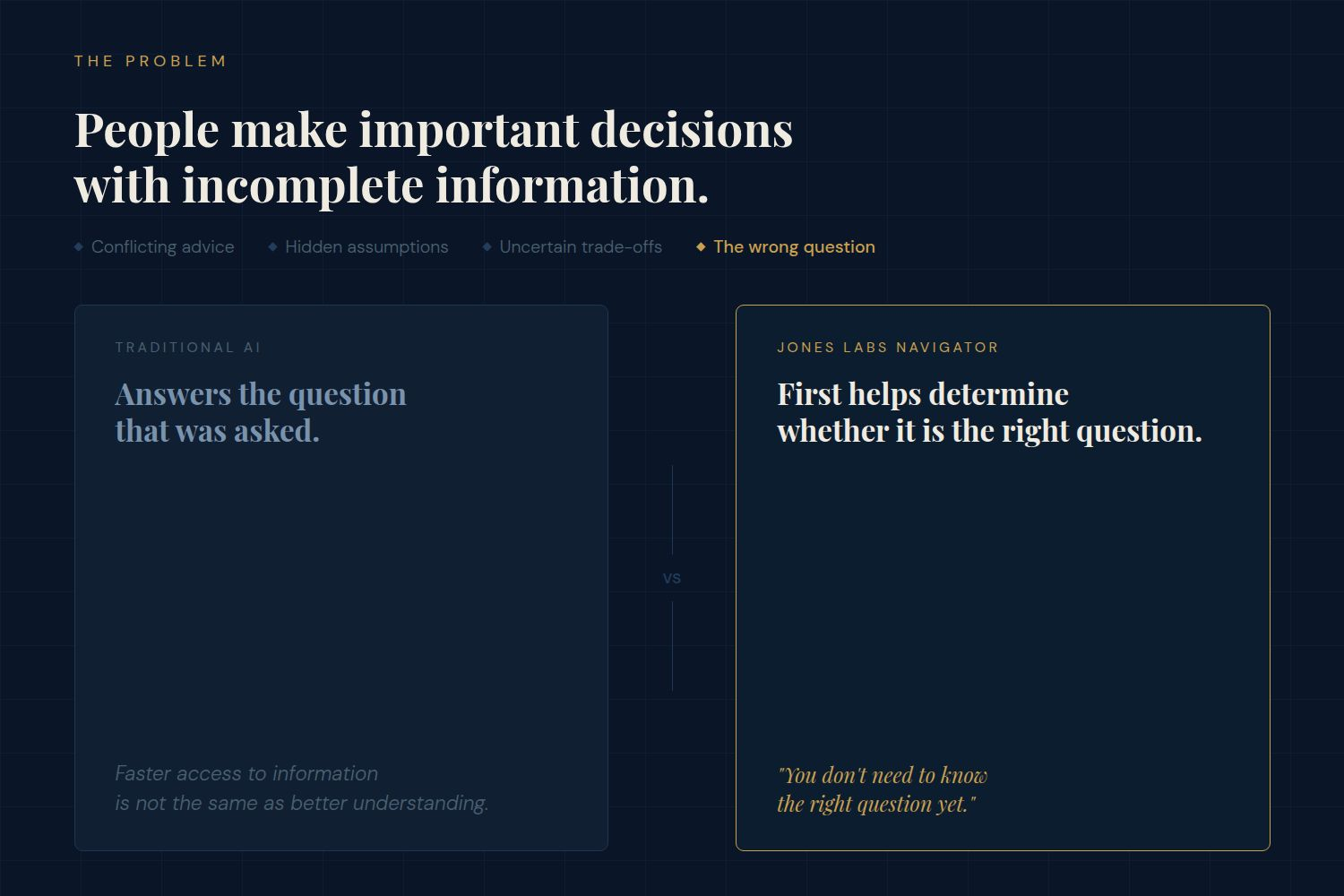
The Problem People make important decisions with incomplete information, hidden assumptions, and uncertainty.
-
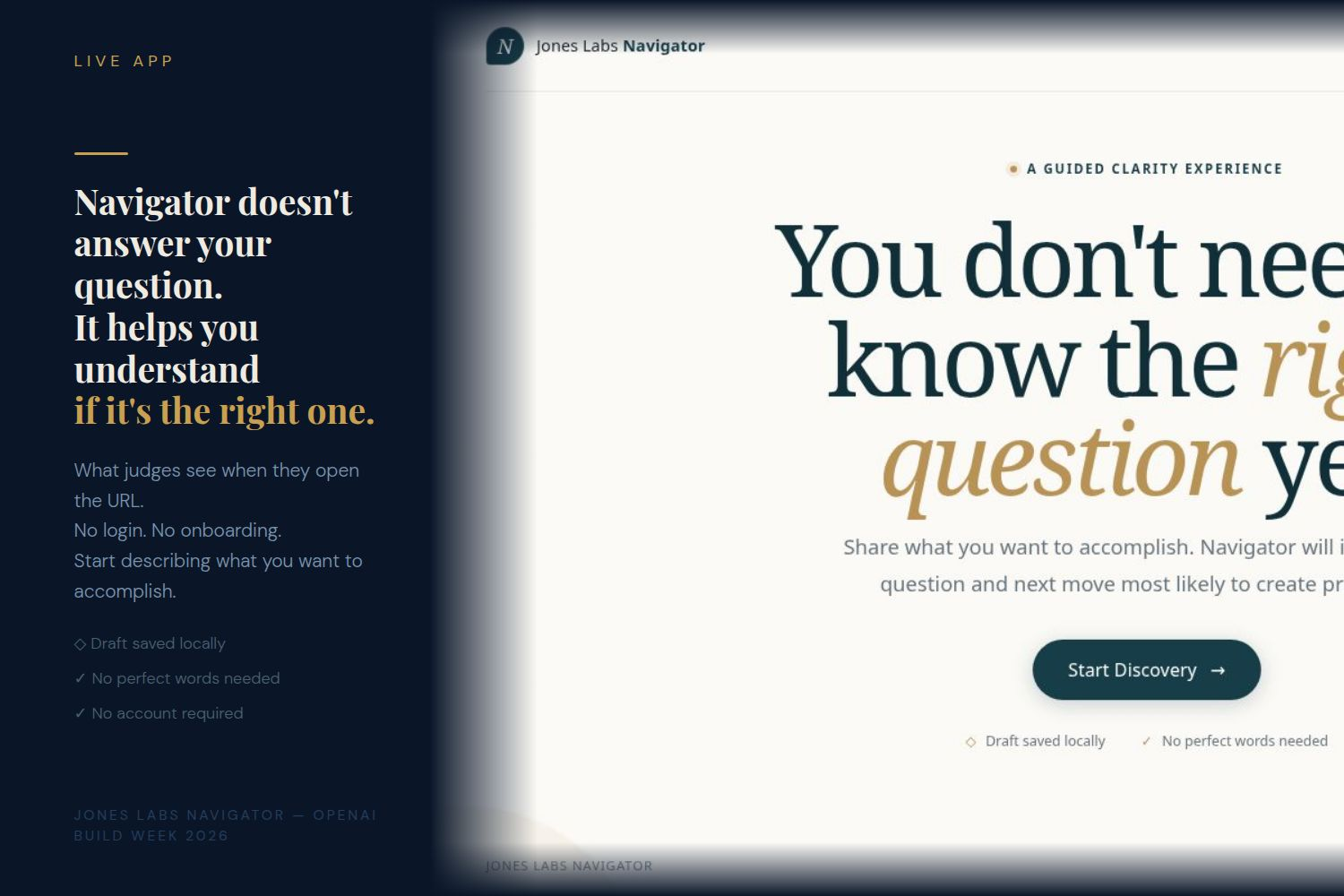
Decision Entry Start with your decision. Navigator identifies the real question before recommending the next step.
-
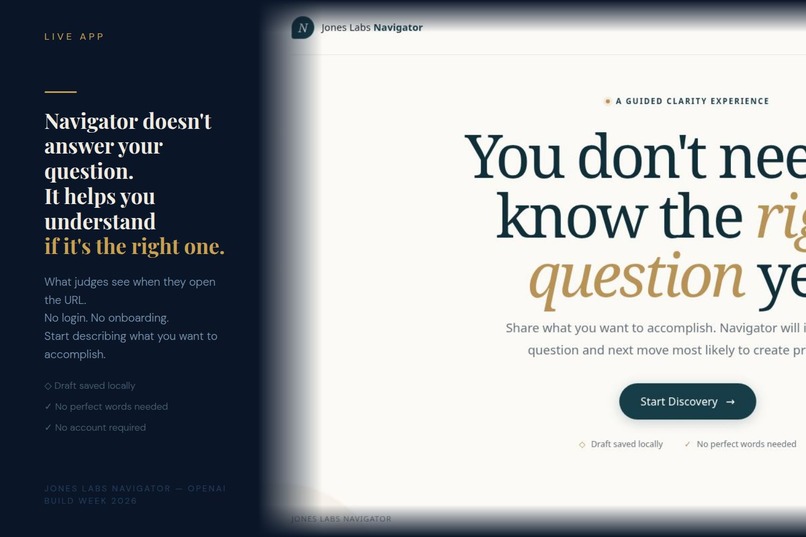
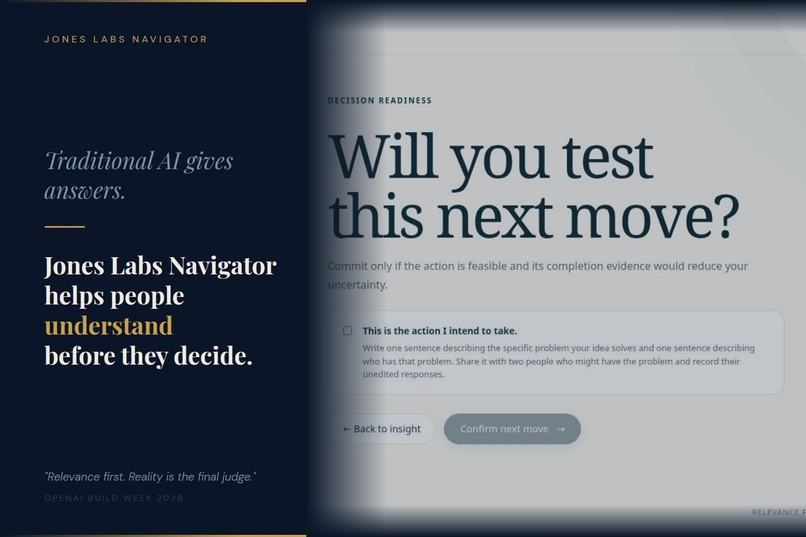
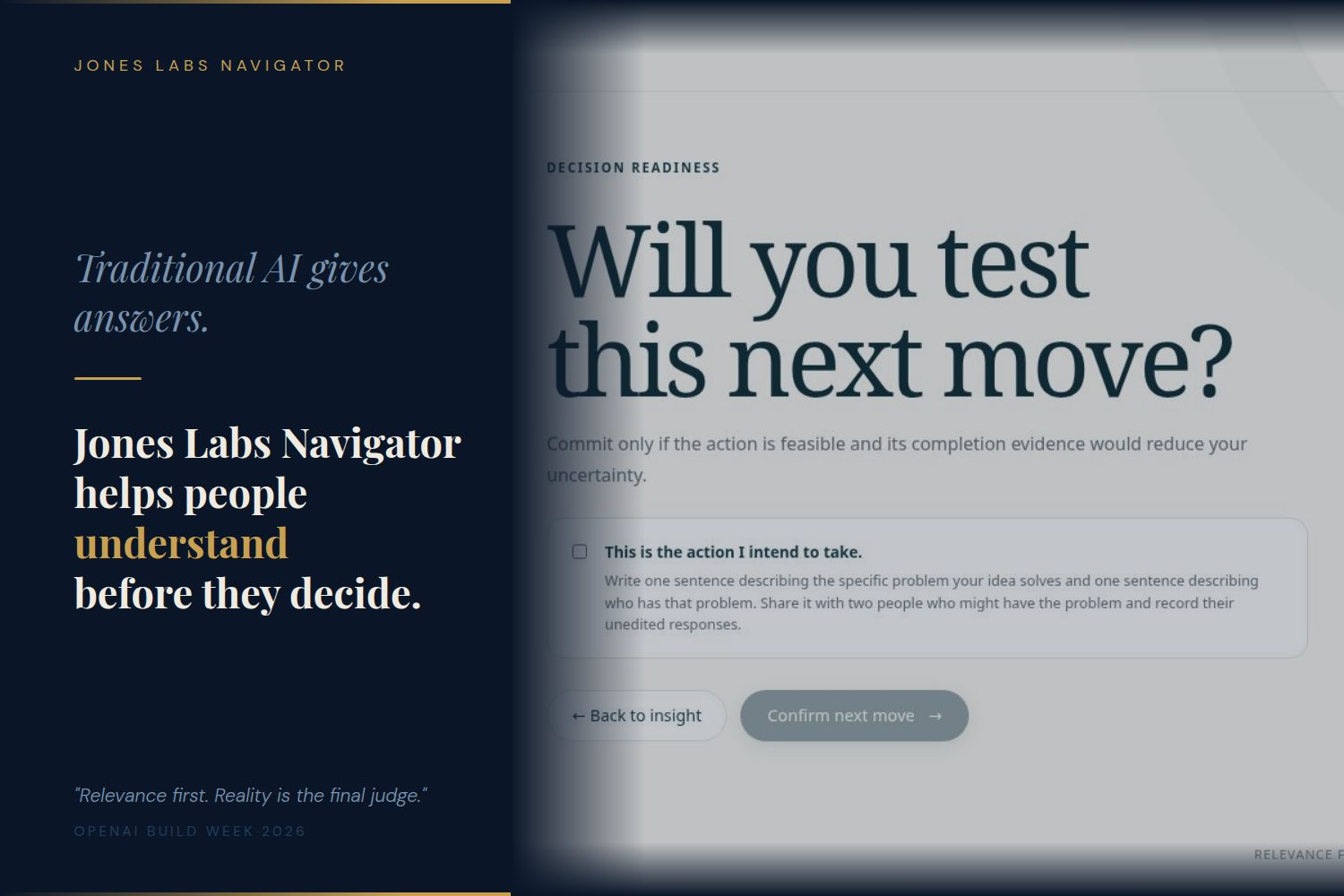
Closing Traditional AI gives answers. Jones Labs Navigator helps people understand before they decide.
Inspiration
I've spent the last year asking a question that wouldn't leave me alone: Why does AI assume people already know the right question? Most people don't. They know what they want to accomplish long before they know how to explain it. Jones Labs Navigator is my attempt to change that. Most people don't. It works when a person already knows the right question, the correct terminology, and the expertise required to describe the problem. In real life, people often know what they want to accomplish before they know how to explain it.
Jones Labs Navigator began with a simple question:
What if AI constructed understanding before recommending an answer?
I wanted to create an experience where users would not need to become prompt engineers, select an expert, or explain their situation perfectly. They could begin with one imperfect statement of intention, and the system would help uncover the question beneath the question. Because most questions and answers revolve around patterns, this system will continue to learn from these patterns before recommending an answer.
The central principle became:
Every question costs time, attention, and cognitive effort. A question should only be asked when it materially improves understanding of the intended outcome.
What it does
Jones Labs Navigator is an intention-first AI decision-support experience.
Instead of asking users to write the perfect prompt, Navigator:
- Accepts one imperfect description of what the user wants to accomplish.
- Identifies several plausible interpretations of that intention.
- Lets the user confirm, combine, or correct those interpretations.
- Asks no more than one adaptive precision question when additional information is truly necessary.
- Produces the Question Beneath the Question, a bounded interpretation of the situation, up to three possible decision paths, and one evidence-producing next move.
- Allows one refinement before the user chooses what to do.
The experience is deliberately subtractive. Questions, options, delays, animations, and explanations are removed when they do not materially improve understanding or decision readiness.
Navigator also adapts its reasoning depth. An exploratory user can receive clear guidance without unnecessary complexity, while an informed or expert user can receive trade-offs, evidence gaps, falsification questions, second-order effects, and competing explanations.
How I built it
Jones Labs Navigator was built as a working adaptive state machine rather than a traditional chatbot interface. Jones Labs Navigator tests the hypothesis that AI systems optimized for understanding before recommendation can improve decision readiness while reducing unnecessary prompting and cognitive effort.
The application uses:
- React 19
- TypeScript
- Next.js 16 structure
- Vinext and Vite
- Tailwind CSS 4
- The OpenAI Responses API
- GPT-5.6
- Strict JSON Schema Structured Outputs
- Vitest-based testing
- Server-side validation and safety controls
The AI workflow is divided into two structured stages: Interpretation stage
The system analyzes the user’s initial intention and produces concise, correctable hypotheses about what the person may actually be trying to achieve.
These are presented as hypotheses—not hidden psychological conclusions—so the user retains authority over the interpretation.
Final insight stage
Once sufficient understanding exists, the system produces:
- The Question Beneath the Question
- A bounded explanation of the situation
- Up to three decision paths
- Important assumptions and evidence gaps
- One practical next move capable of producing real-world evidence
The project uses one unified Navigator instruction with limited internal responsibilities. It does not present visible agents or require the user to choose specialists.
Codex helped convert the original product specification into the adaptive interface, state machine, API contract, trust boundaries, tests, documentation, and deployable build while preserving the intended visual system.
Trust, privacy, and safety
Trust was treated as part of the product architecture rather than an added disclaimer.
Navigator:
- Separates explicit facts from interpretations
- Labels assumptions as hypotheses
- Calibrates confidence
- Explains what evidence could change its interpretation
- Preserves human decision authority
- Avoids claiming hidden psychological certainty
- Does not present itself as a replacement for professional or emergency support
- Interrupts the ordinary experience when urgent-risk content is detected
OpenAI requests are made from the server, and the API is configured with store: false.
Application logs contain operational information such as request IDs, latency, timestamps, and status—not raw consultation text. Draft information is stored only in the user’s local browser and can be cleared by restarting the experience.
Challenges
The hardest challenge was not generating better answers. It was deciding when the system had earned the right to make a recommendation.
Traditional conversational AI often treats more questions as better understanding. Navigator tests the opposite hypothesis: the best question is the one that reduces the greatest amount of relevant uncertainty with the least user effort.
That required repeatedly removing features and interactions that were interesting but not mission-relevant.
Other challenges included:
- Preventing the system from over-interpreting limited information
- Creating useful intention hypotheses without pretending certainty
- Keeping the experience simple while supporting expert-level reasoning
- Producing reliable structured outputs
- Handling API failures without misleading users
- Preserving privacy while still enabling a useful consultation
- Defining a stopping point for clarification
The MVP intentionally limits itself to one intention sample, at most one clarification, and one refinement. This constraint forced every interaction to justify its existence.
What I learned
I learned that prompt engineering is often a symptom of an interface problem. It is a pattern recognition problem.
People should not need to know which expert to consult, what vocabulary to use, or how to structure a request before an AI system can help them.
I also learned that feelings, interpretations, and confidence must be treated carefully. A feeling can be meaningful evidence that something deserves investigation, but it is not automatically proof of its cause.
That led to a broader accountability principle:
Human judgment and AI judgment should both remain correctable, and reality should evaluate them through evidence.
A person can be right about the existence of a problem but wrong about its cause. An AI can identify a useful pattern but express too much confidence. Navigator therefore treats correction as calibration toward the intended outcome—not as conflict between the user and the system.
What is next
The next phase is a Mutual Accountability Loop.
For the human, the system would measure whether the person:
- Took the recommended next move
- Revised the intention
- Identified a real constraint
- Produced new evidence
For Navigator, the system would measure whether:
- Its interpretation was accurate
- Its confidence was calibrated
- Its recommendation improved decision readiness
- The proposed next move generated useful evidence
The long-term research question is whether systems optimized for relevant understanding, transparency, clarity, and accountability can produce better real-world decisions than systems optimized primarily for immediate answer generation.
Jones Labs Navigator is an early working experiment toward that goal: "The goal is not to make AI appear more capable. The goal is to make the user more capable."
What's next for Jones Lab Navigator
The MVP demonstrates the core hypothesis: pattern-recognition AI should build sufficient understanding before making recommendations.
The next phase focuses on validating that hypothesis through real-world use and measurable outcomes.
Planned improvements include:
Mutual Accountability Loop: it will measure whether recommendations improve decision readiness and whether users generate meaningful evidence after taking action.
Outcome Learning : It will learn from completed decisions to improve calibration while preserving user privacy and human decision authority.
Domain Adaptation: Applies the same understanding-first methodology to specialized fields such as healthcare, education, finance, public services, and enterprise decision support.
Research & Evaluation : Itwill measure whether understanding first reduces unnecessary clarification, improves user confidence, and produces better real-world decisions compared to traditional prompt-first systems. Jones Labs Navigator is intended to become the first implementation of a broader understanding-first AI methodology, where transparency, evidence, accountability, and human judgement work together to improve decisions rather than simply generate answers.
The long-term goal is not to make AI appear more intelligent
The goal is to help people make better decisions through better understanding
Built With
- adaptive-interface
- artificial-intelligence
- decision-intelligence
- decision-support
- gpt-5.6
- hackathon
- human-centered-ai
- intention-first
- javascript
- json-schema
- natural-language-processing
- next.js
- node.js
- openai
- openai-responses-api
- promptless-ai
- react
- tailwind-css
- typescript
- understanding
- user-experience
- vite
- vitest
- web-application


Log in or sign up for Devpost to join the conversation.