Inspiration
Every location-aware app starts with the same problem: a visitor arrives, and all you know about them is an IP address. Teams end up downloading GeoIP databases, importing updated CSV files every month, and debugging why one IP maps to the wrong city. The idea behind ipstack is simple: make IP geolocation a single REST call so developers can skip the data maintenance entirely. ipstack grew out of freegeoip, a widely used open source IP lookup project, and evolved into a maintained, production grade API.
What it does
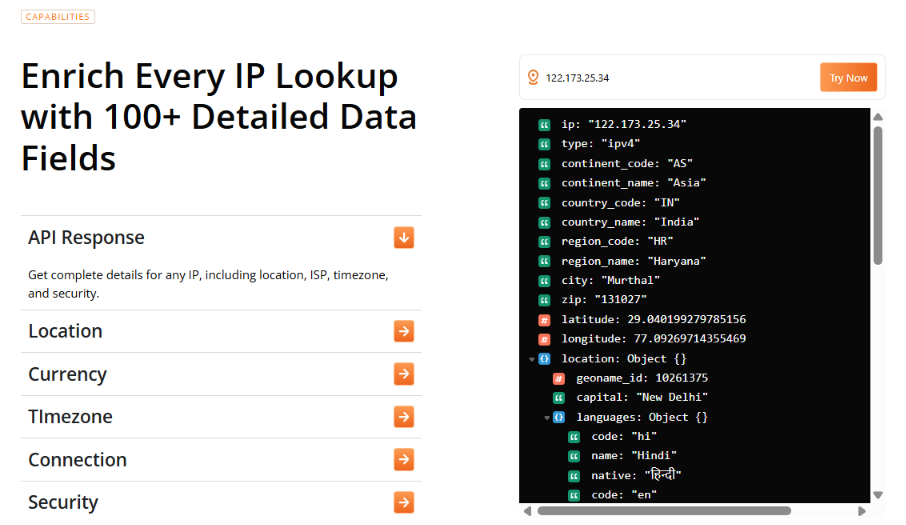
One request to the ipstack endpoint returns structured data for any IPv4 or IPv6 address: country, region, city, zip, latitude and longitude, continent, timezone with GMT offset, currency code and symbol, calling code, and connection details including ASN and ISP. Higher tiers add a security module that flags proxies, Tor exit nodes, and crawlers, which is useful for fraud screening.
It supports bulk lookups (comma separated IPs in one request) and a check endpoint that geolocates the caller automatically, which is handy for personalizing a page server side.
bash
curl https://api.ipstack.com/134.201.250.155?access_key=YOUR_KEY json
{ "ip": "134.201.250.155", "country_name": "United States", "region_name": "California", "city": "Los Angeles", "zip": "90013", "latitude": 34.0522, "longitude": -118.2437, "time_zone": { "code": "America/Los_Angeles", "gmt_offset": -28800 }, "currency": { "code": "USD", "symbol": "$" }, "connection": { "asn": 209366, "isp": "Tier.Net Technologies" } } A typical integration is one fetch call at session start: default the currency, preselect the country in the checkout form, and pass the connection data to your risk engine. Live product and docs at https://ipstack.com/
How I built it
The API is REST over HTTPS with simple access key authentication, so any language that can open a URL can use it. Responses are JSON designed to be parsed in a single line, with optional parameters for hostname lookup and localized place names.
The harder work is invisible: a data pipeline that combines Regional Internet Registry allocations, ASN feeds, and continuous refresh cycles, because IP data decays fast. Infrastructure is built to absorb traffic spikes with low, consistent latency, since geolocation usually sits in the request path where every millisecond is paid for by the user.
Challenges I ran into
The biggest is data freshness. Networks get reallocated constantly, and an address that resolved to Frankfurt in January can resolve to Munich by summer, so the pipeline never really sleeps. IPv6 brought its own problems: an address space that large broke a lot of assumptions older lookup systems made. Accuracy was a third challenge, because city level geolocation is inherently an estimate, and we had to decide to document that honestly rather than overpromise. Finally, operating globally meant taking GDPR and data minimization seriously from the start.
Accomplishments that I'm proud of
Thousands of developers and companies use ipstack for content personalization, currency detection, regional compliance prompts, and fraud signals. Most integrations take under ten minutes from signup to first successful response, and the free tier means a weekend project gets the same quality of data as a production app.
What we learned
Developers forgive limitations; they do not forgive stale data. Publishing honest accuracy notes builds more trust than inflated claims. And a real free tier drives more adoption than any amount of marketing, because people build with what they can test immediately.
What's next for Ipstack
Expanding the security module's detection coverage, adding more localized response languages, and growing the library of code examples for common stacks. Longer term, deeper integrations for fraud scoring workflows where connection context meets address verification.
Built With
- api
- gps
- https
- ipv4
- ipv6
- javascript
- json
- python
- rest

Log in or sign up for Devpost to join the conversation.