Inspiration
In acute stroke, outcome is strongly time-dependent, yet valuable minutes can be lost before a patient recognizes focal neurological symptoms, communicates when they started, reaches emergency care, and triggers parallel preparation across ambulance, emergency medicine, neurology, imaging, laboratory, nursing, and neurointervention teams.
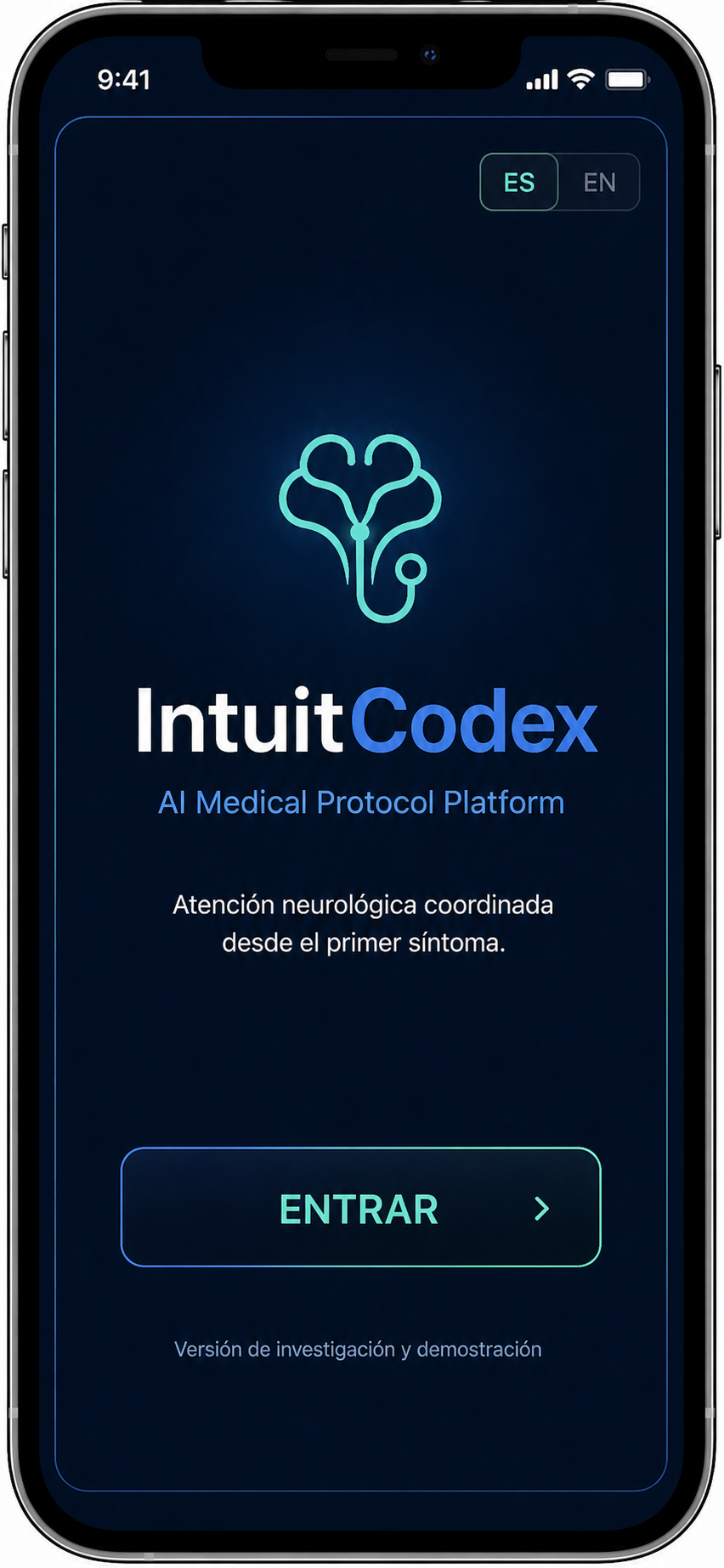
IntuitCodex was conceived by neurologist and bioengineering researcher José Javier Hernández Martínez to explore a single question: can a carefully designed mobile workflow reduce avoidable coordination delay without pretending that an app can replace emergency services or clinical judgment?
What it does
IntuitCodex connects two routes through one simulated stroke episode:
- Protocol 1-P — Patient. The patient reports observable symptoms, can optionally record onset information, authorize available HealthKit and location data, and capture structured neurological evidence. Written instructions remain visible during recording and can be spoken in Spanish or English. Missing information never blocks urgent activation.
- Protocol 1-S — Professionals. Eleven professional roles open the same fictional episode and receive focused preparation tasks. Neurology validates the timeline, assisted-NIHSS evidence, prestroke Rankin and contraindications. Emergency medicine, intensive care, imaging, laboratory, nursing, transport and neurointervention prepare in parallel.
- Conditional escalation. Neurointervention remains on standby until a neurologist explicitly activates its simulated alert.
- Apple ecosystem. The iPhone app integrates optional HealthKit and location snapshots, while the Apple Watch companion can initiate an activation request.
This is a research and development prototype. It does not diagnose stroke, make autonomous treatment decisions, contact a real hospital or dispatch an ambulance. Demonstration data only.
How we built it
The project combines a native SwiftUI iPhone app, an Apple Watch companion using WatchConnectivity, HealthKit, Core Location, camera and microphone capture, a structured COP-001 stroke protocol, and a FastAPI backend with role permissions, protocol versioning and automated tests.
Codex with GPT-5.6 was the principal engineering collaborator during Build Week. It inspected earlier HTML, Python and Swift attempts; mapped them to Protocol 0, Protocol 1-P and Protocol 1-S; implemented and repeatedly compiled the Apple application; diagnosed issues from real-device screenshots and videos; created the bilingual interface; added persistent camera instructions and spoken guidance; implemented the assisted NIHSS evidence model; connected HealthKit, location and Apple Watch activation; built the professional role simulation; and prepared this submission.
The human clinical lead made the safety-critical decisions: unknown onset must not block activation; missing tests must never default to NIHSS zero; the app must not claim a diagnosis; videos remain local until secure clinical transfer exists; therapeutic decisions require professionals; and neurointervention cannot be dispatched by an unvalidated automatic score.
Challenges
- Translating a complex hospital stroke protocol into a fast mobile-first experience.
- Gathering useful neurological evidence while preserving the boundary between evidence capture, AI assistance and professional validation.
- Demonstrating multidisciplinary coordination without implying real alerts or integrations.
- Testing camera, microphone, HealthKit, location and Apple Watch behavior on a physical device.
Accomplishments
- A signed iPhone build tested on a physical device.
- A bilingual patient journey with optional onset information and a fixed 112 action.
- Six guided evidence captures covering consciousness, gaze and face, arm and leg strength, coordination and language.
- An NIHSS evidence structure covering all 15 items without inventing missing scores.
- Persistent camera instructions and optional spoken guidance.
- A shared episode with eleven role-specific professional views.
- Apple Watch companion activation.
- 66 passing backend tests.
What we learned
Codex was most valuable when it combined source inspection, clinical-flow reasoning, implementation, compilation, device installation and screenshot-driven iteration in one continuous workflow. The strongest results came from pairing that speed with explicit clinical safety boundaries and physical-device verification.
What is next
Before any clinical pilot, IntuitCodex requires verified professional identity, secure push notifications, governed media transfer, hospital and emergency-service integration, privacy and security review, formal usability testing, prospective clinical validation, regulatory assessment, and institution-approved treatment logic. Automated video interpretation is a research objective, not a capability claimed by this submission.
Built With
- avfoundation
- codex
- core-location
- fastapi
- gpt-5.6
- healthkit
- javascript
- openai-api
- python
- swiftui
- watchconnectivity
- xcode


Log in or sign up for Devpost to join the conversation.