-
-
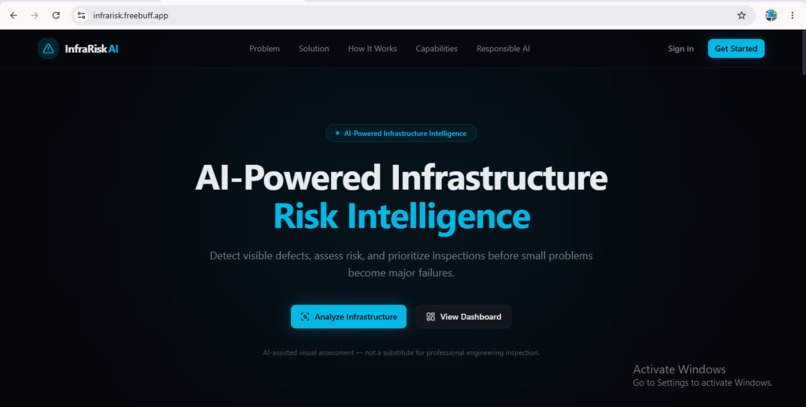
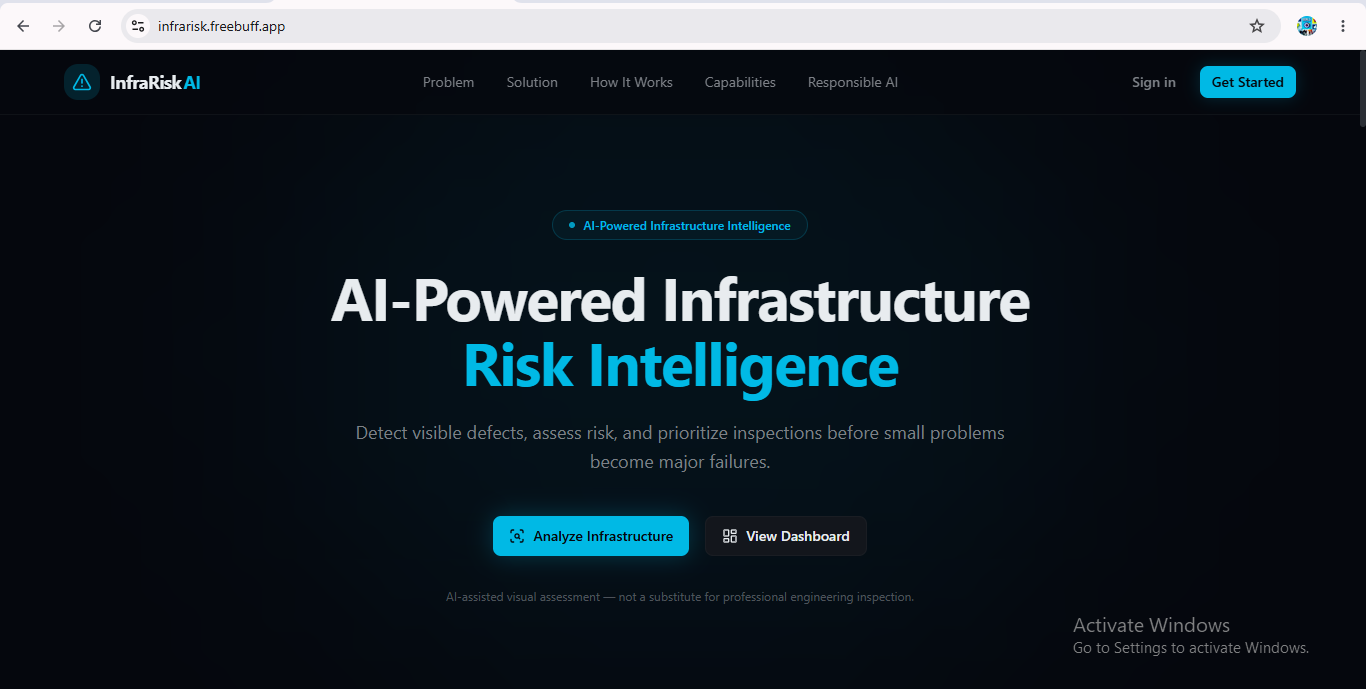
InfraRisk AI — AI-powered infrastructure risk intelligence, designed to detect visible defects, assess risk, and prioritize inspections.
-
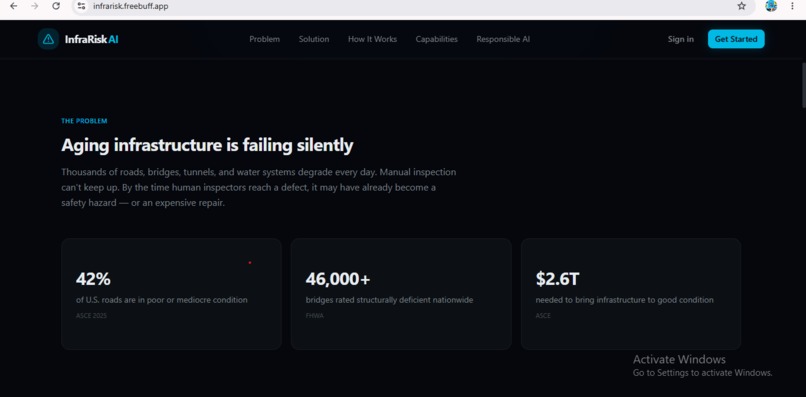
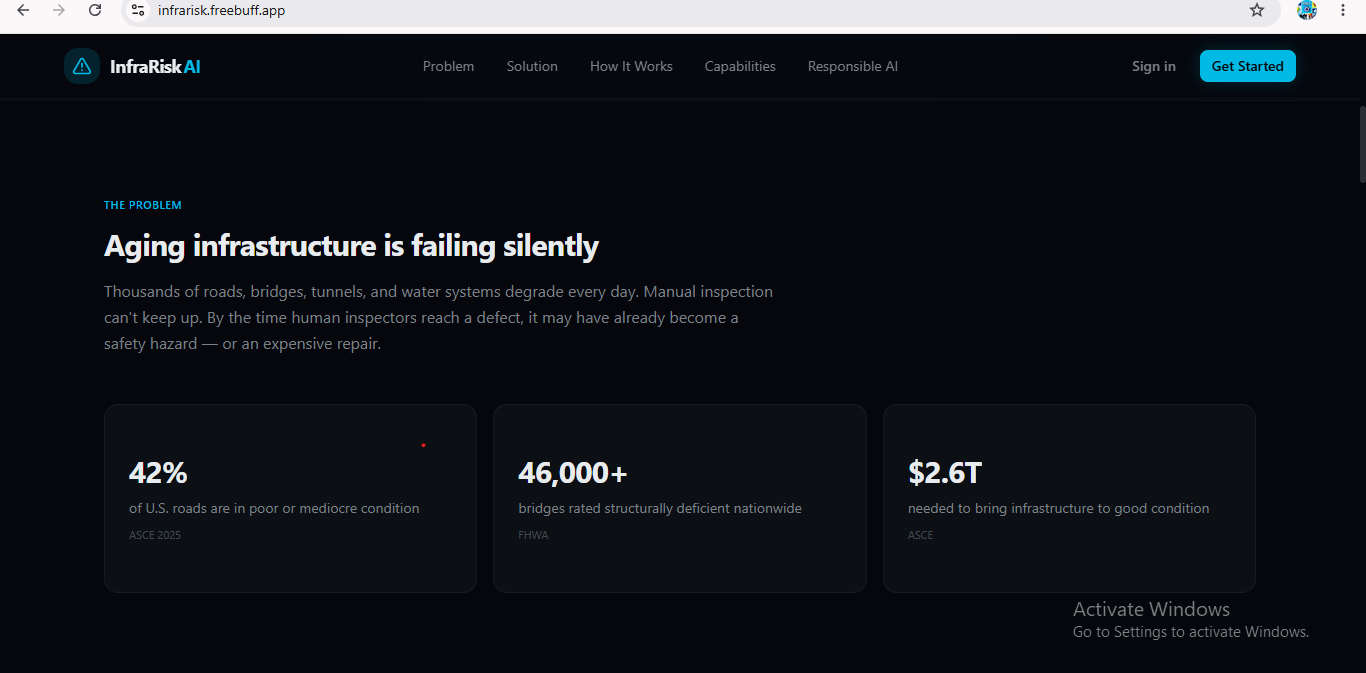
The Challenge — Aging infrastructure demands faster, smarter, and more scalable inspection workflows.
-
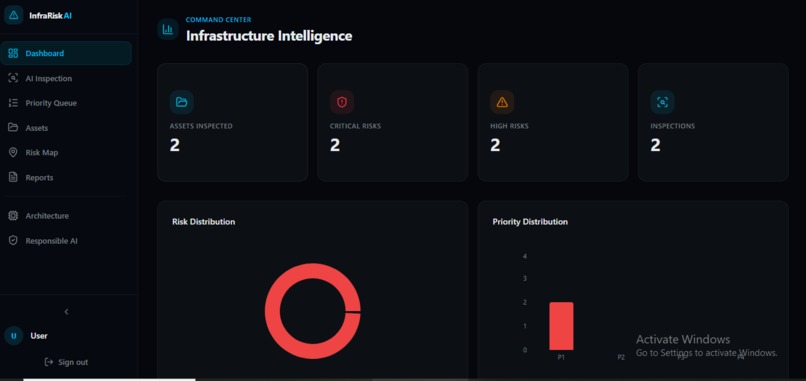
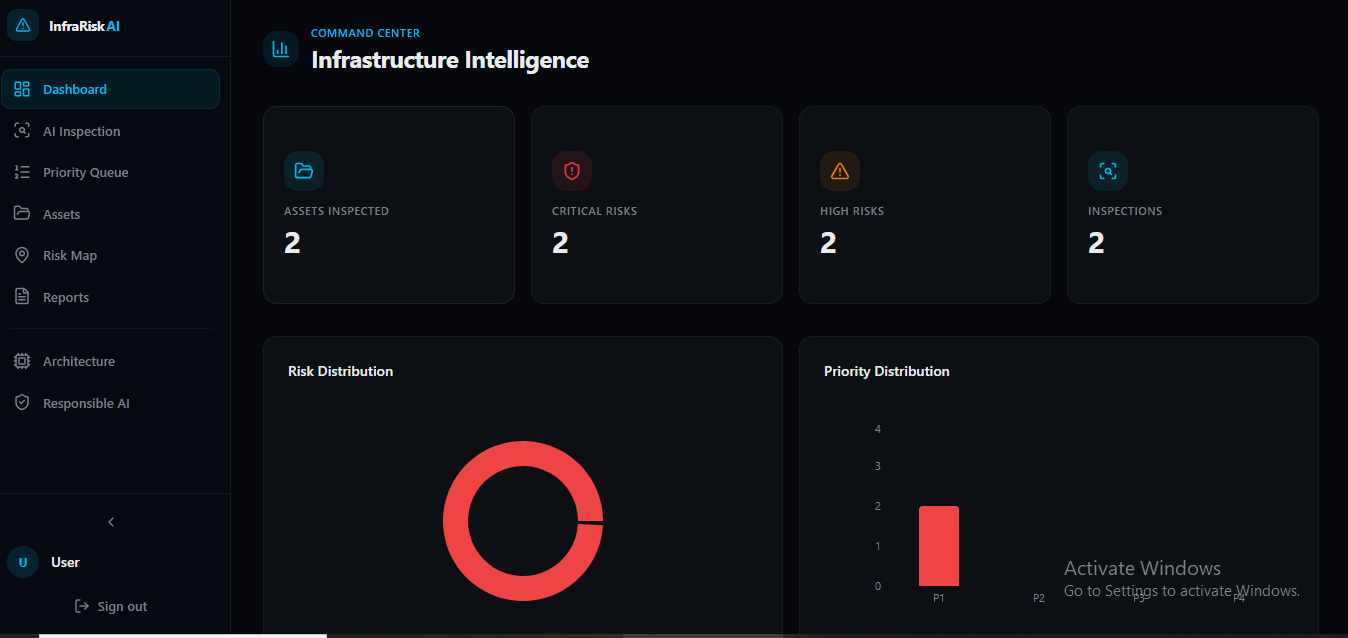
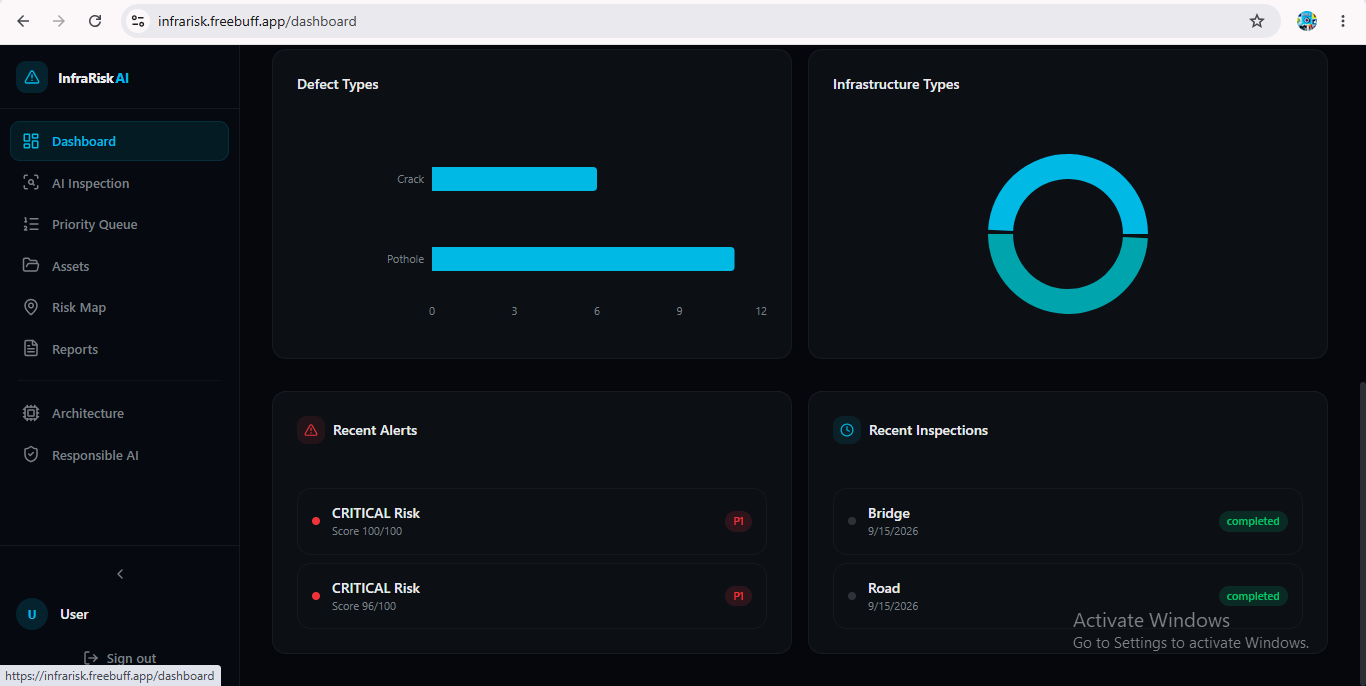
Dashboard — Real-time infrastructure risk insights at a glance.
-
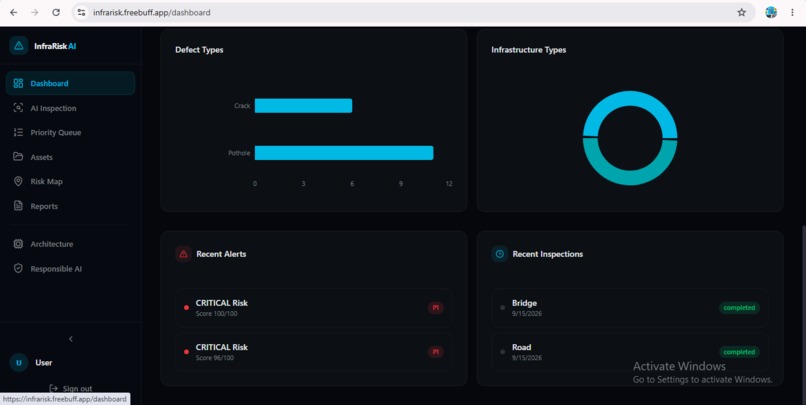
Risk Overview — Smarter decisions.
-
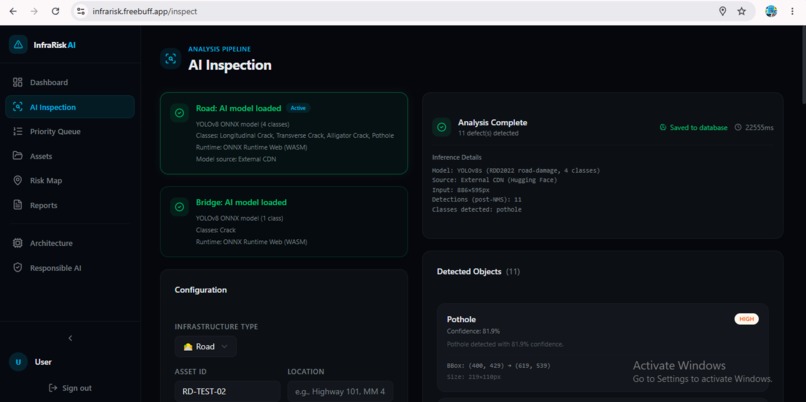
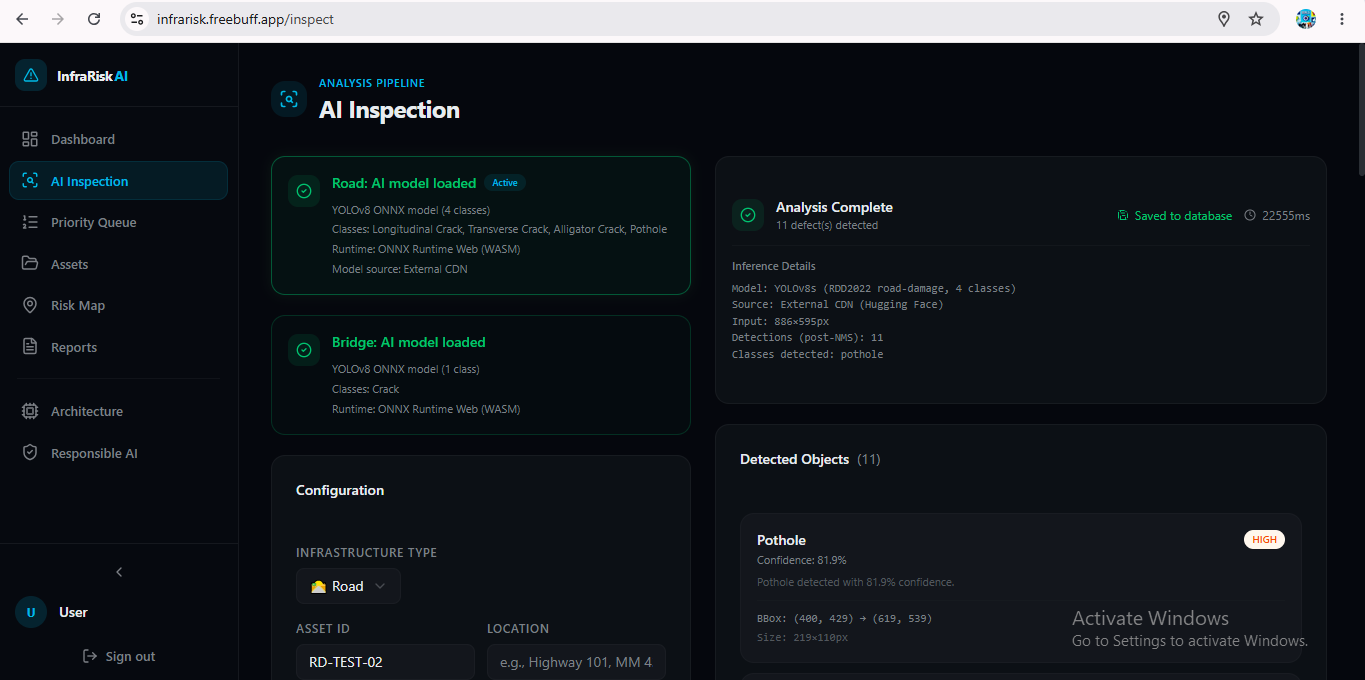
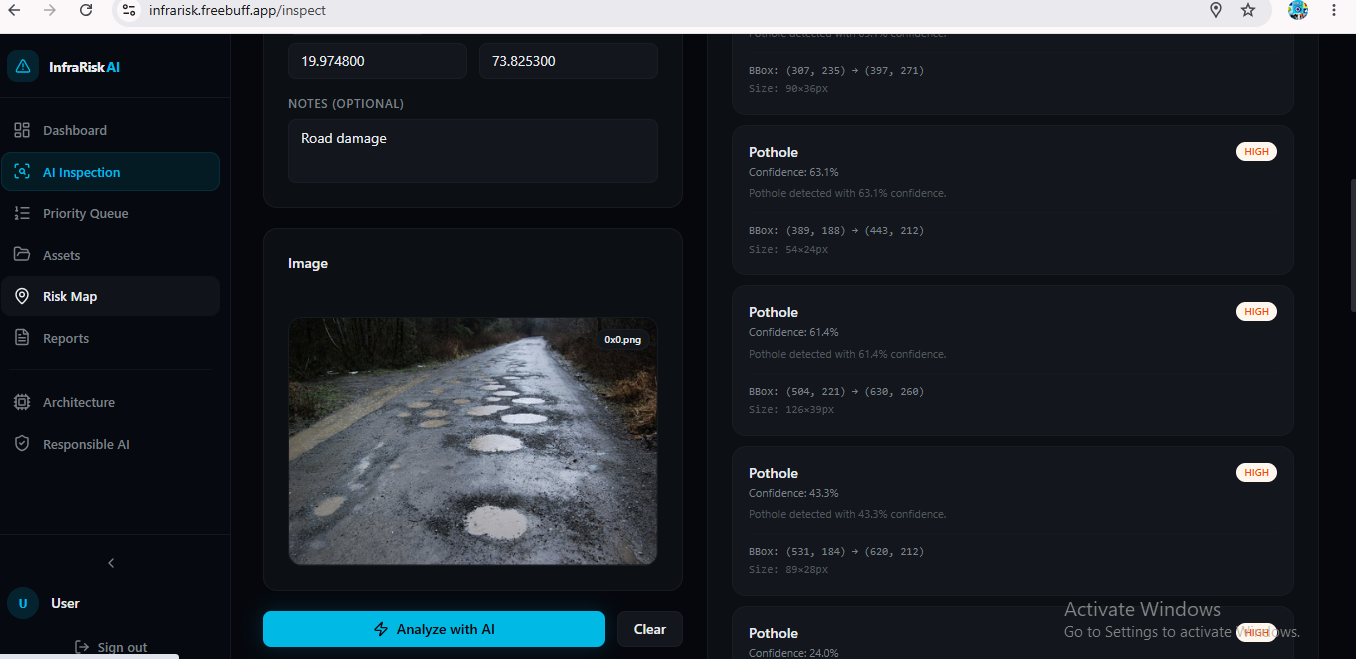
Road AI — Damage detection in action.
-
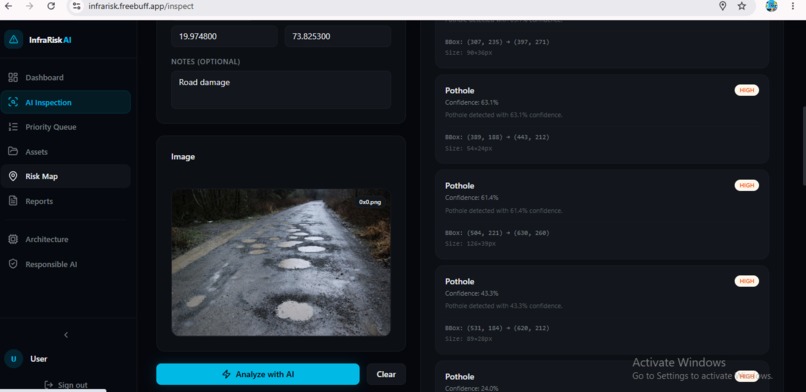
Defect Detection — AI identifies road damage.
-
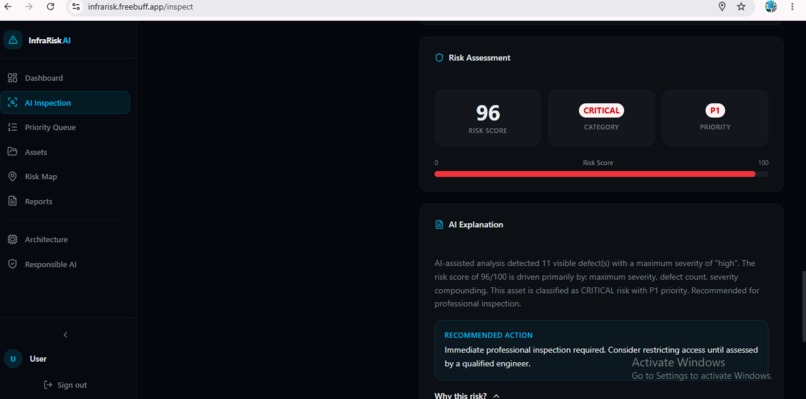
AI Analysis — Multiple defects detected.
-
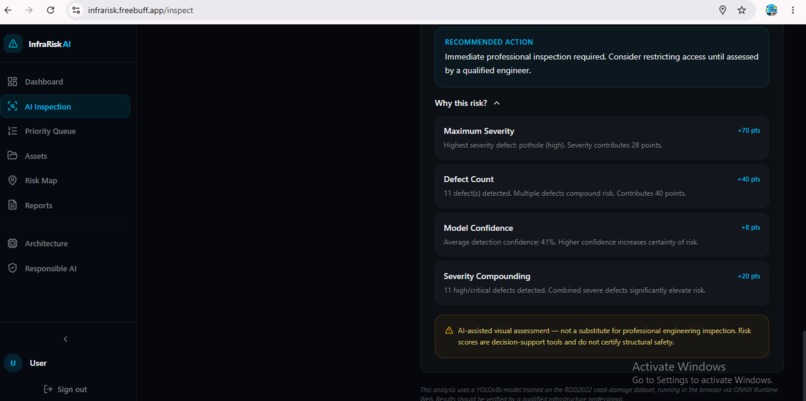
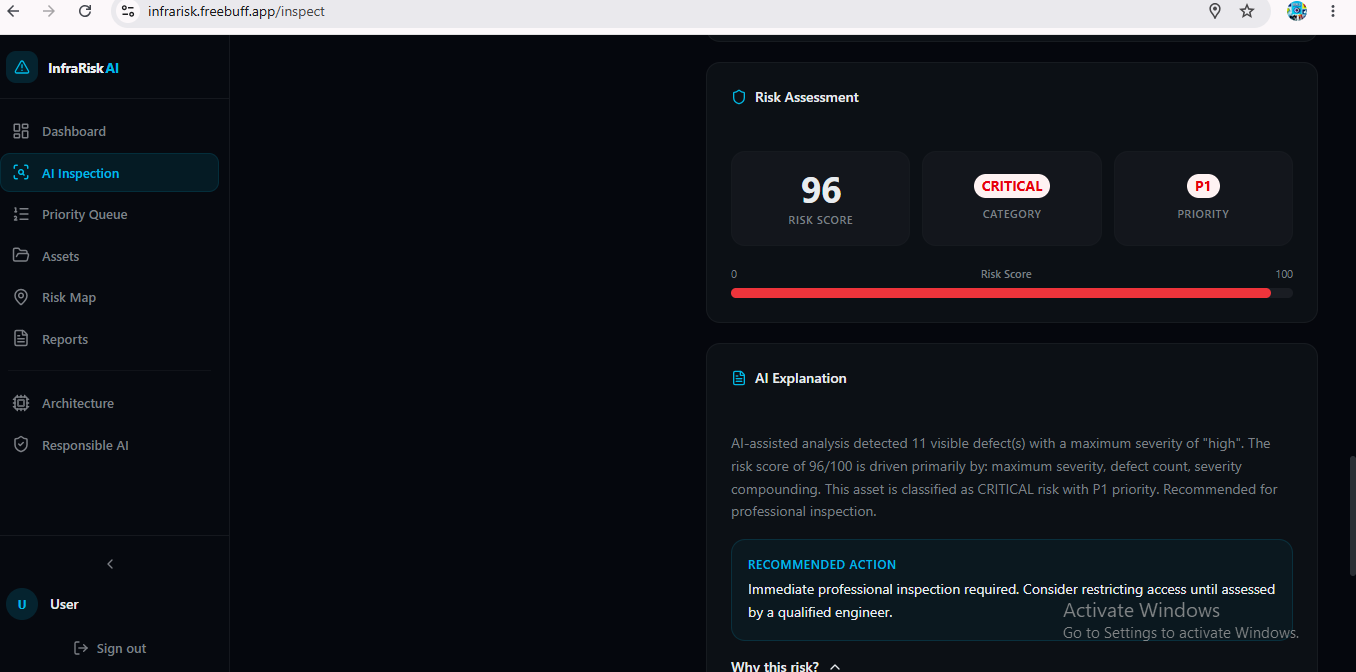
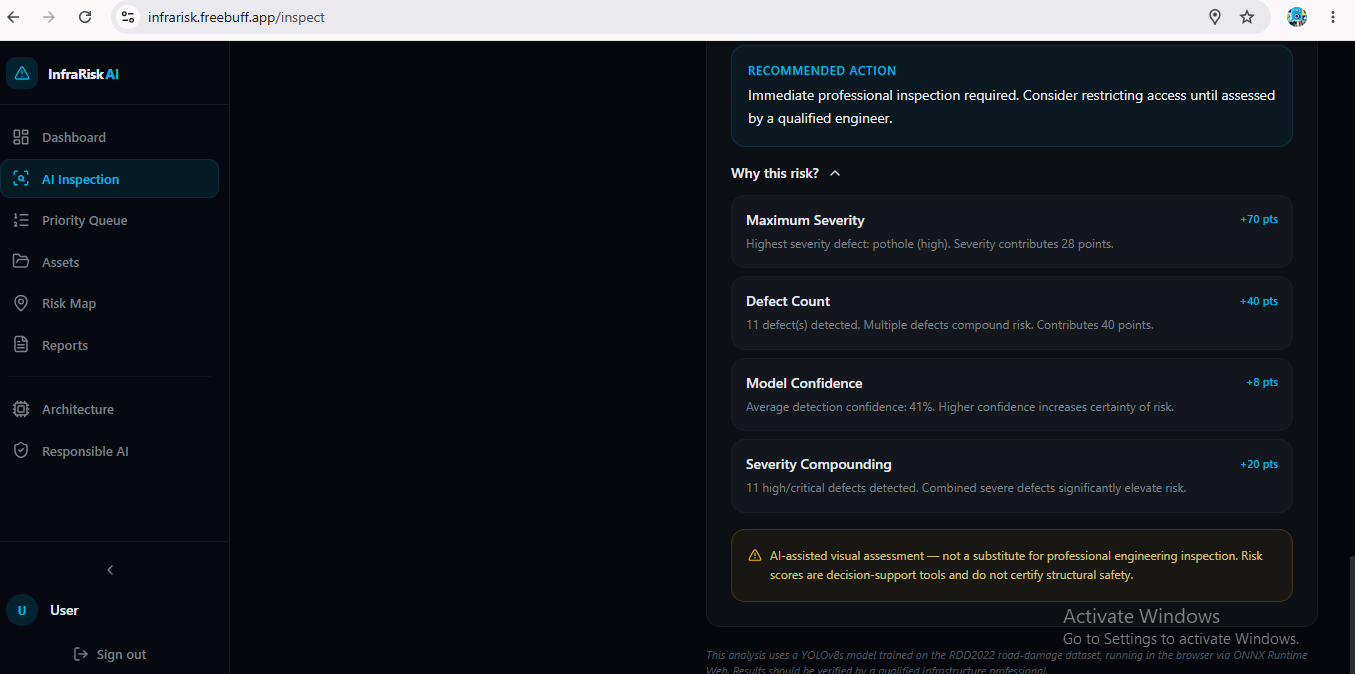
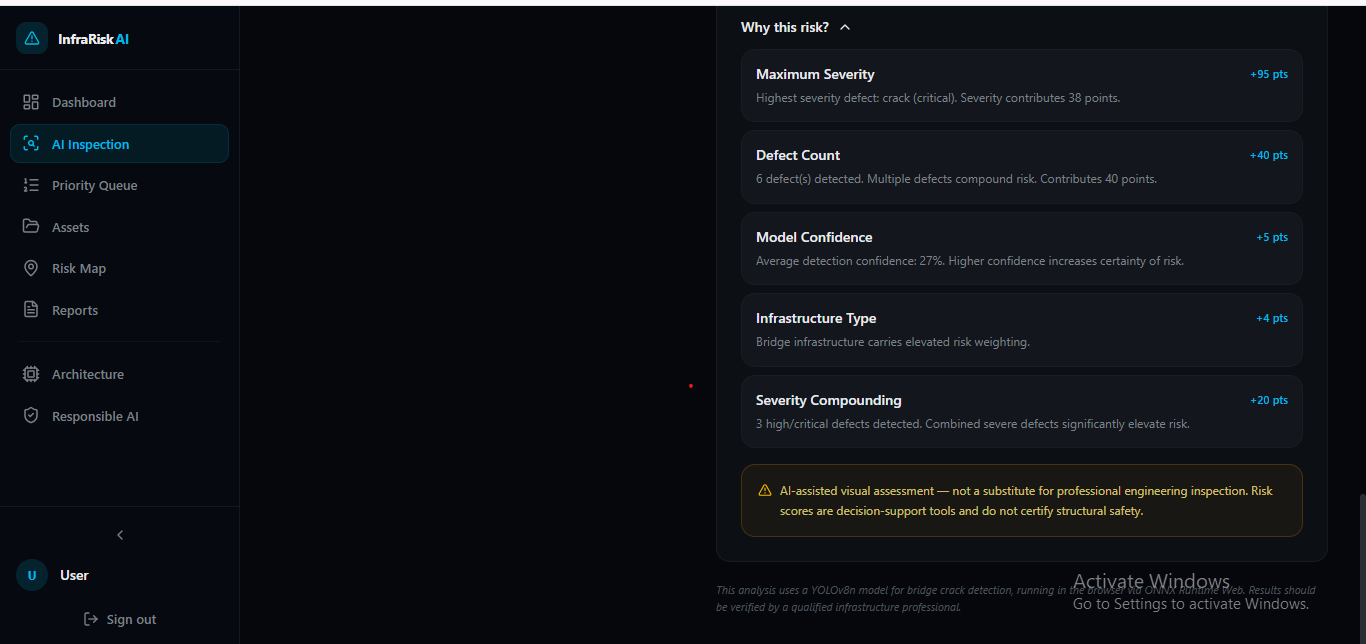
Risk Assessment — Turning detection into priority.
-
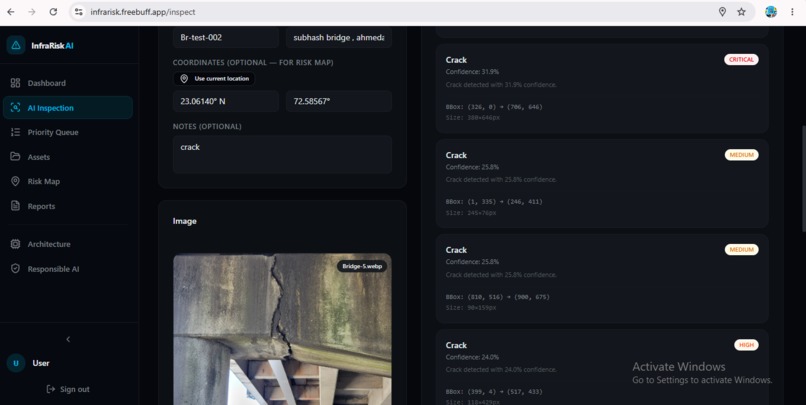
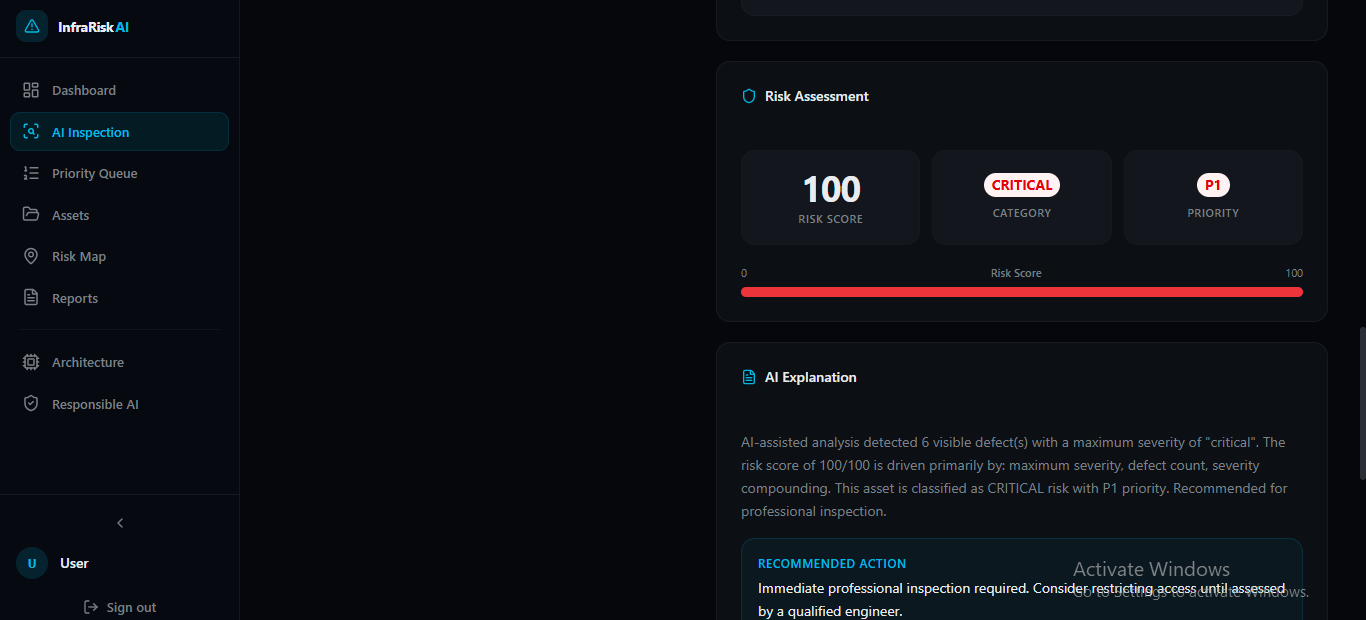
Bridge AI Inspection — Detecting visible bridge cracks and transforming them into actionable risk insights.
-
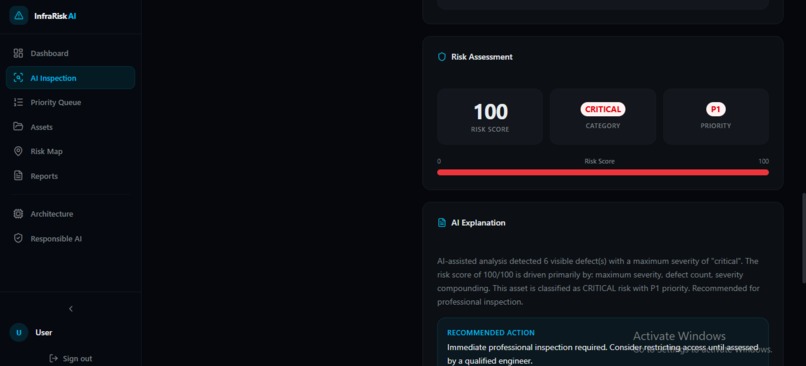
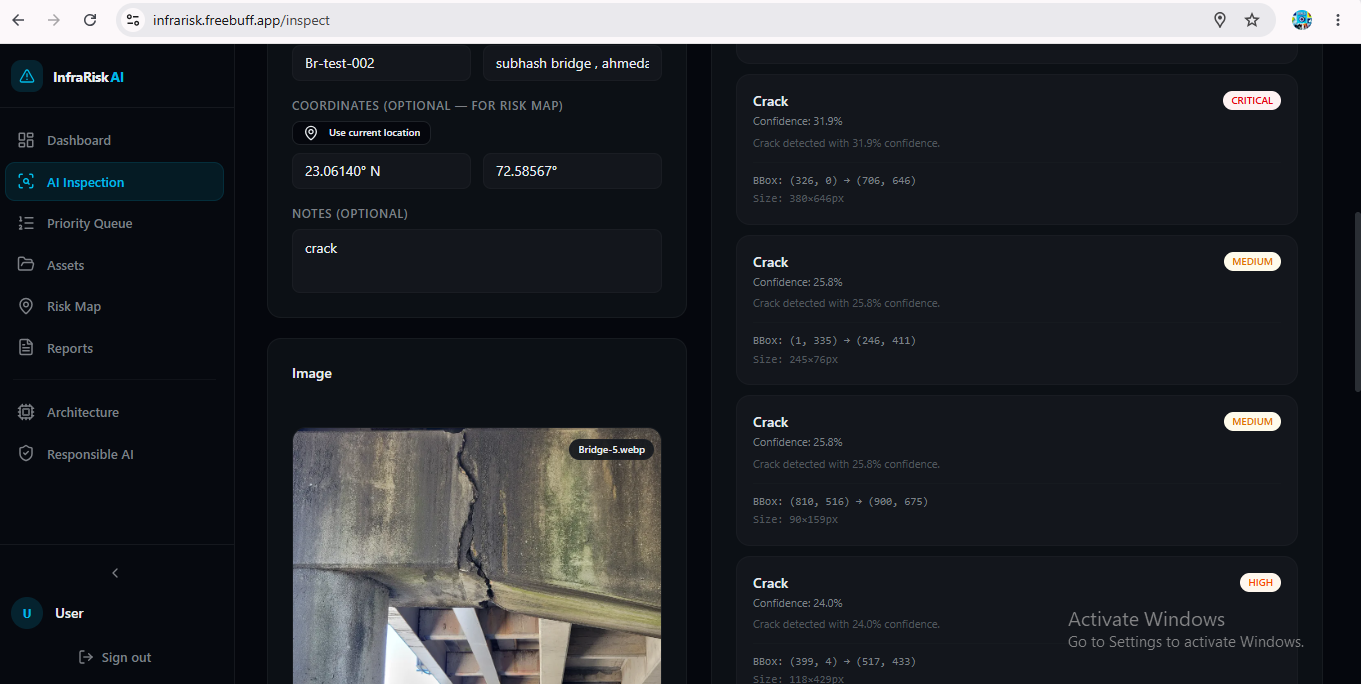
Bridge Crack Detection — AI identifies visible structural defects from inspection imagery.
-
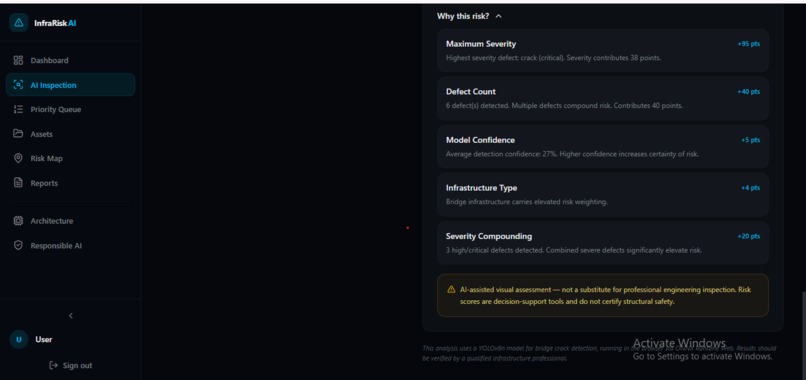
AI-Powered Analysis — Detected bridge defects are evaluated with confidence and inspection context.
-
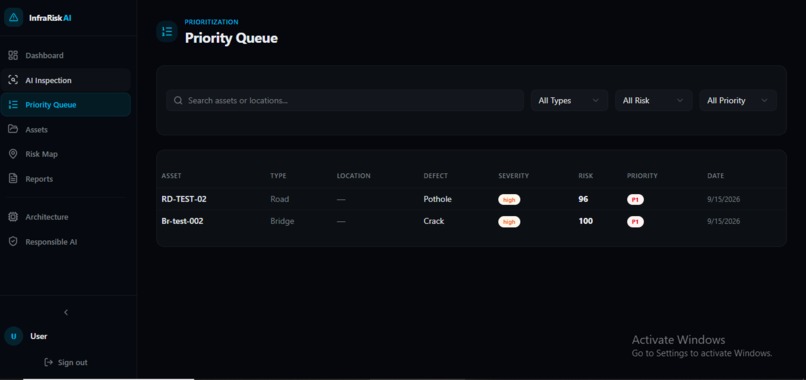
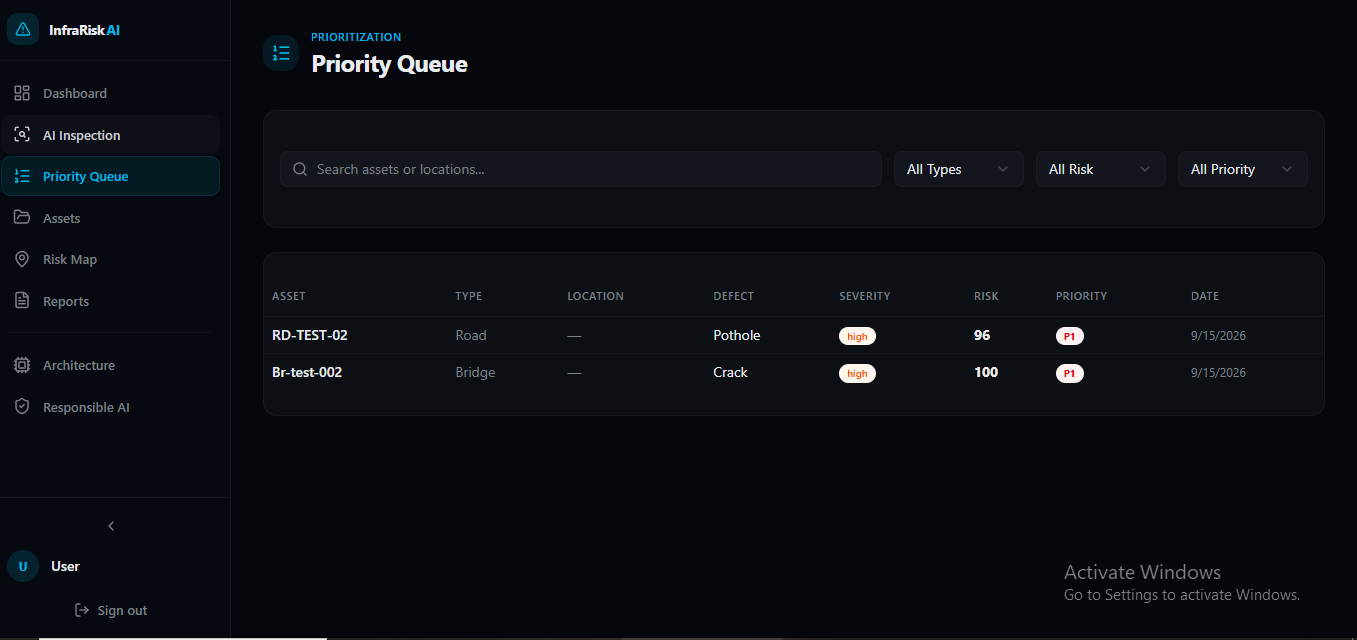
Priority Queue — Ranking inspections by risk to focus attention where it matters most.
-
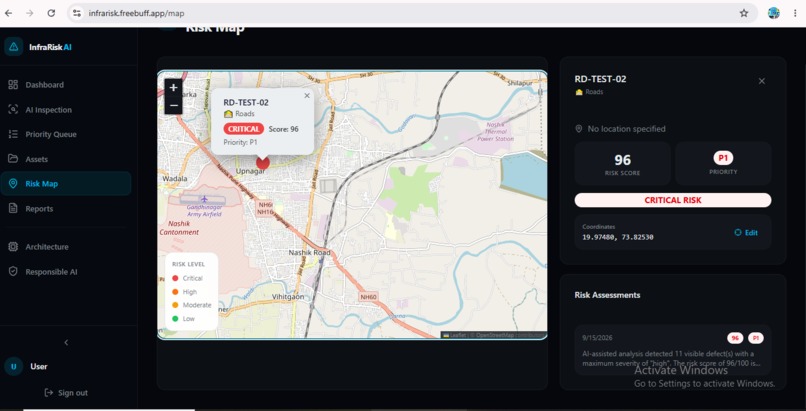
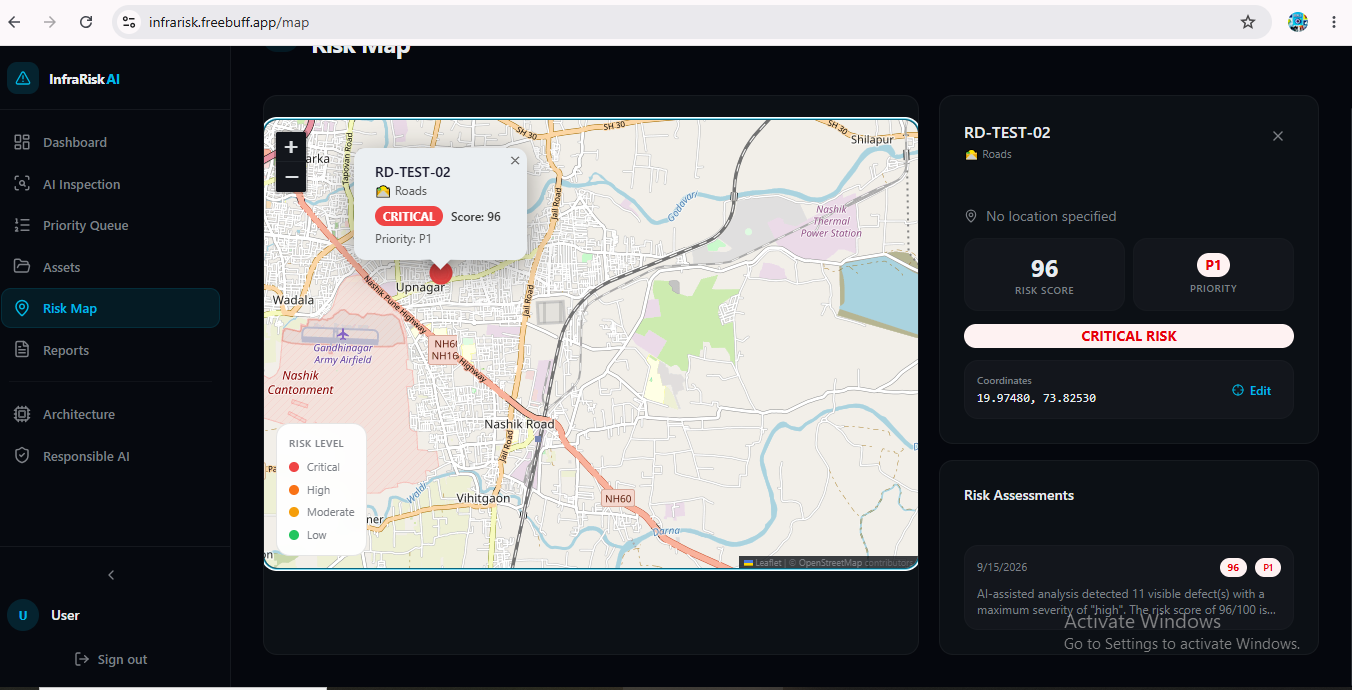
Risk Map — Visualizing infrastructure assets and their risk locations for smarter inspection planning.
-
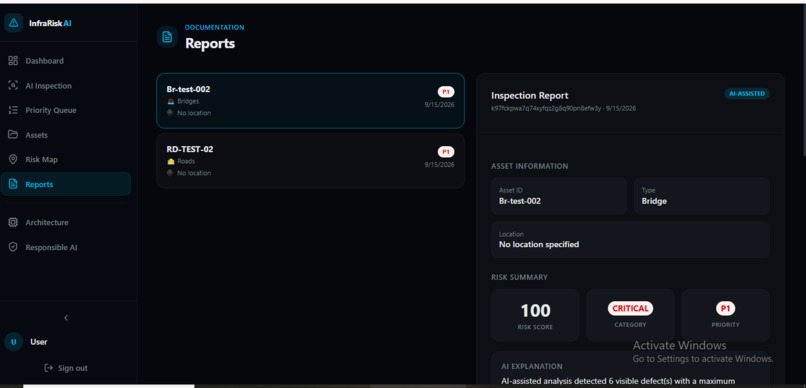
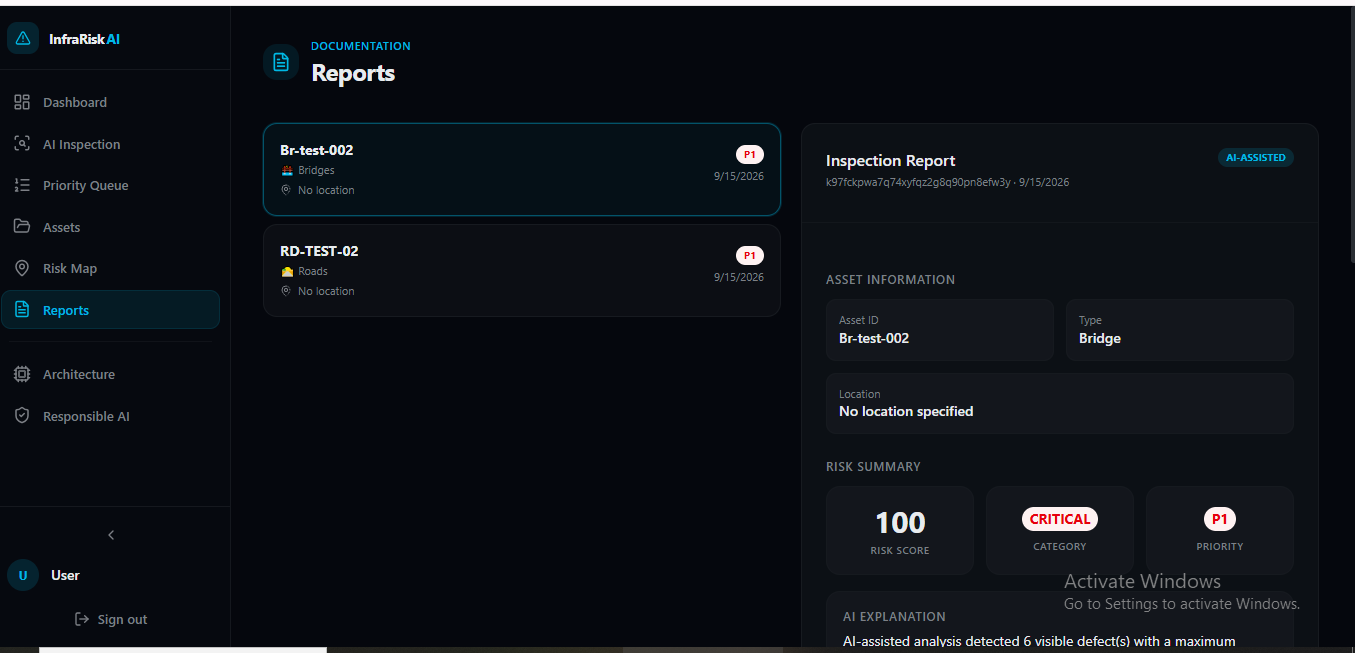
Inspection Reports — Clear, structured records for tracking infrastructure risk and inspections.
Inspiration
A crack on a road or bridge may look small today, but it can become a much bigger maintenance and safety concern if it is missed or addressed too late. The challenge is not only detecting infrastructure damage. With many assets to inspect, the harder question is:
Which problem should be looked at first?
We wanted to build an AI system that could help bridge this gap between visual detection and actionable decision-making.
That idea led to InfraRisk AI.
What it does
InfraRisk AI is an AI-powered infrastructure inspection and risk-prioritization platform that turns visual damage into actionable inspection priorities.
The current platform supports:
🛣️ Road Inspection
Detects:
- Potholes
- Longitudinal cracks
- Transverse cracks
- Alligator cracks
🌉 Bridge Inspection
Detects visible bridge cracks using a dedicated AI model.
But InfraRisk AI does more than draw bounding boxes.
It transforms AI detections into:
Detection → Risk Assessment → Severity → Priority → Report → Tracking
The platform provides risk scores, severity levels, inspection priorities, recommended actions, an interactive Risk Map, a Priority Queue, dashboards, and inspection reports.
This means the user doesn't just get:
“A defect was detected.”
They get:
“A defect was detected — here is its risk level, priority, location, and what deserves attention first.”
How we built it
We built InfraRisk AI as a browser-based AI application using:
- React + TypeScript
- Vite
- YOLOv8
- ONNX Runtime Web / WASM
- Convex
- Leaflet
- OpenStreetMap
- Hugging Face
For road inspection, we use a YOLOv8 model based on the RDD2022 road-damage classes. A separate YOLOv8 model is used for bridge crack detection.
Instead of sending every image to a remote inference server, the application performs model inference in the browser using ONNX Runtime Web. This helped us create a more self-contained inspection experience.
The AI output is then connected to the application's risk, priority, mapping, dashboard, and reporting workflows.
Challenges we ran into
The hardest part was not simply getting an AI model to produce detections.
We had to make the entire AI product work reliably in a web environment.
Large ONNX models and WASM assets created deployment constraints. We also had to solve browser-based model loading, external model delivery, image processing, inference performance, and reliable storage of inspection results.
Another important challenge was deciding how to turn raw AI predictions into something meaningful. A confidence score alone does not tell an inspection team what to do next.
So we built a risk-assessment and prioritization layer around the detections, allowing the application to present results as risk, severity, priority, location, and recommended action.
Accomplishments that we're proud of
We are proud that InfraRisk AI evolved from an AI detection concept into a working end-to-end product.
The current application can:
- Detect road damage using AI.
- Detect bridge cracks using AI.
- Perform inference directly in the browser.
- Convert detections into risk and severity information.
- Prioritize inspections.
- Save inspection results.
- Display assets on an interactive risk map.
- Generate inspection reports.
- Provide a responsive experience across devices.
Most importantly, we connected computer vision with an actual workflow rather than stopping at a model prediction.
What we learned
This project taught us that building an AI product is not just about choosing a model.
The difficult and valuable part is everything around the model:
How do you deploy it?
How do you make the output understandable?
How do you turn predictions into decisions?
How do you make the system useful outside a notebook?
We learned about browser-based machine learning, ONNX deployment, WASM constraints, external model delivery, AI-assisted application development, database-backed workflows, risk logic, and product design.
We also learned an important lesson:
AI becomes more useful when its predictions lead to meaningful next actions.
What's next for InfraRisk AI
Roads and bridges are our starting point, not the final destination.
The architecture is designed to expand toward additional infrastructure categories such as tunnels, railway infrastructure, and power infrastructure.
Future development could include richer inspection workflows, larger-scale infrastructure monitoring, and additional AI capabilities.
Our vision is to build a platform where infrastructure teams can move from:
Built With
- artificial
- assessment
- computer
- convex
- face
- hugging
- infrastructure
- intelligence
- leaflet.js
- learning
- machine
- onnx
- openstreetmap
- react
- risk
- runtime
- typescript
- vision
- vite
- web
- yolov8


Log in or sign up for Devpost to join the conversation.