-
-
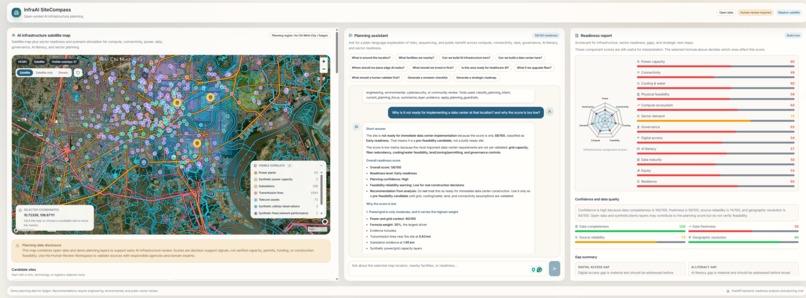
this is our platform
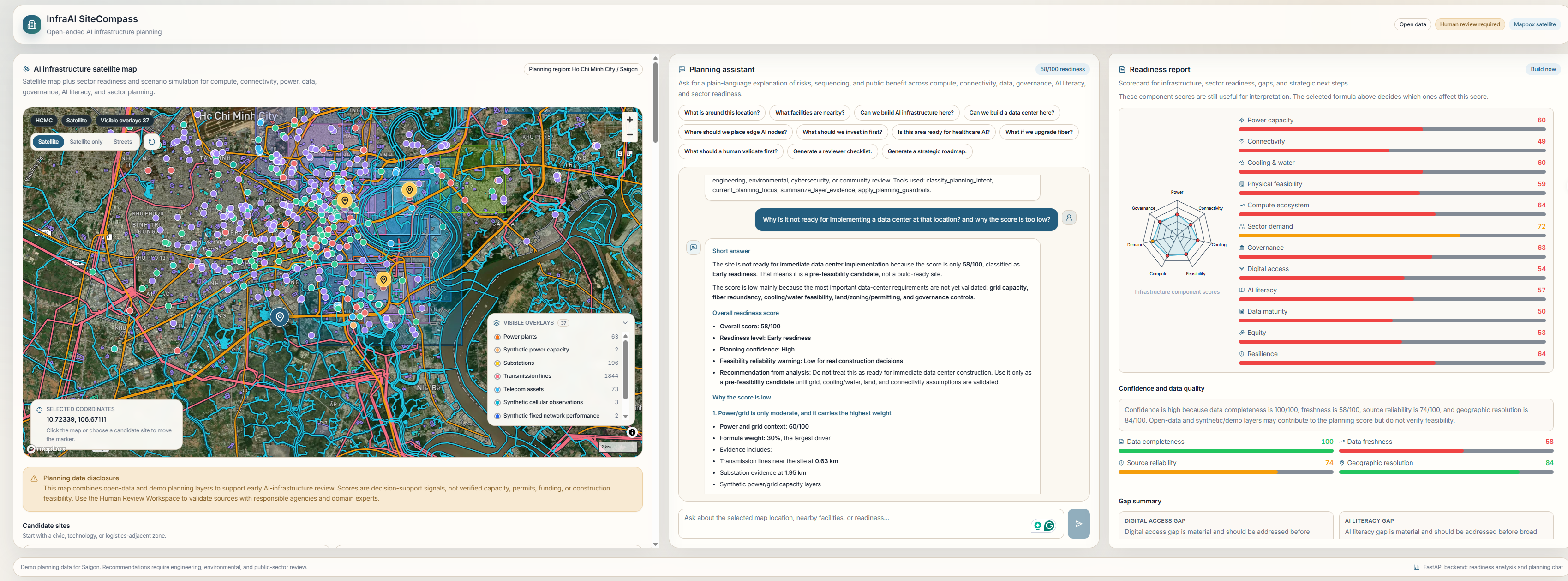
Inspiration
Cities want to use AI for education, healthcare, government services, workforce development, and nonprofits, but many communities do not know whether their local infrastructure is ready. AI readiness is not only about data centers. It also depends on power, fiber, cloud access, data maturity, AI literacy, governance, cybersecurity, equity, and human review.
InfraAI SiteCompass was built to help city leaders explore those questions on a satellite map.
What it does
InfraAI SiteCompass is an AI infrastructure planning assistant. Users can click a location on a Mapbox satellite map, turn infrastructure layers on or off, choose a planning focus, run scenario simulations, and generate an AI readiness report.
The platform supports questions such as:
- Can this area support AI infrastructure?
- Can we build a data center here?
- Where should we place edge AI nodes?
- Which area needs fiber upgrades first?
- Is this area ready for healthcare AI?
- What should we invest in first?
The system generates readiness scores, sector dashboards, evidence summaries, priority investments, strategic roadmaps, agent explanations, and human review checklists.
How we built it
The frontend is built with React, Vite, TypeScript, Tailwind CSS, and Mapbox. The backend is built with FastAPI and Python. The AI system combines deterministic scoring, evidence-grounded analysis, rule-based tools, optional OpenAI explanations, and a human-in-the-loop review workflow.
The backend reads local GeoJSON infrastructure layers, scores the selected location, applies guardrails, and returns a structured report. The agent can answer questions about the map, score drivers, nearby infrastructure, evidence gaps, scenario tradeoffs, and validation steps.
Human-in-the-loop design
InfraAI does not approve construction, permits, funding, or grid capacity. Every report includes warnings, uncertainty notes, source limitations, and a Human Review Workspace where reviewers can validate evidence, add notes, mark review status, and export a planning review packet.
Challenges
The hardest part was making the system honest about uncertainty. Many infrastructure datasets are incomplete, open-data, or synthetic/demo data. Instead of hiding that, the platform surfaces confidence, evidence gaps, source limitations, and validation requirements.
What we learned
AI infrastructure readiness is broader than compute. A responsible planning tool must connect technical infrastructure with governance, data quality, public-sector needs, equity, and human review.
Built With
- fastapi
- geojson
- mapbox
- mcp
- openai-api
- openstreetmap-data
- pydantic
- pytest
- python
- react
- tailwind-css
- typescript
- vite



Log in or sign up for Devpost to join the conversation.