iHealth
Healthcare that starts with you — your words, your world, your language.
🌱 About the Project
🔥 Why We Started
It began with a truth we couldn't ignore: too many people suffer not because medicine doesn't exist, but because access does.
In some parts of the world, a rash can still be mistaken for a curse (Superstitious beliefs). A fever can go untreated because no doctor speaks your language. A mother might scroll through misinformation before she ever finds real help.
We saw this happen up close. In communities across Nigeria, Kenya, India, even rural Europe, people had phones in their hands, but no clear way to understand what their bodies were trying to say.
That disconnect between curiosity and care is where people lose time, hope, and sometimes, their lives.
So we asked:
What if the first step to healthcare didn't have to be a clinic, but a conversation?
What if anyone could just talk, show, or ask, and immediately get guidance that feels human, accurate, and in their language?
That's why we built iHealth. Not to replace doctors, but to help people understand themselves first, so that when they reach for care, they reach with confidence.
💡 What iHealth Does
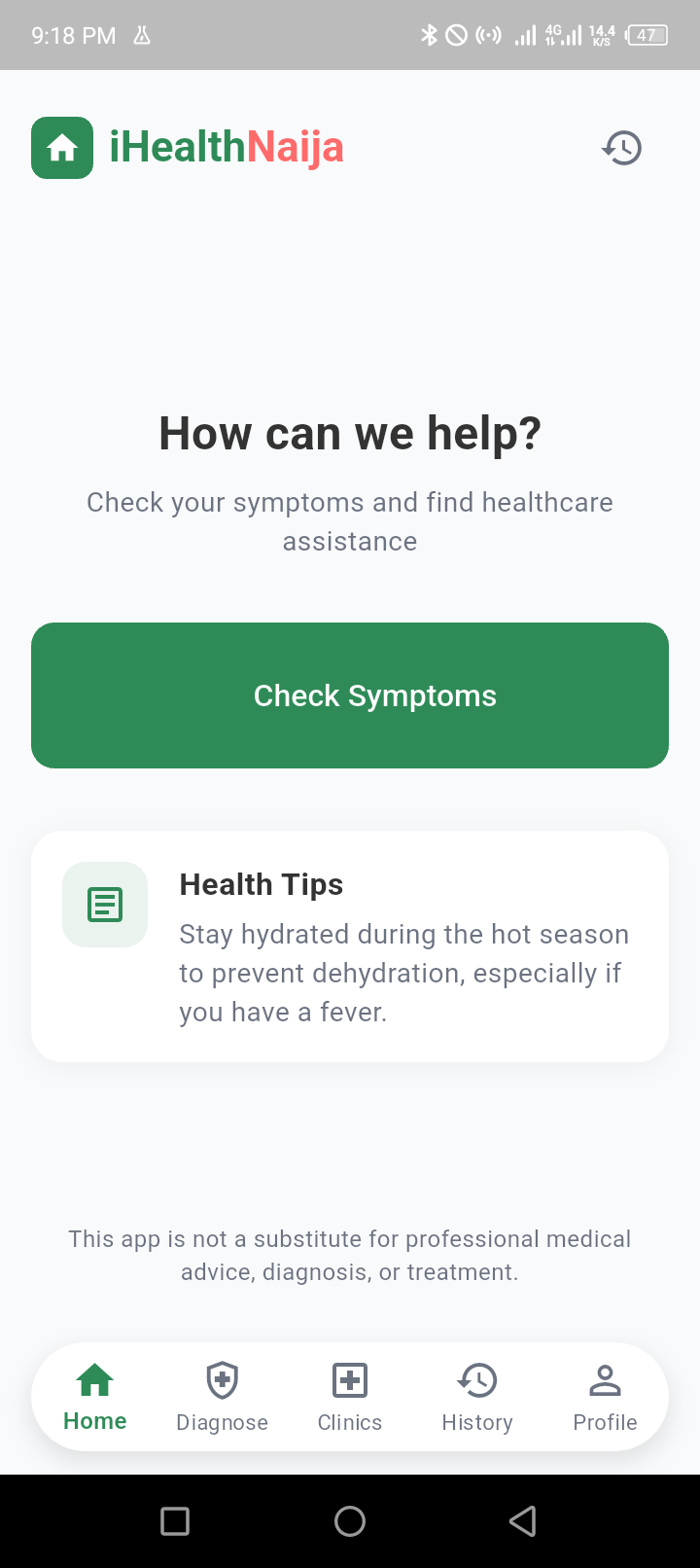
iHealth is a mobile-first health companion that makes understanding your health as natural as a conversation.
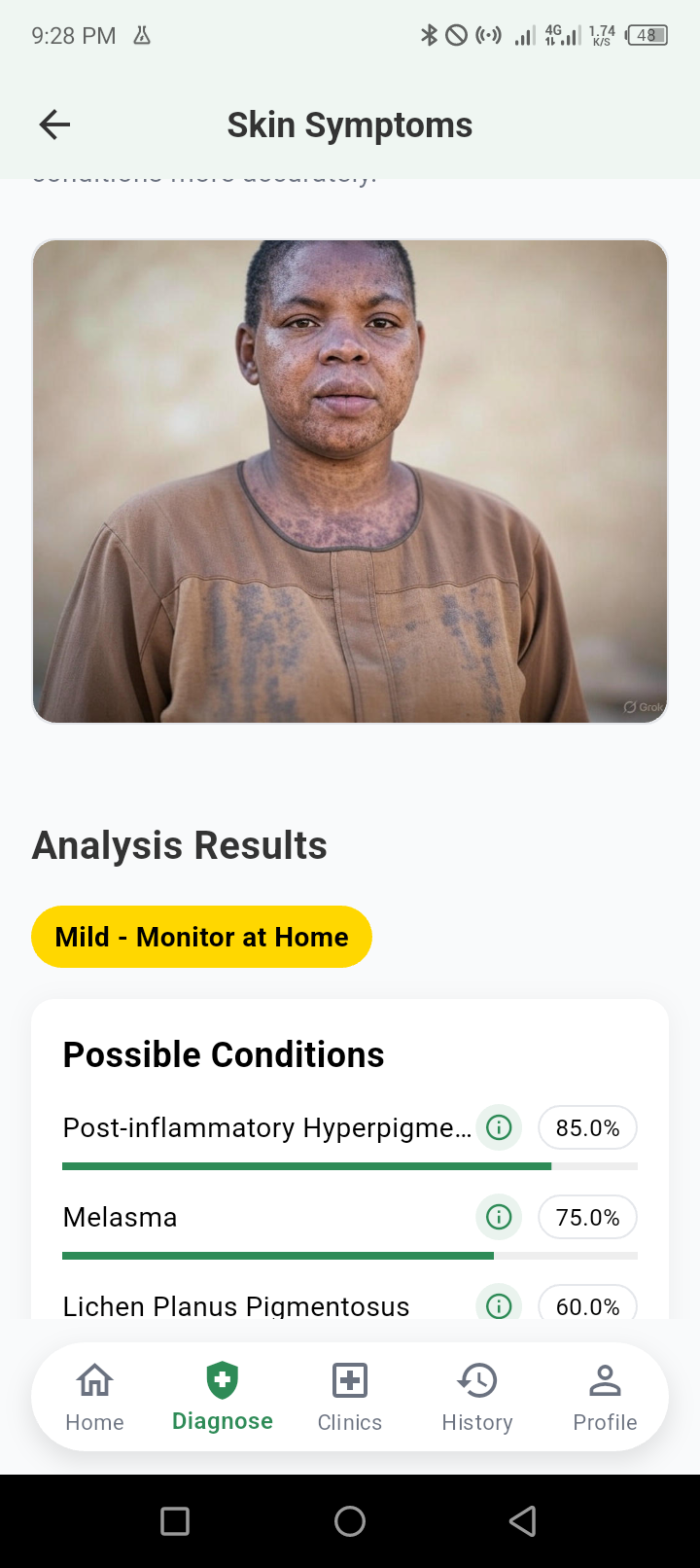
You can speak, type, or take a photo, and iHealth will help you:
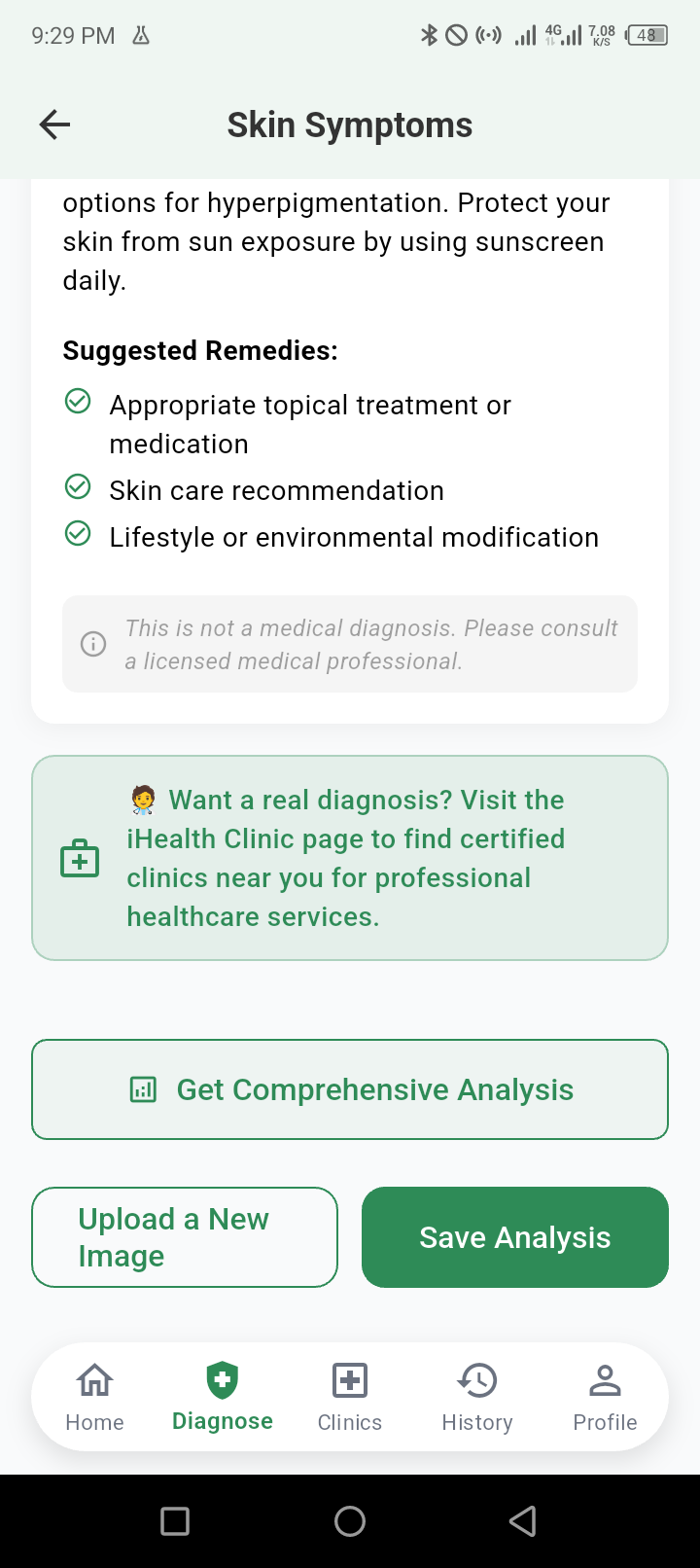
- Understand what might be happening, explained simply and respectfully
- Learn what to do next, whether that's home care or seeing a clinician
- Find nearby verified clinics or pharmacies
- Save and track your health insights privately
It's healthcare that starts with you: your words, your world, your language.
🛠️ How It Works
We built iHealth to work where healthcare often doesn't: places with low bandwidth, low literacy, or limited infrastructure.
Technology Stack
| Layer | Technology | Why We Chose It |
|---|---|---|
| Frontend | Flutter | Lightweight, accessible, and multilingual by design |
| Backend | Express.js + MongoDB | Built for speed and scale |
| AI Intelligence | Multi-model approach | Comprehensive health understanding |
AI Intelligence
Deep learning model for skin analysis (Autoderm via Hugging Face)
Trained across diverse skin tones, With Gemini 2.0 Flash as a fallbackGemini 2.0 Flash
For contextual understanding and health explanationsSelf-hosted LibreTranslate
Private, real-time multilingual support, With Gemini 2.0 Flash as fallbackVoice transcription
Works offline and supports low-resource languagesOpenStreetMap integration
Local care recommendations, free from API limits
Every layer is designed for inclusion, reliability, and respect, not just accuracy.
💭 What We've Learned
- People don't just need information, they need clarity they can trust
- A good interface can do more for public health than a new hospital
- Language, culture, and fear are some of the biggest health barriers
- Real innovation doesn't come from more data, it comes from empathy
⚔️ The Hard Parts
Medical Safety
We made iHealth transparent. Every response comes with reasoning, disclaimers, and a clear "see a doctor if…" path.
Representation
We trained on diverse datasets to ensure fairness across all skin tones.
Connectivity
We built for 2G and offline use with compression and caching.
Translation Accuracy
We fine-tuned translation models to keep medical meaning intact, not just literal words.
🤝 Why It Matters
Because healthcare shouldn't begin with privilege or proximity. It should begin with understanding.
iHealth exists for everyone who's ever had a question about their health and no one to ask:
- For the farmer miles from the nearest clinic
- For the mother who doesn't speak the same language as the doctor
- For the young woman who hides her symptoms out of shame
We built iHealth so that when you speak, healthcare listens back.
Because no one should have to face uncertainty alone.
Built With
- cloudinary
- docker
- express.js
- flutter
- gemini
- hugging-face
- libretranslate
- mongodb
- openstreetmap


Log in or sign up for Devpost to join the conversation.