Inspiration
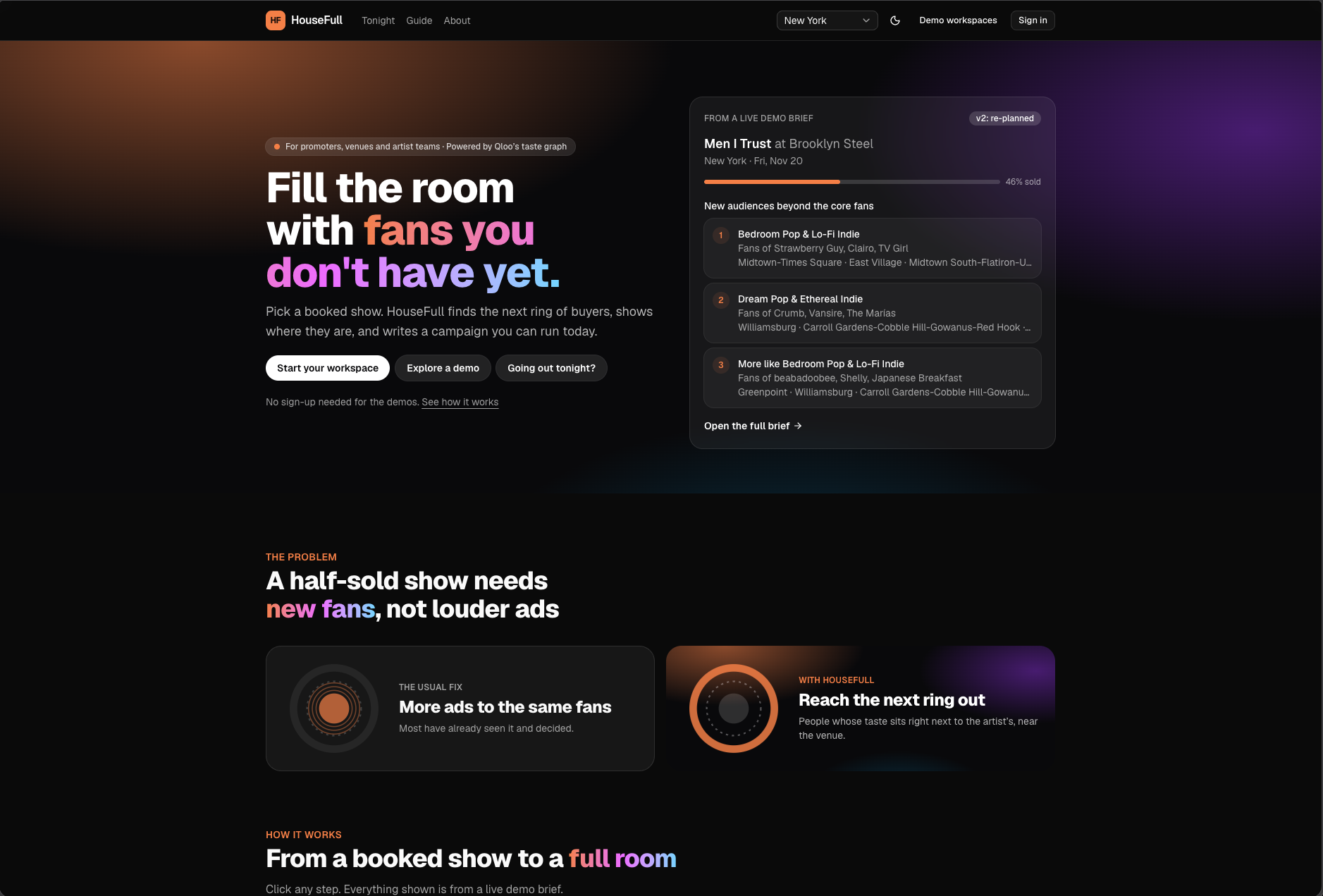
A show that's 40% sold three weeks out is something every promoter, venue and artist team has dealt with. The usual response is more ads to the same people, the artist's fans and lookalikes of them, and most of those people already know about the show and have decided whether to go.
We think the people who fill the room are one step further out: fans of artists close to the headliner, who live near enough to get there and haven't heard about this show. Qloo's taste graph maps that neighborhood. We wanted to see whether an agent could turn it into a campaign a small team could start running the same day, and then learn from the results.
What it does
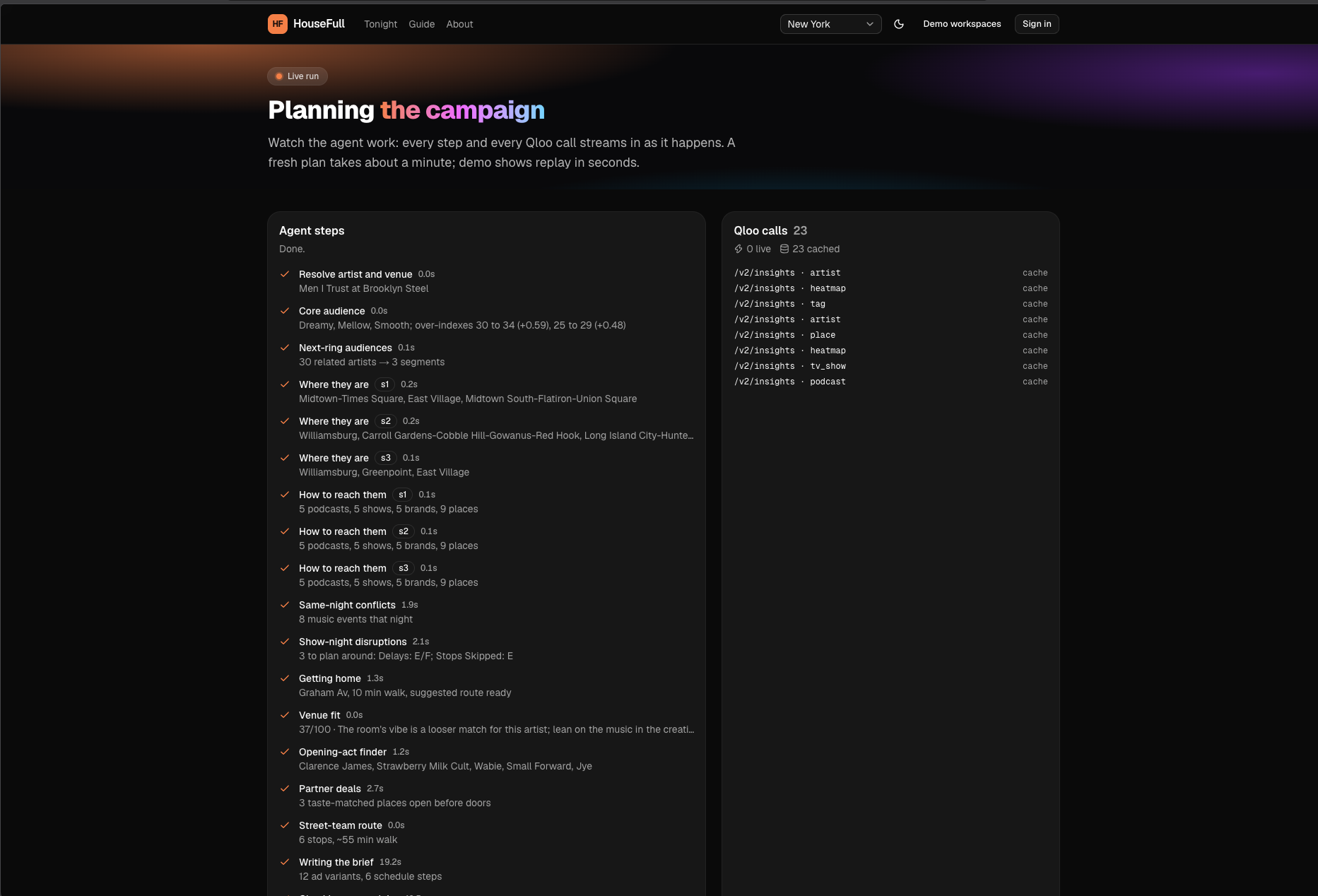
HouseFull is a campaign agent for live music built on Qloo. You pick a booked show, either by entering any artist and any venue in New York, New Orleans or Los Angeles, or by finding it on Ticketmaster. About a minute later you have a campaign brief with:
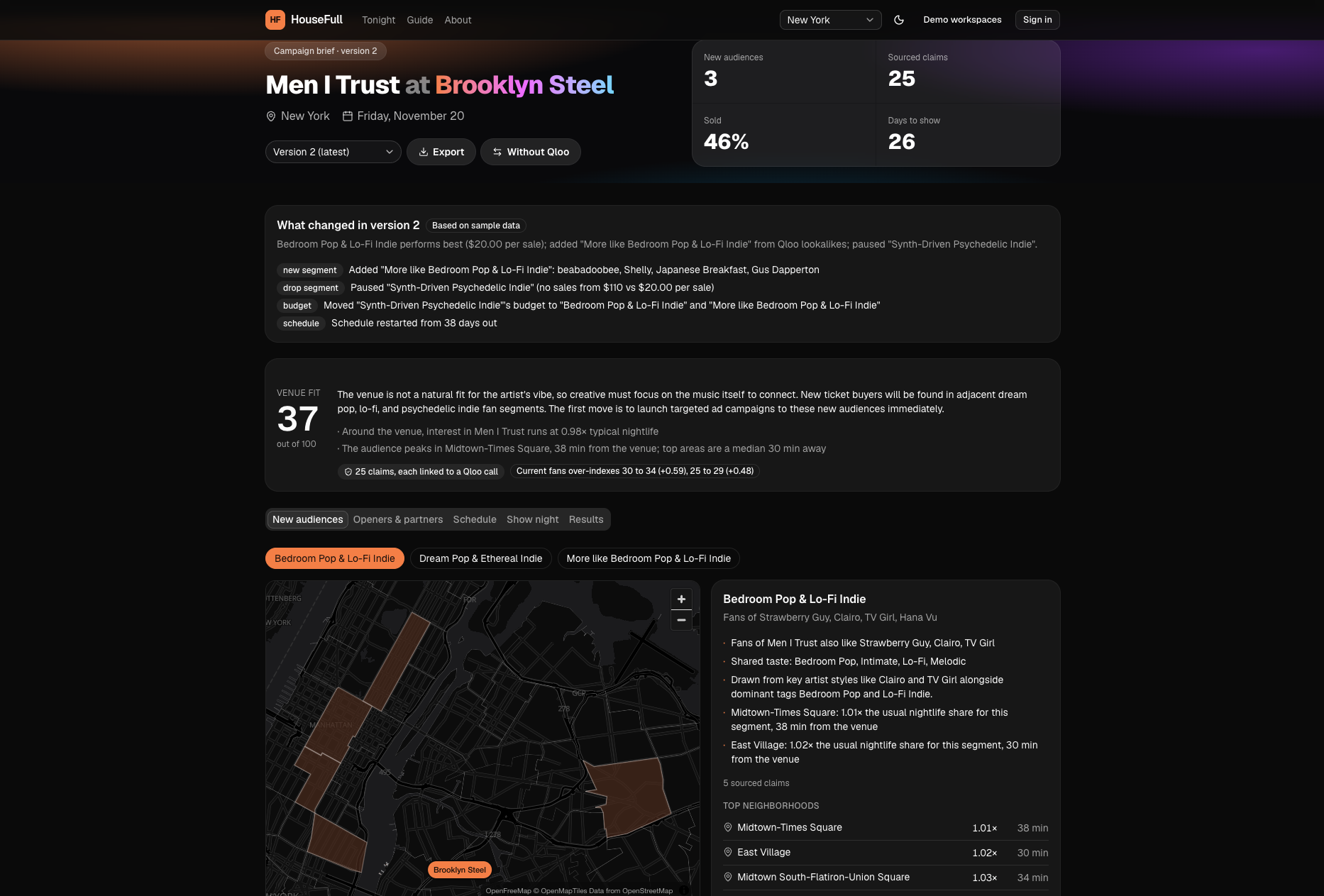
- three new audiences beyond the core fans, grouped by taste, each with reasons that link to the Qloo call they came from;
- the neighborhoods where each audience's taste is stronger than the city's nightlife would predict, with transit or drive time to the venue (in New Orleans, the cities visitors travel from);
- podcasts, TV shows and brands each audience likes, and three ad variants per audience that a critic has checked;
- opening acts, partner bars and record stores, a street-team route, and a day-by-day countdown;
- in New York, a show-night page with competing shows, subway disruptions and a plan for getting home (the best late-night train and a walking route).
Once the campaign is running, you enter clicks and sales or upload a Meta Ads export. HouseFull moves budget to the audiences that convert, adds a new audience from Qloo based on the winners, pauses what isn't working, and explains each change in a new version of the brief.
After the show there's a two-minute anonymous survey. Attendees tick artists they also like, and those artists place them in an audience, so organizers can see which new audiences enjoyed the night and want to come back without tracking anyone. The next re-plan uses this too: an audience whose attendees loved the show won't be paused just because its ads cost more.
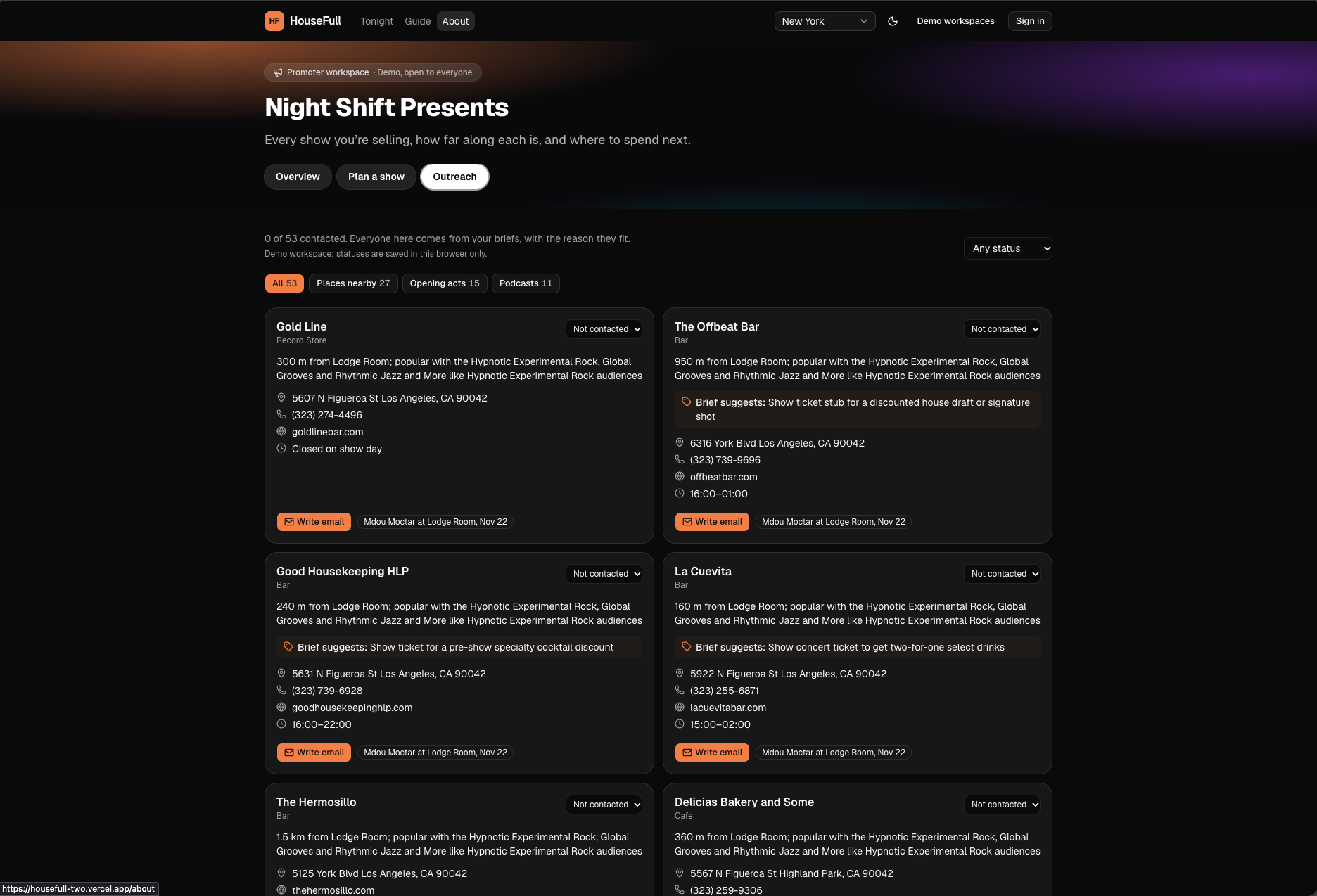
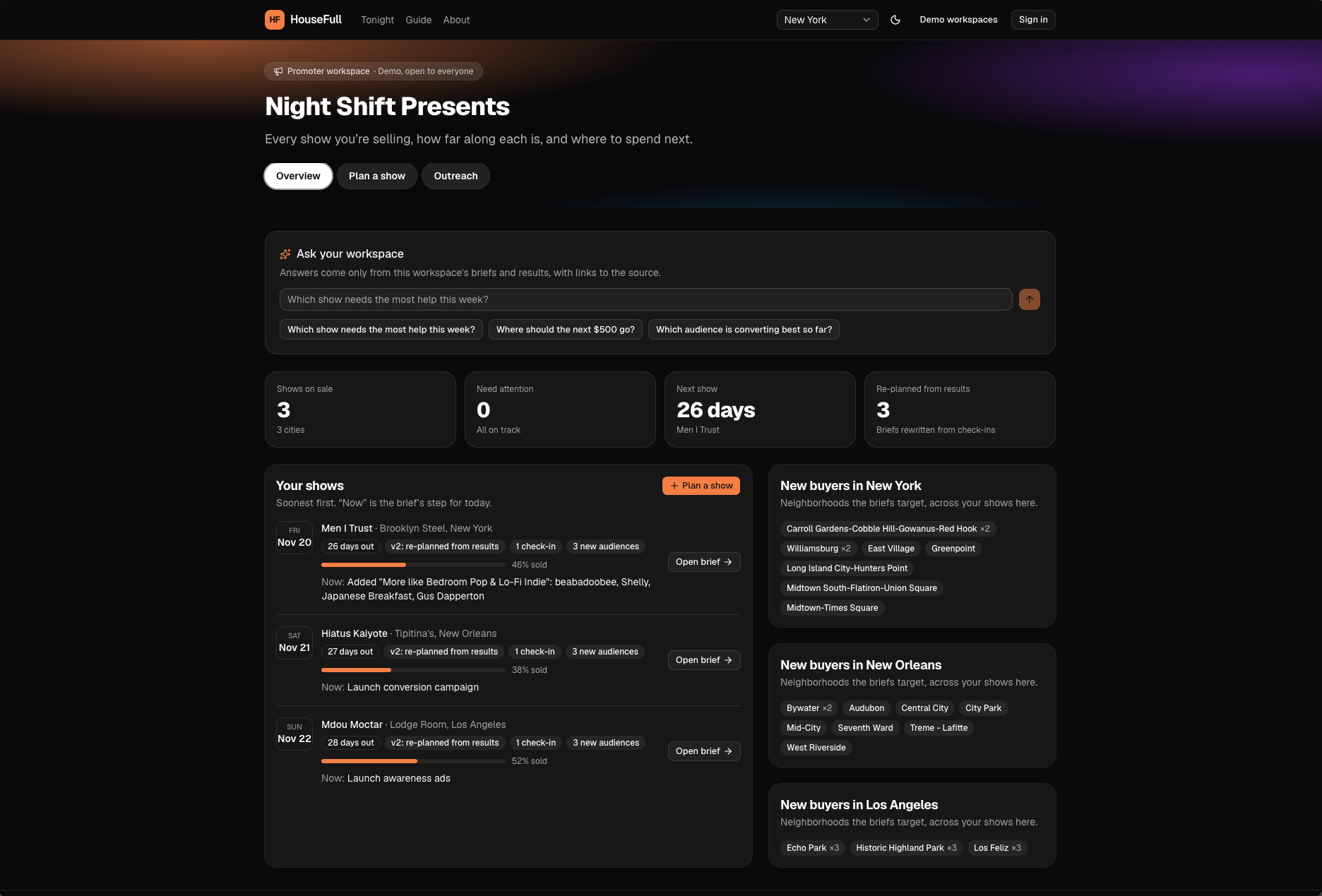
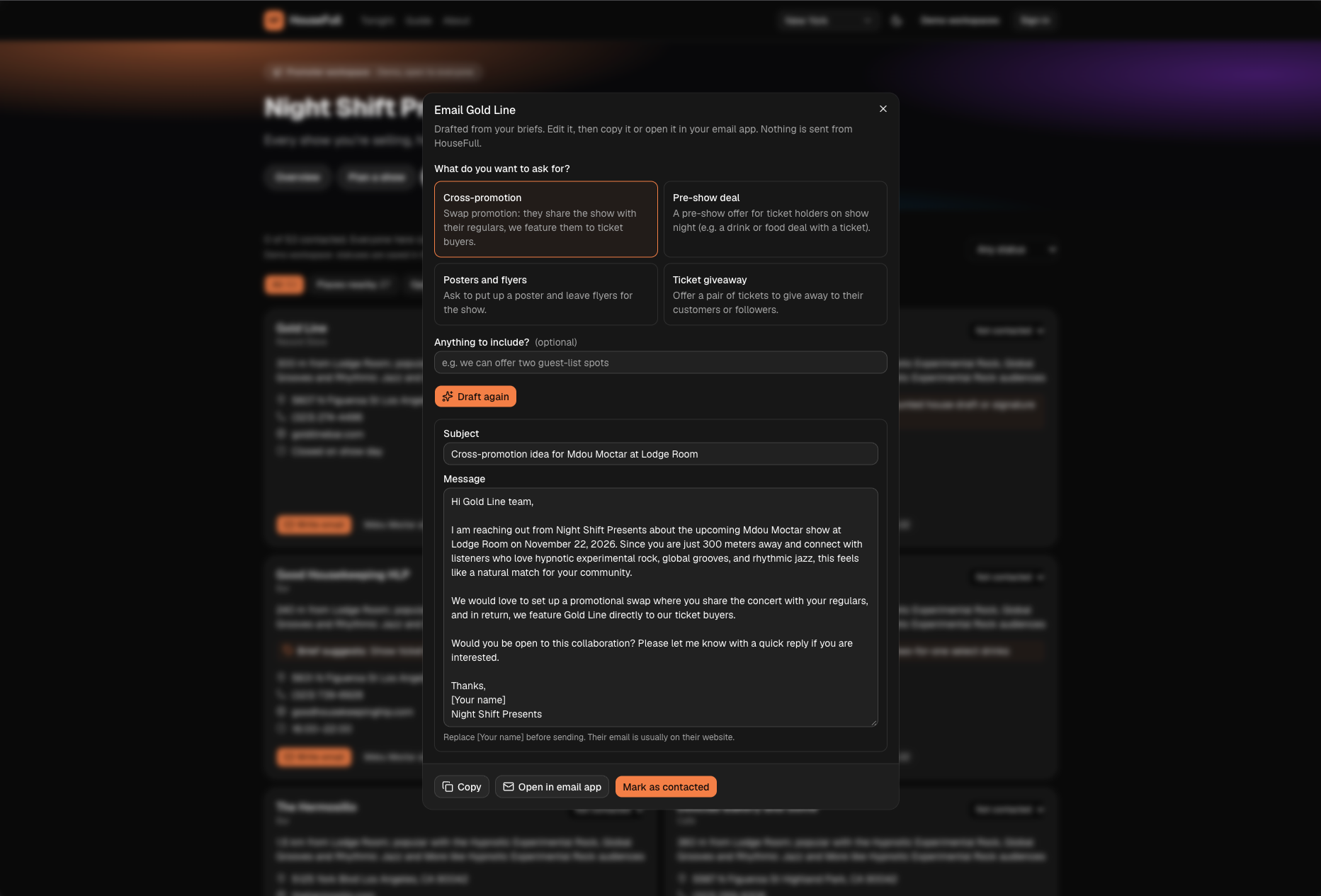
Each team gets its own workspace. Promoters see every show and which ones need attention, venues see their on-sale calendar, who the room draws and local partners, and artist teams compare new fans city by city. Every workspace has Ask, which answers questions using only that workspace's briefs, and Outreach, which lists contact details for the places, acts and podcasts in those briefs and drafts an email to each.
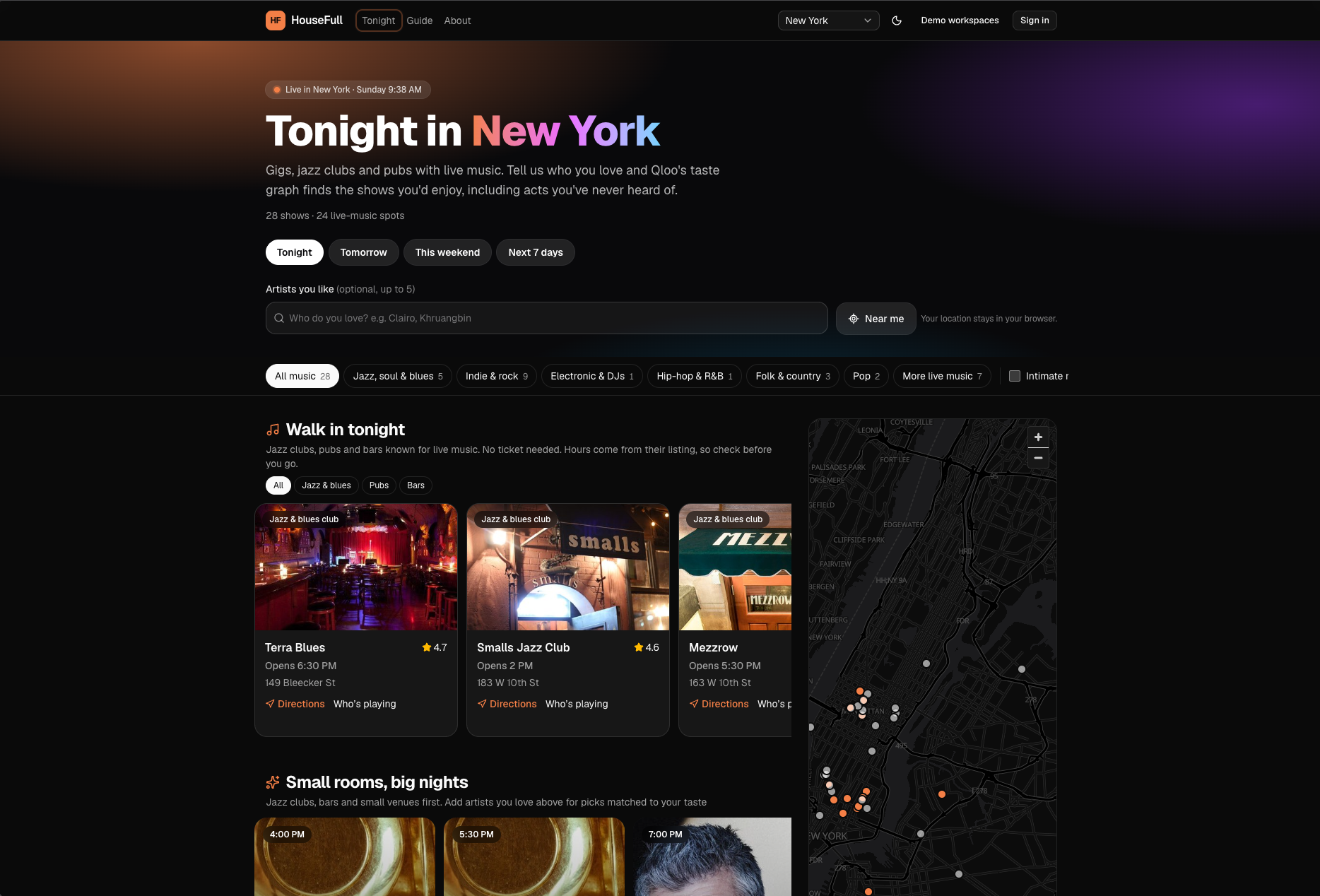
For fans there's Tonight, a gig guide with tonight's shows and the jazz clubs and bars with live music that are open now, ranked by the artists you like. Rate the shows you went to and the picks get better.
How we built it
Qloo makes the decisions in HouseFull. Gemini names things, writes copy and reviews it, but it doesn't choose audiences or places. A run has six steps:
- Resolve and profile.
/searchfinds the artist, and/v2/insightswithurn:tagdescribes the core fans' taste. - Find the next ring. Insights returns artists close in taste, which we cluster into three audiences. Gemini only names them.
- Locate them. We pull a Qloo heatmap for each audience on geohash-6 cells. Raw heatmap affinity mostly tracks how busy an area is, so we divide it by a city-wide nightlife baseline. For each cell, with P the percentile rank over the cells both heatmaps share:
lift = (P_audience + 0.05) / (P_baseline + 0.05)
We snap cells to neighborhoods by area, weight them by P_baseline × share, and join travel times from a GTFS transit graph (drive times in LA).
- Channels, partners and openers. Insights gives podcasts, TV, brands and places near the venue. For openers we cap popularity and use Qloo's explainability, so the acts we suggest bring fans the headliner doesn't already have.
- Write and check. Gemini Pro writes the copy. A deterministic critic then checks that every claim cites a Qloo call from this run, that every number appears in the facts, and that nothing mentions age, gender, ethnicity, religion or sexuality. One model review follows. If the critique fails, the copy gets one rewrite, and a failed critique never fails the run.
- Stream and replay. Each run executes inside the request that streams it over SSE and writes an ordered event log to Postgres, so any instance can replay it.
The code is a pnpm and Turborepo monorepo. The web app uses Next.js 16, React 19, Tailwind 4 and MapLibre and runs on Vercel. The NestJS 12 API runs on Google Cloud Run, with Gemini on Vertex AI. Data lives in Postgres 17 with PostGIS and pgRouting on Supabase, including a 1.27-million-edge OpenStreetMap walking graph of NYC. Workspaces are Clerk organizations. We also use Ticketmaster, MTA and NYC Open Data, and an MCP server lets AI assistants use the same tools.
Challenges we ran into
- Our first heatmaps were really population maps. In our probe, raw heatmap affinity correlated with plain popularity at r ≈ 0.99. Dividing by a baseline brought that down to r ≈ 0.07, which left us with taste. Artist recommendations had the same bias, so Tonight scores acts as
affinity − 0.5 × popularity(both scaled). That lets a club act close to your taste beat a stadium act that's only loosely compatible. - Parts of the hackathon API behaved differently from what we expected. Locality boundaries returned errors, so we moved everything to geohash cells, and we checked which parameters each endpoint accepts before building on them.
- The critic was too strict at first. It flagged artist names like TV Girl and Men I Trust as mentions of traits until we masked known names, and it treated advice like "shift 30% of budget" as an unsourced number until we made it count as advice.
- Early runs took about three minutes because of the model's default thinking. Capping it brought a fresh plan down to about a minute, and finished demo runs replay instantly.
- Real-world data was messy. MTA alerts name lines rather than stops, so we only show live delays that affect a whole line. Qloo's opening hours are sometimes wrong, so the page tells people to check. Ticketmaster's music category includes musicals and drag brunches, which we filter out.
- Production had two surprises. Deleting a workspace in the middle of a run crashed the API through an unhandled database error, which is now caught and covered by a test. And Supabase exposes every table through its REST API by default, so we turned on row-level security and revoked that access.
Accomplishments that we're proud of
- Every reason in a brief links to the Qloo call behind it, and a "With and without Qloo" view shows what the taste data adds.
- The loop closes. You plan, run the campaign, enter results and re-plan, and after the show the survey attributes attendees to audiences by taste, with no tracking.
- The same engine runs dashboards for promoters, venues and artist teams and a gig guide for fans.
- Audiences are defined by taste and never by traits. Safety data is shown to promoters as context and never used to rank people, and a fan's location stays in their browser.
- It's live on Vercel, Cloud Run and Supabase, with unit and integration tests and an end-to-end suite that covers every flow, including sign-in.
What we learned
- Taste data got much more useful once we removed popularity from it. Before that, every map was a population map and every recommendation list was a list of hits.
- Keeping Gemini to naming, copy and review made the output checkable, and we trust it more because of that.
- What small teams wanted most was the next thing to do: today's countdown step, a drafted email, a QR code for the screens at the venue.
- A plan that learns from ticket sales and from how the night went is worth more than a perfect first plan.
What's next for HouseFull
- Sync with ticketing and ad platforms, so results come in automatically instead of by CSV.
- More cities, and a season planner for venues that suggests dates and acts that suit the room.
- Let fans connect Spotify or Apple Music on Tonight, so they get picks without typing in artists.
- Share budgets and caches across instances, and use organization webhooks to clean up when a workspace is deleted.
- Track partner offers with nearby bars and record stores, so venues and promoters can see which partnerships sell tickets.
Built With
- clerk
- drizzle-orm
- gemini
- google-cloud-build
- google-cloud-run
- maplibre
- model-context-protocol
- nestjs
- next.js
- node.js
- openstreetmap
- pgrouting
- playwright
- postgis
- postgresql
- qloo
- react
- shadcn-ui
- supabase
- tailwindcss
- ticketmaster-api
- typescript
- vercel
- vertex-ai
