
The Inspiration behind Homely
We got talking with the team from Mold Busters, and we realized most homeowners (us very much included) have no idea what a substrate is, so when a wall degrades due to mold, they can't describe it well enough to get a real quote.
On the other side, professionals end up spending a whole site visit just to find out what the job is. We believe that communication between both sides should be easier, and wanted to help both sides at once- for every trade, not just mold.
What does Homely do?
Homely, like a circle, has two halves.
Homeowners use the phone app, where they can type the problem they have with their homes, say it out loud, or just show it with the camera. Claude works out which trade it belongs to and asks "Is this right?", with two other guesses and a "Not quite" button in case it got it wrong. Then it walks the client through a guided scan one photo at a time, analyzing each shot and asking for a retake if it's blurry, too dark, or of the wrong thing.
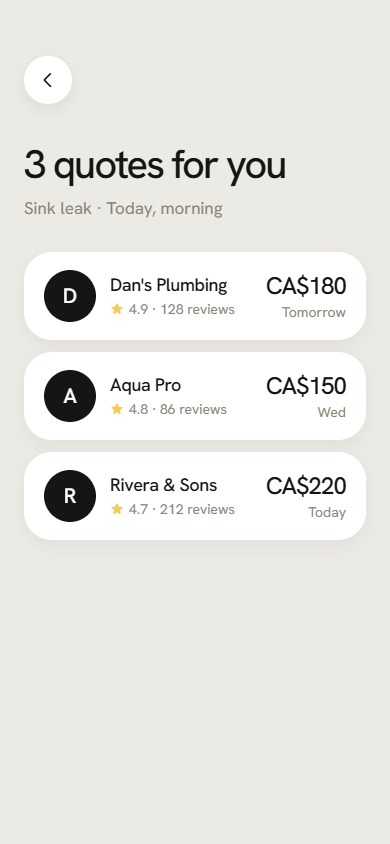
After a few plain-language questions (you'll get asked about "the pipes under the sink", never "the shut-off valve"), it writes a job spec with severity, hours needed to fix, parts and a price range in CA$. The request then goes out to every matching professional nearby, offers automatically come back, and then the homeowner books one, kind of like ordering an Uber.
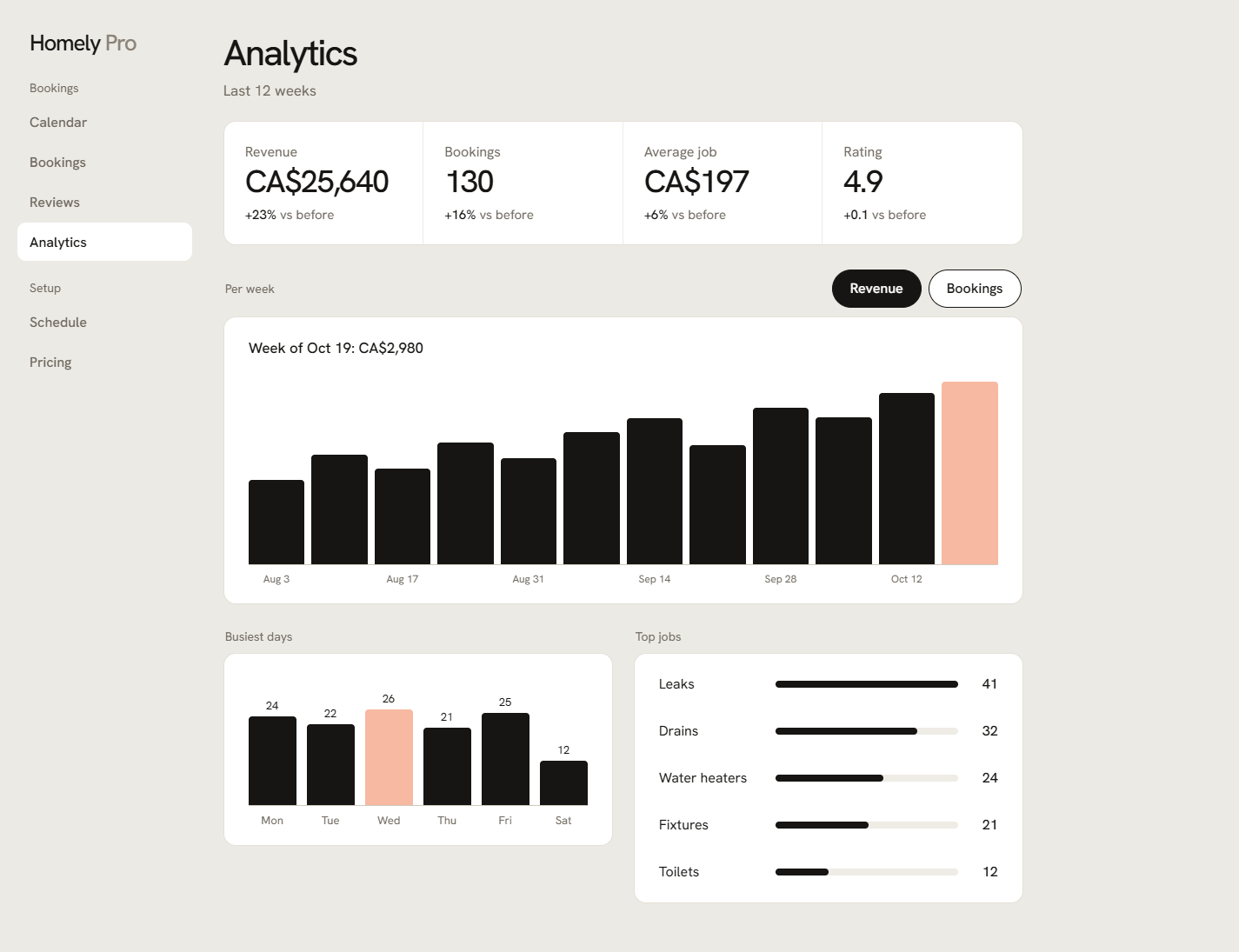
Professionals, or Pros, get Homely Pro, a dashboard where every homeowner request shows up as a complete, photo-backed spec. Pros can ask for more info, which sends the homeowner a notification to rescan only the part the pro needs. On the website version of Homely Pro, the Pro can view their upcoming schedule as well as the analytics.
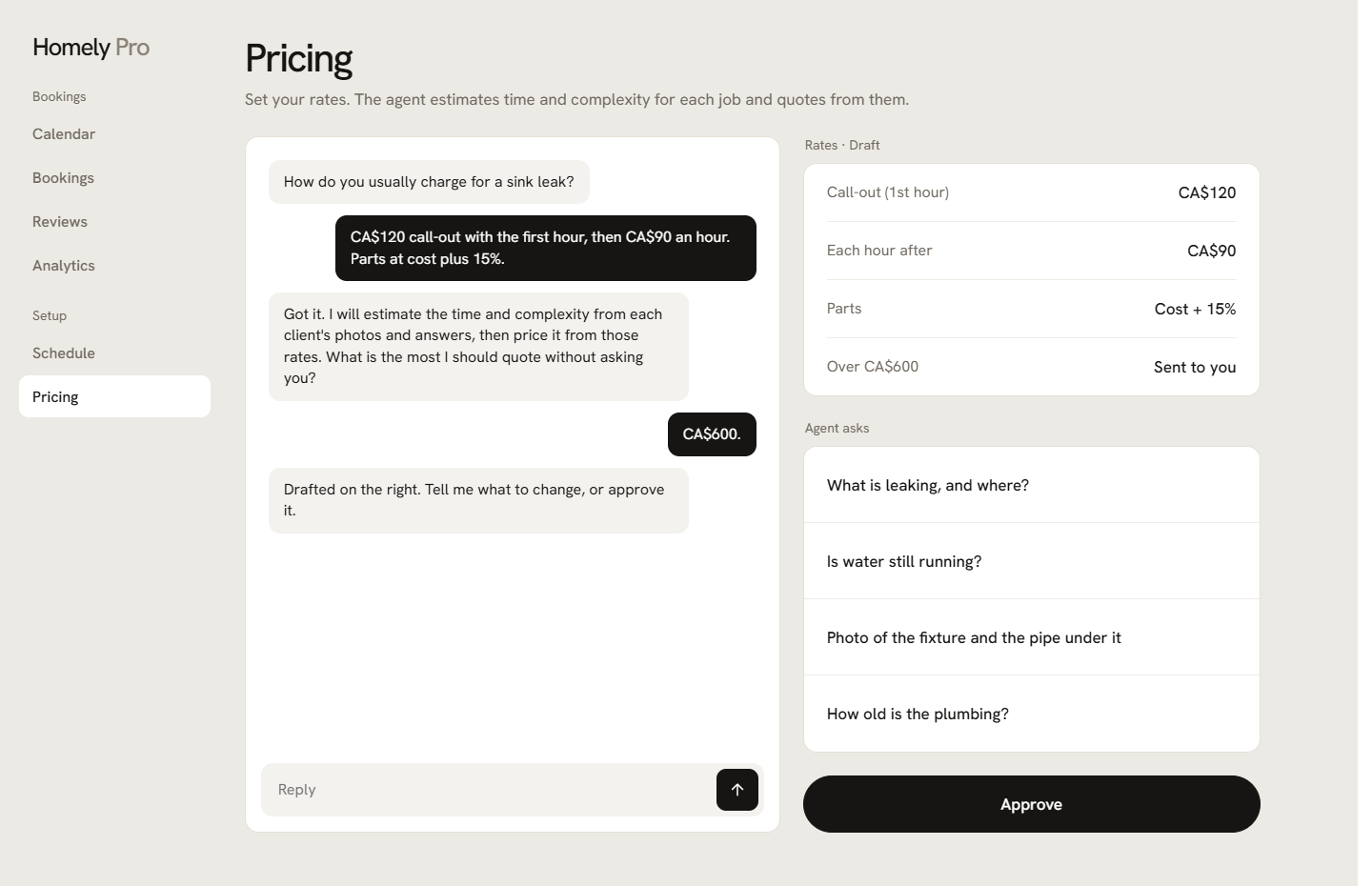
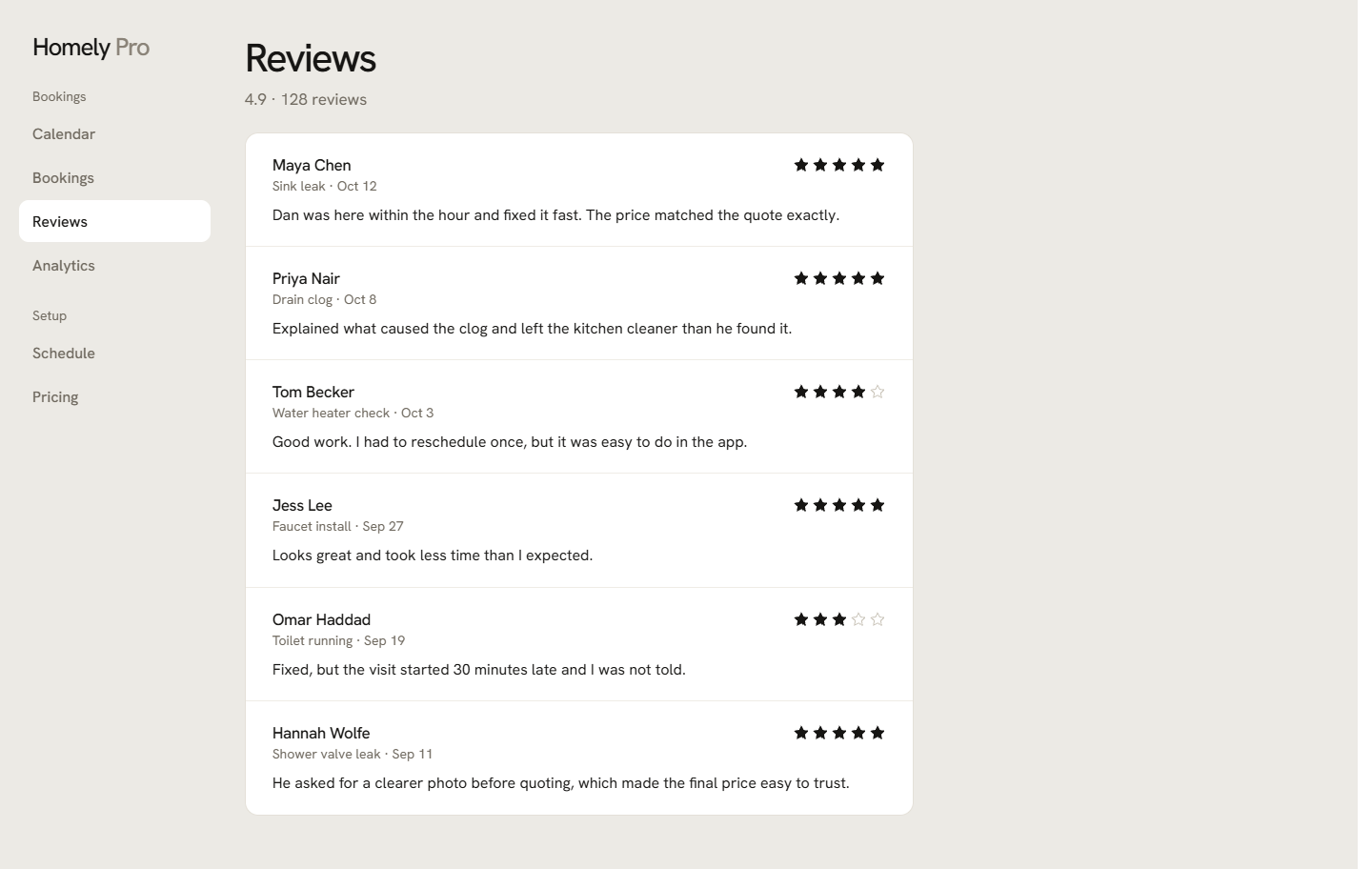
Pros also tell a pricing agent how they charge in plain language (something like "CA$120 call-out with the first hour, then CA$90 an hour, parts plus 15%"), approve the rate card it drafts, and from then on it sends offers for them automatically on anything under the limit they set. The dashboard also covers their calendar, bookings, reviews and analytics.
How Homely was built
The homeowner app is built with Expo and React Native and runs on the phone, while Homely Pro lives at /pro on a Next.js 15 server. Data is stored in SQLite with Drizzle ORM.
The brains are nine Claude agents covering intake, photo checks, questions, specs, matching, estimates, pricing chat, a Pro profile interview, and reading a Pro's website. Every agent uses structured outputs through zod schemas, so answers come back typed and validated instead of as a paragraph we have to hope is formatted correctly.
Voice goes through OpenAI's gpt-4o-mini-transcribe, address type-ahead and geocoding come from OpenStreetMap's Photon and Nominatim (no API keys needed!), and pros can connect Google Calendar so booked jobs land on their schedule. Each trade is defined by a JSON template that sets its photos, questions and rules, and we have eight so far: mold, plumbing, electrical, handyman, roofing, painting, garden and appliances.
Challenges we ran into
The hardest part was getting started. Ideation took some time, and once we landed on an idea, we had to figure out how to divide the work so everyone could build in parallel without stepping on each other's code.
Once that was sorted, it was smooth sailing from there. The challenge that kept lingering around was the user flows. A homeowner who doesn't know the name of anything under their sink and a pro who wants the full picture before driving out need very different things, so we kept iterating on both flows until each side got the best experience we could give them.
Accomplishments that we're proud of
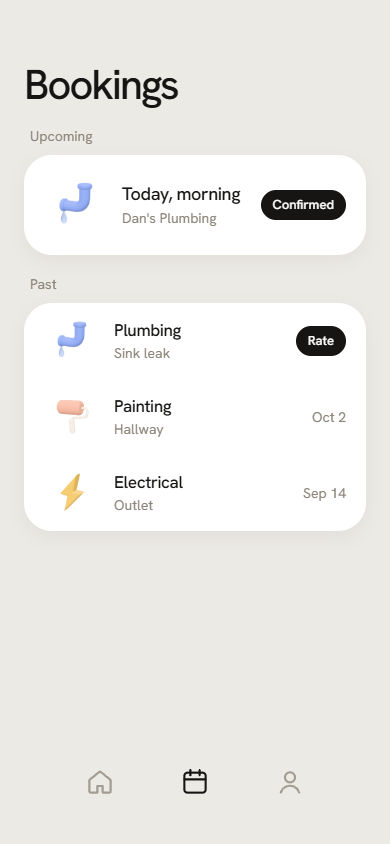
The full loop works like a charm! A homeowner can describe a leak on their phone, get guided through photos and questions, receive offers, book a pro, follow the job from "on my way" to "done", and leave a rating, while the pro handles their side from a laptop. We also wrote an end-to-end test suite with 212 checks across every API flow, covering everything from the happy path to "Ask for more", human handoff, and what happens when no pro is in range.
What we learned
Our biggest lesson was about UI. When something goes wrong at home, like your AC breaking in the middle of summer, it's stressful, and the last thing you want is an app that makes it more confusing.
We realized that stress is really what Homely needs to solve for, so we approached it with simplicity. We kept cutting screens and steps until each one asked the homeowner for one thing at a time, whether that's a single photo, a quick "Is this right?", or a question in plain words.
The goal was for clients to have some peace of mind while they're navigating a difficult moment, and designing around how someone feels when their house is falling apart (sometimes literally) changed a lot of our decisions. On the teamwork side, splitting the work early into the phone app, the pro dashboard and the agents is what let us move fast for the rest of the weekend.
What's next for Homely
We want to get Homely in front of real pros, starting with the Mold Busters team. From there, we'd like to add more trades (which is just a new JSON template each time).
We'd also want to create a Terms and Conditions before official launching for client protection, contractor protection, and just to make sure everything is fair and safe for the two halves of Homely.
Built With
- anthropic-sdk
- better-sqlite3
- claude
- drizzle-orm
- expo-router
- expo.io
- google-calendar-api
- gpt-4o-mini-transcribe
- iron-session
- next.js
- node.js
- nominatim
- openai
- openstreetmap
- photon
- react
- react-native
- react-native-reanimated
- sqlite
- swr
- typescript
- zod


Log in or sign up for Devpost to join the conversation.