-
-
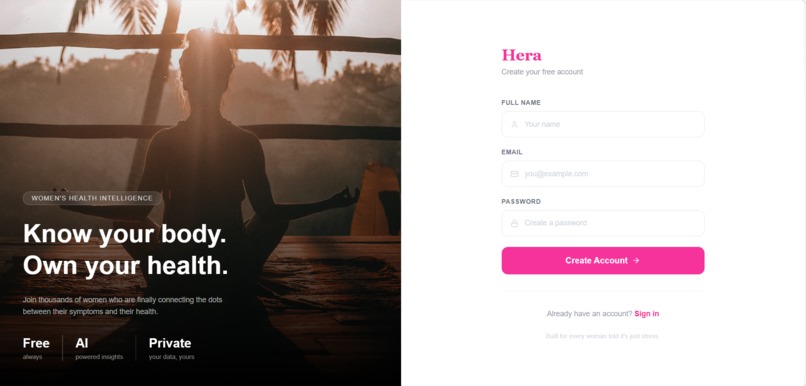
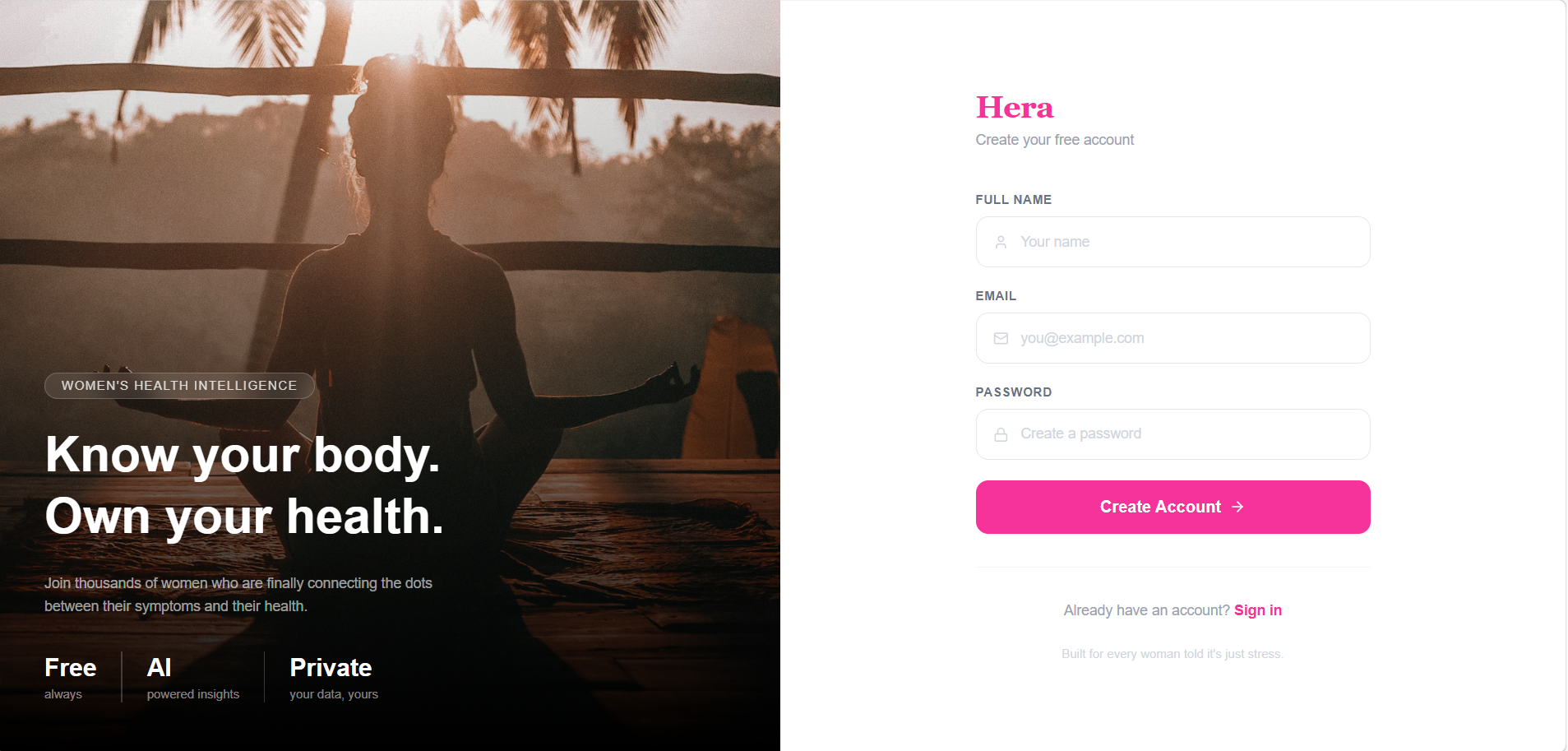
Clean, minimal signup with a full-bleed Unsplash background. Designed to feel like a product people trust with their health data.
-
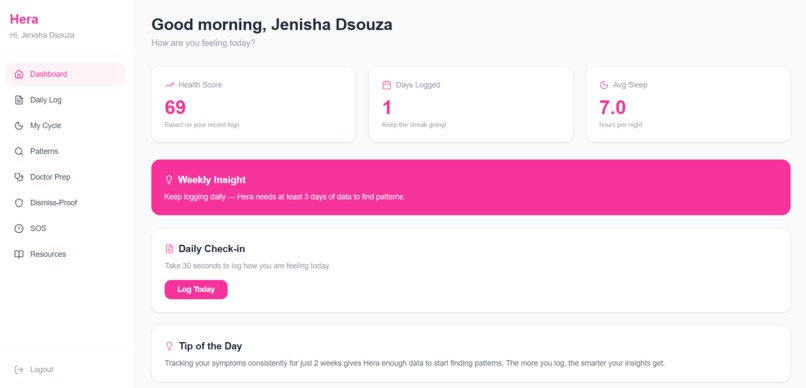
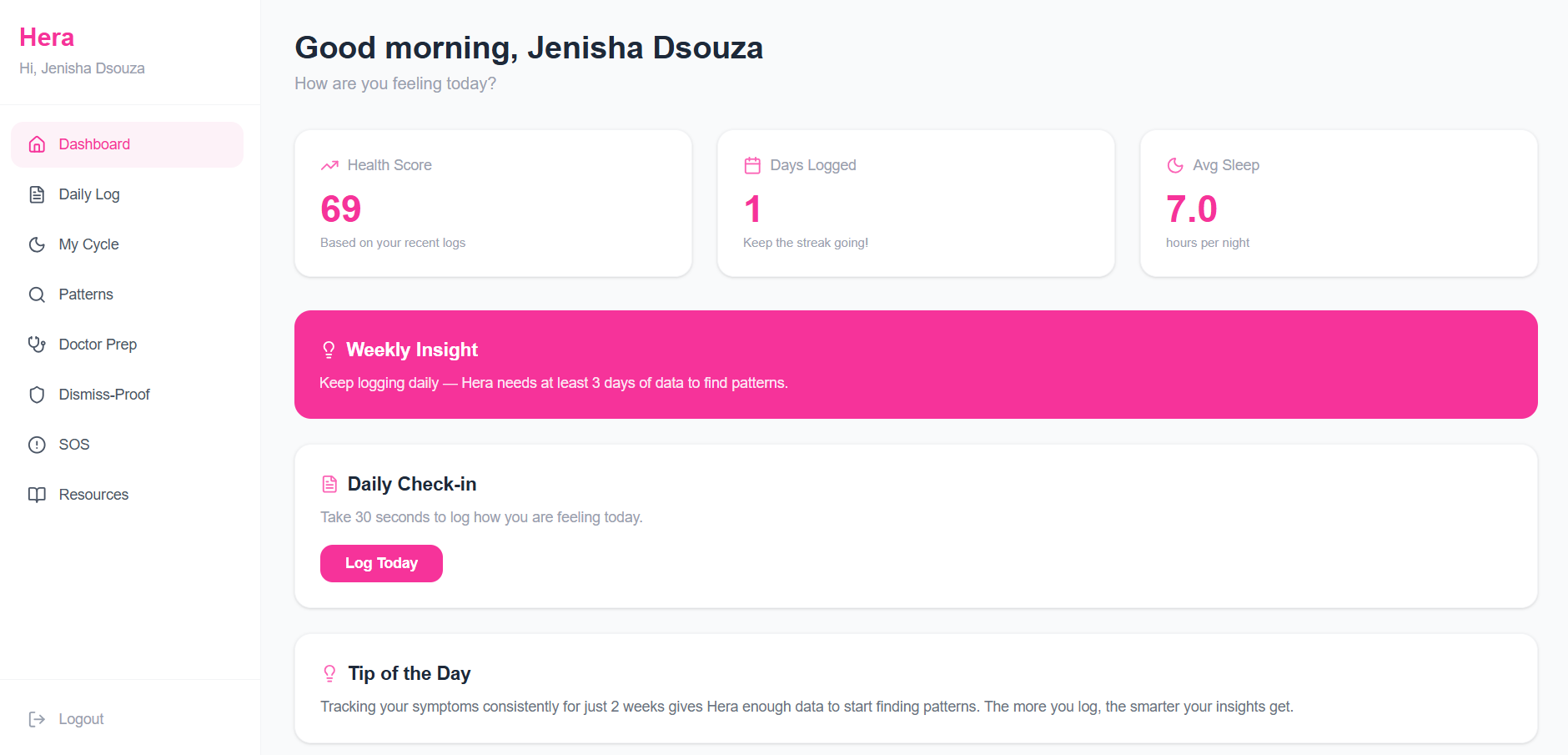
The main dashboard showing real-time health score, days logged, average sleep, AI-generated weekly insight, and risk flags.
-
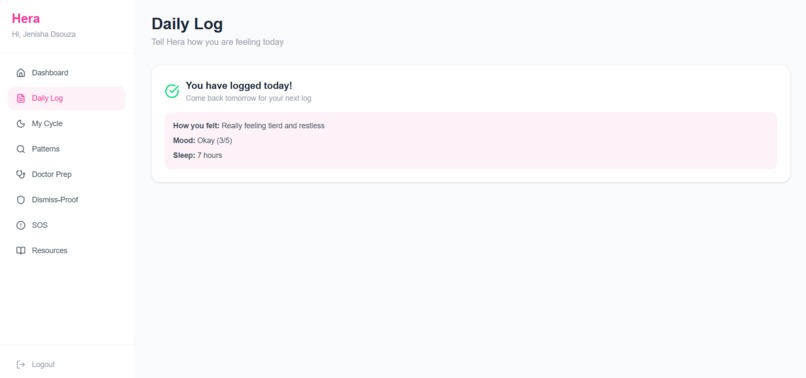
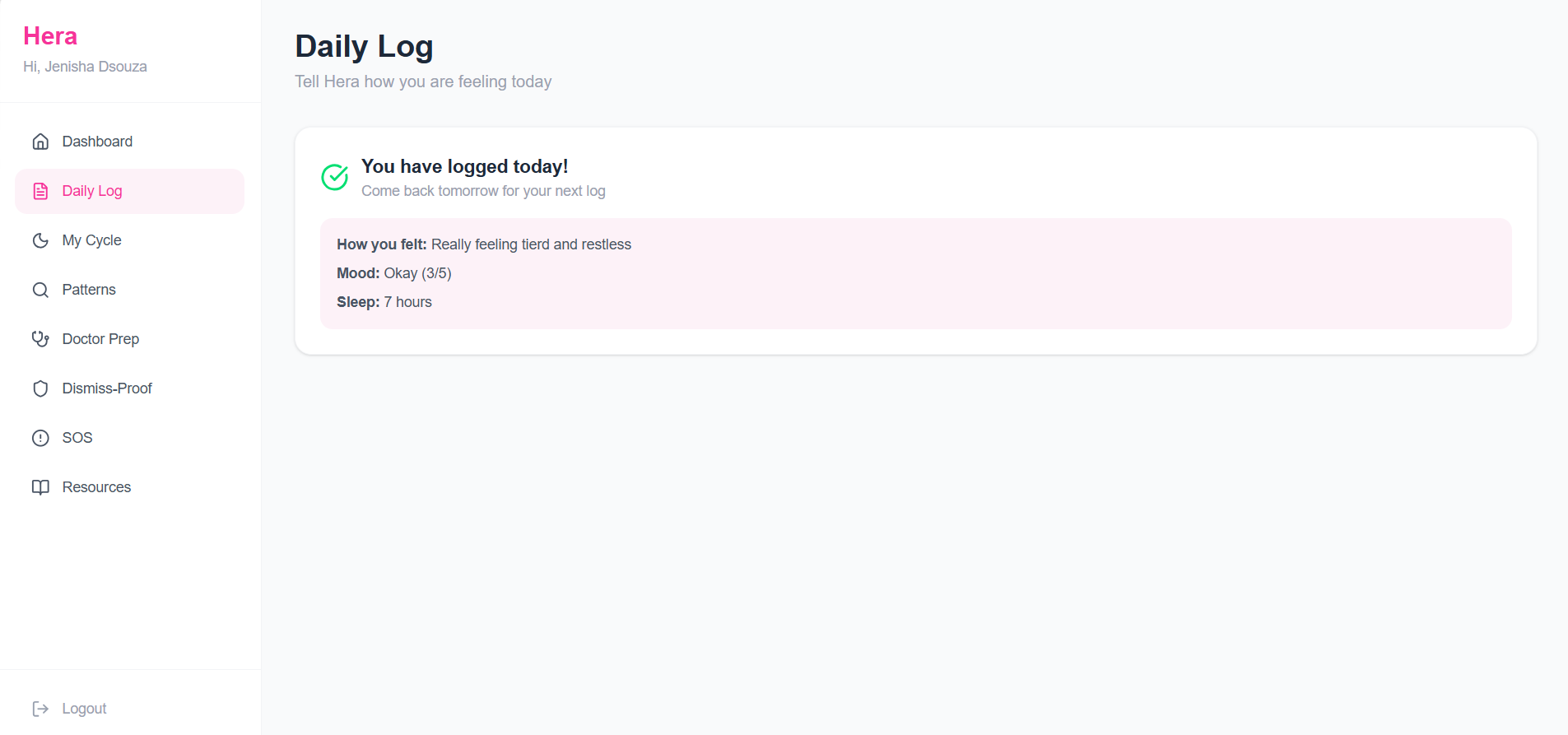
The daily log page - users type naturally and Groq's LLaMA 3.1 NLP engine automatically extracts structured, severity-rated symptoms .
-
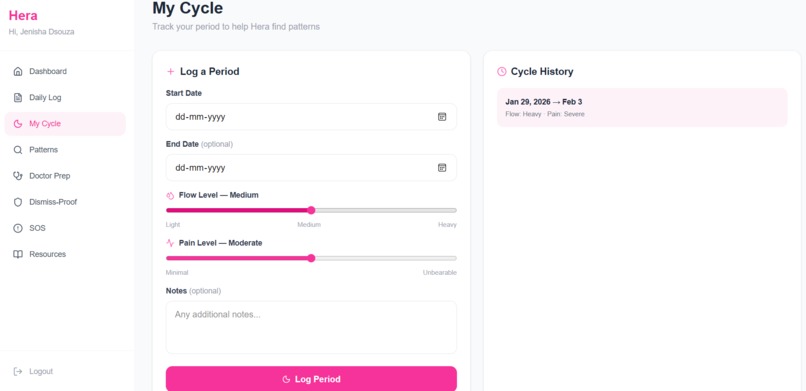
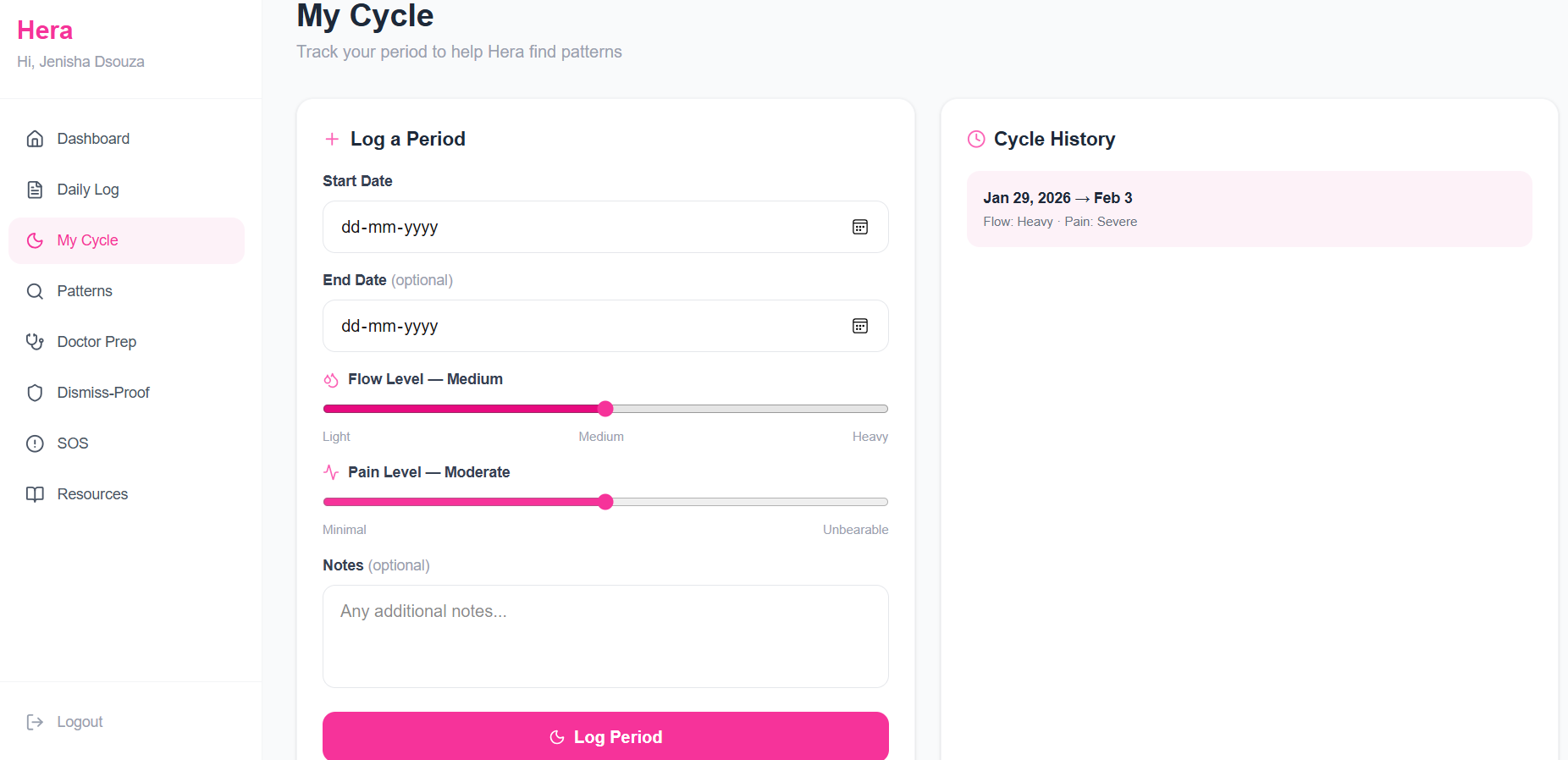
Period logging with flow level, pain level, start and end dates. Every entry feeds the ML pattern engine.
-
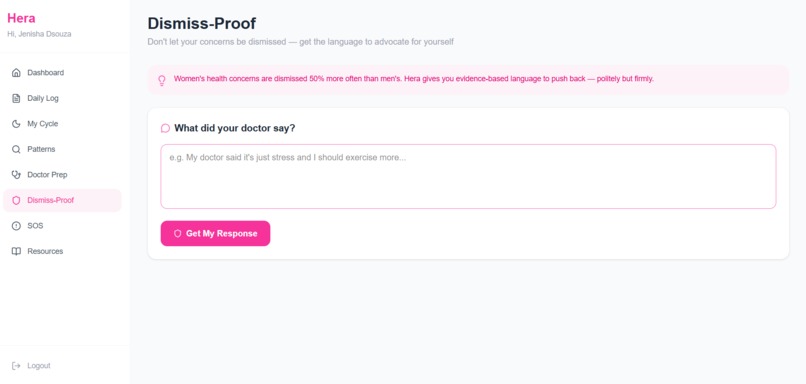
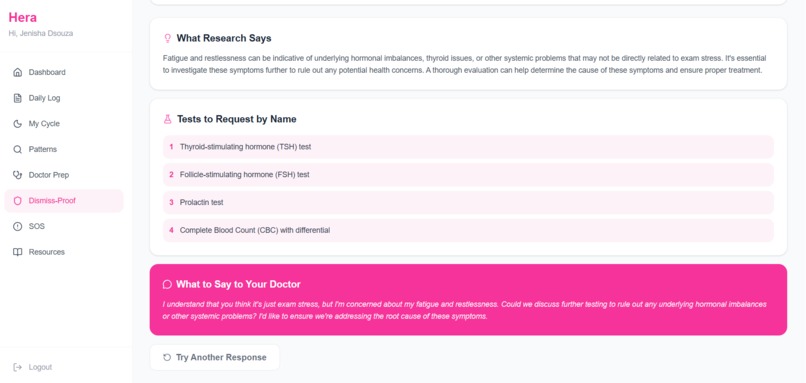
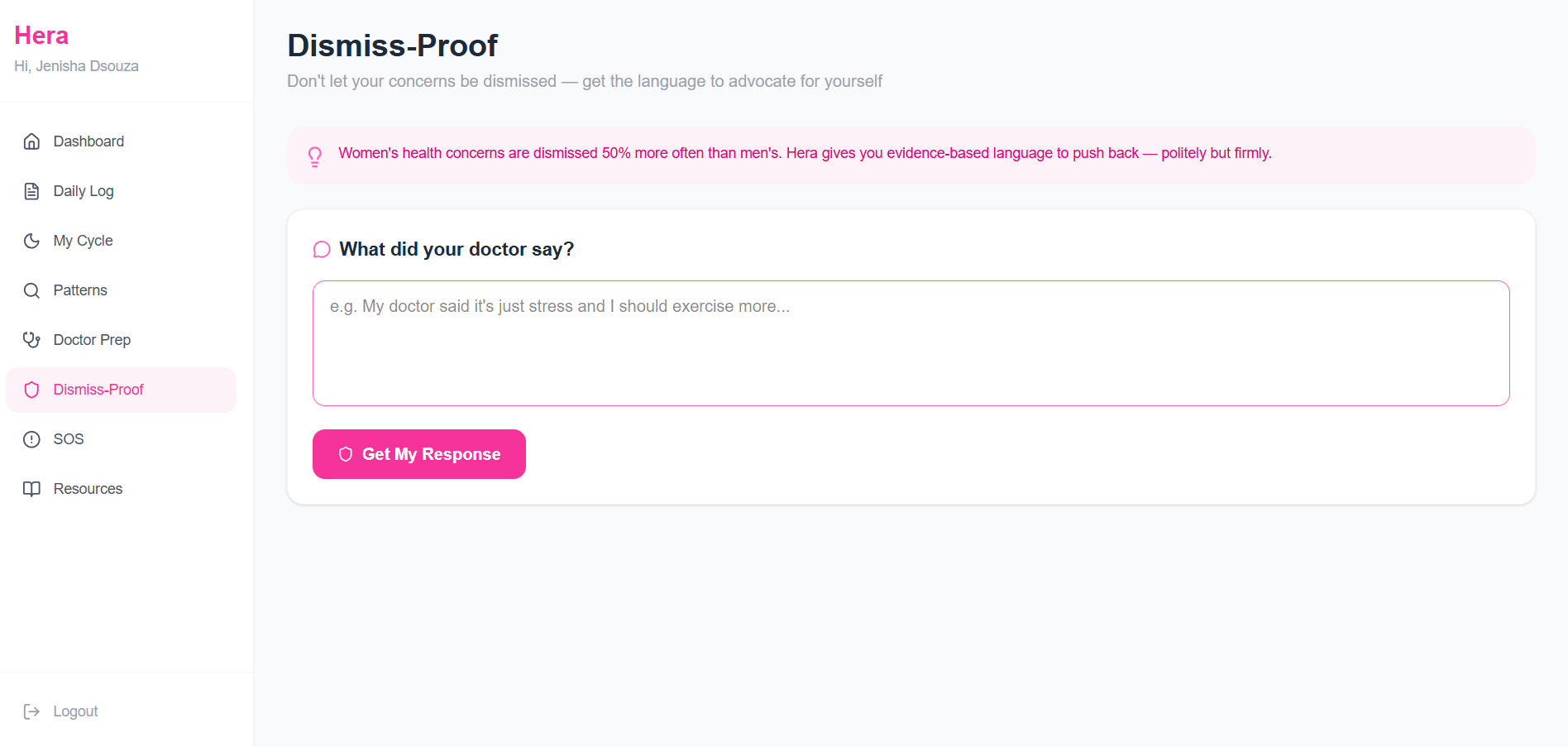
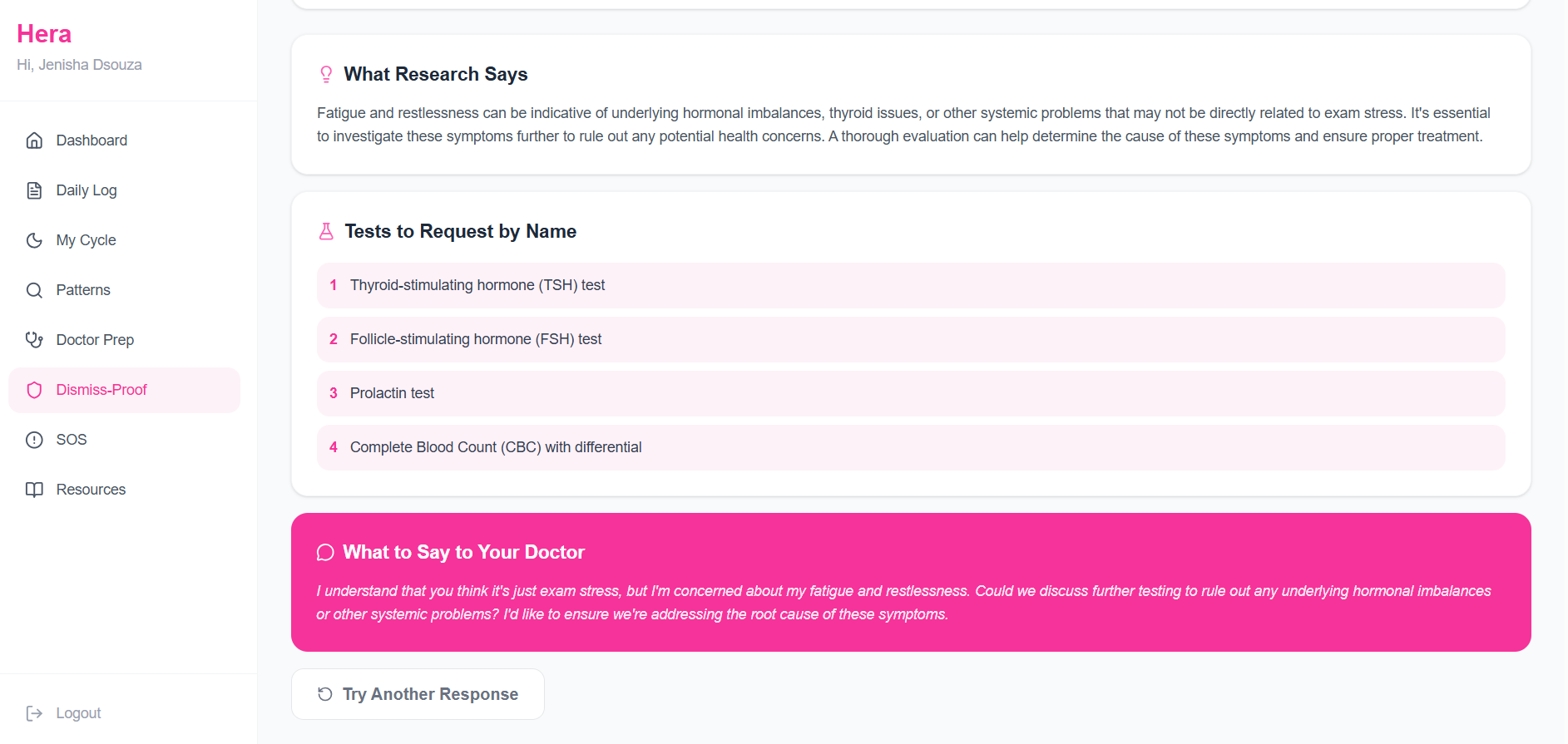
Dismiss-Proof- the user inputs what their doctor said and Hera returns evidence based research and an advocacy script.
-
AI-generated doctor prep sheet showing patient summary, health highlights, and tailored questions — ready to download as a PDF.
-
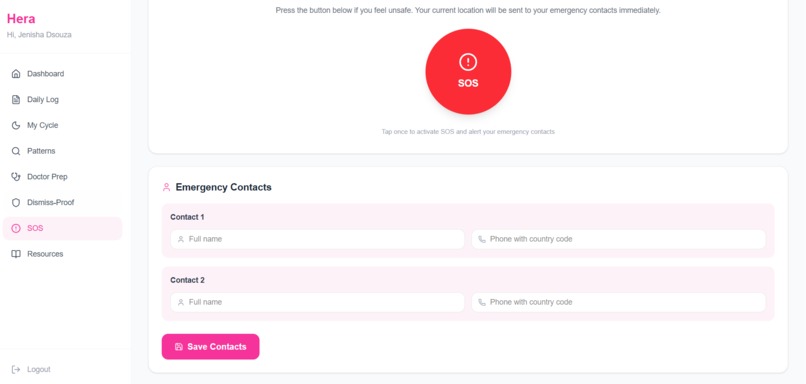
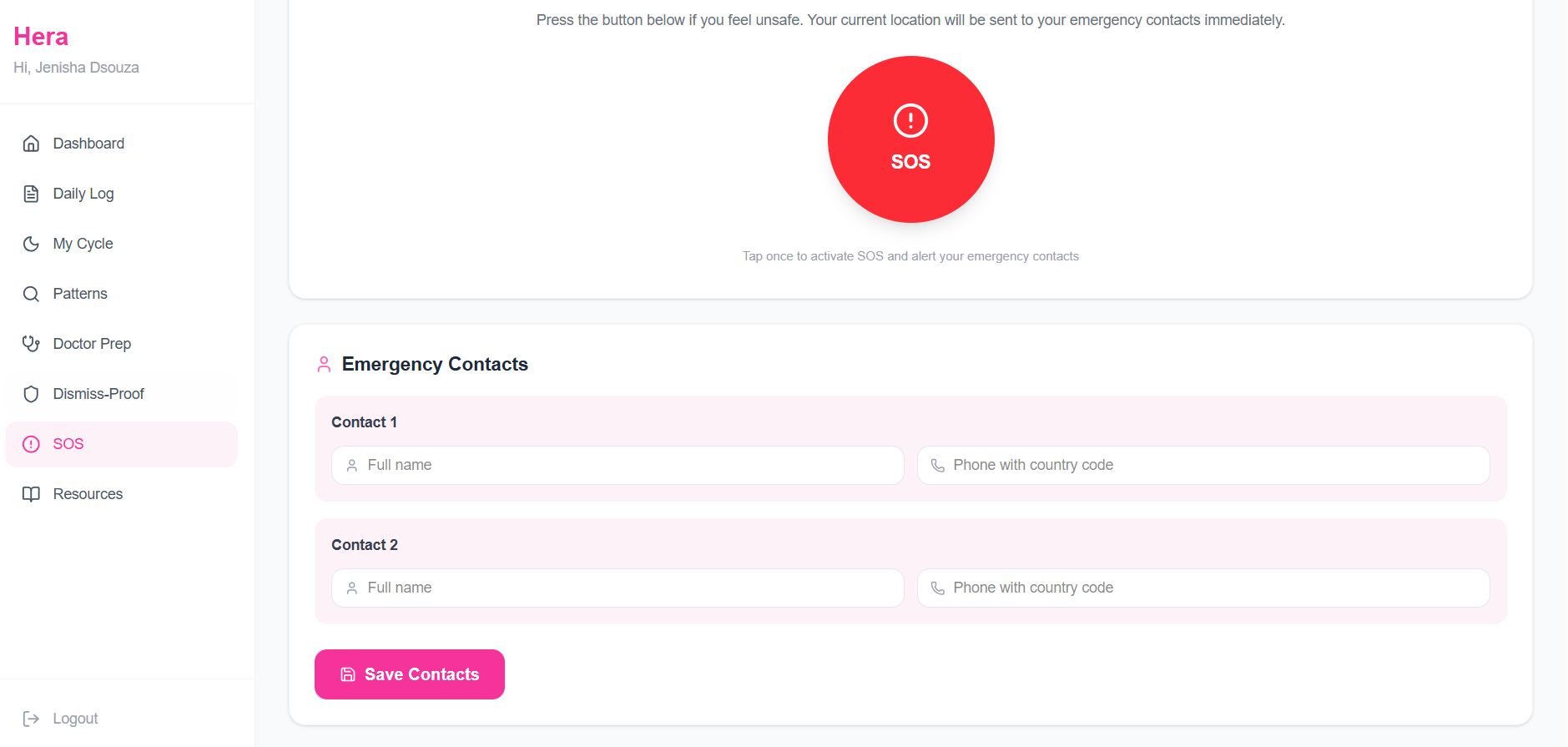
The SOS safety feature — one tap detects location and opens WhatsApp with a pre-filled emergency alert to saved contacts.
-
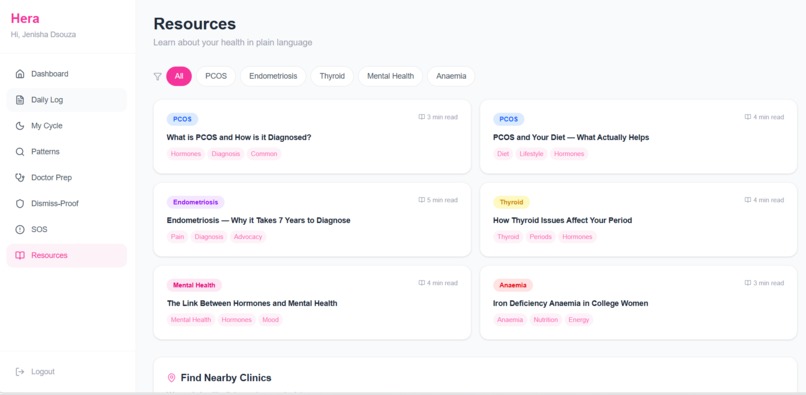
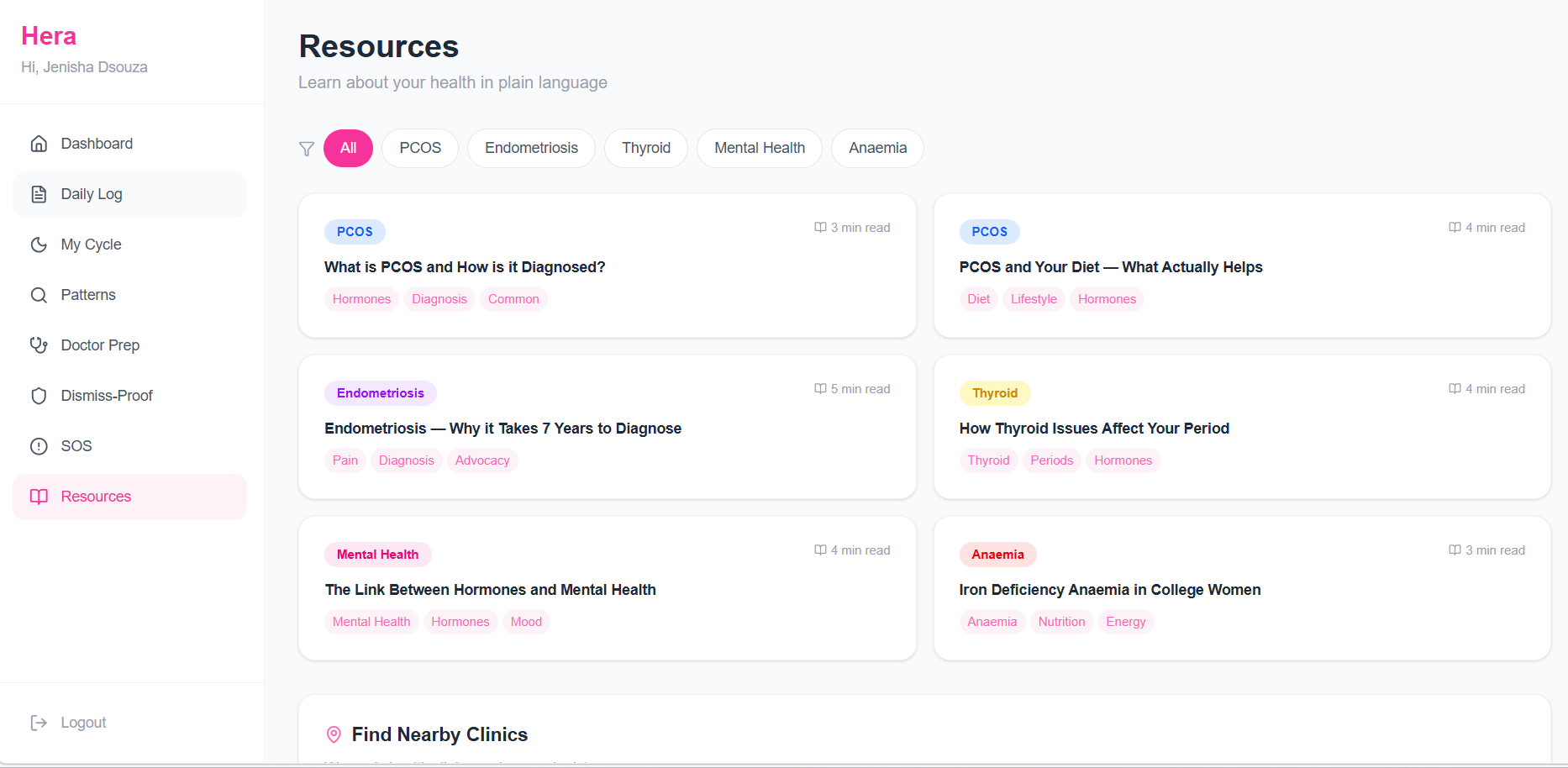
The Resources page with condition guides filtered by category and an OpenStreetMap embed showing nearby clinics.
-
additional feature
Hera: Women's Health Intelligence Platform
Inspiration
Women's health has been systemically underfunded, understudied, and dismissed for decades. The numbers are staggering:
$$\text{Average endometriosis diagnosis time} = 7\text{-}10 \text{ years}$$
$$\text{Women's pain dismissed } 50\% \text{ more often than men's}$$
$$1 \text{ in } 10 \text{ women have PCOS, most undiagnosed}$$
The inspiration for Hera came from a personal place. Someone close to me spent three years visiting doctors with fatigue, bloating, irregular periods, and skin breakouts, and was sent home every single time with the same verdict: "It's probably just stress."
She had no data to present. She had no language to push back. She had no way to prove that what she was experiencing was real, consistent, and worth investigating.
Hera was built for her. And for every woman like her.
What It Does
Hera is a women's health intelligence platform that sits between a woman and her healthcare system, giving her the data, the language, and the confidence to be taken seriously.
AI Powered Symptom Parsing
Every daily log entry is processed through a large language model. When a user types "really tired today, stomach feels off and I have bad cramps", Hera's NLP engine automatically extracts structured, severity rated symptom tags in the background. The user never fills out a form. She just speaks naturally.
ML Pattern Detection
A dedicated Python Flask microservice runs Jaccard similarity analysis on symptom co-occurrences and Pearson correlation on mood and sleep data across rolling 30-day windows:
$$J(A, B) = \frac{|A \cap B|}{|A \cup B|}$$
$$r = \frac{\sum_{i=1}^{n}(x_i - \bar{x})(y_i - \bar{y})} {\sqrt{\sum_{i=1}^{n}(x_i-\bar{x})^2 \cdot \sum_{i=1}^{n}(y_i-\bar{y})^2}}$$
The result is a Pattern Board that surfaces insights like "fatigue and bloating appear together 75% of the time before your period", correlations a user would never notice manually.
Risk Flagging
The ML service cross-references symptom clusters against known clinical profiles for PCOS, endometriosis, thyroid disorders, and anaemia. When a pattern matches, Hera raises a confidence rated health flag and suggests next steps, without diagnosing.
Doctor Prep Sheet
Before any appointment, Hera's AI reads the user's last 28 days of logs, cycle history, and risk flags, and generates a professional patient summary, key health highlights, and five tailored questions to ask the doctor. The sheet downloads as a PDF the user can hand directly to her physician.
Dismiss-Proof Mode
If a doctor dismisses the user's concerns, she types what was said. Hera responds with evidence based research, specific test names to request by name, and a polite but firm script to advocate for herself in the room.
Cycle Tracker and SOS Safety
Period logging feeds the pattern engine with flow and pain data. A one-tap SOS button detects the user's location and opens WhatsApp with a pre-filled emergency alert to saved contacts.
How We Built It
Hera is a multi-service architecture with three independent layers that communicate over HTTP.
Frontend
// Groq NLP parsing — natural language to structured symptoms
const parsedSymptoms = await parseSymptoms(rawInput);
// "really tired, bloated" becomes:
// [{ tag: "fatigue", severity: "moderate" },
//  { tag: "bloating", severity: "mild" }]
Built in Next.js with Tailwind CSS, deployed on Vercel. The interface uses Recharts for data visualization and jsPDF for downloadable doctor prep sheets.
Backend
A Node.js and Express REST API deployed on Render, connected to MongoDB Atlas via Mongoose. Handles authentication, user data, daily logs, cycle history, and coordinates between the AI and ML services.
AI Layer
Powered by the Groq API running LLaMA 3.1. Three distinct AI functions:
// Three AI functions, each with a specific job
exports.parseSymptoms()       // NLP: text to structured data
exports.generateDoctorPrep()  // generates patient summary + questions
exports.generateDismissProof() // evidence + advocacy script
ML Layer
A separate Python Flask microservice implementing:
# Jaccard similarity for symptom co-occurrence
overlap = len(days_a & days_b)
total = len(days_a | days_b)
strength = round(overlap / total, 2)

# Pearson correlation for mood vs sleep
correlation = np.corrcoef(mood_arr, sleep_arr)[0, 1]
Challenges We Ran Into
The AI Provider Pivot
We originally built the entire NLP layer on the Gemini API. After exhausting the free tier quota across multiple API keys and two days of debugging 429 errors, we made the decision to pivot to Groq. The migration took two hours and ultimately produced faster, more reliable results. The forced pivot led to the better solution.
Prompt Engineering for Empathy
Getting the AI to return responses that feel like a trusted friend rather than a medical textbook required significant iteration. The difference between a cold clinical summary and a warm, empowering response is entirely in the prompt. Tone instructions, example outputs, and temperature tuning all played a role.
Schema Alignment with AI Output
The first time we wired the Doctor Prep generation, Groq returned a perfectly
valid JSON object, but our Mongoose schema expected a string array for
highlights instead of an object array. A CastError at 11pm taught us to
always design the schema around the AI output shape, not the other way around.
Deployment Networking
Our development environment used a local MongoDB instance. Migrating to MongoDB Atlas revealed network restrictions on our local connection that did not exist on Render's servers, a good reminder that cloud infrastructure behaves differently from localhost.
Accomplishments That We Are Proud Of
We are most proud of the fact that the AI features are genuinely useful, not decorative. Every AI call in Hera has a specific, measurable job. The NLP parser converts natural language into structured data that feeds the ML engine. The ML engine finds real correlations from real user data. The doctor prep generator produces content specific enough to hand to an actual physician.
We are proud of building a true multi-service architecture, a Next.js frontend, a Node.js API, and a Python Flask ML microservice communicating cleanly as independent, deployable units.
Most importantly, we are proud of building a product that takes a real, underserved problem seriously. Hera is not a wellness app with motivational quotes. It is a health intelligence tool built around the specific, documented ways women are failed by the medical system.
What We Learned
We learned that the most impactful AI applications are narrow, not broad. Every AI feature in Hera does one thing extremely well rather than attempting to be a general purpose health assistant. Specificity is what makes the output trustworthy.
We learned that prompt engineering is a first-class engineering skill. The quality of structured JSON output, the tone of generated text, and the reliability of parsing all depend entirely on how the prompt is constructed. Small changes in wording produce dramatically different results.
We learned that building for a dismissed user is a fundamentally different design problem than building for a typical user. Every feature had to answer the question: what does this give her that she did not have before? Data, language, or confidence. Every screen had to deliver at least one of those three things.
What's Next for Hera
Wearable Integration
Syncing with Apple Health and Fitbit to passively capture heart rate, sleep quality, and activity data. This would enrich the pattern engine with continuous signals rather than once daily logs, dramatically improving \( r \) values in our correlation model.
Trained Risk Classifier
Replacing the current rule based risk flagging with a trained classifier. With sufficient anonymized data, a model could detect early indicators of hormonal conditions with clinical grade confidence scores:
$$P(\text{condition} \mid \text{symptoms}) = \frac{P(\text{symptoms} \mid \text{condition}) \cdot P(\text{condition})} {P(\text{symptoms})}$$
Multilingual Support
Expanding to Hindi, Kannada, and Tamil, making Hera accessible to women in rural India who interact with healthcare systems that are even less equipped to take their concerns seriously.
Clinician Dashboard
An anonymized, aggregated view of symptom patterns across Hera's user base that gynecologists can use to better understand their patient population before appointments even begin.
Community Layer
An anonymous space where women can find others who have experienced the same symptom patterns, share what worked, and know that what they are experiencing is real and recognized.
What new was added in the final round :
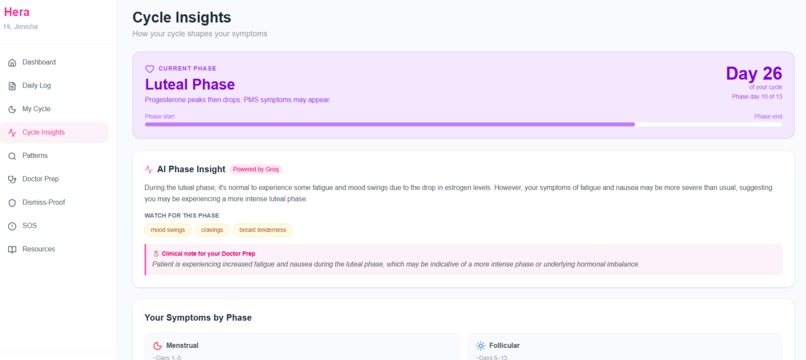
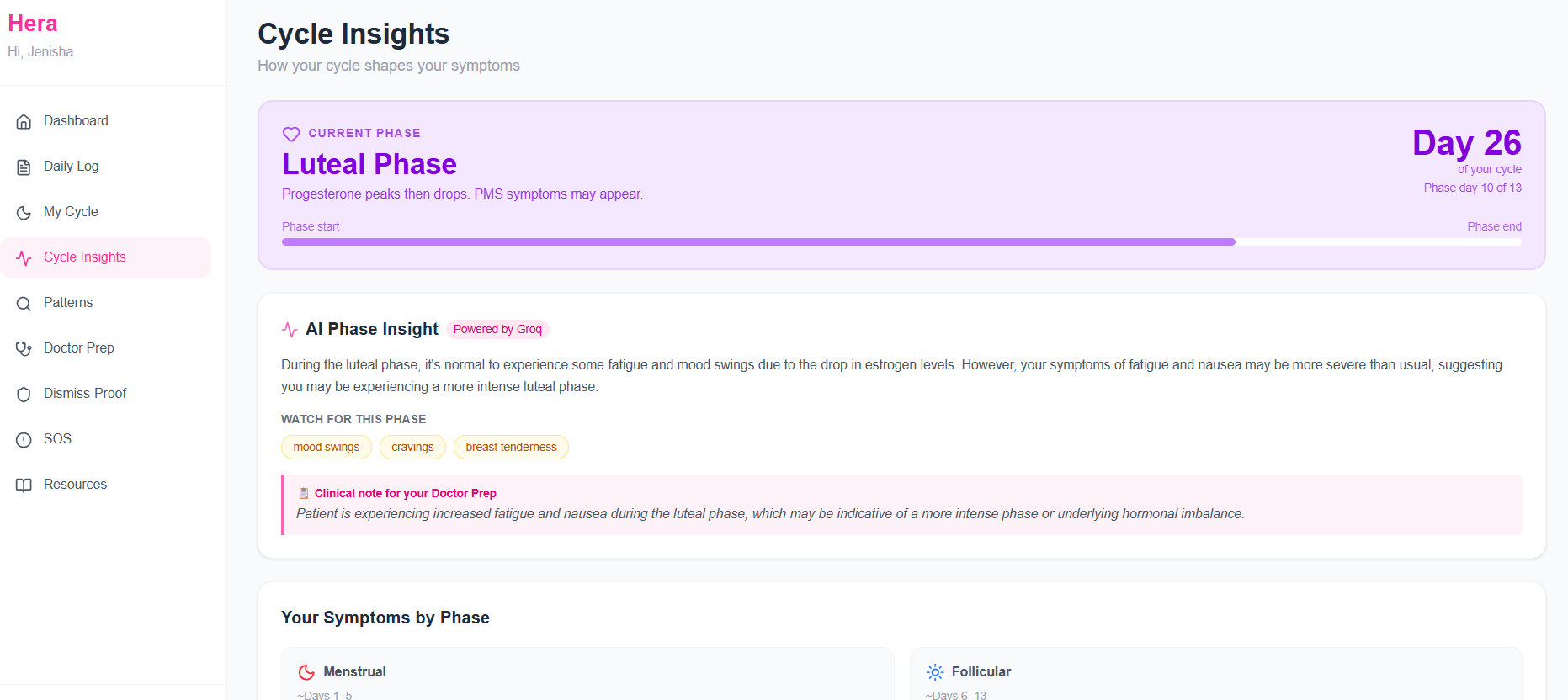
Cycle Phase Intelligence Hera now maps every symptom log to its cycle phase - Menstrual, Follicular, Ovulatory, or Luteal - and uses AI to generate a phase-specific clinical insight. A doctor seeing "fatigue appears consistently in every luteal phase across 3 cycles" is looking at clinical evidence, not a complaint. No existing women's health app connects cycle phase to symptom patterns with AI-generated clinical notes - this is what makes Hera a diagnostic tool, not just a tracker.
Built With
- axios
- bcryptjs
- css3
- express.js
- flask
- git
- github
- grop-api
- javascript
- json-web-token
- jspdf
- lucide-react
- mongodb-atlas
- mongodb-compass
- mongoose
- next.js
- numpy
- openstreetmap
- pandas
- postman
- python
- recharts
- render
- scikit-learn
- tailwindcss
- vercel
- vscode

Log in or sign up for Devpost to join the conversation.