Inspiration
OpenClaw setups have taken the internet by storm. From simple task automation to full-on personal assistants, we've seen developers and non-technical enthusiasts alike showcase the power of agentic artificial intelligence, causing us to think, "What if we could harness this power to protect society?" Emergencies often become deadly because people fail to respond quickly and coherently. In 2023, U.S. residential fires caused 2,890 deaths. In fast-moving disasters like the Camp Fire, 85 people died, and most of the destruction happened within four hours. In medical emergencies, survival from cardiac arrest drops by about 10% for every minute CPR or AED use is delayed. Our app addresses the last-mile response gap: detecting danger is only step one; the real value is instant notification of the right people, coordination within the household, and turning panic into a plan. The problem is not just emergencies. It is the chaos between detection and action.
What it does
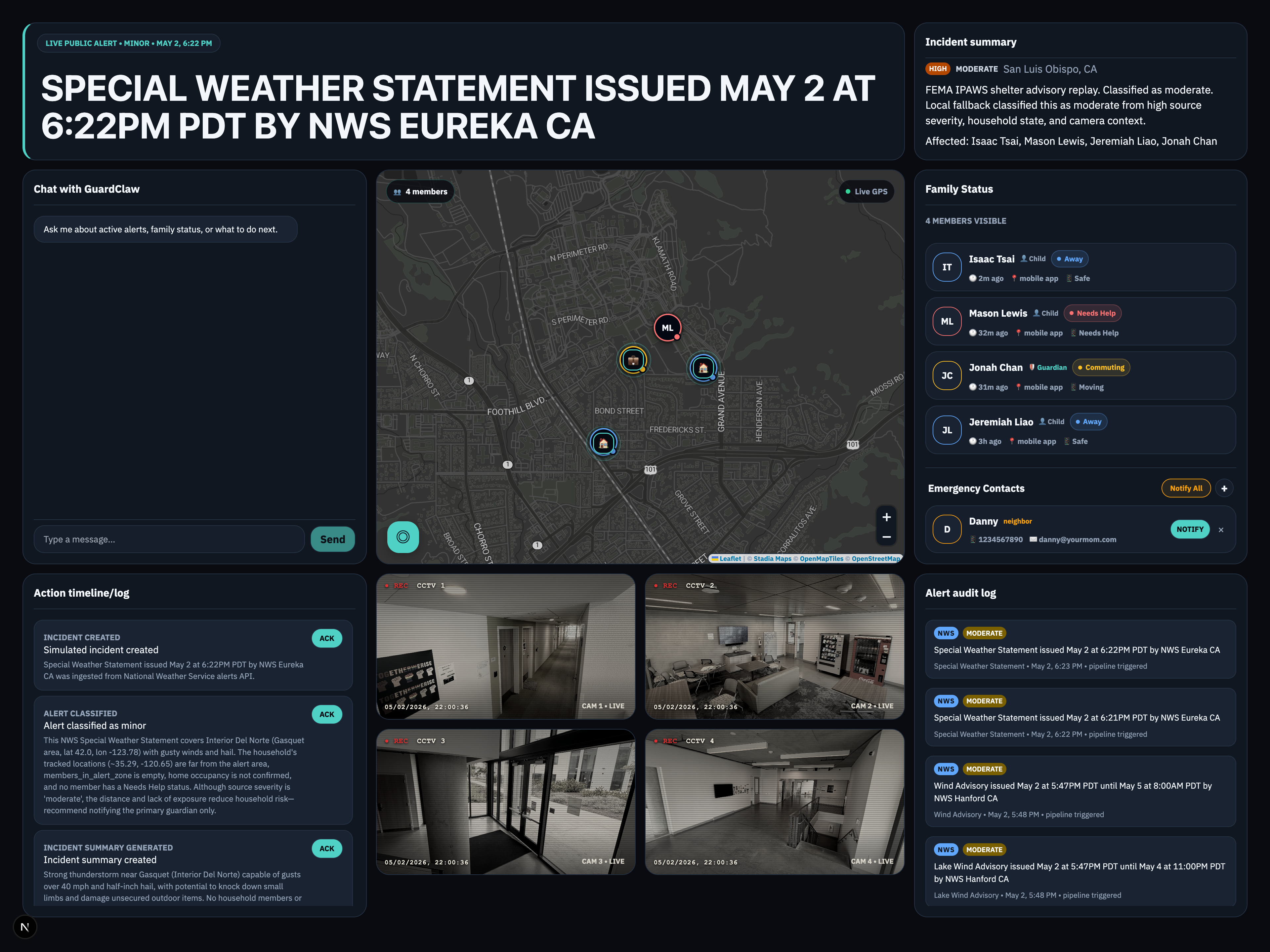
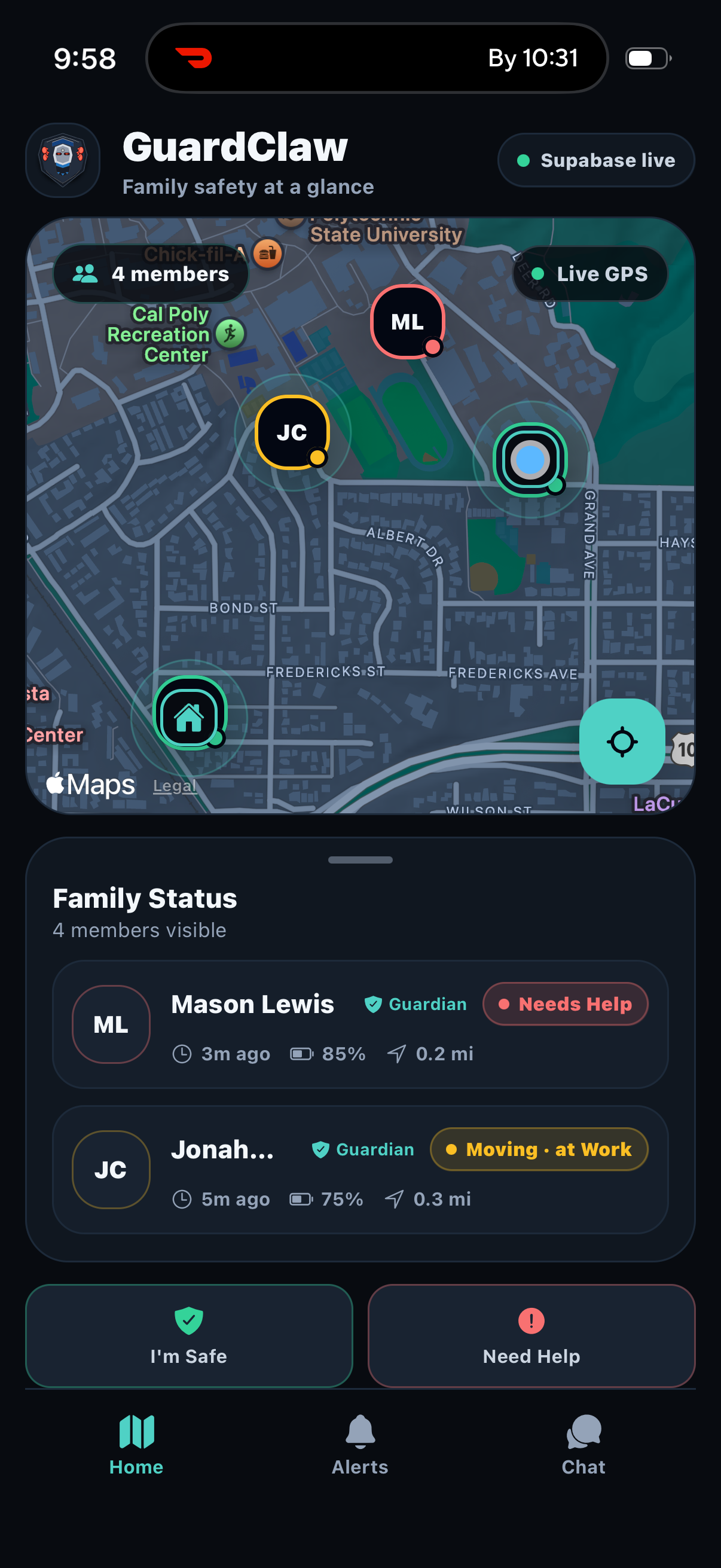
GuardClaw polls local and national sources for real-time updates on natural disasters, security alerts, and other emergencies. Additionally, the system continuously monitors CCTV footage to detect suspicious activity. Hermes, a self-learning and persistent agent at the core of the system, aggregates this input, evaluates its severity, correlates it with real-time data on family members’ locations and statuses, and alerts the appropriate individuals to respond. GuardClaw has full context and remains unfazed in the face of imminent danger, making it the ideal candidate for coordinating emergency responses.
How we built it
Our team of four developers created a detailed spec and implementation plan, laying out the blueprints for our mobile app, backend, and web dashboard. We subsequently used Kiro to prototype our product, generating 23,000 lines of code in a little over 9 hours, something that would have been unthinkable even just a year ago. To ensure smooth development, we first set up CI/CD tests to prevent regressions, then divided the app into parts based on our respective strengths. Humans were in the loop at every step, making design choices and monitoring agentic code generation, while Kiro did the heavy lifting.
Challenges we ran into
One of the largest challenges we ran into was connecting our backends to the agent running on a remote PC in the dorms during the development and testing phases. Because of the university network's security features, peer-to-peer networking is prohibited. We worked around this by setting up CloudFlare tunnels so that we could all communicate with the agent.
Another challenge we faced was tracking the tool usage and flow for each alert sent to our agent, so we could properly adjust its hooks and prompts. We added detailed logging so that we can easily trace every turn taken in a Supabase table.
Accomplishments that we're proud of
One of the things that our team is most proud of is our human-centric product. Normally, in hackathons, we immediately dive into the nitty-gritty technical details. This time, we took a step back and really thought about what would be most beneficial to society at large. Of course, we are also proud of the technical depth and functionality we achieved in this one-day hackathon. From our multi-source alert ingestion, mobile + web integration, CCTV workflow, and real-time-ready database layer, our end-to-end emergency pipeline brings together the core capabilities needed for effective, real-time response.
What we learned
In the age of agentic coding, problem-solving skills and design are more important than ever. LLM tooling can generate entire repositories in the blink of an eye, but without a captain, the fastest ship will be the last to reach port. It is definitely tempting to start writing code right off the bat, but we really learned the importance of sitting down and ensuring we had a fully fleshed-out idea before letting Kiro loose.
Additionally, context engineering is crucial, especially when multiple team members are working in parallel. To make sure everyone was on the same page, we shared a Kiro setup with steering docs, agents, and hooks. Otherwise, agent drift would have led to disparate results across our different dev branches. Thanks to Kiro's built-in features, though, we were able to stay consistent and focused on the end product.
What's next for GuardClaw - Your autonomous family safety coordinator
I know my mom for sure wants to use this! Because we are firm believers in open source, all our code is available on GitHub under the Apache 2.0 license for anyone to install and use. They simply need to provide their own API key to power the agent at the core of the system. However, even without a paid API key, users can still use the dashboard and app to monitor alerts and family members.
Development-wise, this is definitely a project that we want to take to production, and we have prepared for that by adding detailed logging in our backend. To make installation more accessible to those less technically inclined, we plan to add an OS-aware setup script and onboarding for family members.
Note: our demo frontend link is intentionally not connected to our backend in order to conserve API usage tokens. Please clone the repository and run locally to experience the full feature suite.
Built With
- bash
- css
- docker
- expo.io
- fastapi
- fema-feed
- hermes
- javascript
- leaflet.js
- national-weather-service-api
- next.js
- opencv
- openstreetmap
- pydantic
- python
- react
- react-native
- sql
- sqlite
- supabase
- tailwind
- typescript
- usgs-earthquake-feed
- utralytics
- uvicorn
- yolov8


Log in or sign up for Devpost to join the conversation.