-
-
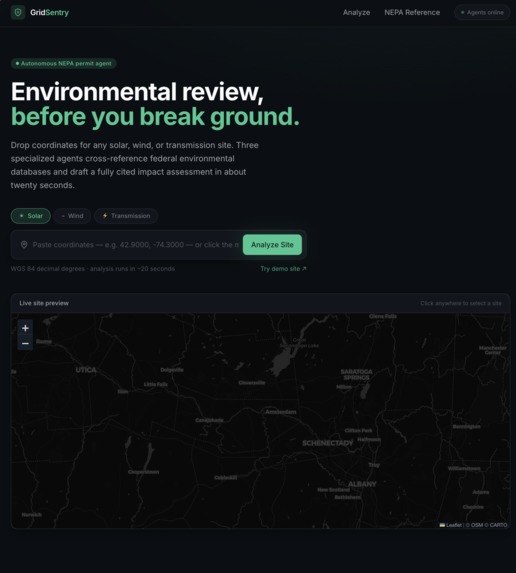
Home Page
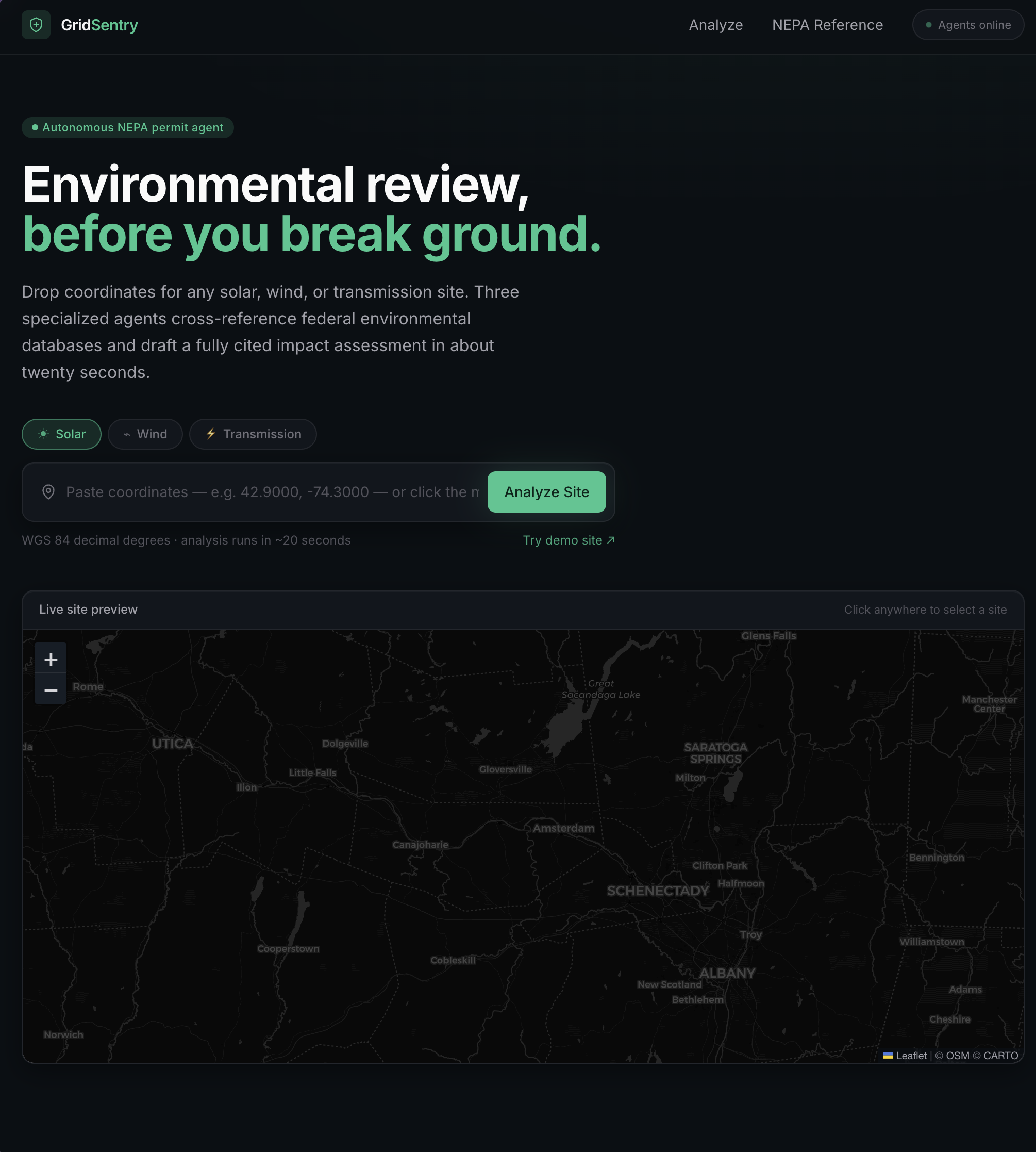
Inspiration
Every solar farm, wind project, and grid upgrade in the US has to survive the National Environmental Policy Act (NEPA) review process — a system that averages 4.5 years and $4.2M per project, with over $229B worth of energy infrastructure currently stuck in the backlog. We kept seeing the same story: brilliant clean energy projects dying not from bad engineering, but from getting buried under thousands of pages of environmental paperwork. We wanted to know — what if an AI agent could do in minutes what currently takes a team of consultants months to draft?
What it does
GridSentry is an autonomous compliance agent for energy infrastructure permitting. A developer inputs the coordinates of a proposed project — say, a solar farm in upstate New York — and GridSentry:
- Maps the exact site and pulls surrounding GIS data
- Cross-references wetlands maps and endangered species habitat databases
- Flags critical "stop-work" risks (like a wetland crossing 200 yards from the proposed site)
- Cites the exact state or federal regulation triggered by each risk
- Generates a fully cited, interactive PDF environmental assessment draft
What used to take a compliance team weeks of manual cross-referencing now happens in about 20 seconds.
How we built it
We split the system into three parts:
- Ingestion layer — a Python backend that scrapes and queries open-source GIS and environmental databases (wetlands, endangered species habitats)
- Multi-agent reasoning engine — three specialized AI agents working in sequence: a Geolocation Analyst (maps the site), a Legal Compliance Officer (matches findings to NEPA and state regulations), and a Red-Team Critic (stress-tests the findings for weak citations or missed risks)
- Output layer — a rendering pipeline that turns the agents' findings into a clean, fully cited, interactive PDF report
On the frontend, we focused heavily on making the experience feel like a real compliance tool rather than a demo script — an interactive map with risk overlays, live agent status updates, and a scrollable cited report panel.
Challenges we ran into
- Environmental data is scattered across dozens of inconsistent federal and state sources, so we had to normalize schemas on the fly
- Getting the AI agents to cite specific regulations accurately (not just plausible-sounding ones) required a dedicated "critic" agent to catch hallucinated citations
- Balancing speed (we wanted a sub-30-second demo) with the depth of cross-referencing needed to make the output trustworthy
What's next for GridSentry
- Expand database coverage to all 50 states plus full federal EIS templates
- Partner with solar and wind developers to pilot on real, live projects
- Add legal review partnerships to move from "draft assistant" to a submission-ready compliance tool
- Pursue SOC2 compliance and enterprise API access for utilities and engineering firms
Built With
- carto
- cursor
- fastapi
- fema
- github
- httpx
- mrlc
- nextjs
- openai
- openstreetmap
- pydantic
- python
- render
- tavily
- usfws-geospatial-service
- usgs
- uvicorn
- vercel

Log in or sign up for Devpost to join the conversation.