-
-
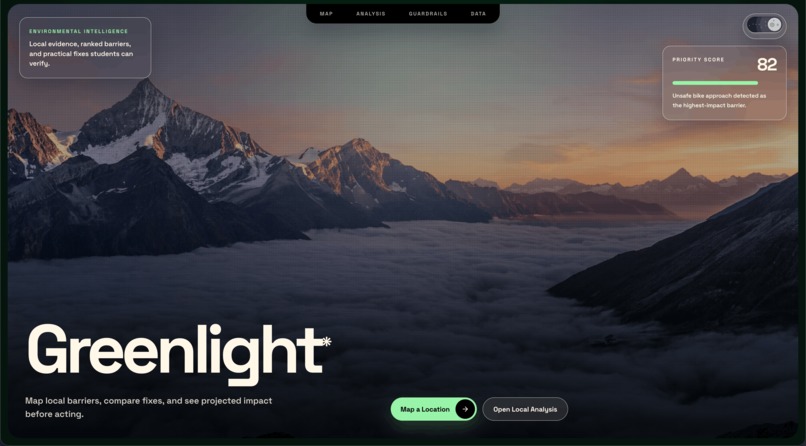
Hero Page
-
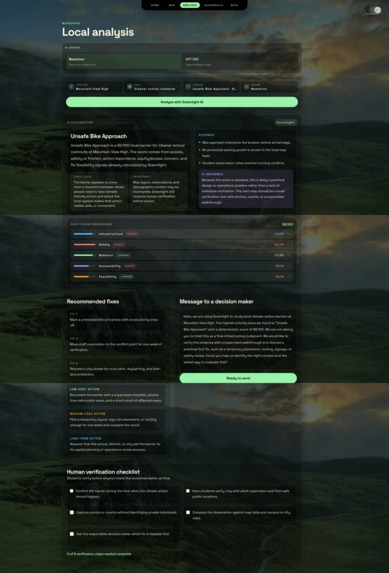
AI Powered Analysis
-
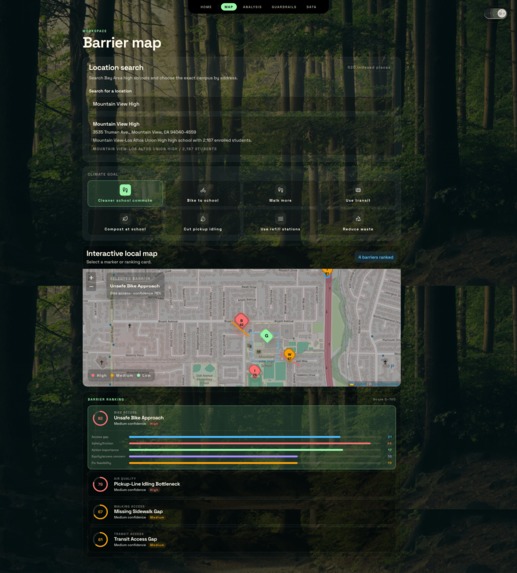
Graphical Analysis
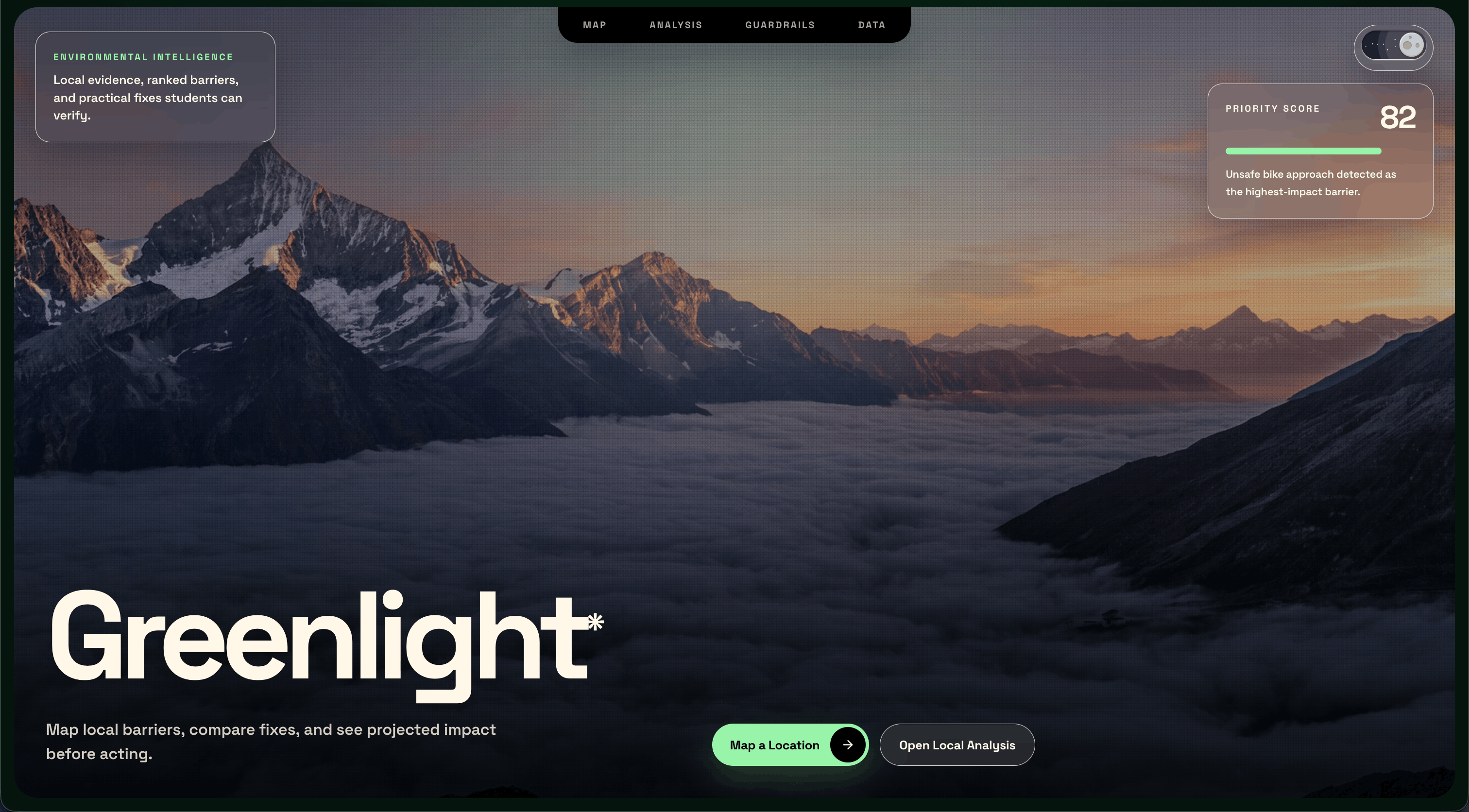
Inspiration
Every morning before school, the same thing happens outside campuses across the Bay Area. Traffic backs up, parents idle in long drop-off lines, and only a handful of students arrive by bike or on foot.
Schools encourage sustainable transportation, but that got us thinking: if everyone agrees sustainability is important, why aren't more students actually choosing those options?
The problem usually isn't awareness. It's infrastructure. Maybe there aren't enough bike racks. Maybe crossing a nearby road doesn't feel safe. Maybe the nearest bus stop isn't convenient. Those barriers are different at every school, but schools rarely have an easy way to identify or prioritize them.
We built Greenlight because we wanted to move beyond generic advice and help schools answer a much more practical question:
What changes would actually make the biggest difference here?
What it does
Greenlight is a decision-support platform built for Bay Area high schools.
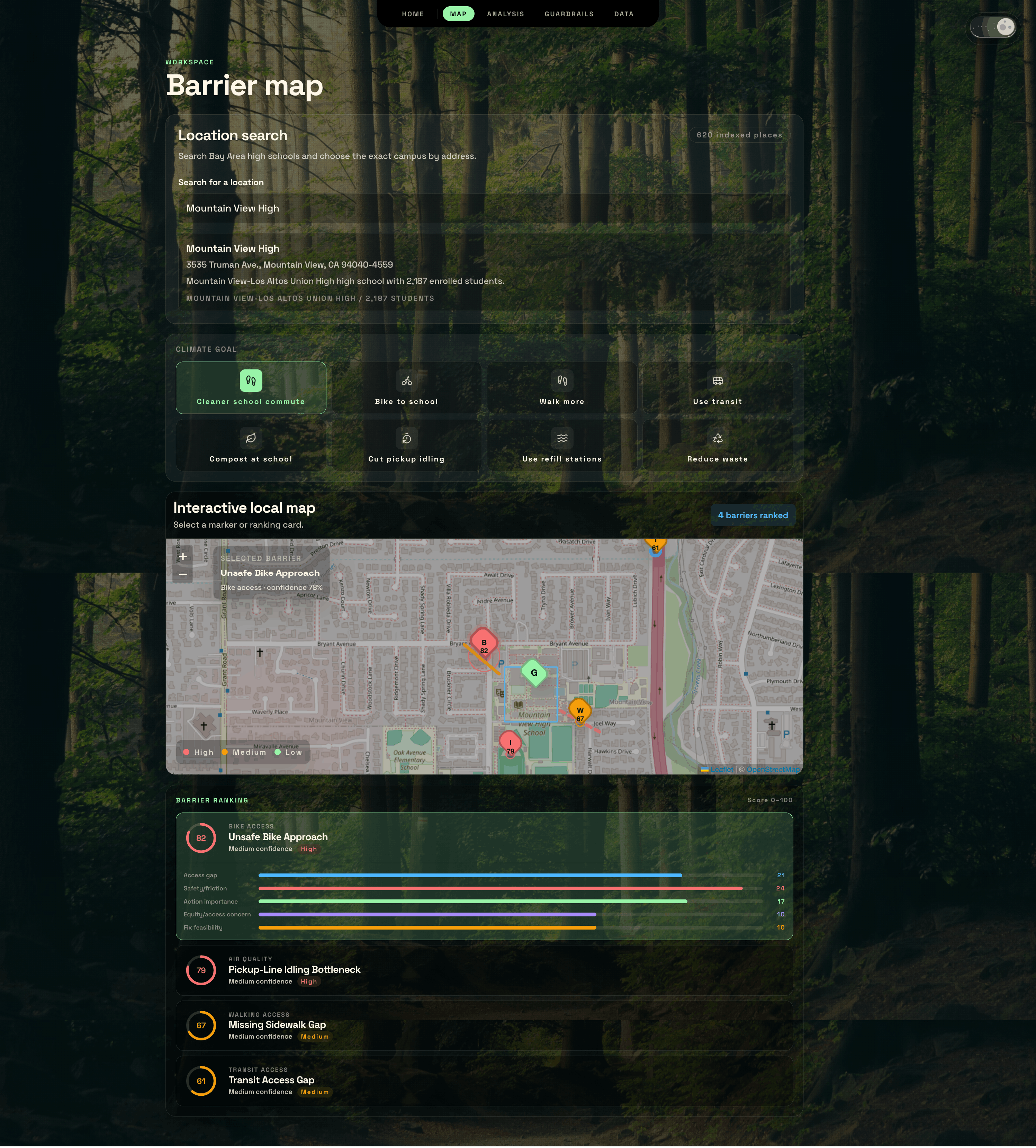
Users select a school on the map, and Greenlight analyzes the surrounding area using a deterministic scoring system based on accessibility, safety, environmental importance, equity, and feasibility.
From there, schools can simulate improvements like installing bike racks, adding protected crosswalks, or improving recycling infrastructure. The platform recalculates projected barrier scores and expected impacts instantly, allowing users to compare different ideas before investing time or money.
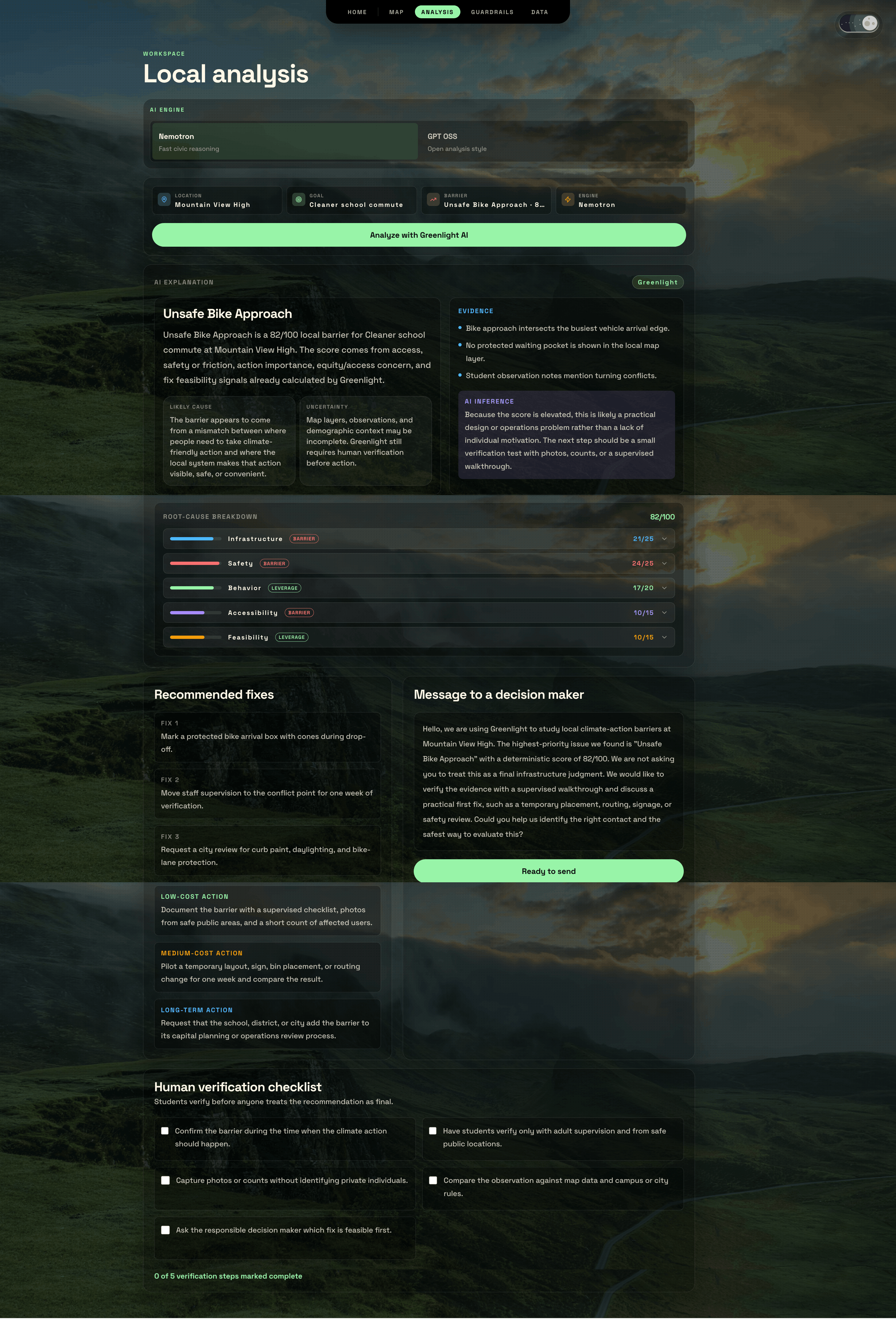
Rather than generating recommendations from scratch, Greenlight uses AI to explain the results, summarize the reasoning behind each recommendation, and present the information in language that's easy to understand.
How we built it
We built Greenlight with Next.js, React, TypeScript, Tailwind CSS, and Leaflet for the interactive map.
One of the biggest design decisions we made was separating calculations from AI.
Instead of asking a language model to generate scores or projections, we built a deterministic scoring engine that performs all of the analysis locally. The simulator and intervention rankings are based entirely on those calculations, making every result consistent and reproducible.
The language model sits on top of that system as an explainability layer. It receives structured outputs from the scoring engine and turns them into clear, readable explanations without changing the underlying numbers.
This approach gave us the flexibility of AI while keeping the core analysis transparent and reliable.
Challenges we ran into
One of our biggest challenges was deciding where AI actually added value.
At first, we considered letting the model generate recommendations directly. The more we tested, the more we realized that wasn't the right approach for a project involving decision-making. Schools should be able to trust where every number comes from.
That led us to redesign our architecture so that every calculation is deterministic and the AI is responsible only for explaining the results.
Another challenge was balancing technical depth with usability. We wanted Greenlight to perform meaningful analysis without overwhelming users, so we spent a lot of time simplifying the interface and presenting complex information through maps, visualizations, and simulations instead of large blocks of text.
What we learned
This project taught us that building with AI isn't just about adding a chatbot to an application.
The more interesting challenge is figuring out where AI belongs in a workflow and where traditional software is the better solution.
We also learned a lot about designing systems that people can trust. Separating deterministic calculations from AI-generated explanations made the platform easier to understand, easier to debug, and ultimately more useful.
Most importantly, we learned that local problems often need local solutions. By focusing on Bay Area high schools instead of trying to solve sustainability everywhere, we were able to build something much more practical and grounded.
What's next
Greenlight is currently focused on Bay Area high schools, but the framework could be expanded to support additional schools, districts, and communities globally.
Going forward, we'd like to incorporate more real-world infrastructure data, improve our simulation models, and allow schools to compare historical improvements over time.
Our goal isn't to replace decision-makers, rather to give students and schools better information so they can make smarter sustainability decisions with confidence.


Log in or sign up for Devpost to join the conversation.