Inspiration
E-waste is one of the fastest-growing environmental problems in the world — global e-waste hit 62 million tonnes in 2022, up 82% since 2010, and it's growing roughly five times faster than the world's ability to recycle it. India alone is among the top three generators globally, and an estimated 95% of that waste is handled by an informal, unregulated sector with no safety standards.
What struck us wasn't just the scale of the problem — it was how incomplete every existing solution was. Platforms like OLX or Cashify treat a device as one indivisible unit, even when only the screen is broken and the battery, RAM, or SSD inside are still perfectly usable. And certified recyclers have no real digital channel to reach households directly. We kept asking: why does a broken laptop have to be "trash," when half of it might still be valuable? That question became Green Loop.
What it does
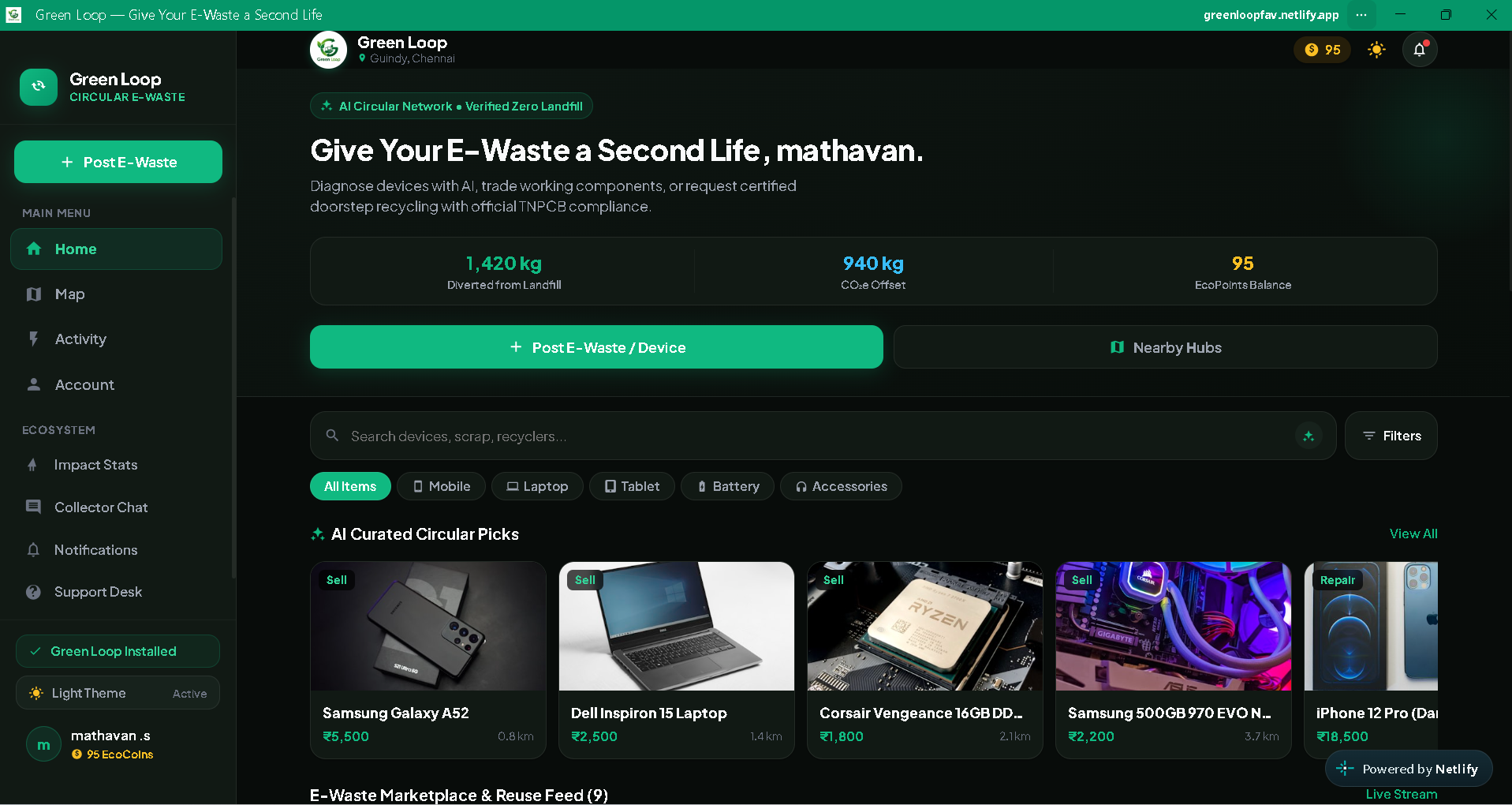
Green Loop gives every electronic device five possible paths at the end of its life instead of one: Sell, Harvest Parts, Donate, Exchange, or Certified Recycle.
- AI-assisted listing — users capture a live photo, and our AI analysis engine detects brand, model, category, and condition with a confidence score, flagging hazards like a swollen battery automatically.
- Harvestable Parts Marketplace — individual components (RAM, SSD, battery, display) can be listed and sold separately from a broken device.
- Certified Recycling — a dedicated pickup flow references TNPCB certification standards, auto-calculates EcoPoints (25 per kg), and issues a real, traceable certificate ID.
- Live map — built on Leaflet/OpenStreetMap, connecting users to nearby buyers, repair shops, and certified recyclers.
- Green Coins — a full rewards economy with tier progression that turns sustainable action into a habit, not a one-off.
- Impact tracking — every user has a persistent record of kilograms diverted and CO₂ avoided.
How we built it
We split the work by strength. Mathavan built the full stack: a React 19 + TypeScript + Vite frontend with TanStack Query, Zod-validated forms, and Framer Motion, backed by a Node.js + Express + MongoDB/Mongoose API with four core schemas — User, Listing, Order, and Recycling — each with automated QR/certificate ID generation baked directly into the data layer. We also explored a native version in Flutter + Material 3 to test the same concept cross-platform.
Vimal Raj designed a complete token-based design system from scratch — a consistent color and spacing language, full Light/Dark/System theming, and step-by-step guided flows for every complex action (posting a device, requesting a recycling pickup, onboarding) so the product never feels overwhelming despite having five distinct disposal paths under the hood.
Karthick grounded the whole thing in research before any code was written — studying the Global E-waste Monitor, auditing where existing marketplaces fall short, and researching TNPCB certification standards so our recycling flow reflects real-world compliance rather than a made-up label.
We shipped it as a live, deployed application (not a static mockup), with a working backend and database tracking real data end-to-end.
Challenges we ran into
- Modeling "partial value." Most e-commerce data models assume one listing = one product. We had to redesign our
Listingschema to support a nestedharvestableParts[]array, each with its own condition, price, and harvestable flag — a genuinely different data shape from a typical marketplace. - Making complexity feel simple. With five disposal paths, AI scanning, a live map, and a rewards economy, the risk of overwhelming a first-time user was real. We solved this by breaking every complex action into small guided steps instead of long forms.
- PWA installability. We initially had an "Install App" button that didn't actually work — it turned out we were missing a proper web app manifest and registered service worker, so the browser never had what it needed to trigger a real install prompt. Fixing this taught us a lot about how
beforeinstallpromptand manifest requirements actually work under the hood. - Grounding claims in real data. It was tempting to make big claims about impact, so we made a point of tying every major feature back to a specific, documented gap in the existing market rather than an assumption.
Accomplishments that we're proud of
- Building a genuinely full-stack, deployed product — not a prototype — with a real database tracking listings, orders, recycling requests, and cumulative user impact.
- Designing the Harvestable Parts feature, which we believe is the single biggest differentiator from any existing e-waste or resale platform.
- Wiring a real incentive loop (Green Coins, tiers, EcoPoints-per-kg) that ties directly into the database rather than being a cosmetic UI number.
- Keeping the UI usable and trustworthy despite the underlying complexity of five different disposal flows and multiple user roles (individual, shop, recycler, NGO, admin).
What we learned
We learned that solving an environmental problem well is as much a data modeling and UX problem as it is an "AI" problem — the hardest part wasn't detecting a device in a photo, it was designing a schema and a flow that could represent something as unconventional as "sell only the working half of a broken laptop." We also learned, very concretely, how PWA installability actually works (manifest + service worker + the beforeinstallprompt event) after debugging our own broken install button.
What's next for Green Loop
- Replacing our current heuristic-based AI analysis with a trained computer-vision model for device recognition.
- Real integrations with certified TNPCB recycling partners for live pickup dispatch.
- Payment gateway integration (Razorpay/UPI) beyond our current checkout flow.
- Full feature parity for the Flutter mobile app, published to the Play Store.
- Expanding beyond our current Tamil Nadu seed cities into new regions.
Built With
- css3
- dart
- express.js
- figma
- flutter
- framer-motion
- html5
- javascript
- leaflet.js
- material-design
- mongodb
- mongoose
- node.js
- openstreetmap
- react
- react-hook-form
- react-router
- rest-api
- tanstack-query
- typescript
- vite
- zod

Log in or sign up for Devpost to join the conversation.