-
-
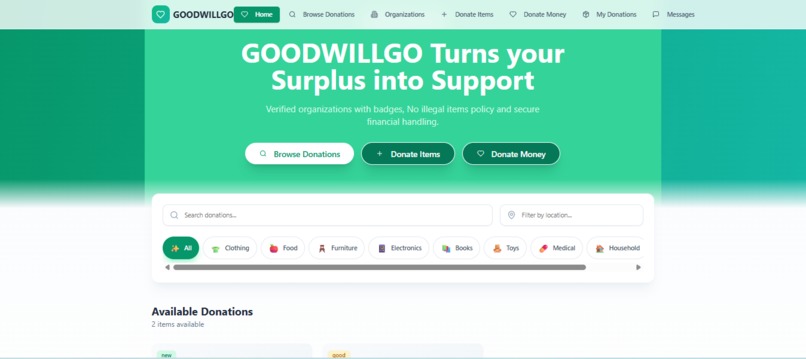
Home Page
-
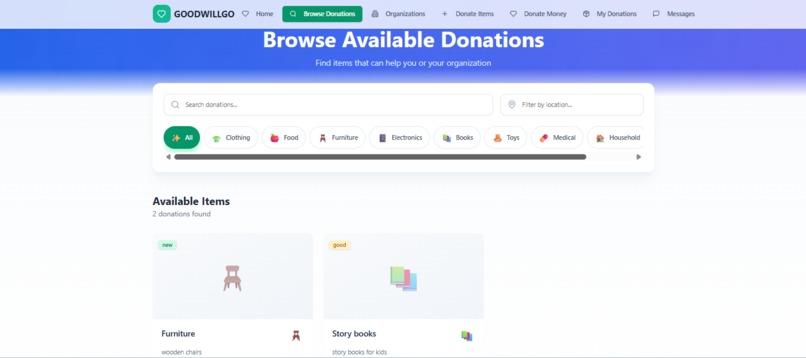
Browse Donations
-
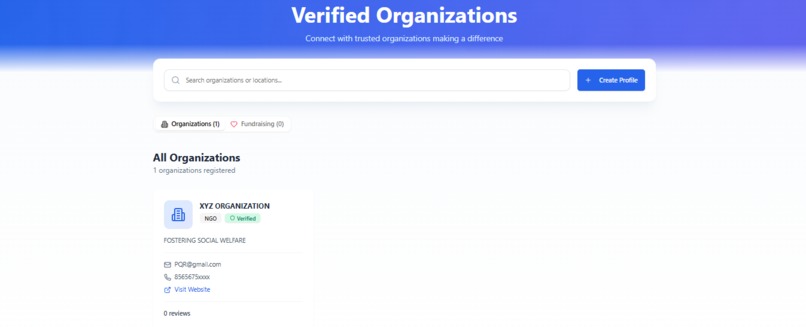
Organizations and fundraising campaigns
-
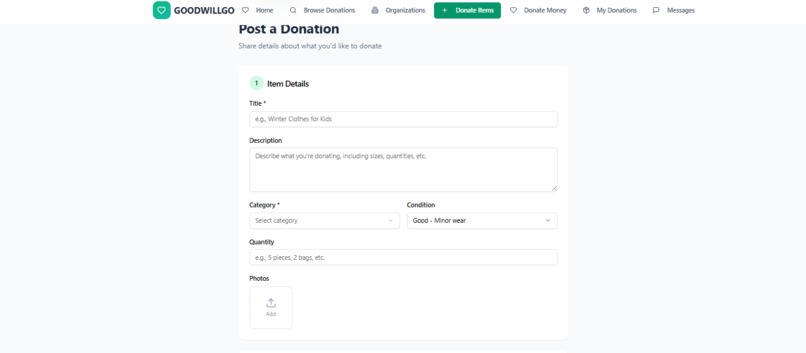
Post Donations
-
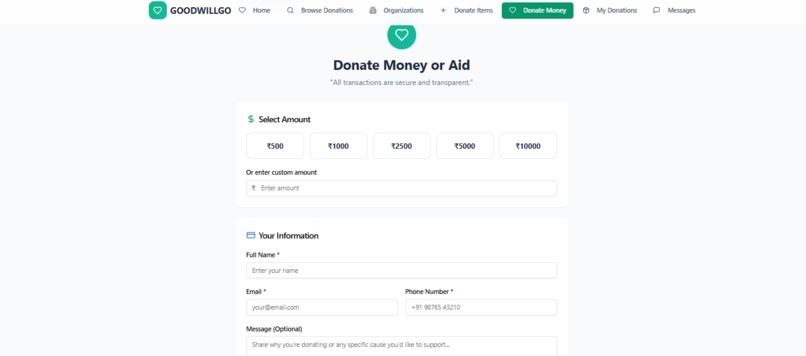
Aid or Money Donation
-

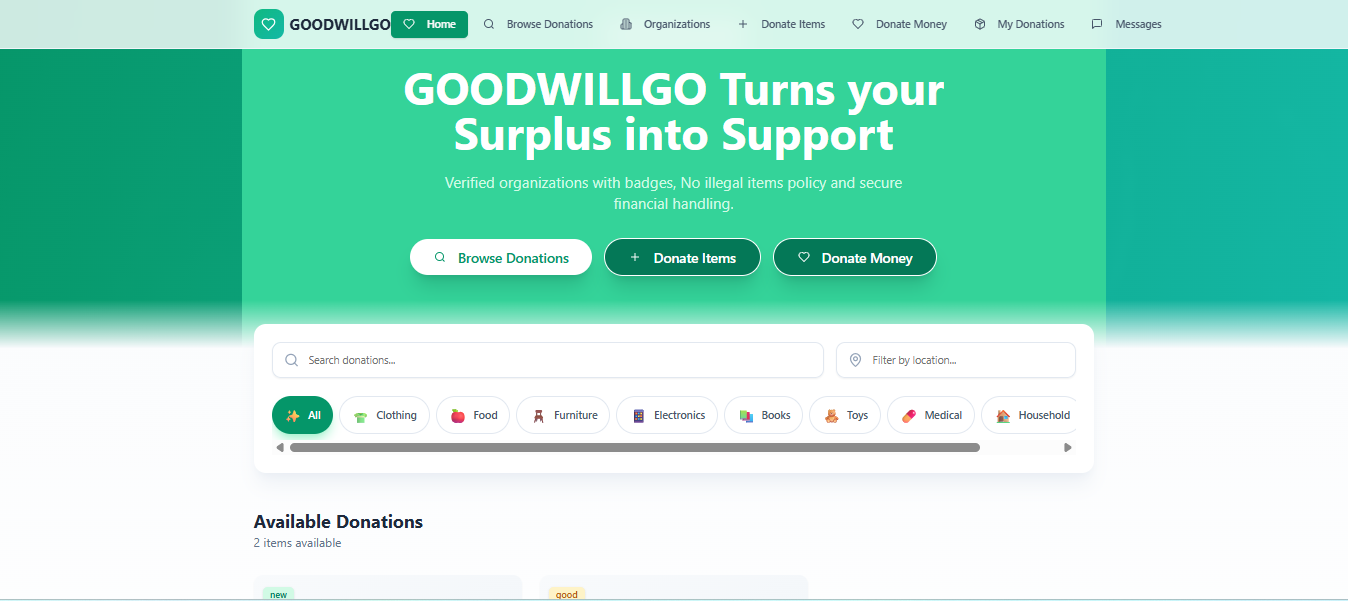
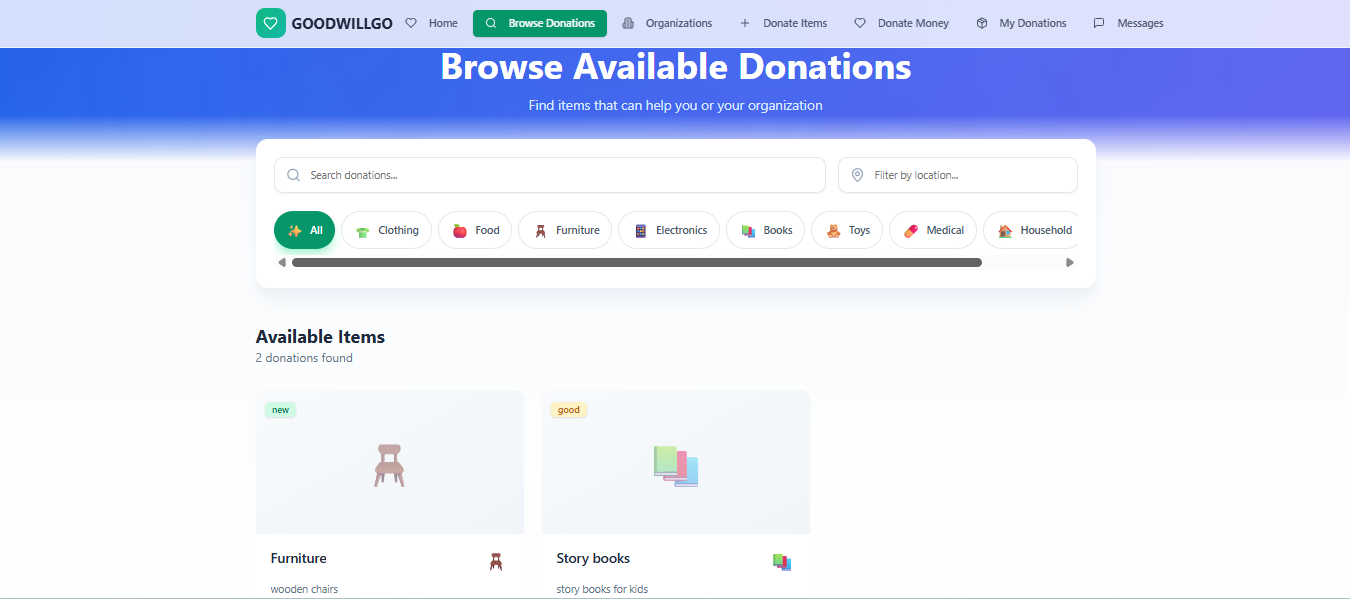
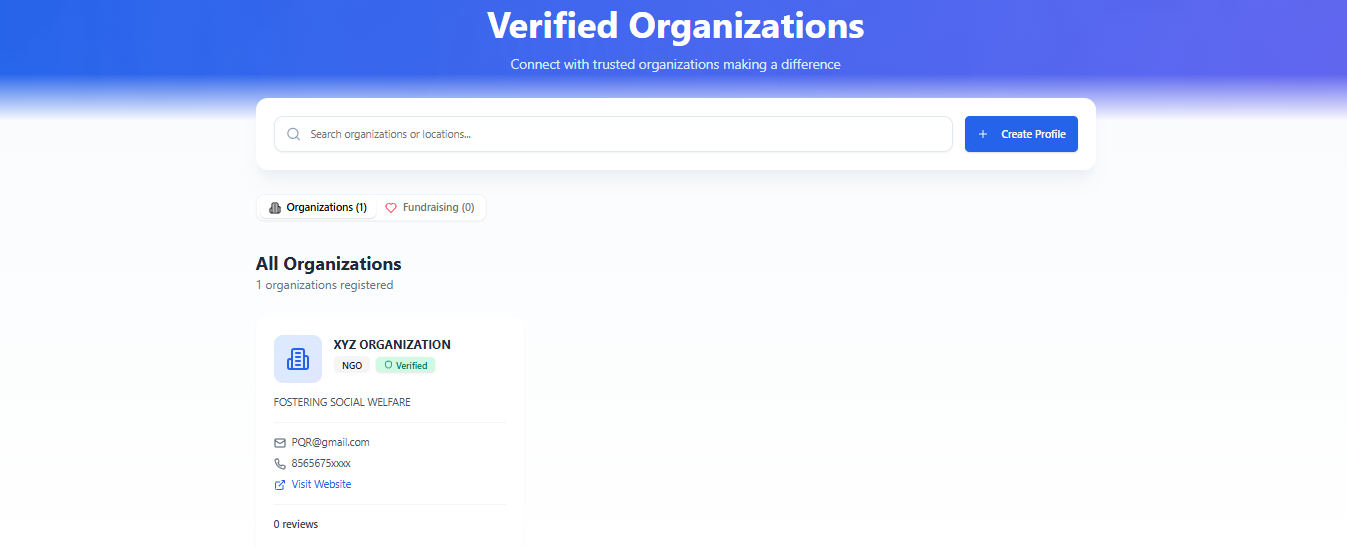
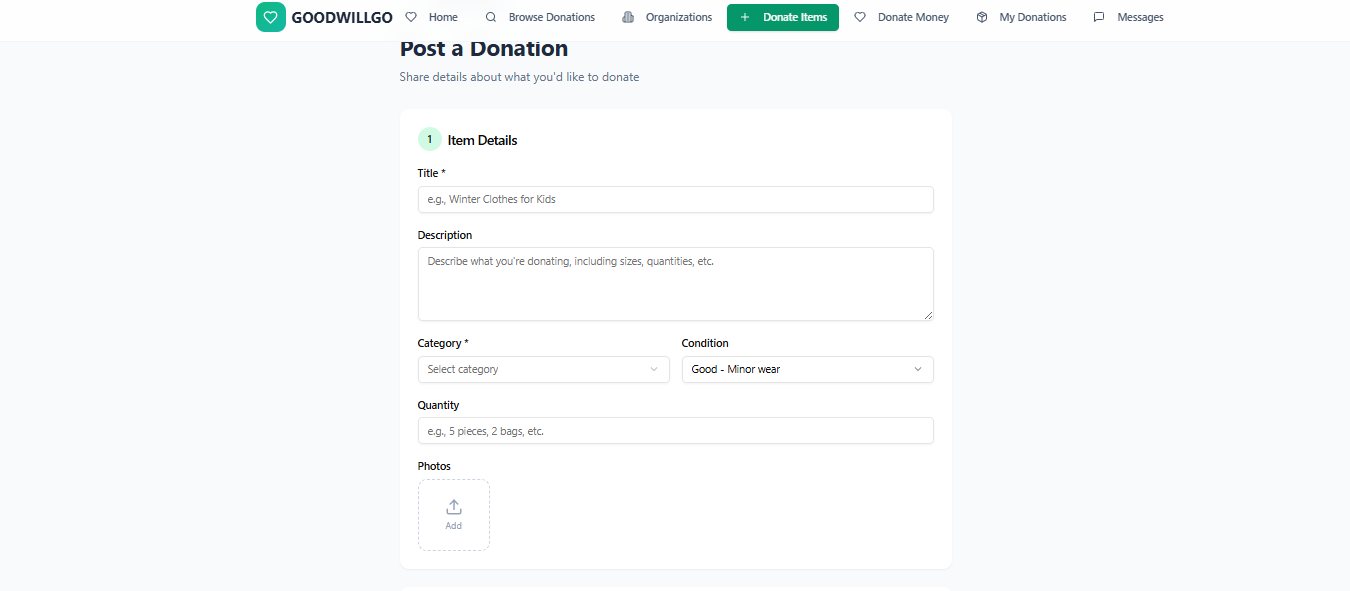
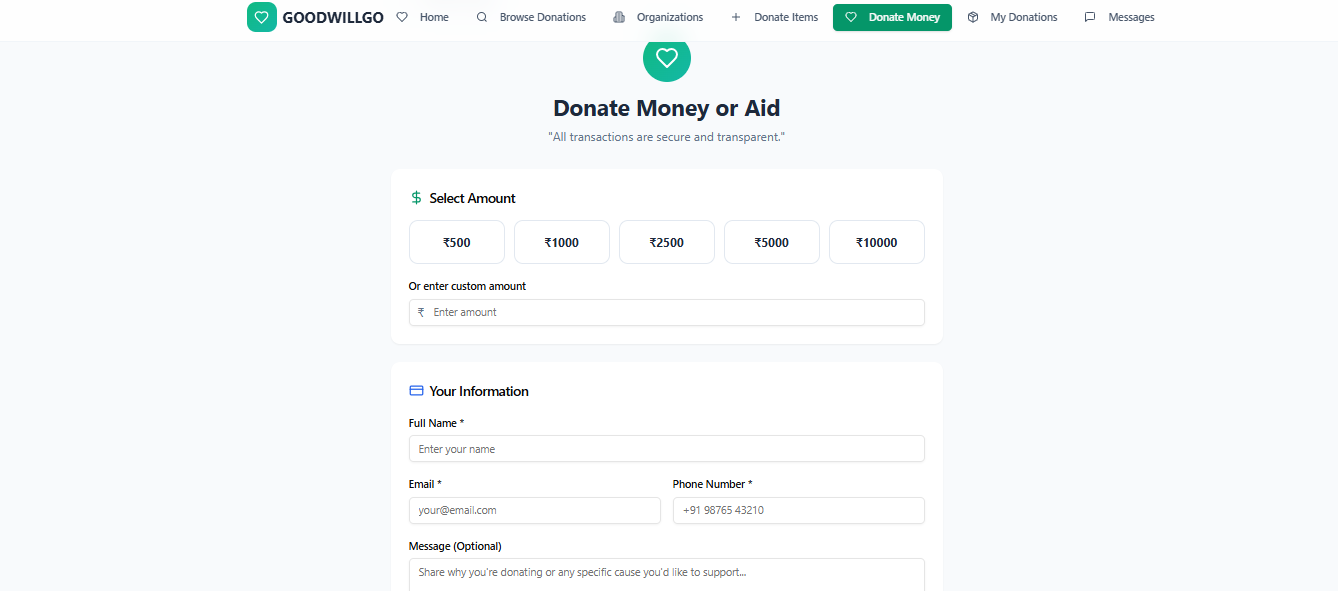

GoodwillGo NEXUS – A Safe Local Donation and Welfare Platform
What Inspired Me (Problem & Impact)
GoodwillGo was inspired by a critical inefficiency in hyperlocal resource distribution. While surplus goods are readily available within communities, there is no intelligent, trust-aware system to facilitate efficient redistribution to individuals in need.
This disconnect leads to resource wastage and limits the impact of community-driven welfare. Existing solutions lack locality-sensitive intelligence, trust validation, and real-time interaction capabilities. My objective was to design a system that enables scalable, data-driven, and socially impactful donation ecosystems.
Innovation & Solution
GoodwillGo introduces a multi-modal donation platform that integrates:
- Item-based donations
- Monetary fundraising campaigns
- AI-assisted matching systems
The platform evolves beyond traditional donation systems by incorporating predictive intelligence, user interaction layers, and trust-building mechanisms, enabling a more dynamic and reliable welfare network.
Technical Implementation (Complexity & Engineering)
The system was developed using Base44 with a focus on modularity, scalability, and intelligent data flow.
Key technical components include:
- A data analytics pipeline to preprocess and structure donation and fundraising data for optimized retrieval and prioritization
- AI-assisted predictive modeling, leveraging heuristic-based inference to identify high-demand items and optimize donation allocation
- A location-aware recommendation engine that ranks both donation listings and fundraising campaigns based on proximity, urgency, and contextual relevance
- A dedicated fundraising module enabling users to create and contribute to monetary aid campaigns, supporting financial assistance alongside physical donations
- Integration of secure monetary interaction flows for streamlined contribution to campaigns
- A user feedback system, incorporating review and rating mechanisms to enhance trust, credibility, and accountability across participants
- A real-time messaging interface, enabling direct communication between donors and recipients, facilitating coordination and transparency
- An event-driven architecture with asynchronous state management, ensuring responsive UI updates and low-latency interactions
- A component-based frontend architecture, aligned with modular design principles for maintainability and extensibility
- A Audio description availabilty,making it easy for older people and people with less technological experience
- A Voice messaging option,fostering easy communication and error reduction
The system emphasizes efficient data orchestration, abstraction layers, and scalable interaction flows, enabling complex functionality within a streamlined user experience.
Design & User Experience
The application is designed with a trust-centric and interaction-focused UI, ensuring accessibility while supporting advanced backend logic.
Key design considerations:
- Intuitive workflows for donations, fundraising, and communication
- Seamless integration of reviews, ratings, and messaging into the user journey
- Clean visual hierarchy to reduce cognitive load
- Responsive design for cross-device usability
This ensures that even with advanced features, the platform remains user-friendly and adoption-ready.
Challenges & Problem-Solving
One of the primary challenges was integrating multiple system layers—donation management, fundraising, AI logic, and user interaction—into a cohesive and efficient platform.
Additional challenges included:
- Designing trust mechanisms using ratings and reviews without compromising simplicity
- Implementing real-time messaging flows within platform constraints
- Balancing predictive intelligence with transparency and user control
- Structuring multi-type donation systems (items + money) within a unified architecture
- Maintaining performance while handling dynamic data flows and user interactions
These challenges required careful system design and optimization strategies.
What I Learned
This project provided hands-on experience in:
- Designing multi-functional, data-driven platforms
- Applying predictive modeling and recommendation systems in real-world contexts
- Building trust-centric systems using feedback and communication layers
- Managing complex system integration while maintaining usability
I also developed a deeper understanding of how interaction, trust, and intelligence intersect in scalable digital platforms.
Feasibility & Future Scope
GoodwillGo is designed to scale into a production-ready ecosystem.
Future enhancements include:
- Advanced machine learning pipelines for demand prediction and personalization
- Implementation of trust scoring algorithms based on user behavior and ratings
- Enhanced real-time communication systems
- Integration of secure payment gateways for large-scale fundraising
- Use of geospatial clustering and optimization algorithms for improved efficiency
Conclusion
GoodwillGo represents a convergence of social impact and intelligent system design. By integrating AI-driven matching, fundraising capabilities, and trust-building mechanisms such as reviews, ratings, and messaging, the platform transforms decentralized goodwill into a structured, scalable welfare ecosystem.
It demonstrates a strong alignment between innovation, technical depth, user experience, and societal impact, making it a robust solution for modern community-driven challenges.
Built With
- ai
- asynchronousstatemanagement
- audiodescription
- base44
- dataanalytics
- dataprocessing
- eventdrivenarchitecture
- gps
- javascript
- modulararchitecture
- predictiveanalytics
- recommendationsystem
- ui
- ux
- webapp
- webdevelopment

Log in or sign up for Devpost to join the conversation.