** "Please note: The original submission I uploaded incorrect PDF :(. So I just uploaded it in photos at 9:02pm **
Inspiration
The inspiration for HaHa Earth came from wanting to create a unique take on the survival resource management genre. At this point, there are countless games based around surviving in the wilderness, gathering resources, crafting systems, zombie apocalypses, and open-world survival loops.
This isn’t my usual genre of games, so I needed a way to reconnect with the idea in a way that felt fresh and motivating for me personally. Instead of repeating the same survival formula, I decided to twist the core concept while keeping the foundation intact.
I also drew inspiration from modern internet culture—especially the explosion of streaming, content creation, and the idea that “everyone wants to be an influencer.” I reimagined that idea in a sci-fi setting where you are an alien trying to become a viral streamer on Earth.
Instead of managing health, you manage live viewers. That simple shift turns survival into entertainment-driven chaos.
What it does
HaHa Earth is a survival-chaos sandbox game where you play as an alien livestreaming your experience on Earth to a galactic audience.
Your goal is to:
- Explore Earth
- Collect human objects
- Build chaotic inventions from found items
- Send Earth objects back home for research purposes
- Cause destruction
- Grow your live viewer count
- Avoid losing your audience
- Gain as many followers as possible
Your “health” is your live viewer count. If it reaches zero, your stream is canceled and your alien is recalled.
The more chaos you create, the more viewers you gain—but the more attention you attract from escalating threats on Earth.
How we built it
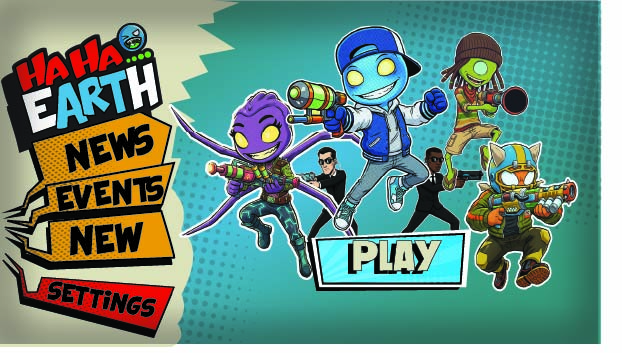
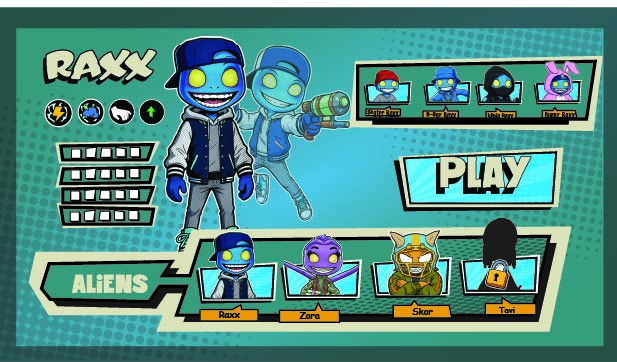
I started with the artwork, which is my strongest skill set. I’ve always wanted to create something with a comic book, retro-inspired vibe, so I began by focusing on the visual identity first.
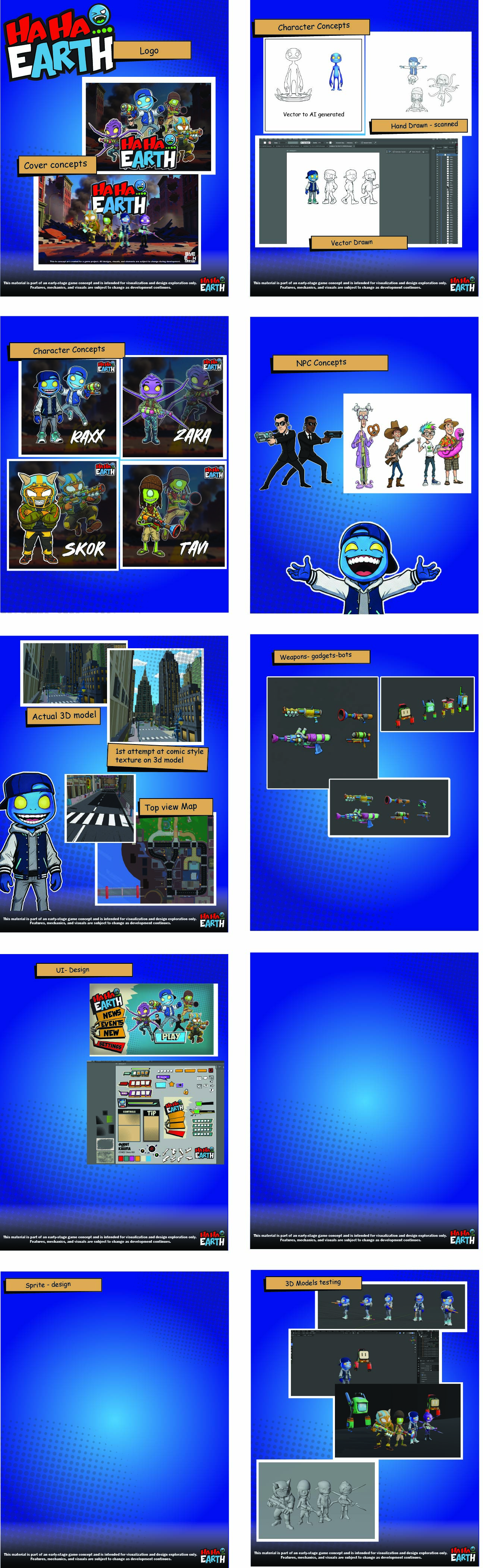
All of the art was created in vector software and then refined and edited in Photoshop. This workflow allowed me to keep the visuals clean, bold, and stylized while still having flexibility for polish, shading, and composition.
I worked in vector software to design the core visual elements of the game—characters, weapons, robots, and early concept props. These were then taken into Photoshop for refinement and final presentation, helping establish a strong visual tone early in development.
To quickly validate the direction of the game, I also built simple environments and low-poly models for gameplay shots and prototypes. These were not meant to be final assets, but rather fast test scenes to prove how quickly the game could come together visually with this art style.
This approach reinforced one of the core strengths of the project: the art style allows the game to stay highly optimized, lightweight, and efficient while still looking distinct and stylized. It also helped confirm that the visual direction works well in gameplay, not just in concept art.
My goal from the beginning was to make the game feel unique in every aspect, not just in gameplay but also in its presentation. I wanted the concept, art style, and mechanics to all feel connected as one cohesive identity rather than separate parts.
Starting with art allowed me to shape the direction of the game visually first, which then guided how the systems and gameplay evolved around that style.
Challenges we ran into
One of the biggest challenges was staying focused on a single genre identity.
Because the concept is flexible, it was easy to drift between multiple directions:
- Survival game
- Sandbox physics toy
- Comedy chaos simulator
- Strategy/resource management system
Keeping everything aligned under one core loop—survive by entertaining your audience—was essential.
Another challenge was balancing structure with freedom. Too much structure made it feel like a traditional survival game, while too much freedom made it lose direction.
I also had to do a lot of research and iteration to ensure the idea still felt like a legitimate survival resource management game, while also being something completely new in tone and execution.
Accomplishments that we're proud of
- Reframing survival mechanics into a live “viewer count” system instead of health or hunger
- Creating a clear core loop centered around chaos and entertainment
- Blending survival gameplay with physics-based sandbox interaction
- Building a strong thematic identity around alien streaming culture
- Maintaining a balance between structured progression and emergent chaos
- Rapidly validating the visual direction with lightweight low-poly gameplay prototypes
What we learned
We learned that survival games don’t need traditional systems like hunger, thirst, or crafting trees to feel engaging.
The real core of the genre is pressure, decision-making, and progression under stress. By changing what creates that pressure—turning it into audience attention—we were able to completely reshape the experience while still keeping the survival foundation intact.
We also learned how important it is to lock in a clear core loop early. Without that, even strong ideas can become unfocused very quickly.
Another key insight was that art direction can define gameplay direction. By starting with visuals first, we were able to guide the design of systems in a more cohesive and intentional way.
What's next for HaHa Earth
The next step for HaHa Earth is to turn the concept into a playable prototype and refine the core systems.
This includes:
- Expanding the object interaction and invention system
- Building out viewer growth and escalation mechanics
- Designing AEO response systems and threat progression
- Creating early-game flow and tutorial onboarding
- Testing how chaos-based gameplay scales over time
The long-term goal is to evolve HaHa Earth into a fully realized survival-chaos experience where every action feeds back into one thing:
staying entertaining enough to survive..
Built With
- adobe-illustrator
- blender
- chatgpt
- clickup
- figma
- github
- milanote
- noesis
- photoshop


Log in or sign up for Devpost to join the conversation.