-
-
logo
-
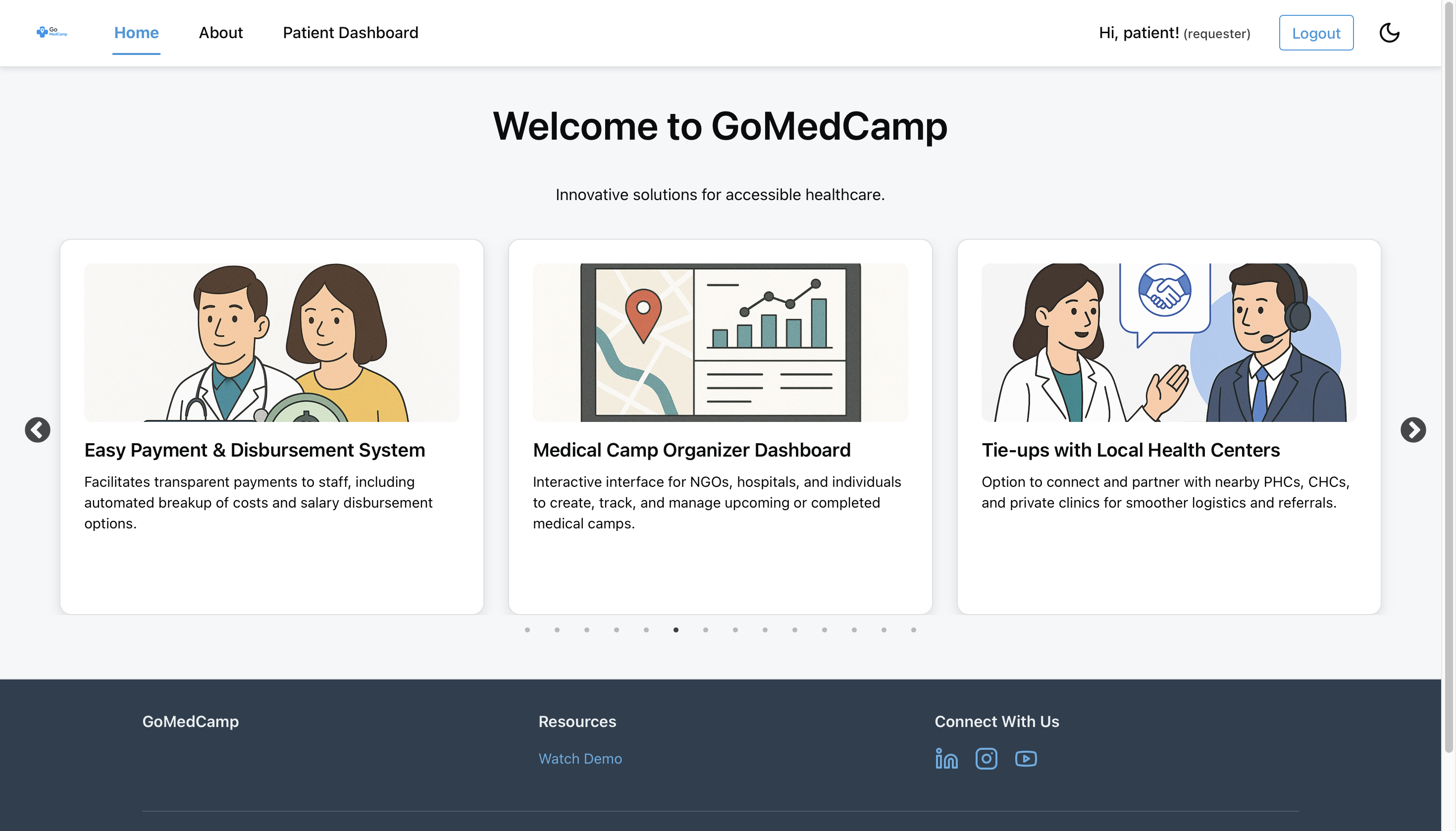
home page
-
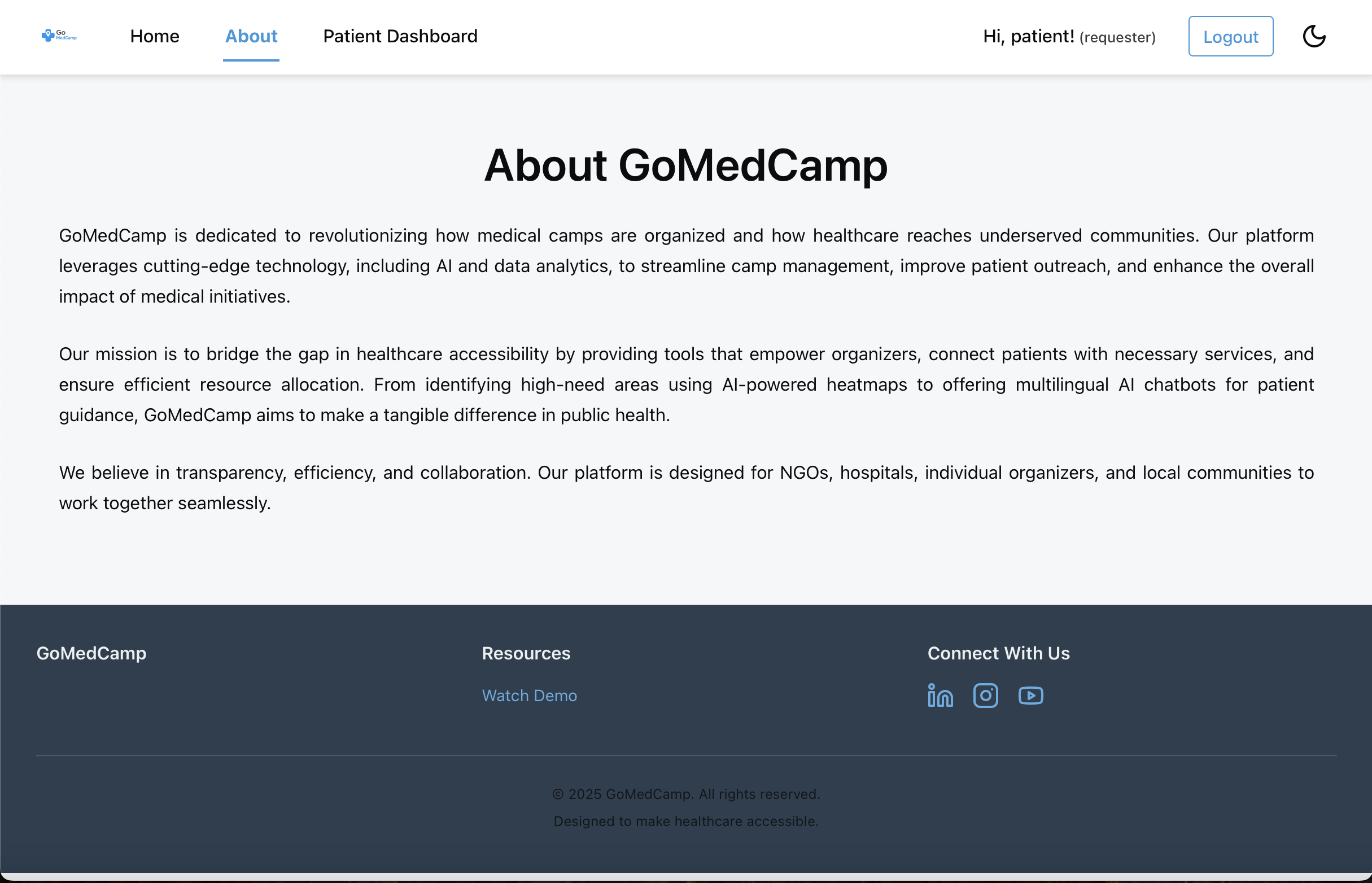
about section
-
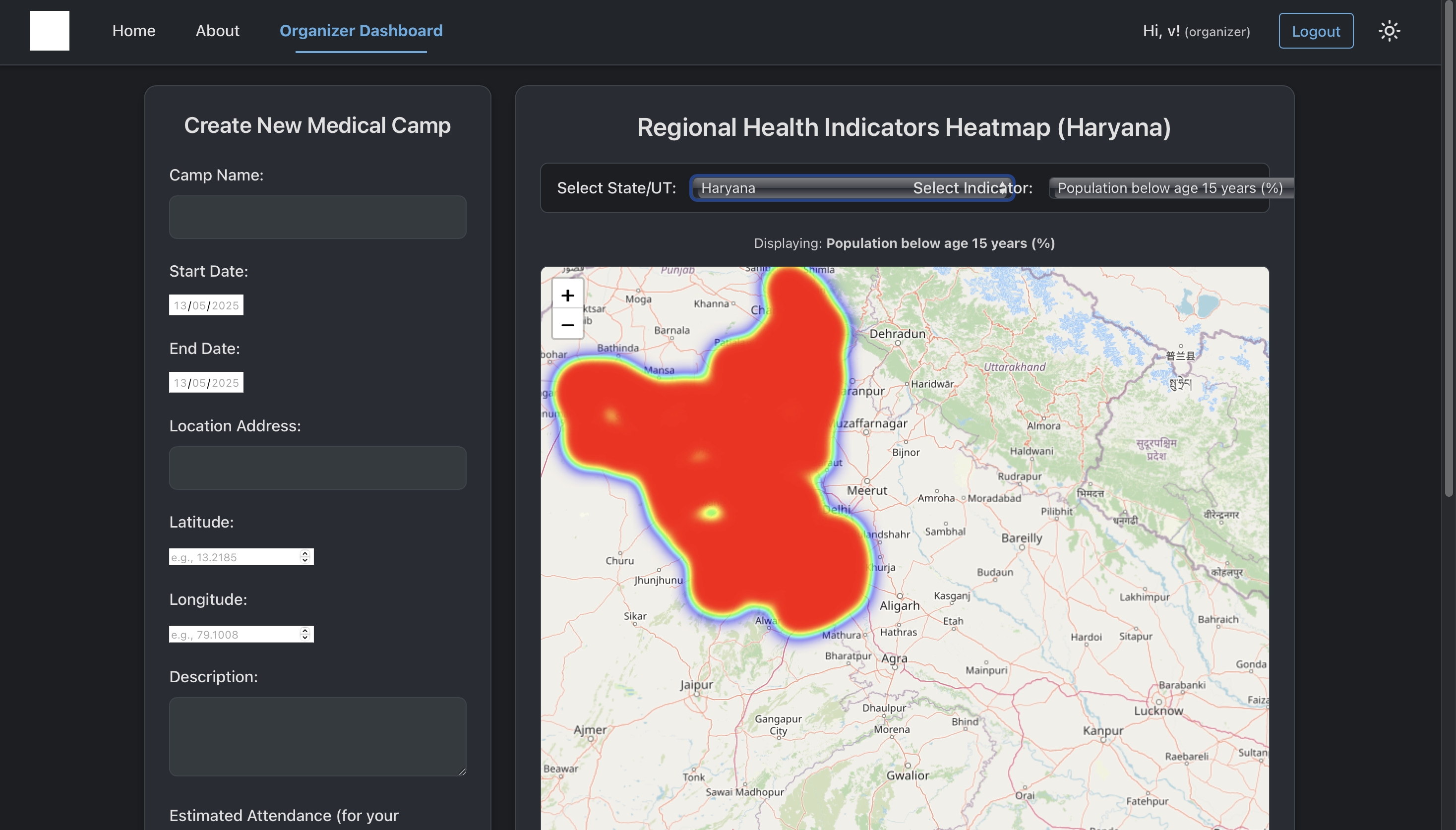
organizer dashboard
Inspiration
GoMedCamp was born from personal experience. Coming from a family deeply involved in the medical field, I witnessed firsthand the challenges faced in organizing and managing medical camps. My mother, a dedicated nursing officer in the DEIC (District Early Intervention Centre) department, has spent years coordinating camps across rural and underserved areas. I’ve seen her struggles with logistics, data handling, patient registration, and follow-ups.
Meanwhile, my father—a doctor and a medicine business owner—has been directly involved in attending and supporting these camps. I often observed the inefficiencies, manual documentation issues, and lack of structured follow-up in their work. This close exposure planted the idea in my mind: there must be a better, smarter, and more accessible way to conduct medical camps.
What it does
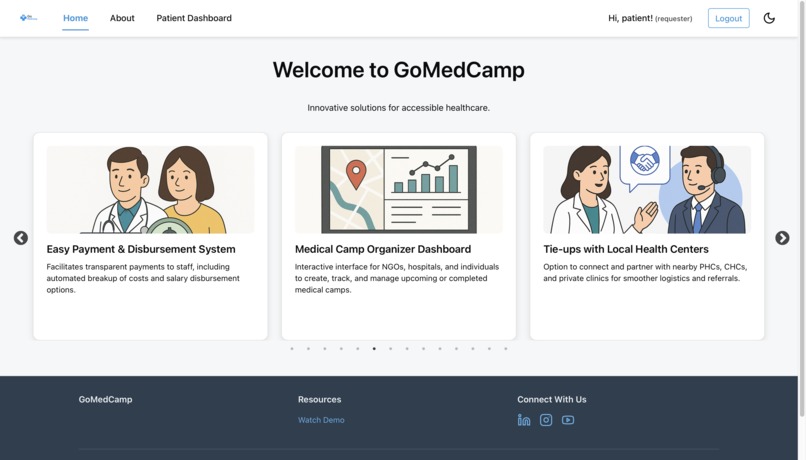
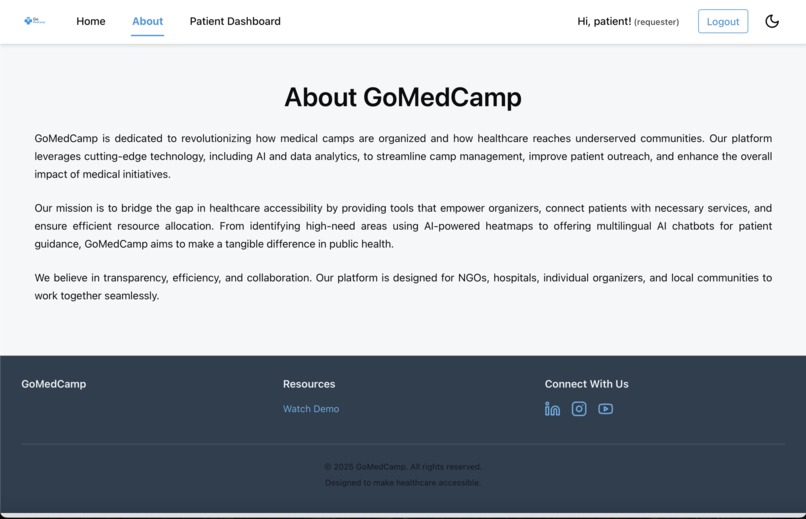
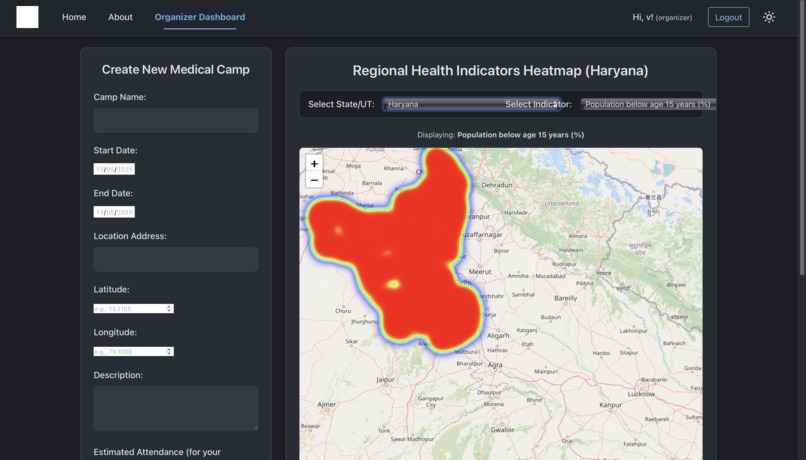
GoMedCamp is a smart healthcare platform designed to digitize and streamline medical camp organization, enhance patient care, and bring accountability and analytics to healthcare delivery in rural and underserved regions. The platform includes features like smart referrals, doctor/staff management, live analytics dashboard, document upload, follow-up tracker, and a local representative request system—each crafted to solve a real challenge faced in on-ground camp operations.
How we built it
I built it with passion, hardwork and technologies like
A React-based frontend integrated with OpenStreetMap to track and display active and upcoming camps. A powerful AI-guided chatbot for patients that offers multilingual support and real-time assistance. A robust Python backend using multiple health-related libraries (detailed in requirements). A PostgreSQL database to manage users, camps, prescriptions, documents, analytics, and referrals.
Challenges we ran into
Designing for Rural Use-Cases: Ensuring the platform is usable by low-tech users, in low-bandwidth areas, and across multiple regional languages. Map and Location Integration: Integrating OpenStreetMap with dynamic camp data updates was technically complex. Real-Time Chatbot Support: Making the AI chatbot functional across devices and languages demanded intricate logic design and fallback mechanisms. End-to-End Data Handling: Linking patient registration, diagnosis, referrals, documents, and prescriptions into one seamless workflow was challenging. Financial Constraints: With no external funding, we had to rely entirely on free tiers of services and self-hosted tools, which limited advanced functionalities. Storage Limitations: Uploading and managing scanned documents, prescriptions, and medical histories required careful data compression and cleanup strategies. Hosting and Deployment: Deploying both frontend and backend under resource-limited environments while maintaining uptime and security posed significant hurdles. Time Pressure: Managing scope and implementation within the hackathon time frame pushed us to rapidly prototype and make hard prioritization decisions.
Accomplishments that we're proud of
Building a Complete End-to-End System Within Days We successfully created a fully functional, integrated platform that covers everything from camp setup and patient registration to AI-based follow-up—within the tight timeline of the hackathon. Solving Real-World Healthcare Challenges Our solution directly addresses inefficiencies faced by field health workers, doctors, and rural patients. We’re proud to have built something with real, tangible impact potential, inspired by actual frontline experiences. OpenStreetMap Integration for Camp Mapping We integrated a map system that allows camps to be visualized in real time—bringing clarity, direction, and efficiency to ground-level operations. Multilingual Support for Inclusive Access We designed the chatbot and interface to be adaptable to regional languages, ensuring accessibility for users from rural and non-English-speaking backgrounds. Smart Referral and Follow-up Tracker We developed an intelligent follow-up system that not only tracks patient journeys across camps but also allows for better health outcomes through reminders and continuity of care. Self-Funded and Resource-Conscious Execution Despite facing financial and infrastructure limitations, we maximized free tools and efficient libraries to achieve a scalable and secure system—showcasing our ability to innovate under constraints. Insightful Analytics Dashboard The analytics and reporting module provides stakeholders with actionable insights into camp performance, patient demographics, and treatment outcomes—something traditionally done with pen and paper. Intuitive Design for Low-Tech Users We created a simple, responsive UI that health workers with minimal tech experience can use comfortably—without training. Strong Personal Motivation Turned Into a Tech Solution Most importantly, we turned a personal problem—seen at home every day—into a real digital solution, bridging the gap between healthcare and technology
What we learned
Throughout the project, we learned:
Real-world healthcare operations: Learning the camp flow, staff hierarchy, common pain points, and regulatory standards. Map integrations using OpenStreetMap APIs. Building real-time responsive UIs with React and managing state across components effectively. Structuring backend systems for scalability, ensuring data security and performance. Designing with accessibility in mind, especially for multilingual and rural users.
What's next for GOMEDCAMP
Deployment in Real-World Camps We plan to collaborate with government health departments, NGOs, and local hospitals to pilot the platform in real medical camps—starting with areas where maternal and child health camps are regularly held. Mobile App Development To increase accessibility for rural health workers and patients without laptops, we're working on launching Android and iOS versions of GOMEDCAMP with offline-first support. Integration with Government Health Portals We aim to integrate with national health records (like ABDM in India) and schemes like Ayushman Bharat for seamless record-keeping and insurance validation. AI-Powered Diagnosis and Triage We’re planning to integrate AI modules that can pre-diagnose symptoms entered by patients or frontline workers to guide them to appropriate specialists more efficiently. Data Encryption and HIPAA-Compliant Security As we scale, our next steps include implementing end-to-end encryption and strict role-based access control to ensure secure and compliant handling of medical data. Smart Inventory & Medicine Refill Tracking We're building a module to track medicine usage and refill needs during camps so that shortages can be predicted and prevented. Regional Language Expansion We'll continue expanding language support with speech-to-text features to serve a broader demographic, including tribal and remote communities. Hosting on Scalable Infrastructure After the prototype, we plan to migrate to a cloud infrastructure (like AWS or GCP) to support larger data volumes and concurrent users efficiently. Public Health Insights for Policymakers With more data, we aim to generate health trends and dashboards that can help policymakers target regions with recurring health issues or low follow-up rates. Open-Source Collaboration GOMEDCAMP is something we want to open-source—so others in the health-tech space can contribute to it, localize it, and scale it in different geographies.
Built With
- axios
- bootstrap
- click
- css
- flask
- flask-cors
- geopy
- gunicorn
- html
- itsdangerous
- javascript
- jinja
- json
- leaflet.js
- markupsafe
- matplotlib
- numpy
- openstreetmap
- pandas
- postgresql
- psycopg2
- python
- pytorch
- pytz
- react
- requests
- setuptools
- six
- tzdata
- werkzeug


Log in or sign up for Devpost to join the conversation.