Inspiration
We arrived at the OpenAI Build Week hackathon in Israel with a simple thought: how amazing would it be to walk through the places connected to a film, series, or book you truly love?
Stories stay with us for years, but the places behind them are scattered across maps, databases, fan pages, and travel blogs. We wanted to bring those worlds together and turn them into something people could experience outside the screen or the page.
That idea became GloryMap: an application that discovers meaningful story locations, builds a real walking route between them, and turns the walk into an engaging AI-guided journey.
What it does
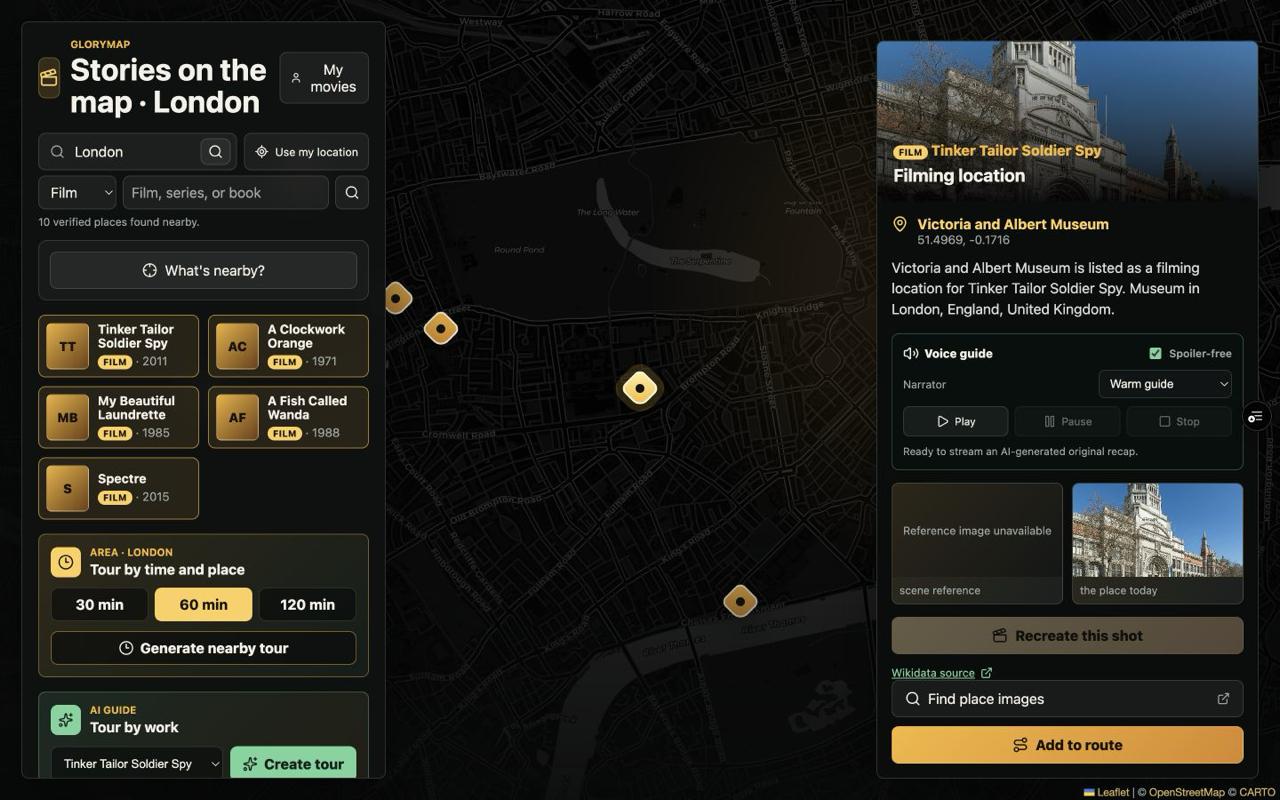
GloryMap is an interactive map for films, TV series, and books.
Users can:
- Search any city and explore verified filming locations and literary settings.
- Search for a specific film, series, or book within the selected city.
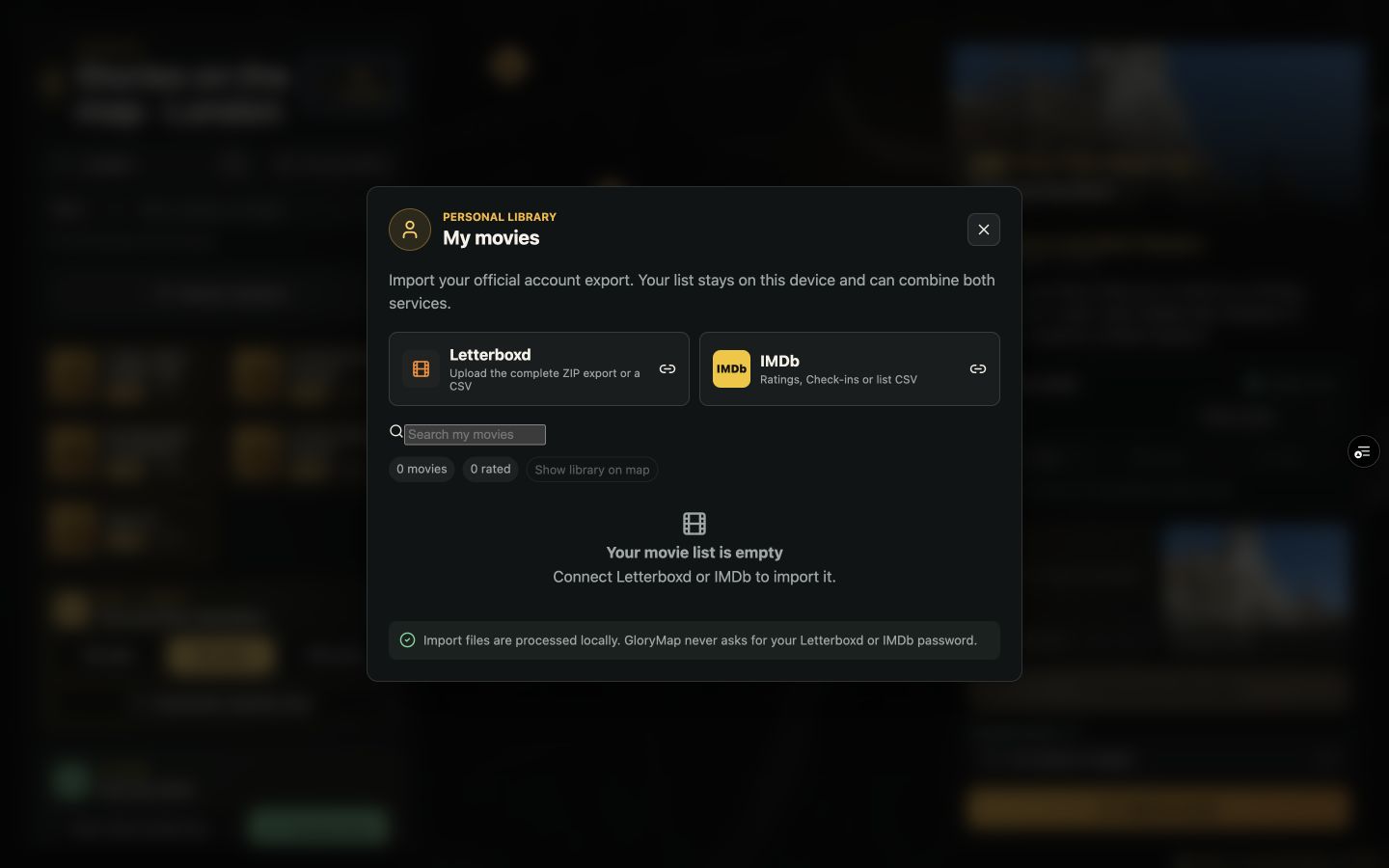
- Import a Letterboxd ZIP or Letterboxd/IMDb CSV to personalize the map. These files are processed locally in the browser.
- Open location cards with story context, source links, present-day photos, and AI-matched scene references.
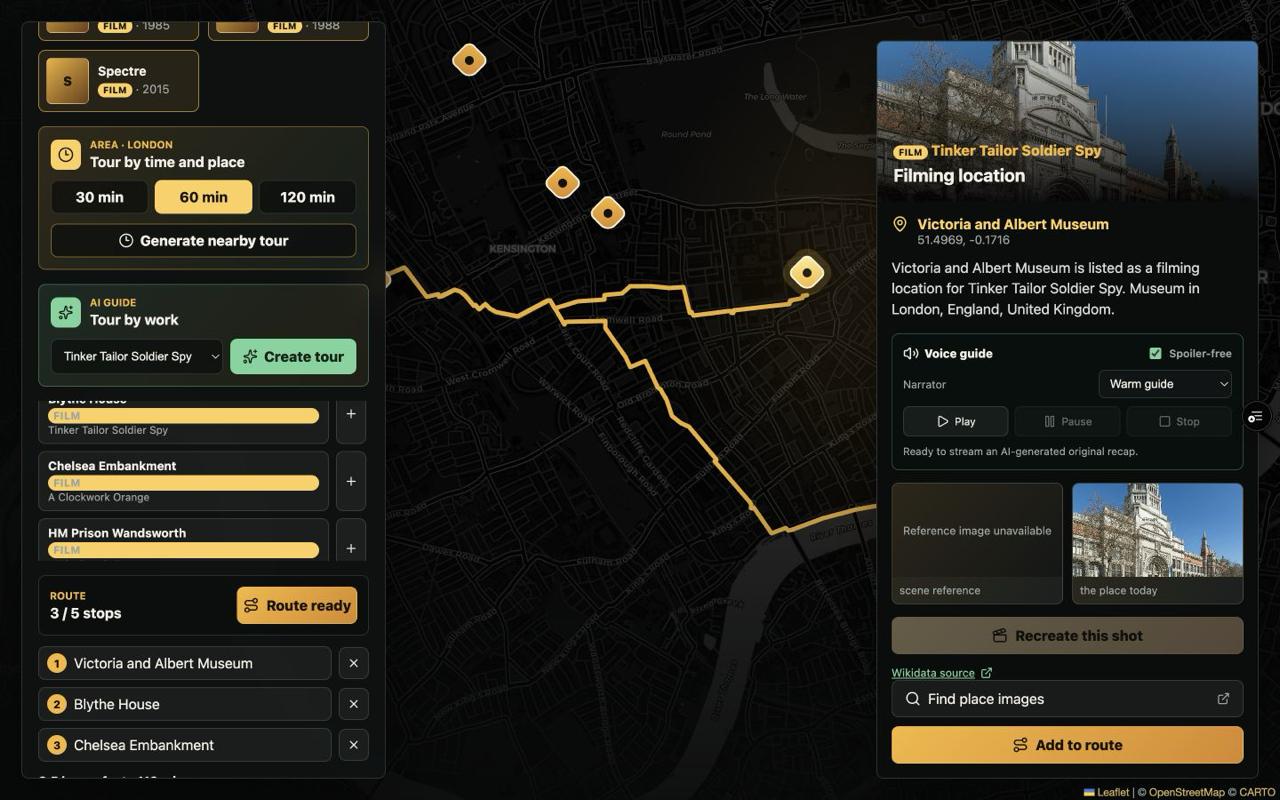
- Select 3–5 locations and build a real walking route with distance and duration.
- Generate a nearby tour for a 30, 60, or 120-minute time budget.
- Receive an AI-written, spoiler-aware guide for every stop.
- Listen to the tour using OpenAI-generated narration.
- Upload a local photo and use an adjustable overlay to recreate a scene without sending the image to our server.
How we built it
GloryMap is a Next.js and React application deployed on Vercel. Leaflet and OpenStreetMap power the interactive map, Wikidata connects stories with real places, TMDB supplies film imagery, and pedestrian routing creates walkable tours.
GPT-5.6 researches source-backed locations when structured data is incomplete and generates engaging tour narratives using only verified places and facts. Structured Outputs and application-level validation prevent missing, duplicated, reordered, or invented stops. OpenAI vision conservatively matches scenes to locations, while text-to-speech turns the guide into an audio experience.
ChatGPT and Codex were the foundation of our development process. ChatGPT helped us shape the product concept, user journey, and storytelling. Codex translated that vision into a working product: it implemented the interface and API routes, integrated data sources, investigated live failures, wrote regression tests, and verified the deployed experience in a real browser.
With this AI-native workflow, we built the first complete end-to-end version of GloryMap in approximately three focused hours—from the initial idea at the hackathon in Israel to a working map, real walking routes, and an AI guide.
Challenges we ran into
The hardest challenge was data quality. Filming locations, narrative settings, images, and coordinates come from different sources and do not always agree. We addressed this with strict schemas, geographic boundary checks, source links, conservative confidence thresholds, and honest fallbacks instead of presenting uncertain information as fact.
Another challenge was building tours that fit a real time budget. Straight-line distance was not enough, so GloryMap validates candidate stops against actual walking routes and accepts them only when the calculated duration fits the selected budget.
We also had to preserve privacy while supporting personal libraries. Letterboxd and IMDb exports are parsed locally, and GloryMap never asks for account passwords or uploads the imported files.
Accomplishments that we're proud of
- A complete journey from personal library to real-world walking tour.
- Support for films, TV series, and books across different cities.
- Grounded AI research with visible supporting sources.
- Structured GPT-5.6 output with application-level validation.
- Real walking routes instead of simple straight lines between pins.
- Privacy-first local Letterboxd and IMDb imports.
- Graceful fallbacks when an AI service or external data source is unavailable.
- 89 automated tests plus production builds and real-browser verification.
What we learned
We learned that AI travel experiences become useful only when generation is constrained by verified data. Structured Outputs, source validation, geographic checks, and deterministic routing were just as important as the model itself.
We also learned that Codex is most effective as an active engineering collaborator: not only writing code, but reproducing failures, comparing possible fixes, running tests, and checking the deployed result.
What's next for GloryMap
Next, we want to expand location coverage, improve support for personal book and series libraries, add collaborative tours, and make the mobile walking experience even smoother. Our long-term vision is a living map where every city can be explored through the stories that matter to each person.
Built With
- api
- codex
- gpt-5.6
- javascript
- jszip
- leaflet.js
- letterboxd
- next.js
- openai
- openstreetmap
- outputs
- react
- responses
- search
- structured
- text-to-speech
- tmdb
- vercel
- web
- wikidata
- zod


Log in or sign up for Devpost to join the conversation.