-
-
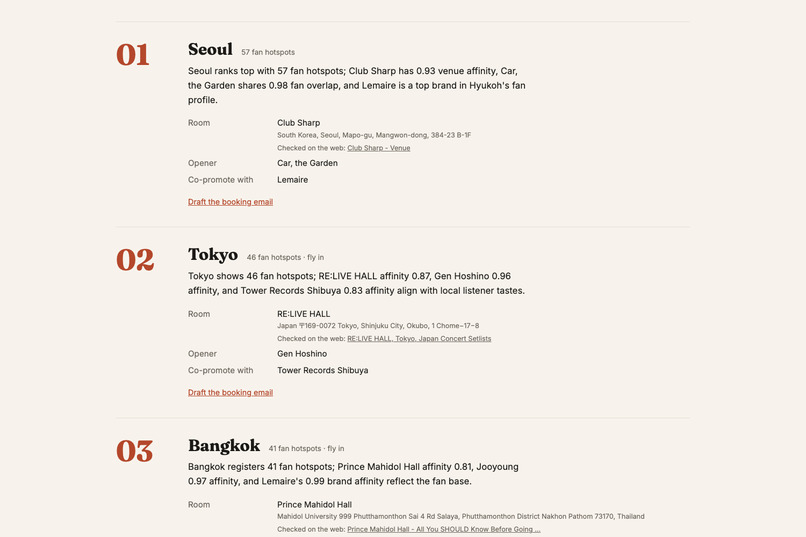
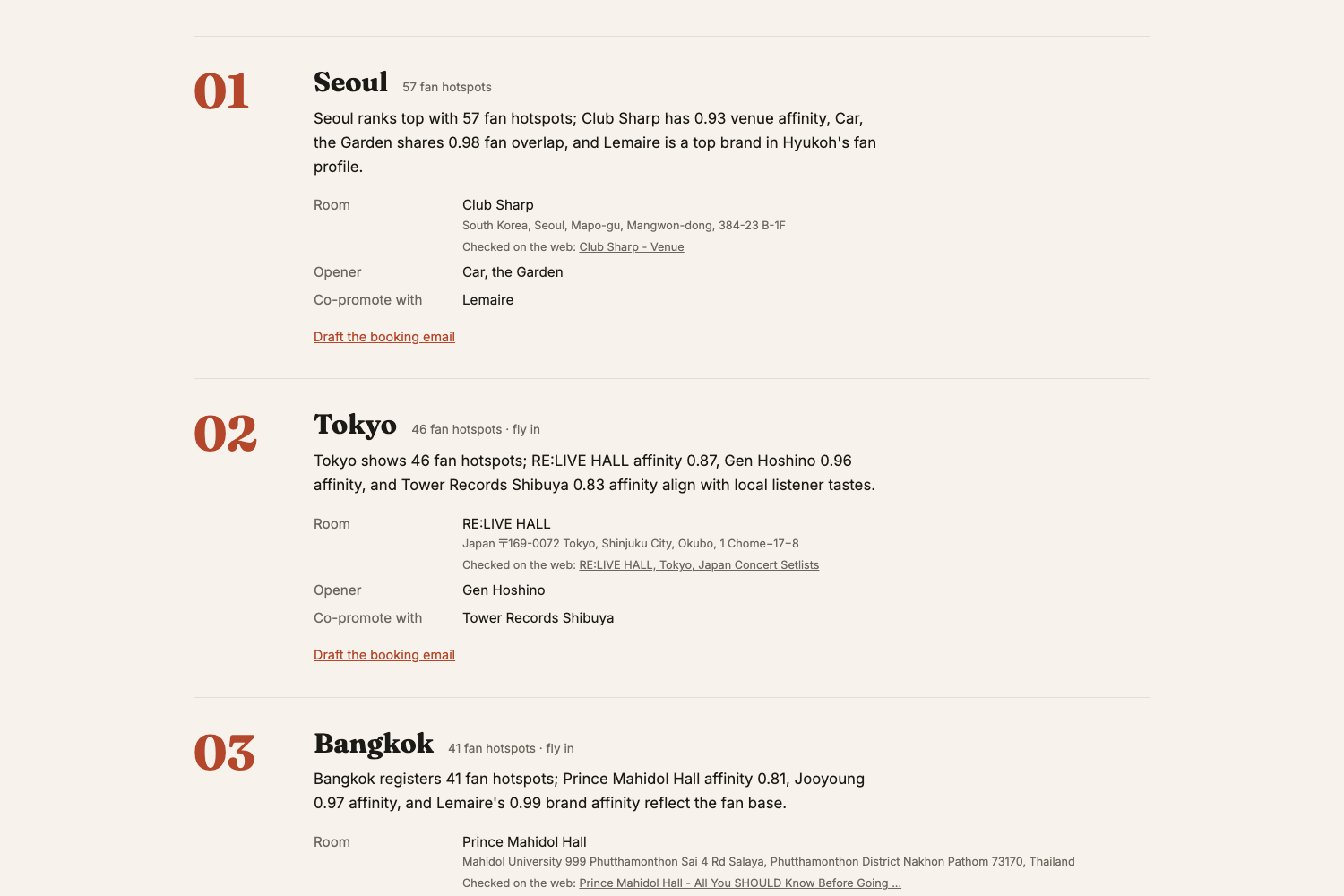
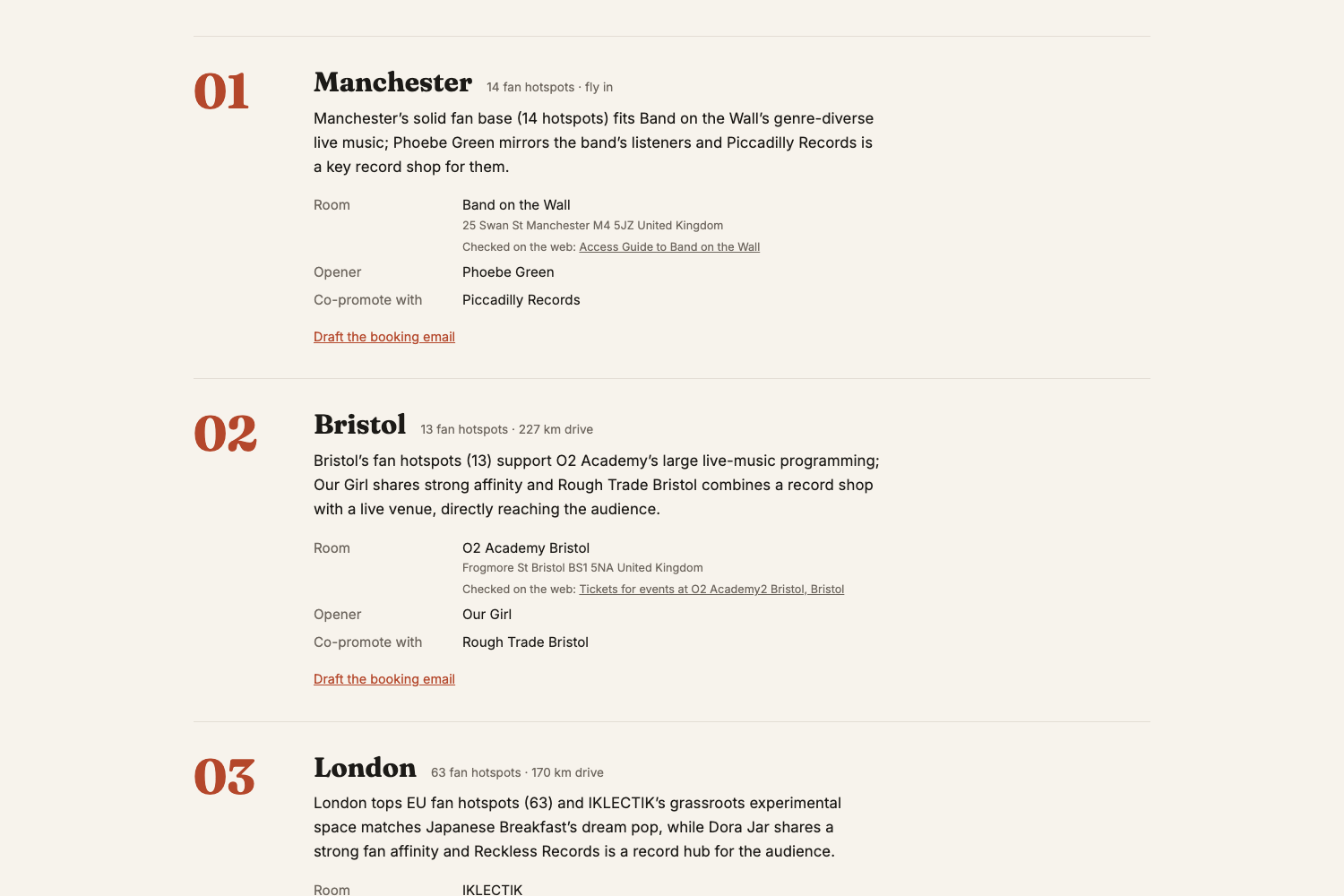
Each room carries the page Tavily found for it, with the Qloo evidence for the room, opener and partner.
-
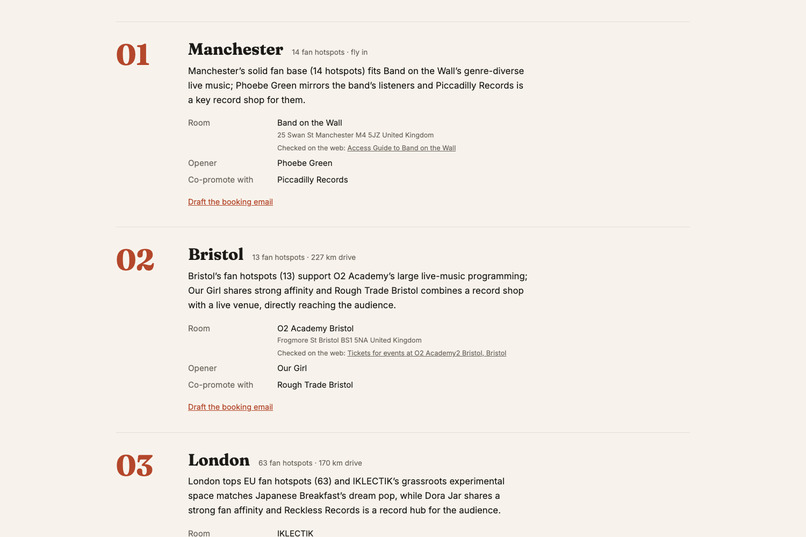
Japanese Breakfast in Europe on Nemotron: Manchester, Bristol, London, Berlin, Milan, each room checked on the web.
-
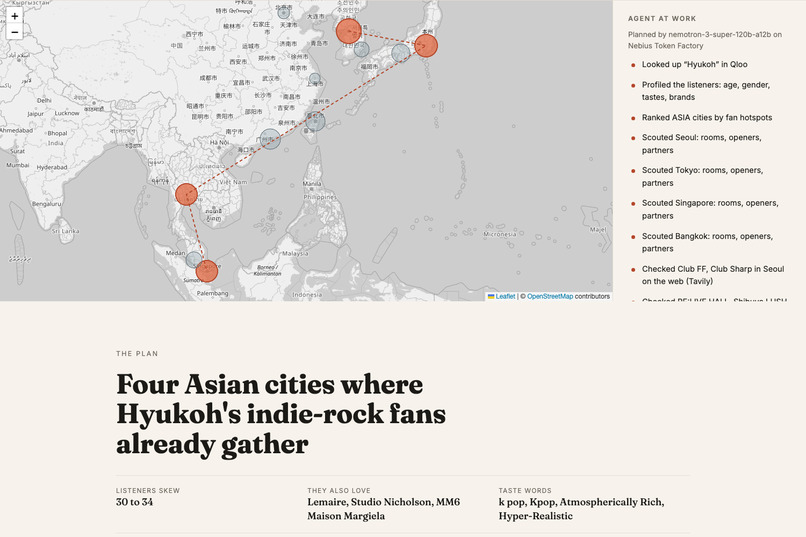
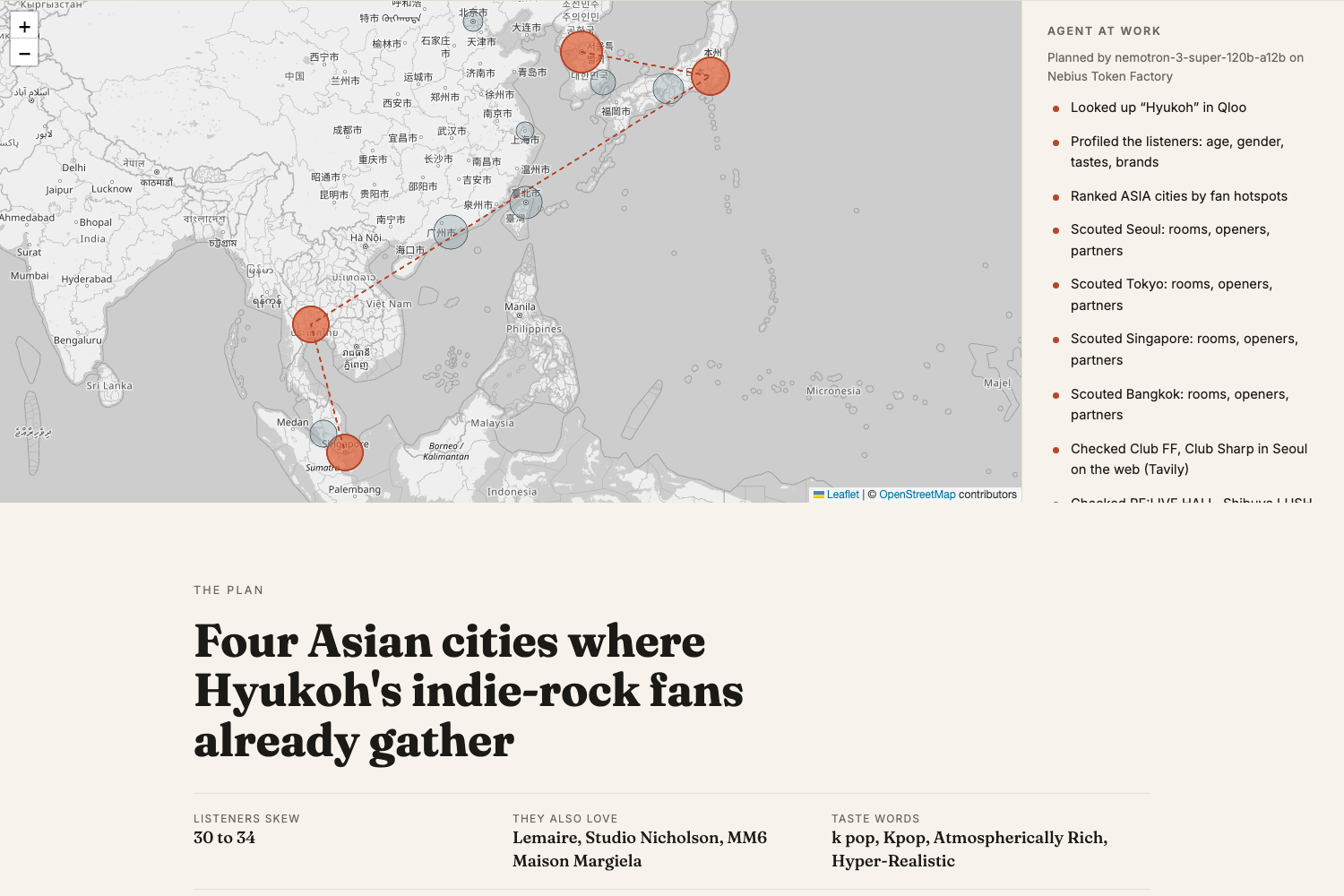
HYUKOH in Asia: fan hotspots from Qloo heatmaps on the map, and Nemotron's tool calls as it works, ending with Tavily checks.
-
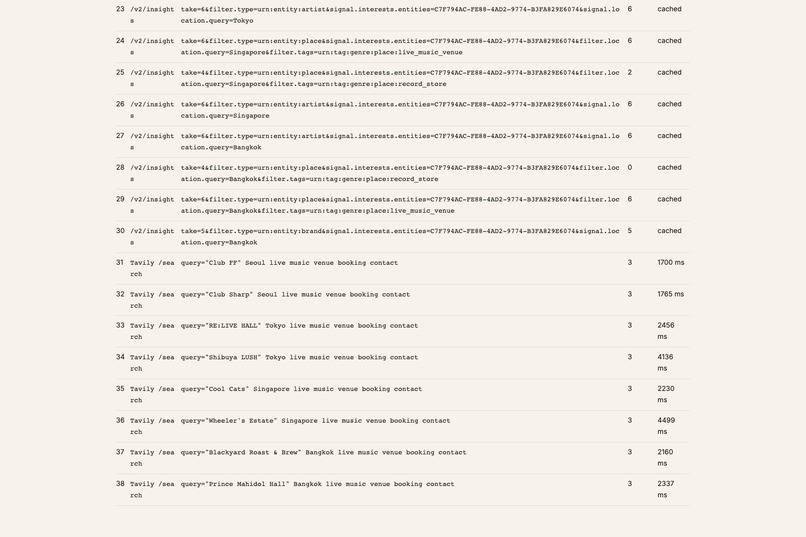
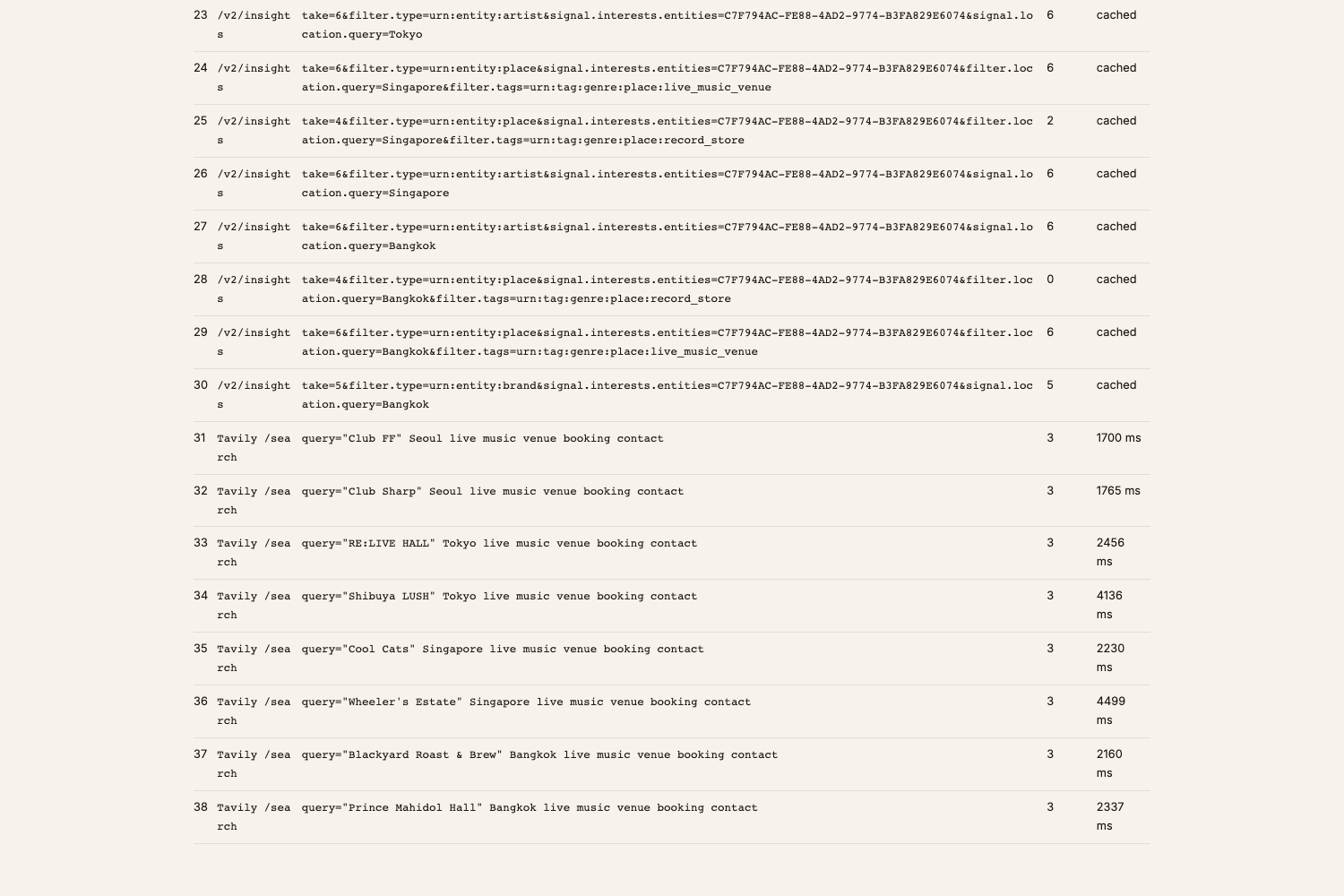
Provenance: every Qloo and Tavily call behind the plan, with parameters, result counts and timing.
-
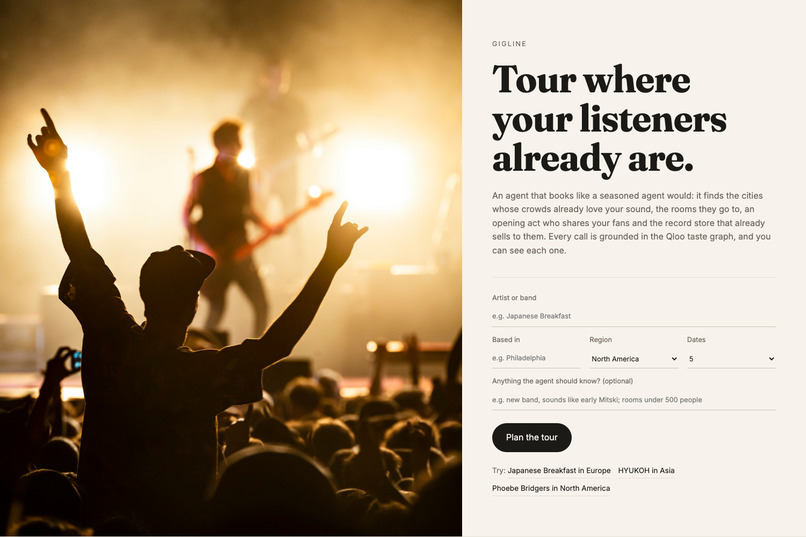
The brief: artist, home city, region, number of dates and an optional note. Three examples replay real Nemotron plans.

Why
A touring agent's value is market knowledge: which cities hold an act's listeners, which rooms those listeners go to, who could open. An act without an agent has to guess, and a guessed route costs fuel, hotel nights and empty rooms. Gigline asks those questions in order with data, and shows the evidence for every pick so the band can check it.
What it does
Type the act, the home city, the region, the number of dates and an optional note ("rooms under 1,000 people"). An agent
on NVIDIA Nemotron 3 Super, served by Nebius Token Factory, works through the Qloo taste graph step by step in front of
you: find the act, profile the listeners, ask the heatmap where they are (country by country, rolled up to touring
cities), then rooms, openers and record stores per city. Before it commits to a room it calls verify_venues: a
Tavily web search for that room in that city, keeping the page it found. The plan is one stop per date, routed from
home, each with a room, an opener, a partner, one sentence of Qloo evidence, and the room's web source or a plain
warning ("Not found on the web. Confirm the room before you write."). A provenance table lists every Qloo and Tavily call.
How we built it
- Agent loop on Cloudflare Workers, one step per HTTP request, so the browser shows each step as it happens.
src/llm.js: Nemotron through Token Factory's OpenAI-compatible chat completions with tool calling, modelnvidia/nemotron-3-super-120b-a12b(confirmed throughGET /v1/models). The same loop runs on Workers AI for the Qloo hackathon entry, so the model is one environment variable away.src/tavily.js: one Tavily search per room, cached, and a name match before a result counts as found.- Code checks around the model: rooms must sit within 60 km of the touring city in Qloo's own coordinates (Qloo matched "Glasgow" to Glasgow, Kentucky once), an act never opens for itself (HYUKOH's suggested opener was its own singer), rooms whose Qloo description says live music come first, and a plan with gaps is completed from the heatmap ranking.
Real runs on Nemotron (live deployment, 2026-10-18)
| Brief | Plan | Model calls / time | Tokens in / out | Rooms found on the web |
|---|---|---|---|---|
| HYUKOH, from Seoul, Asia, 4 dates | Seoul (Club Sharp), Tokyo (RE:LIVE HALL, Tower Records Shibuya), Bangkok (Prince Mahidol Hall), Singapore (Wheeler's Estate, Choice Cuts Pizza & Records) | 12 / 53 s | 54,725 / 2,097 | 4 of 4 |
| Japanese Breakfast, from Philadelphia, Europe, 5 dates | Manchester (Band on the Wall), Bristol (O2 Academy Bristol, Rough Trade Bristol), London (IKLECTIK), Berlin (LARK), Milan (Magnolia) | 14 / 57 s | 77,870 / 3,763 | 4 of 5 (IKLECTIK flagged) |
What changed during the hackathon period
Gigline started on Oct 13, 2026, after this hackathon opened. For this entry we added the Nemotron provider on Token Factory, the Tavily room checks with source links and warnings in the UI, a separate deployment that runs on Nemotron, and the real-data fixes above.
Challenges
- Before the Qloo key arrived we built against a mock; the real data then exposed Glasgow, Kentucky, a band opening for itself, and hostels tagged as live-music venues. Each became a code check rather than a prompt instruction.
- Tool-calling plans run 12-14 model calls with growing context (55k-78k input tokens per plan), so the plan cache matters: example plans replay instantly, and only new briefs call the model.
Disclosure
Built by a solo developer in Korea with an AI coding agent (Claude Code). English text was written with AI assistance.
Built With
- cloudflare-workers
- javascript
- leaflet.js
- nebius-token-factory
- nvidia-nemotron
- openstreetmap
- qloo
- tavily

Log in or sign up for Devpost to join the conversation.