Forever Guesser
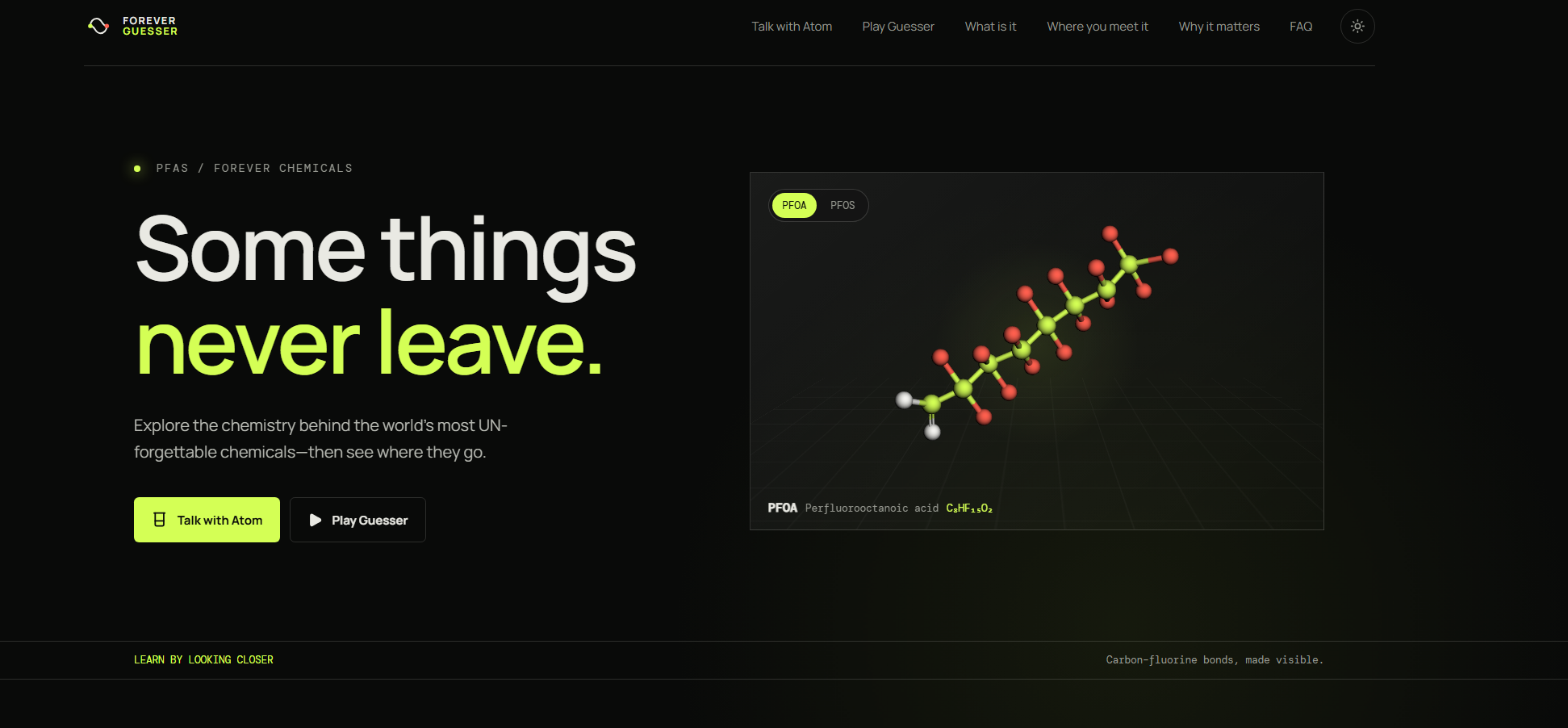
Built unbreakable. Now unavoidable. Scientists call PFAS the forever chemicals for a reason. PFAS (per- and polyfluoroalkyl substances) are characterized by their carbon-fluorine bonds, among the strongest in organic chemistry and notoriously hard to get rid of. These molecules are everywhere you look: cookware, food packaging, textiles, industrial processes, electronics… and at least 45% of US tap water. They don’t break down, so they build up in our water, our soil, and our bodies. And the damage is real: PFAS exposure is linked to cancer, immune suppression, liver damage, and developmental harm.
Inspiration
This project started close to home. One of our teammates works in a PFAS research lab, and through him we saw the many difficult questions about these chemicals that are still unanswered. Scientists are still working out how to find PFAS in the environment, how to eliminate them, or how to filter them out of things that we touch, drink, and eat everyday. Most of that work happens in dense papers and lab meetings, far from the people it affects. We wanted to bring that conversation into the open, so we built a place where anyone can see PFAS molecules, ask questions about them, and test their instincts about where they hide.
But what are PFAS Molecules?
PFAS are a family of thousands of synthetic chemicals, built on carbon and armored in fluorine. Atoms bond by sharing electrons, and the tighter the grip, the harder the bond is to break. Life runs on carbon-hydrogen bonds, think of fats, sugars, and other fuels. Man-made PFAS molecules swap those hydrogens for fluorine, forming carbon-fluorine bonds, the strongest single bond carbon can form. Many PFAS also have a split personality: a fluorinated tail that repels water and oil, and a head that is drawn to water. That combination makes them excellent at repelling but also good at spreading in water.
Okay, How About... to the Normal Person?
PFAS matter well beyond the lab. PFAS are the chemicals that make modern life slicker, tougher, and safer. They’re the reason your pan is non-stick, your rain jacket sheds water, your pizza box doesn’t soak through with grease, and firefighters can put out fuel fires that water alone can’t touch. They were built to repel almost everything and never wear out, which is exactly what made them so useful. But that strength is also their main drawback.
Relevance in the Scientific Community
While there are heavier regulations now, these “forever chemicals” have been used for decades past and they continue to persist in soil, water, wildlife, and human blood around the globe due to their chemical properties. Their spanning reach into the distant future is why PFAS research has grown into one of the most active areas of environmental science. Researchers are still working to detect these compounds at ever lower concentrations (and even routine detection remains a challenge, since standard tests screen for only a small fraction of the thousands of PFAS in existence), understand how mixtures of them affect the body, and sort out which of the thousands of variants pose the greatest risk, and recent studies show how easily some effects can be overlooked. At the same time, the scale of the problem has pushed regulators to act: the US EPA set its first enforceable drinking water limits in 2024, the Stockholm Convention has begun restricting individual PFAS worldwide (such as including PFOA in annex A), and the EU is weighing a restriction covering more than 10,000 of them.
Yet policy can only go as far as the science allows. Most current water treatment merely separates PFAS from water rather than destroying them, so chemists and engineers are racing to develop destruction methods, such as the heated sodium hydroxide in DMSO approach, that can break the bonds themselves. In short, PFAS pose many relevant discussions and sit at the intersection of chemistry, public health, and policy, and what we learn about them will shape how we regulate and manage persistent pollutants for generations.
Our Educational Platform
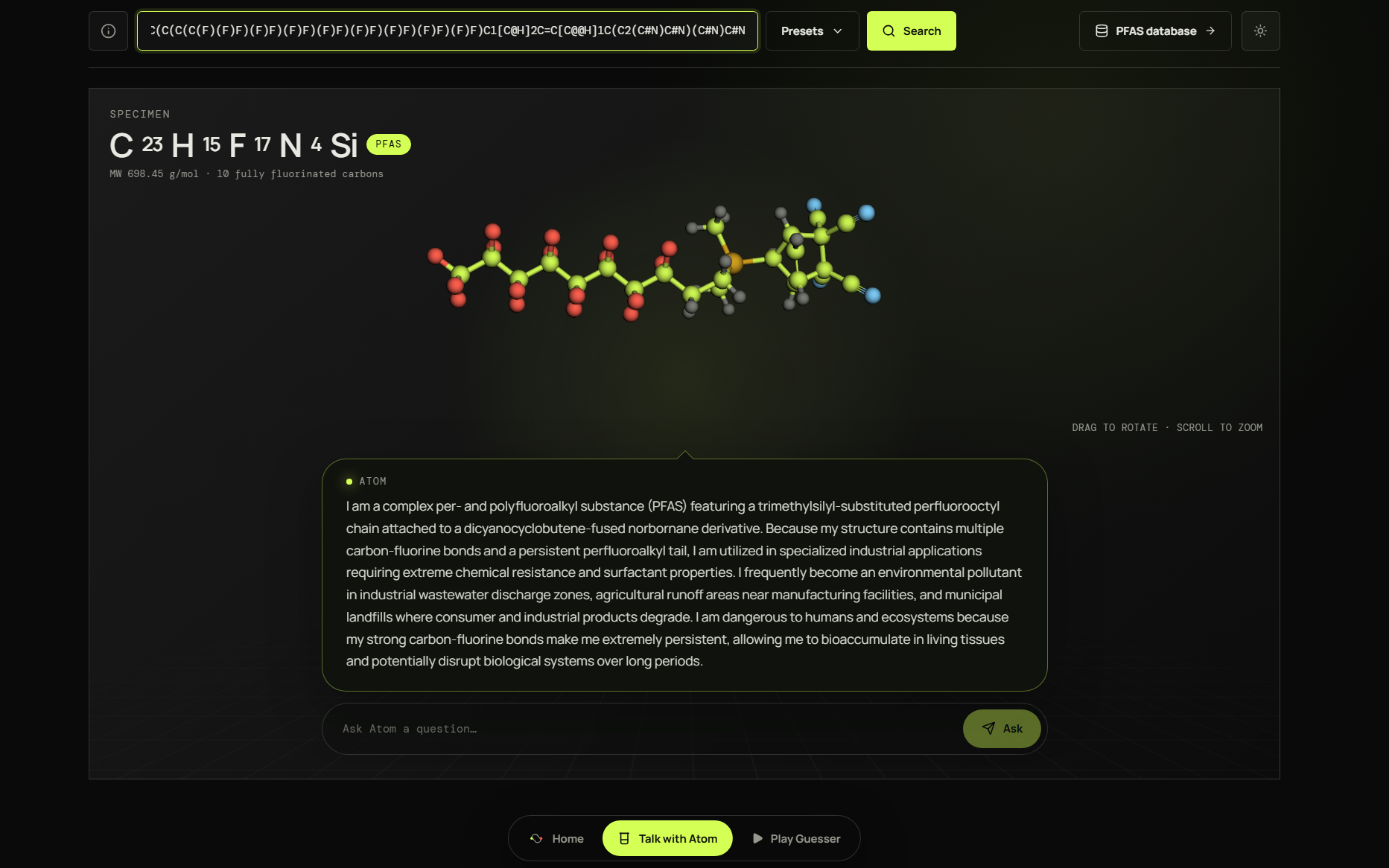
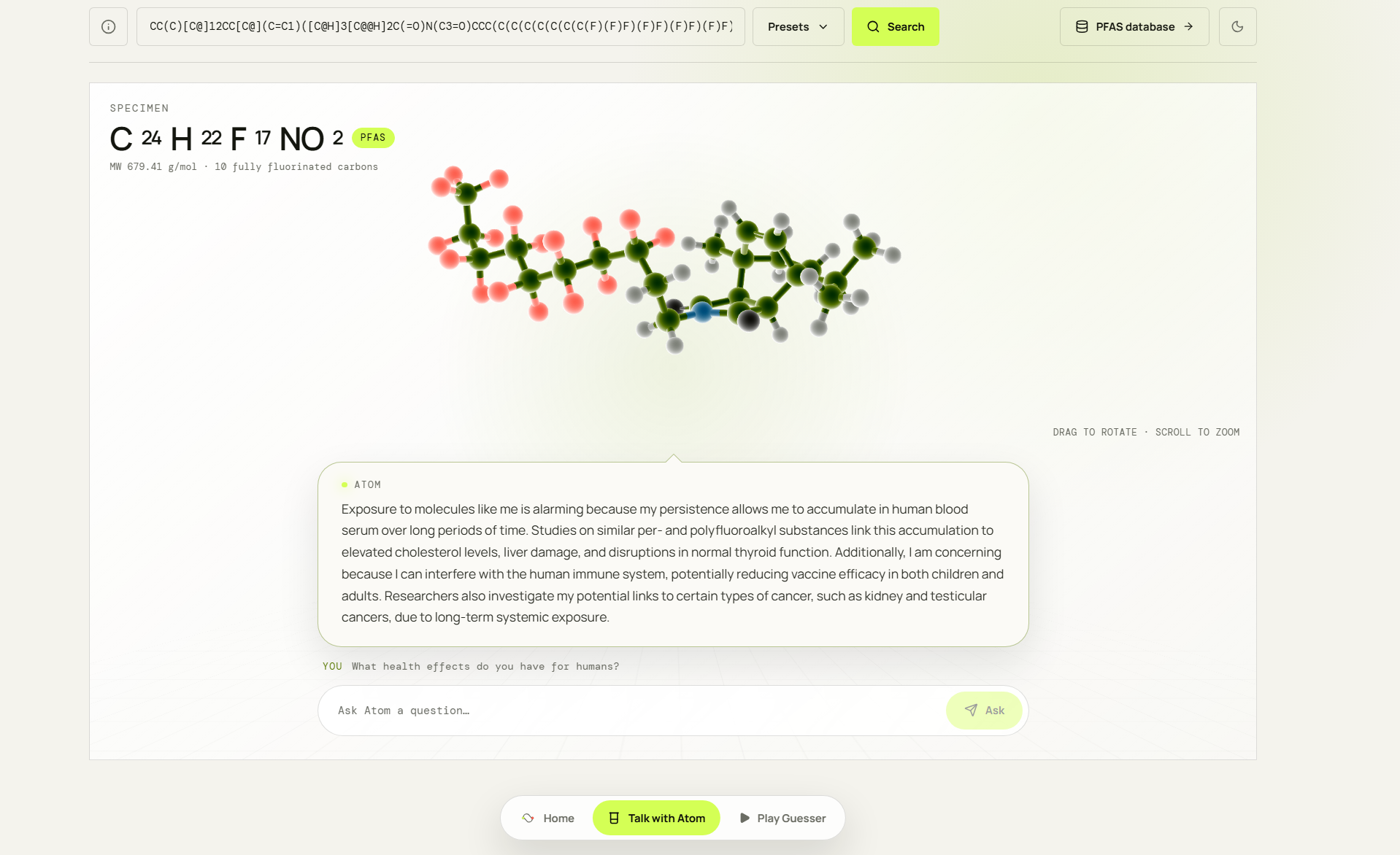
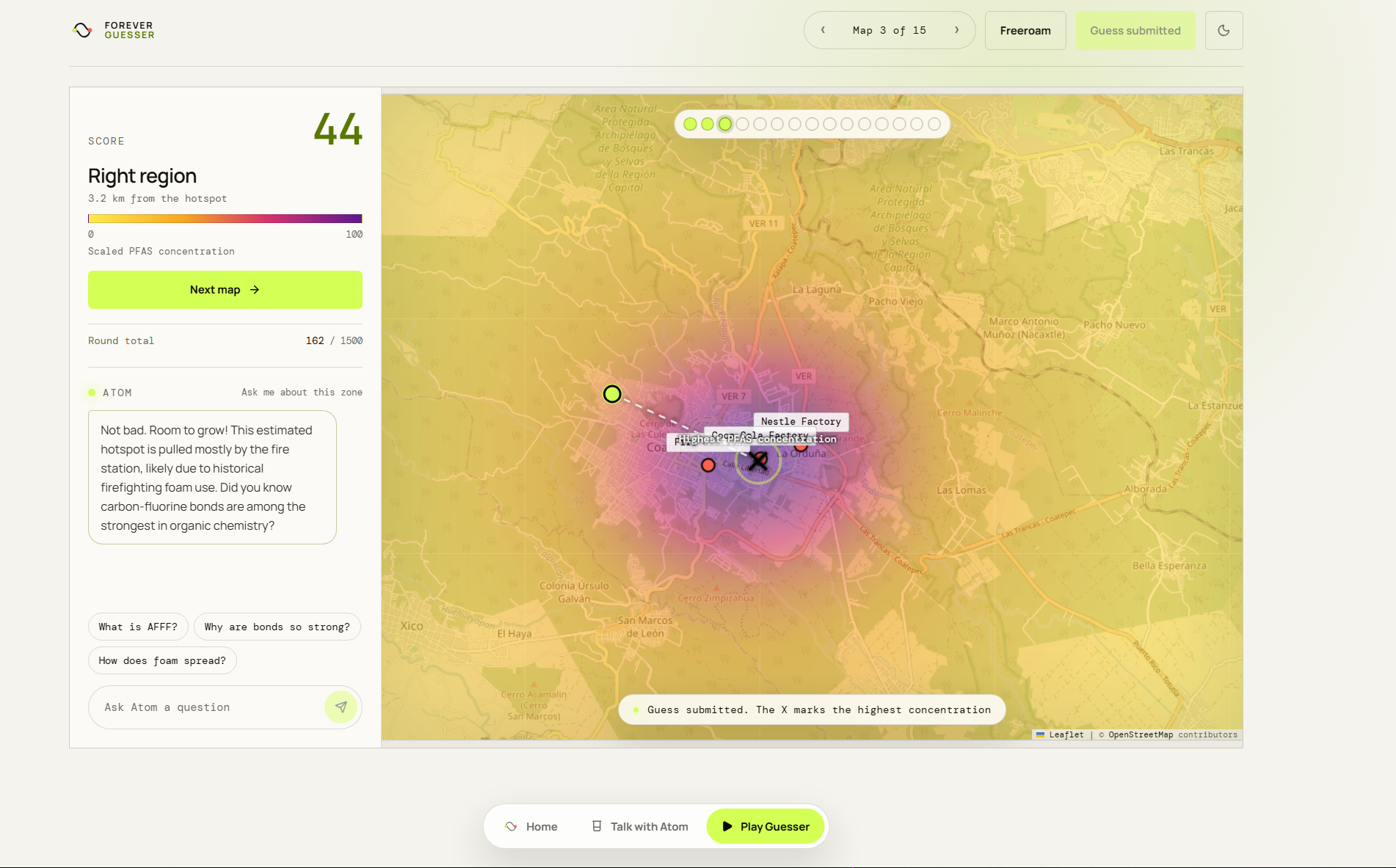
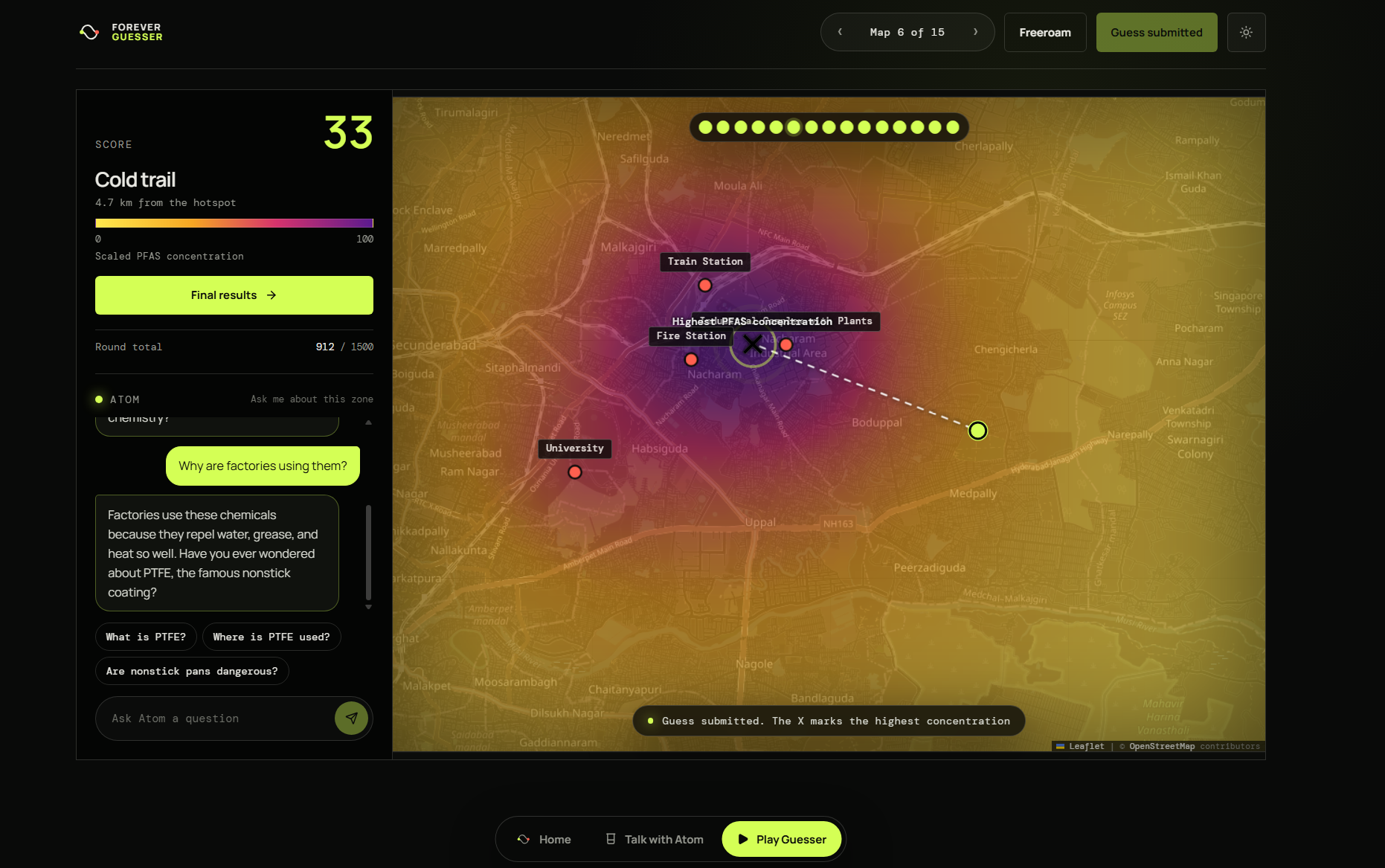
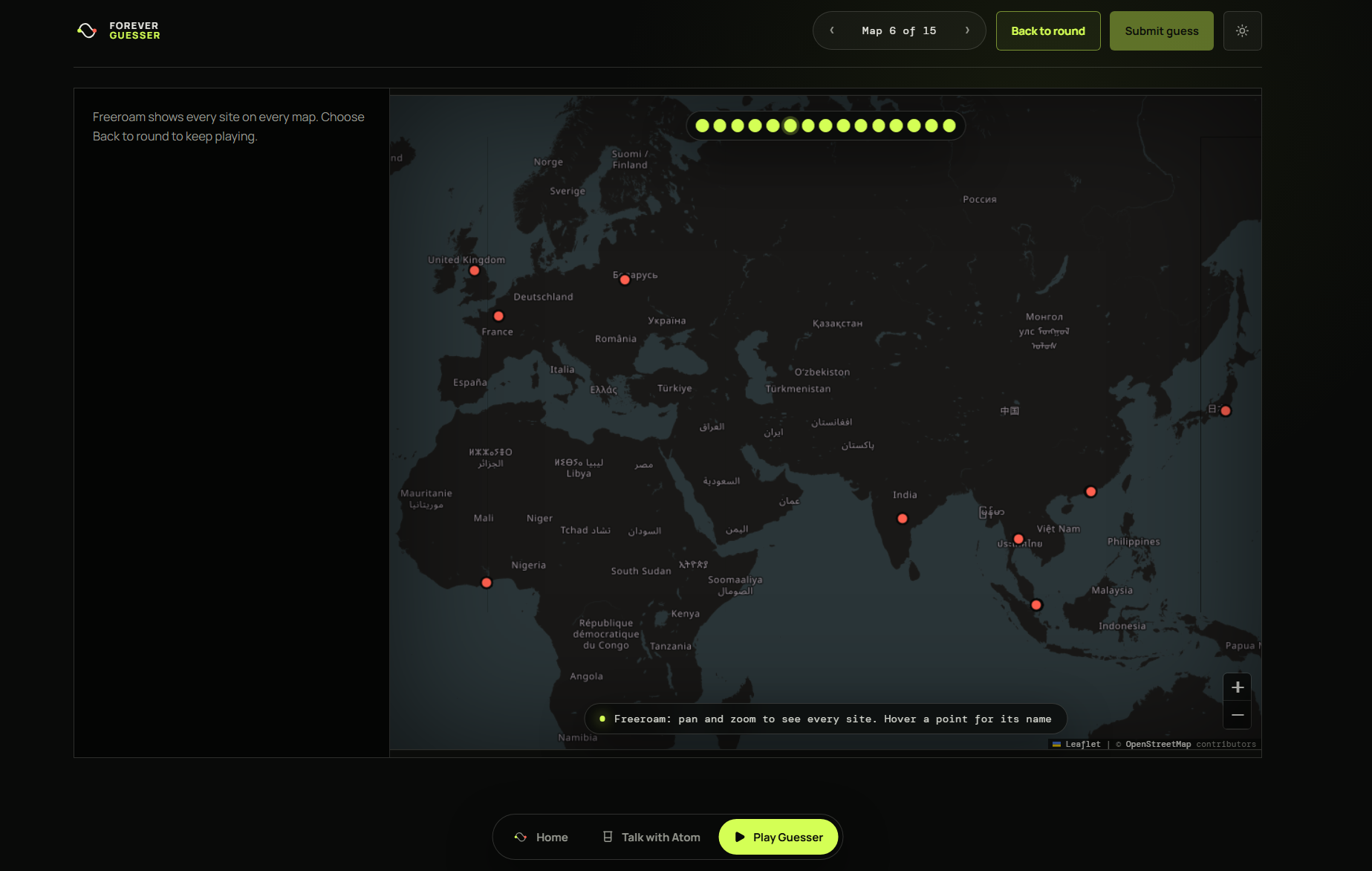
Forever Guesser turns complex science into something you can easily interact with. Talk with Atom lets you explore 3D models of any PFAS, really any molecule in general. Curious about a compound? Atom, our AI guide, can help you learn about each one and tell you how it's classified, where it lingers most, common use cases, and any other things you should know. Afterwards, test your intuition and knowledge in Guesser. You’re dropped onto one of 15 real maps worldwide. Read the landscape, from airports to fire stations to factories to landfills, then pin your guess for where PFAS pollution and contamination peaks. After your guess, we reveal a real heat map as well as your score based on the distance to the true hotspot. If you have any questions, Atom, your helpful friend, chimes in to help. He's able to explain the reasoning behind concentration levels in the heat map and can prompt follow-up questions for you to ask, so every guess, right or wrong, becomes a lesson.
Bonding with the User
Our web application is split into two halves that talk to each other. The front end is built in React and Vite, which handles everything you see and touch: the honeycomb layout of the explainer sections, the interactive 3D molecule viewer in Talk with Atom, and the map in Guesser where you drop a pin and watch the PFAS heat map reveal itself. For the UI we paired React with the Liquid-Glass-React package, this made our interfaces smooth and tight, like C-F bonds. Atom, our friendly molecule chatbot, is mostly possible due to FastAPI where he is able to communicate with our own dedicated backend server through API calls which later route even further to Google Gemini. Atom's body (the PFAS molecules that you can interact with) is made via the combination of two libraries: rdkit and 3dmol. Rdkit allows us to use SMILE strings to perfectly write complex chemical formulas while preserving their shape and 3dmol then renders them to make Atom's true self appear in front of you. Guesser, like Atom, is also written with the help of FastAPI calls to our backend. However on the front facing side, it mostly uses Leaflet and tiles from OpenStreetMap to create a world map in which you can learn to identify and recognize patterns.
Behind the Molecules
Powering it from behind is a Python backend. The backend is ran continuously along side the static website. Both of these are hosted on Render. The first thing our backend handles are calls from Atom. Here we take in the compound you enter and use 3dmol to create seamless 3D data. Along with this API call to render, we send an API call to Atom's Google Gemini (his home away from home). This allows for Google Gemini 3.5 Flash Lite to then send back an explanation for you. Guesser, too, connects to our python backend via API calls. After connecting to the backend, the Guesser tab generates a heatmap based on mathematical equations. These equations take into account real life data points, such as fire stations, airports, landfills, and other locations. Each location is weighted differently and then uses a summation formula to calculate a score from 0-100 to every spot on the Leaflet map. From here we send this data back to the front end so it can be displayed on top of the original OSM tiles. Another use case of the backend was large data manipulation. We gathered data from PubChem and while this data was helpful, it was not necessarily the cleanest. This backend implementation helped facilitate the readability of our data by rdkit and 3dmol libraries before sending it back to the frontend.
From Ideas to Atoms: Our Challenges
Building Forever Guesser meant solving problems at every layer of the stack. On the Atom side, we had to figure out how to handle user input for the AI chatbot, since open-ended questions about chemistry can go in any direction and we needed Atom to stay accurate, helpful, and on topic. Closely tied to that was managing our API calls, which had to pass cleanly and quickly from the React front end through FastAPI to our backend and on to Google Gemini. On the Guesser side, we had to balance the points of interest on the map: enough landmarks (like airports, fire stations, factories, and landfills) to give players real clues, but not so many that the map took forever to render or overwhelmed them. Calculating the heat map was another hurdle, because it had to reflect real PFAS contamination patterns while still revealing quickly and clearly after each guess. Finally, as the project grew across React, FastAPI, RDKit, and 3Dmol, simply organizing our directories and keeping track of dependencies became a challenge of its own.
Accomplishments that we're proud of
Above all, we’re proud that Forever Guesser brings attention to chemicals that are still poorly understood, giving people a clear, approachable way to learn about PFAS and why they matter in everyday life.
We’re also proud of how it feels to use the site: the interface is clean and polished, and the Liquid Glass design makes every page feel smooth and cohesive. We love that talking with Atom is whimsical and fun, since chatting with a molecule turns what could be a dry chemistry lesson into a conversation you actually want to have. We were also excited to build a web game in the spirit of daily guessing games we love, like Globle, and to tie it to real PFAS contamination data so that every guess teaches something. Finally, we’re proud of how quickly everything runs, from loading the 3D molecules and PFAS dataset to rendering the maps and revealing the heat map, so the experience stays seamless from start to finish.
What we learned
Building Forever Guesser taught us as much about science as it did about software. On the science side, we learned just how deep the PFAS problem goes: the same carbon-fluorine bonds that make these chemicals so useful are what make them nearly impossible to break down, and that most of the open questions, from detecting them at low concentrations to destroying them rather than just filtering them out, are still being worked on in labs today. Hearing about this research firsthand from our teammate in a PFAS lab showed us how much valuable knowledge never leaves academic papers, and how much a project like ours can do to bridge that gap.
On the technical side, we learned how to connect a React and Vite front end to a FastAPI backend, and how much care it takes to handle user input and API calls so a chatbot stays reliable and on topic. We learned to use RDKit and 3Dmol to turn SMILES strings into interactive 3D molecules, and Leaflet with OpenStreetMap to build a world map players can explore. Designing Guesser also taught us that performance and clarity are a balancing act. Calculating a meaningful heat map showed us how to turn real contamination patterns into something a player can understand at a glance. Finally, we learned that a clean directory structure and clear communication matter just as much as clever code when several people are building one project together.
What's next for Forever Guesser
We see Forever Guesser as a starting point, and there’s a lot we’d like to build on. First, we want to expand Guesser beyond its current 15 maps, adding more locations around the world and a daily challenge mode in the spirit of games like Globle, so players have a reason to come back each day and keep sharpening their intuition. We want to deepen the science behind the heat maps by incorporating more real-world monitoring data, so the hotspots players uncover reflect the most current picture of PFAS contamination as researchers continue to detect these compounds at lower concentrations and in more locations. We’d also love to add features like score tracking, leaderboards, and shareable results so friends can compete and spread awareness together. Longer term, we’d like to partner with researchers, educators, and public health groups so Forever Guesser can serve as a classroom resource and a bridge between the lab and the people PFAS affects most.
Built With
- css
- fastapi
- gemini
- github
- javascript
- json
- leaflet.js
- liquidglass
- mitlicense
- openstreetmap
- python
- react
- render
- vite


Log in or sign up for Devpost to join the conversation.