-
-
Cover page
-
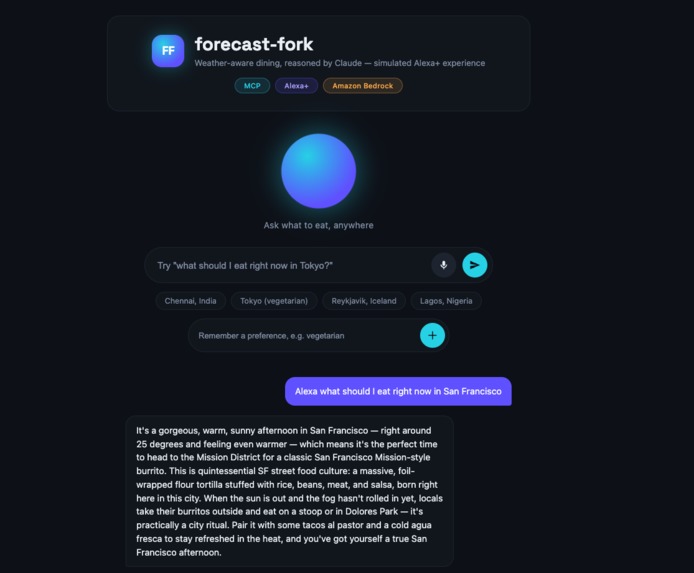
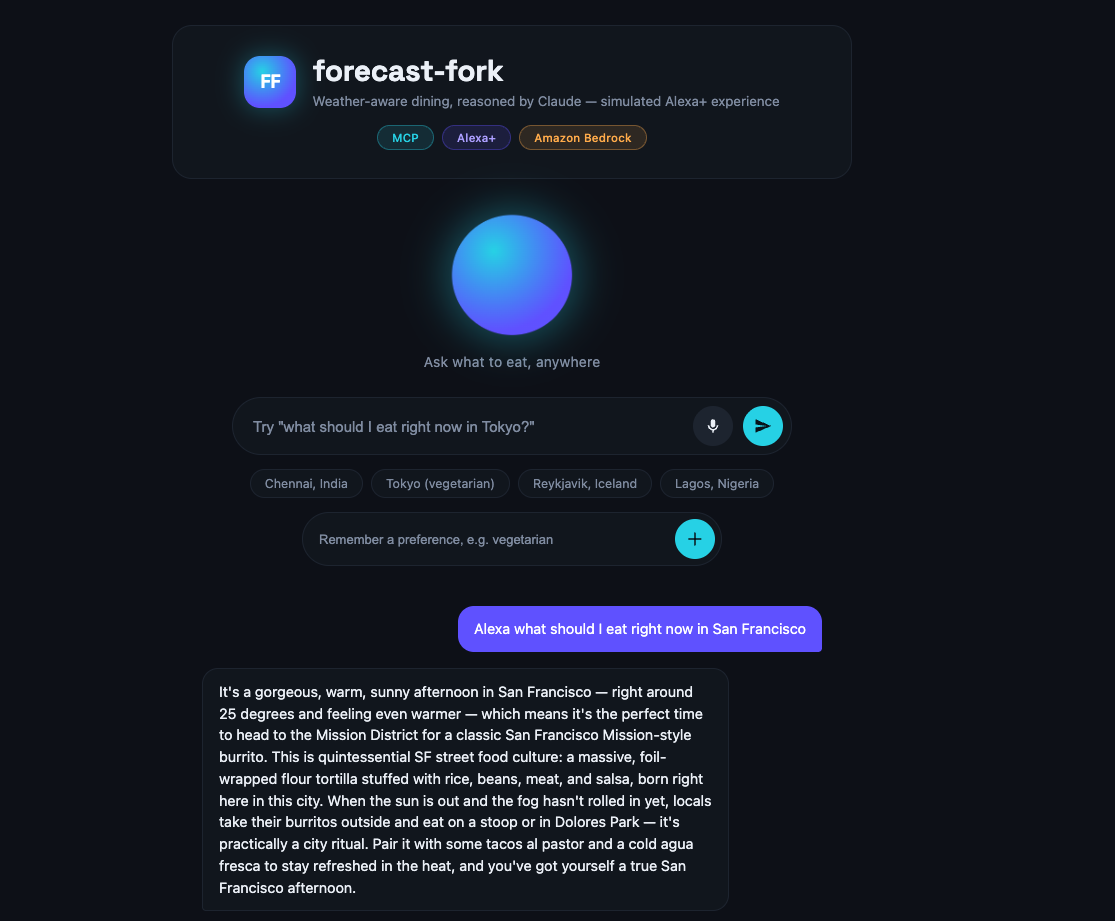
Recommendation
-
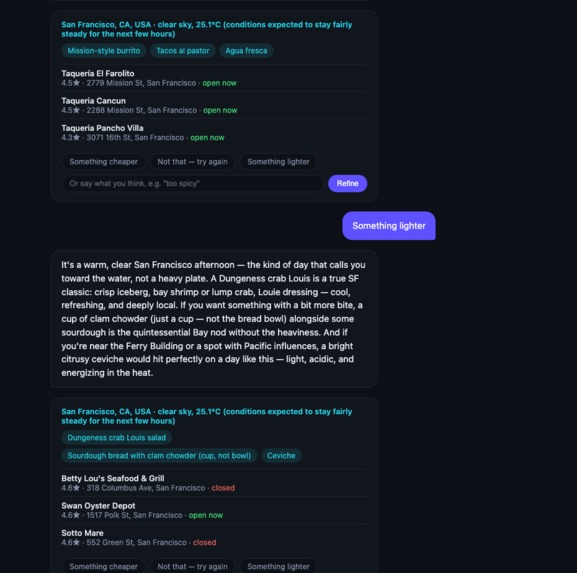
Refinement
-
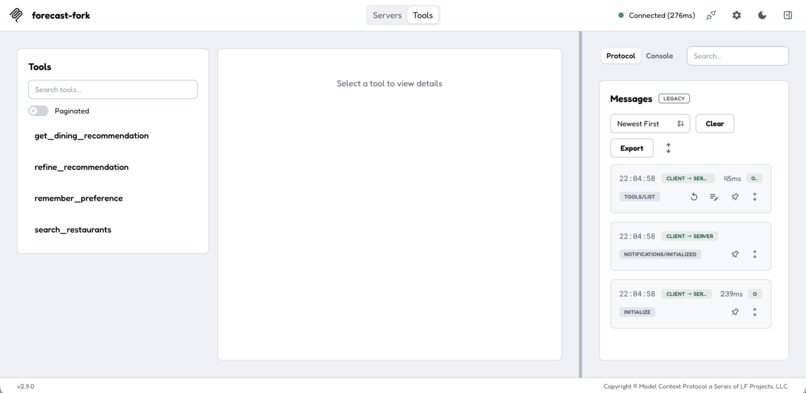
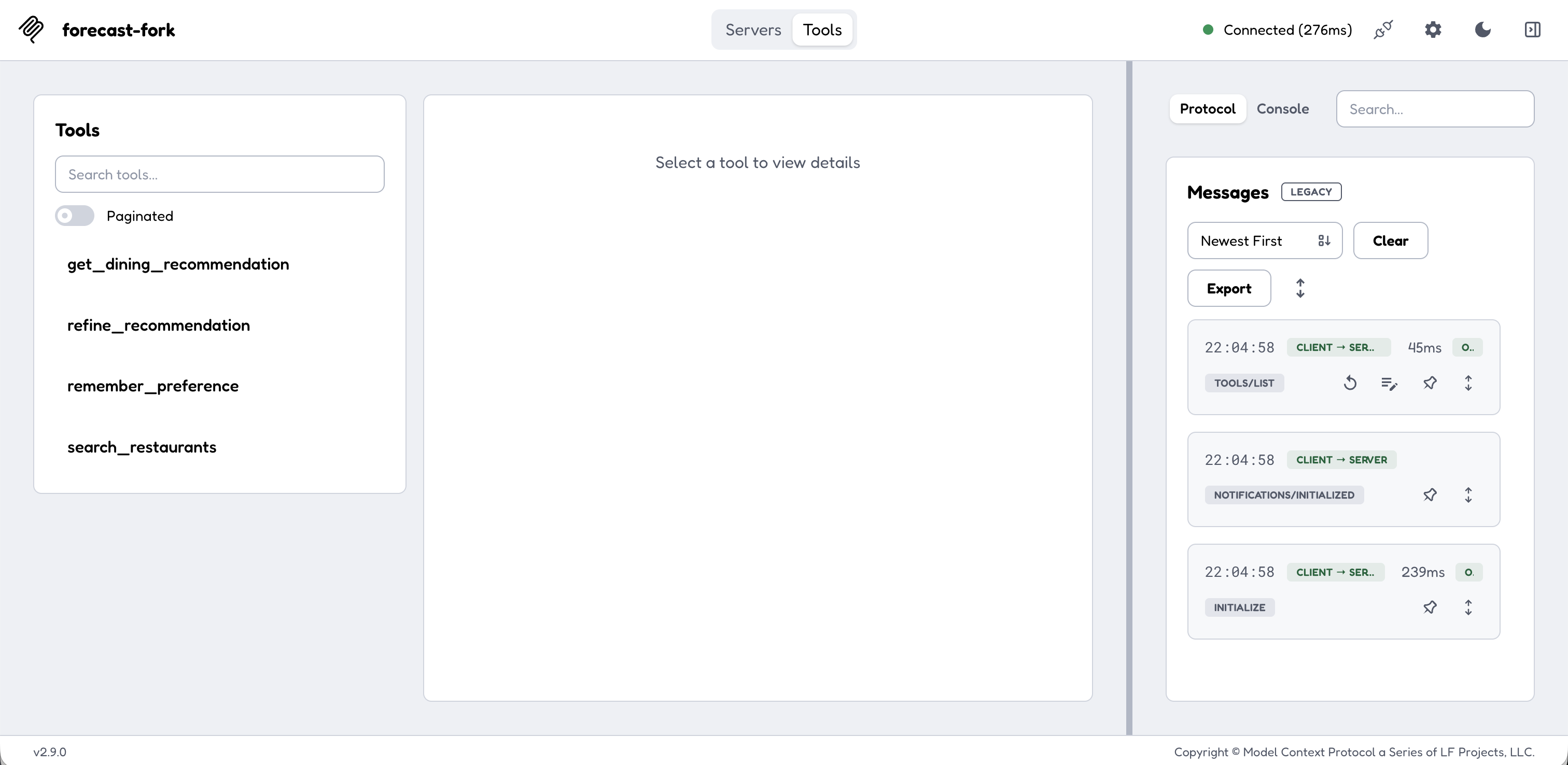
MCP Inspector
-
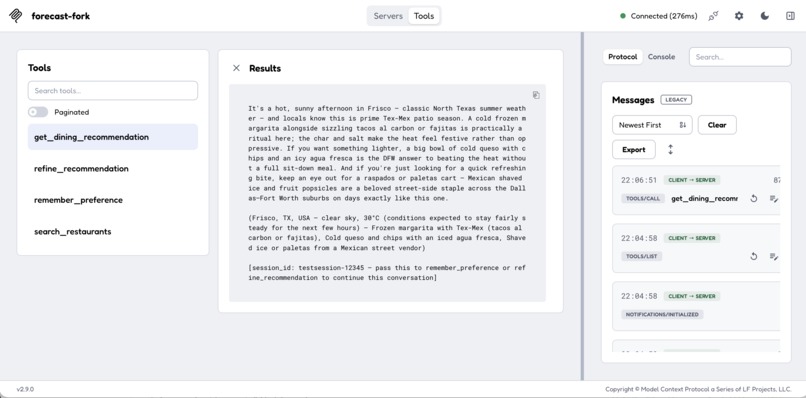
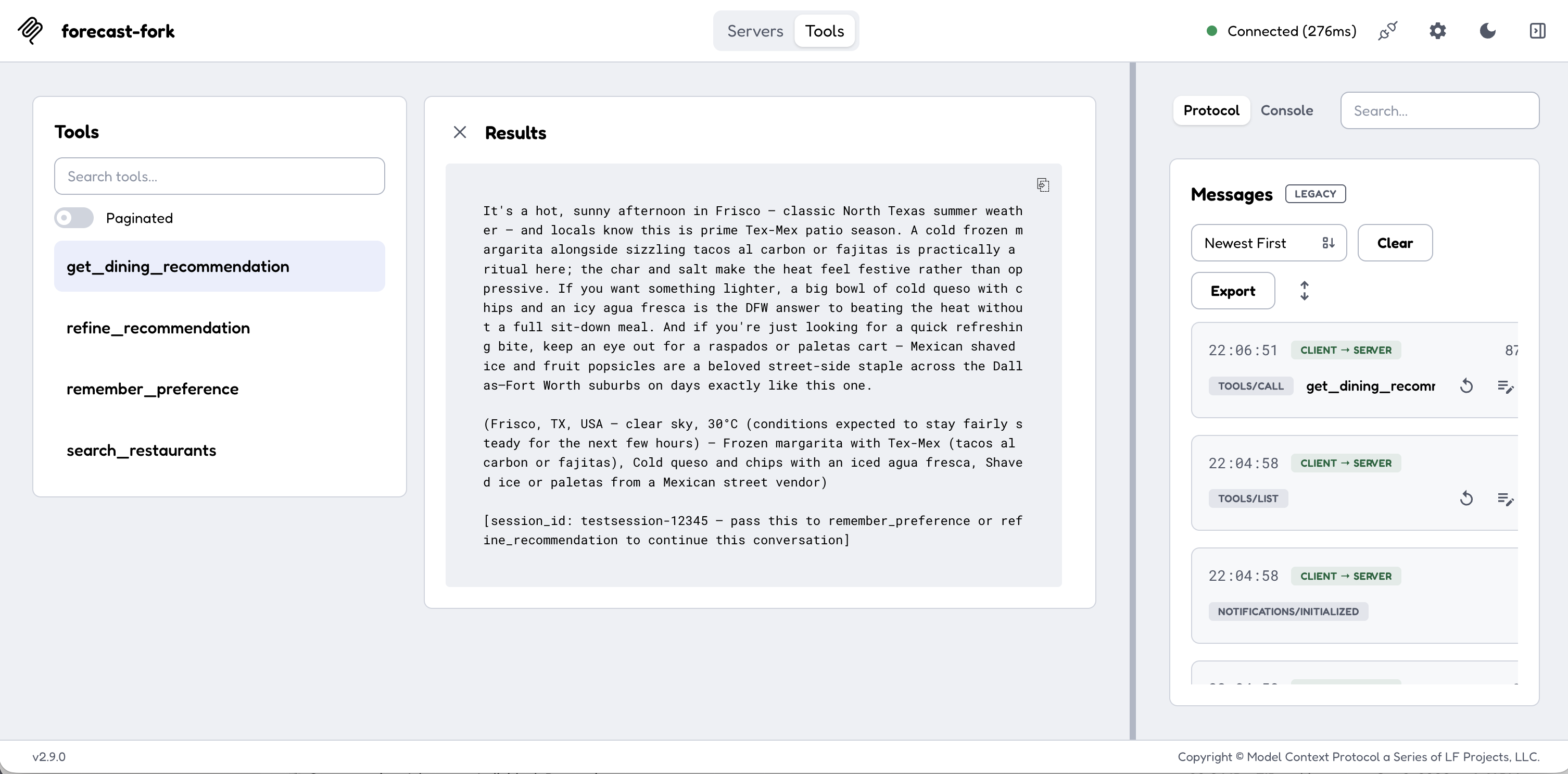
MCP Inspector Recommendation
-
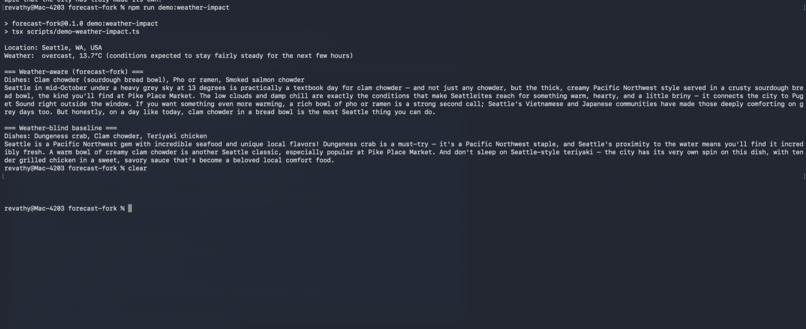
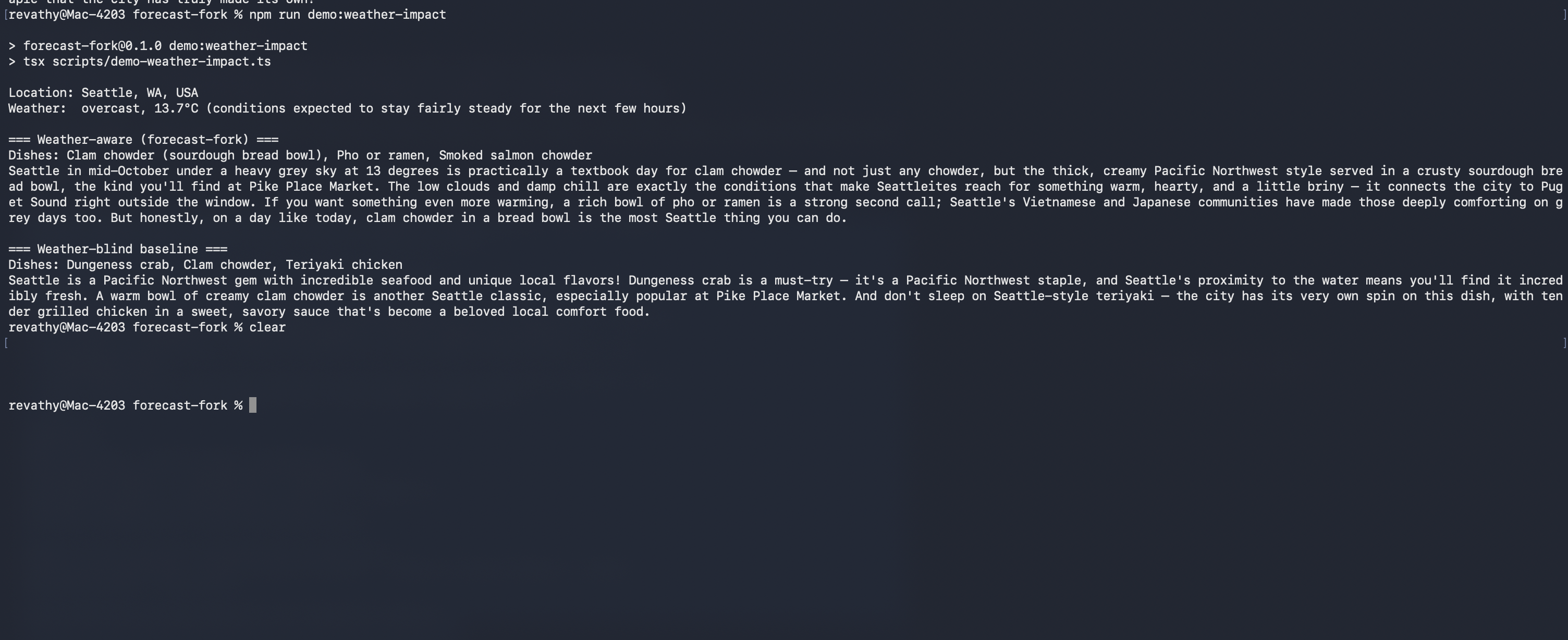
Weather Aware vs Weather Blind
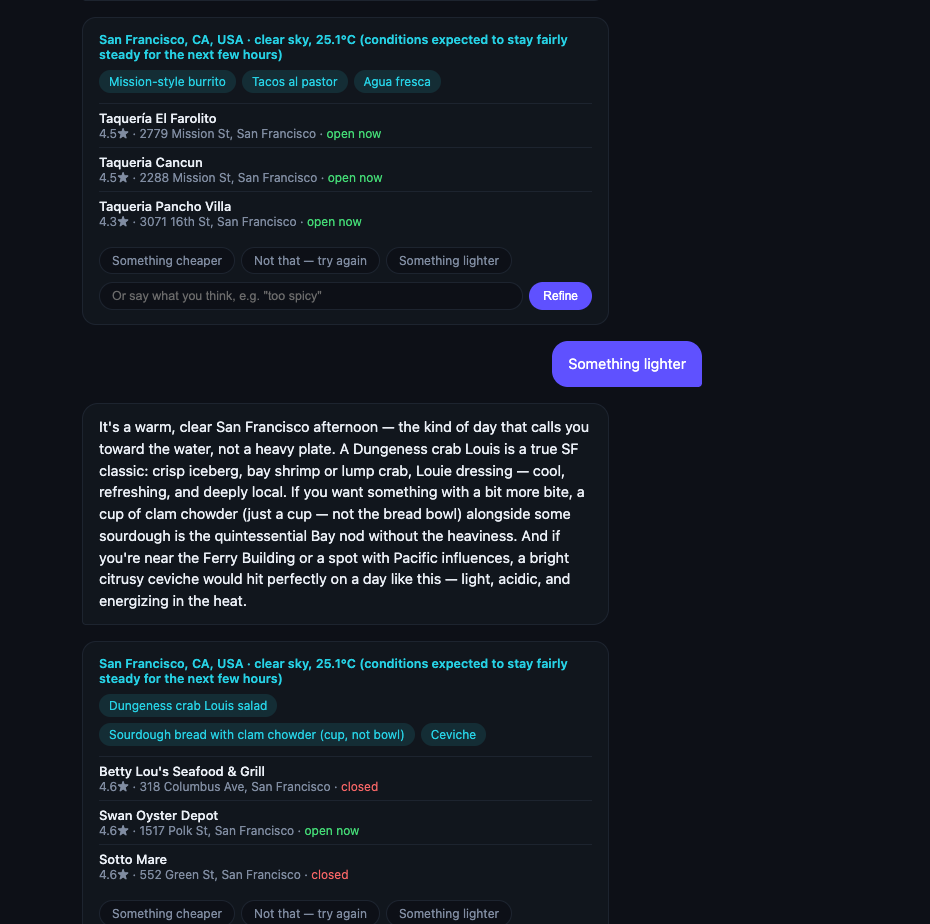
Inspiration
This project started from an arxiv paper on agentic dining recommendation — an LLM orchestrating a location tool and a weather tool, then reasoning about culturally appropriate food, rather than filtering a restaurant database by cuisine tags. It mapped almost exactly onto the Alexa+ track: package that same pattern as an MCP tool, let Alexa+ act as the orchestrator instead of a standalone app.
I already had a head start — an existing blog post covering the location + restaurant-search half of the pipeline with Google Places. What was missing was the piece the paper actually contributes: weather as a first-class input to the reasoning step, not just another filter. That gap became the whole point of the project.
What it does
Forecast Fork is an MCP server exposing four tools Alexa+ can call mid-conversation:
get_dining_recommendation— geocodes a location, pulls live weather and a near-term forecast trend, and asks Claude (on Amazon Bedrock) to reason about what's culturally comforting to eat right now, in this exact place and weather — not filter by cuisine keyword.search_restaurants— finds real nearby places. The two chain automatically: askget_dining_recommendationwithinclude_restaurants: trueand it reasons about the dish, then uses that dish as the search keyword to point you at an actual open restaurant nearby.remember_preference— stores a standing preference ("I'm vegetarian", "no seafood") against asession_id, so the customer states it once and it's applied automatically from then on.refine_recommendation— a follow-up turn ("actually, something cheaper") that reuses the session's cached location and weather (no re-geocoding) and avoids repeating the dish it already suggested.
That last pair is what turns this from a single-turn Q&A bot into a multi-turn agentic conversation — the customer doesn't have to restate their dietary needs every time, and a reaction to the first suggestion doesn't require starting over.
How I built it
The core pipeline: geocode the location (Google Geocoding API) → pull live conditions and a
near-term forecast trend (Open-Meteo, no key) → hand both to Claude on Amazon Bedrock with forced
tool-use, so the response comes back as structured data (dishes[], primary_keyword,
reasoning) instead of parsed prose → optionally chain that primary_keyword straight into a
Google Places search.
Session memory sits alongside that pipeline as a small in-memory store keyed by session_id:
get_dining_recommendation writes the location/weather/dishes it just produced (and any
remembered preferences it applied), and refine_recommendation reads that back so it can reason
again without repeating an API call or a rejected suggestion.
I validated it three ways, deliberately:
- MCP Inspector — protocol-level proof: tool discovery, schema, live invocation, and (now)
confirming that a
refine_recommendationcall after aget_dining_recommendationcall actually carries session state across the two. - A simulated Alexa+ web UI — an Echo-style interface with a glowing orb (idle/listening/ thinking/speaking states), real voice input and spoken responses in-browser, a "remember a preference" field, and per-suggestion refine chips — calling the same functions the MCP tools call.
- alexa-skill-mcp-bridge — a Strands agent on Bedrock AgentCore (Amazon Nova) emulating
Alexa+'s own orchestrator: it decided on its own to call
get_dining_recommendation, then separately decided to callsearch_restaurantsto ground the suggestion in real places, entirely unscripted.
Challenges I ran into
Getting Bedrock model access right took real trial and error. My first attempt used an invalid model identifier and failed outright. Fixing that surfaced a second error: some newer Claude models on Bedrock can't be invoked by their base model ID at all — they require the full inference-profile ARN instead.
A Bedrock API key and full IAM credentials aren't interchangeable. My server worked fine with
a simple Bedrock-scoped bearer token, but alexa-skill-mcp-bridge's health checks call AWS STS
directly, which only understands real IAM SigV4 credentials — getting the bridge running against
my server meant creating a separate IAM user just for that.
Alexa+ access is invite-only, not a queue. Amazon's own developer docs describe Alexa+ for Builders as "currently available to select partners working directly with our team" — no public waitlist. That reframed my validation strategy around emulating the real orchestrator instead of waiting on access.
Latency versus the voice-assistant budget. The bridge simulates Alexa's ~6.5 second response deadline. My reasoning step alone averages 6.2 seconds, so live testing regularly produced the natural "I'm still working on that, ask me again in a moment" filler response before the full answer landed — genuine behavior surfacing the same <500ms round-trip requirement Alexa+'s docs describe, not a bug.
Accomplishments that I'm proud of
- A real, measured 100% success rate across 30 regions spanning five climate zones (tropical, arid, cold, temperate, southern-hemisphere) — not a projection.
- The orchestrator chaining tools on its own, unscripted — during bridge testing, the
Nova-based agent independently decided to call
search_restaurantsafterget_dining_recommendationto ground its answer in real places. - A genuine, demonstrated differentiator: the weather-aware vs. weather-blind comparison mode
surfaces real, specific answers that a cuisine-filter recommender structurally can't produce —
(fill in your favorite side-by-side example from
npm run demo:weather-impactoutput here). - Personalization and multi-turn refinement, not just single-shot answers:
remember_preferenceandrefine_recommendationlet a customer state a dietary need once and react to a suggestion naturally ("something cheaper") without repeating themselves or restarting the conversation. - A spec-compliant MCP server (
2025-11-25, Streamable HTTP), verified against a real MCP client handshake, not just claimed. - Honesty over polish — I surfaced my own edge cases (Sydney/Auckland returning pan-Asian rather than distinctly local dishes) instead of cherry-picking only the clean examples.
What I learned
The MCP protocol has real, non-obvious requirements — spec version negotiation, stdio vs.
Streamable HTTP transports, tool schemas — that only surface once you implement a remote client
against your own server. I also learned that "AI reasoning beats a rule engine" is a claim worth
actually testing, not asserting: running the comparison mode and reading the real output, side by
side, is far more convincing than describing the idea. And once session state entered the picture,
I learned how much of "feels like a real assistant" comes specifically from not having to repeat
yourself — a single well-placed session_id did more for that impression than any prompt tuning.
What's next for Forecast Fork
- Elicitation — prompt for a missing location instead of erroring, so a vaguer request still works.
- OAuth 2.1 with PKCE + a PRM document — the real auth layer Alexa+ requires for production.
- Closing the latency gap — streaming partial responses or a faster model on the reasoning path, rather than one synchronous multi-second call.
- Durable session storage — today's session memory is an in-memory
Mapper server process; moving it to a shared store (Redis/DynamoDB) would let it survive restarts and scale across multiple instances, which is what a real deployment needs. - Real Alexa+ access, if/when it becomes available through the hackathon's sponsor channel rather than the general invite-only program.
Built With
- agentic-ai
- alexa+
- amazon-alexa
- amazon-bedrock
- amazon-nova
- amazon-web-services
- anthropic
- aws-sdk
- bedrock-agentcore
- claude
- css3
- express.js
- google-geocoding-api
- google-maps
- google-places
- html5
- javascript
- llm
- mcp
- model-context-protocol
- node.js
- open-meteo
- strands-agents
- typescript
- web-speech-api

Log in or sign up for Devpost to join the conversation.