-
-
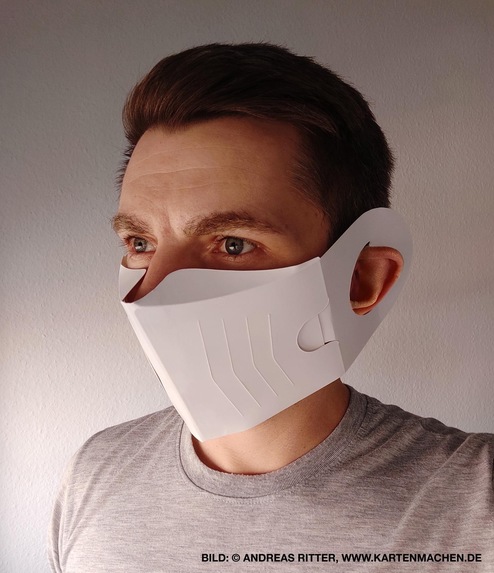
Face Mask Prototype
-
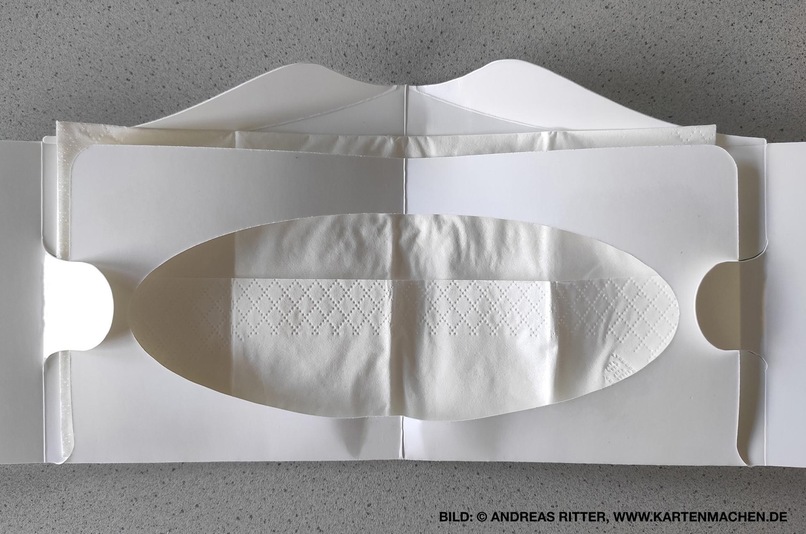
Inner view with disposable tissue
-
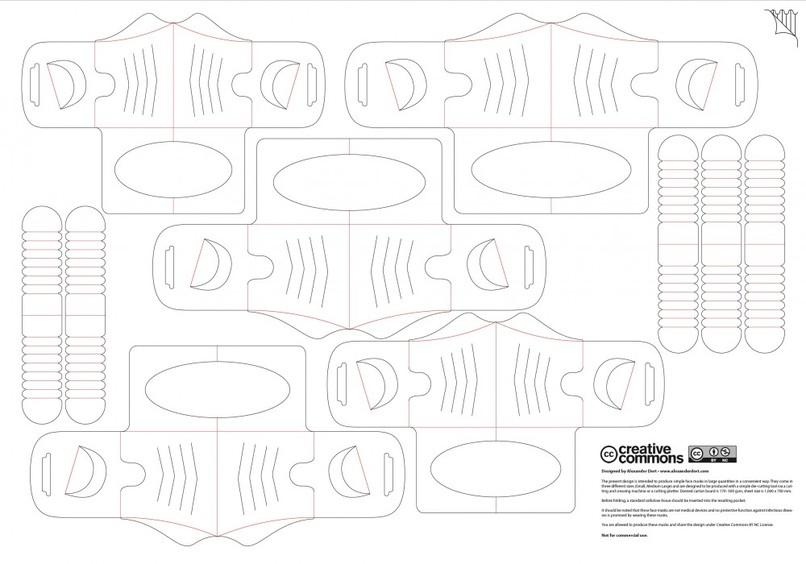
Most recent version now with additional straps and 5 different sizes on B1 sheet.


The demand for face masks is currently enormous due to the worldwide COVID-19 pandemic. However, the availability of such masks is limited. As a result, masks are now often produced manually by workshops, tailors and volunteer workers. However, the production capacities and speeds for this are very limited. On the other hand, many industrial production systems in the packaging industry are currently at halt due to the pandemic. This gave me the idea to use the enormous production capacities of the worldwide printing and packaging industry to produce simple face masks in large quantities. I designed this in such a way that theoretically every printing company and every converter that has a simple die-cutter in 3B format or also owners of cutting plotters can produce such masks from folding carton or film. In the simplest case, printing is not even necessary, but it could also be used to embellish the masks or for advertising purposes.
The basis of these face masks is a flat blank that can be produced in such a way that by folding it together a pocket is created to hold standard cellulose tissues, which simply have to be inserted and can also be replaced periodically. It was also important to ensure that these masks do not have to be processed in a time-consuming manner - for example by attaching rubber bands - but can be sent to the dispatch department stacked flat exactly as they come out of the die-cutting machine. This means that even very large quantities can be transported in a very space-saving manner.
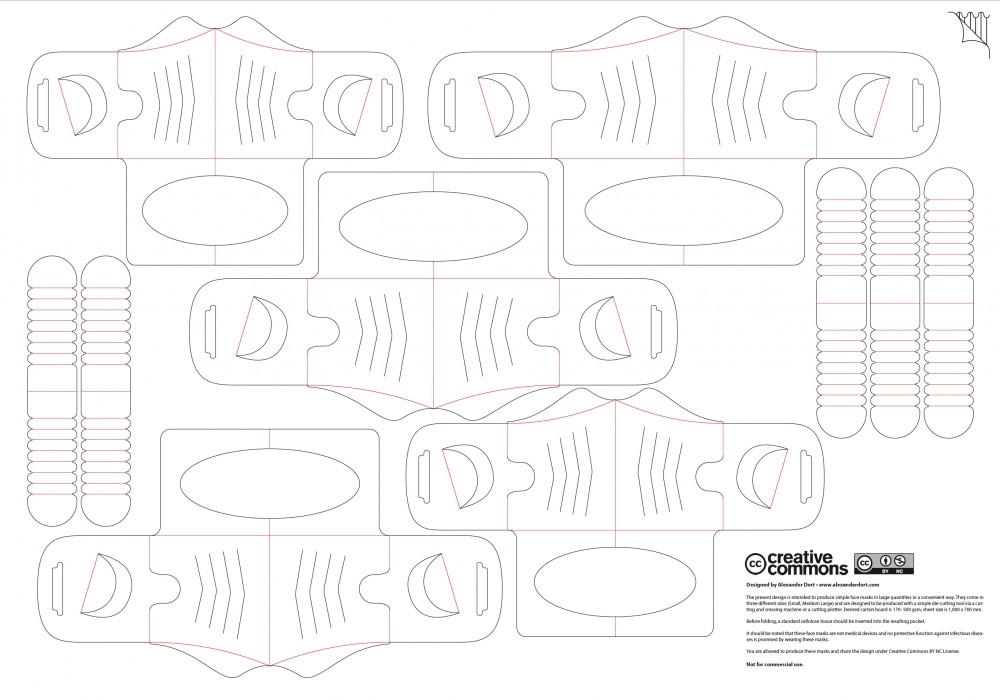
To ensure that the masks fit as best as possible on every head size and shape, five different (marked) mask sizes are available on the sheet. This means that the dieine published under Creative Common only needs to be used by the companies to build a cutting die and production can start immediately on standard substrates. I specified all folding cartons from 170 gsm up to a maximum of 500 gsm as suitable substrates, as well as all films from 25 µm. There are no assembly instructions, because the cutting is self-explanatory.
The data can be used and shared worldwide for non-commercial use without any restrictions. A coloring and printing of the masks is also allowed.
I’m not able to say whether and to what extent these masks can protect against a possible infection with Sars-CoV-2 viruses or other pathogens. I hope, however, that these masks will at least provide simple protection against direct droplet infection, especially in the case of possibly already infected wearers of the masks to protect their surroundings. I‘m also not yet able to say anything about the wearing comfort of the masks or their durability. But I hope to receive as much feedback as possible from the industry and the users of the data in order to be able to optimize the design and adapt it to the needs of the users. I can also imagine a joint design and further development of the rather short-term designs of the masks in dialogue with other designers. Even more complex mask solutions for further processing via gluing lines would be conceivable here.
My intention was to enable the availability of simple face masks in very large quantities and in the shortest possible time. On the one hand, I believe that we will have to make masks mandatory in many nations, and on the other hand, I have noticed a great acceptance and demand for such masks among the population for some time now. Therefore, I used my possibilities as a packaging designer to develop such simple masks and to design them in such a way that they can have a quite long life span despite their simple construction due to easily changeable filters, which are nothing more than inserted standard cellulose tissues. The design of these masks should be as simple as possible and the production effort should be very low. As is well known, the printing industry is predestined for such large-scale production. Provided that everyone is involved and the worldwide production capacities, especially of packaging printers and converters, are fully utilized, billions of these masks could be produced worldwide within a very short time and distributed to the population or handed out in supermarkets, for example. Of course, this production costs every company that wants to take part in it a little money. But I also know that in many printing plants, various substrates left over from earlier productions, which are mostly already paid for or written off, are still available unused and often after a certain period of time are only recycled. Therefore, with a determined effort of the companies, only one cutting die would have to be built and the machine hours calculated. In return, this mask can, if desired, of course be printed with self-advertising and thus a part of the costs can be written off via marketing. I hope that the possibilities of such a worldwide distributed production, which has never existed before by the way, but which we now urgently need, will be understood by all companies, businesses and also private persons (whom we also need to spread these links via social networks) and that these production data will be shared as often as possible. In fact, this is the first time that we need a working symbiosis between the Internet and the printing and packaging industry to ensure the worldwide availability of urgently needed face masks. You know, this virus confronts us humans with a highly philosophical task: Because none of us knows whether we are already infected and can therefore infect other people and endanger their lives, the virus demands that we understand that only if we protect our fellow human beings and only if everyone participates in it, we can ultimately protect ourselves. A coincidence? I don't think so. Only together we will be able to write this success story in the fight against the virus.
Built With
- adobe-illustrator
- carton
- creasing
- cutting
- packaging


Log in or sign up for Devpost to join the conversation.