-
-
Nigeria Artisans
-
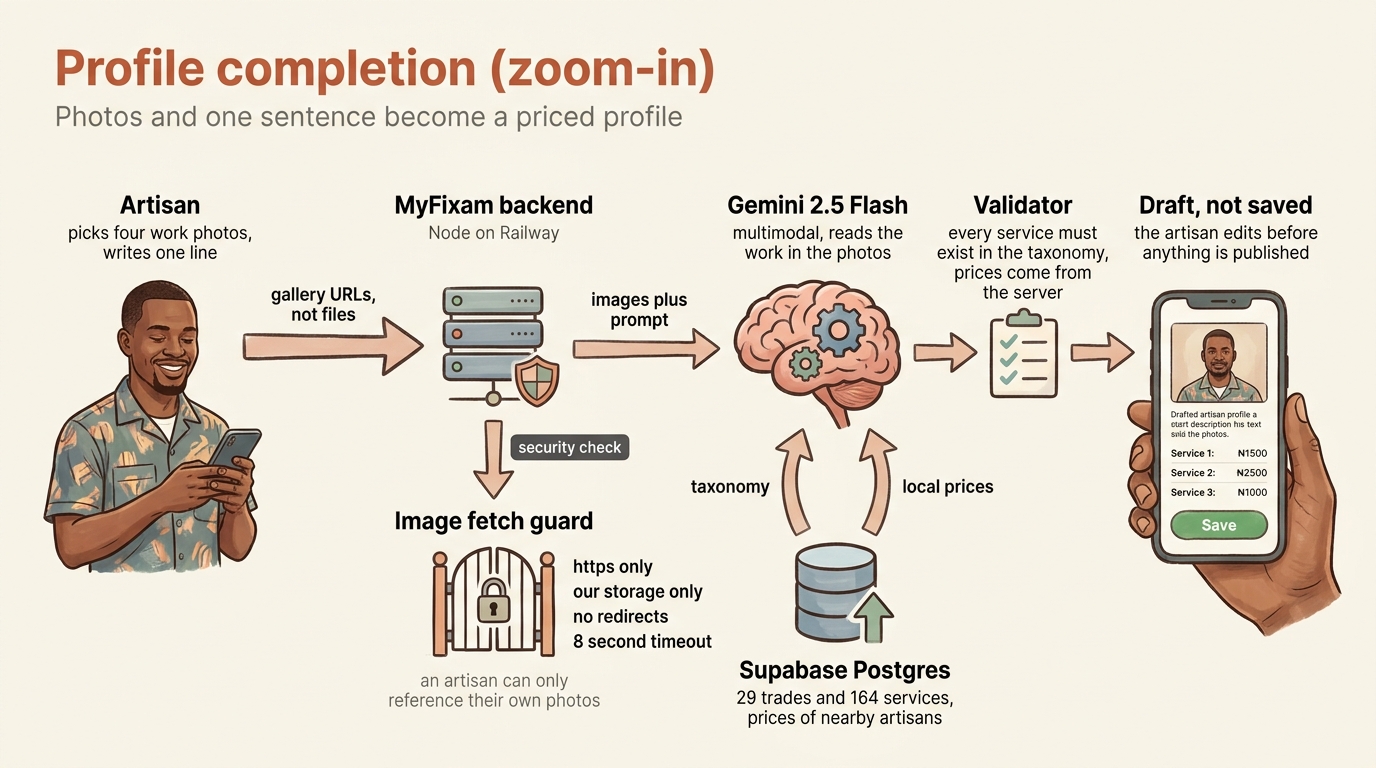
AI Profile Completion
-
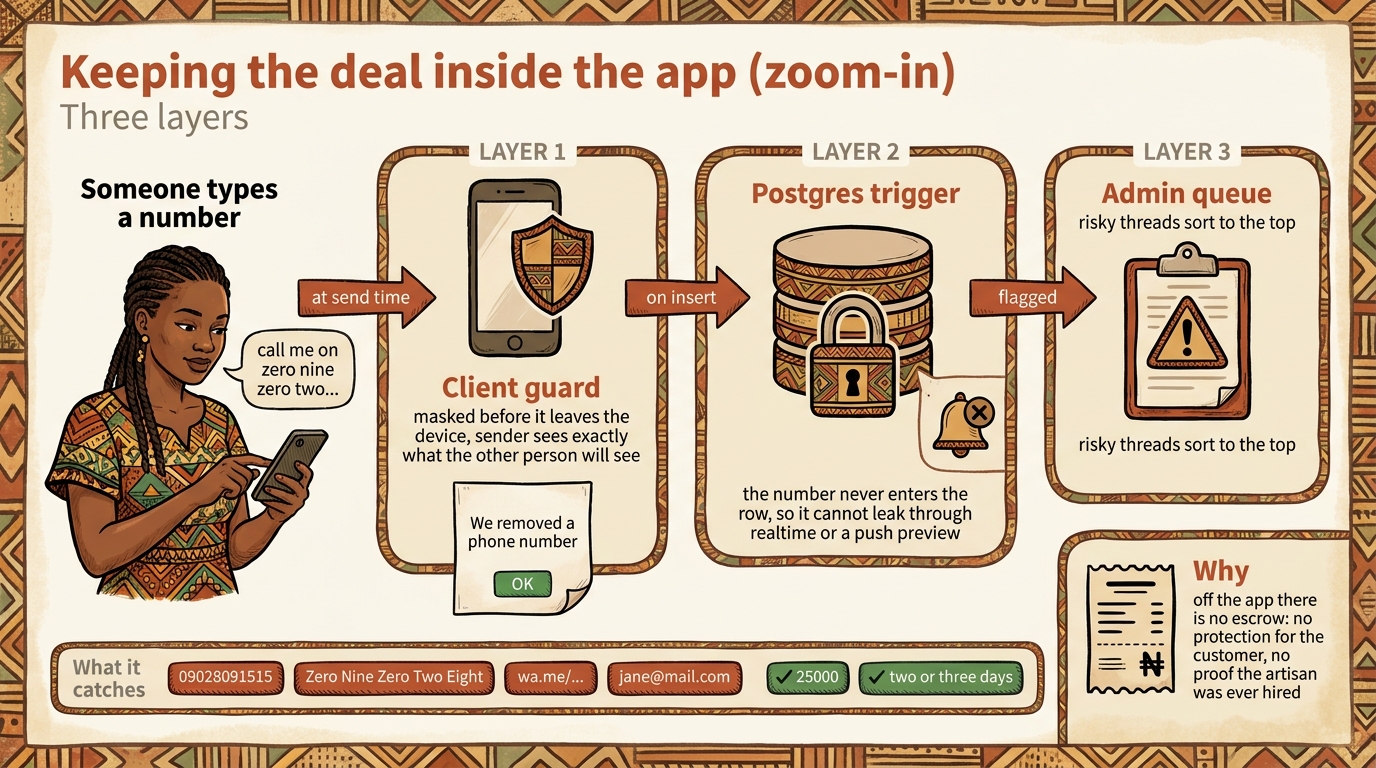
AI Job Post Moderation
-
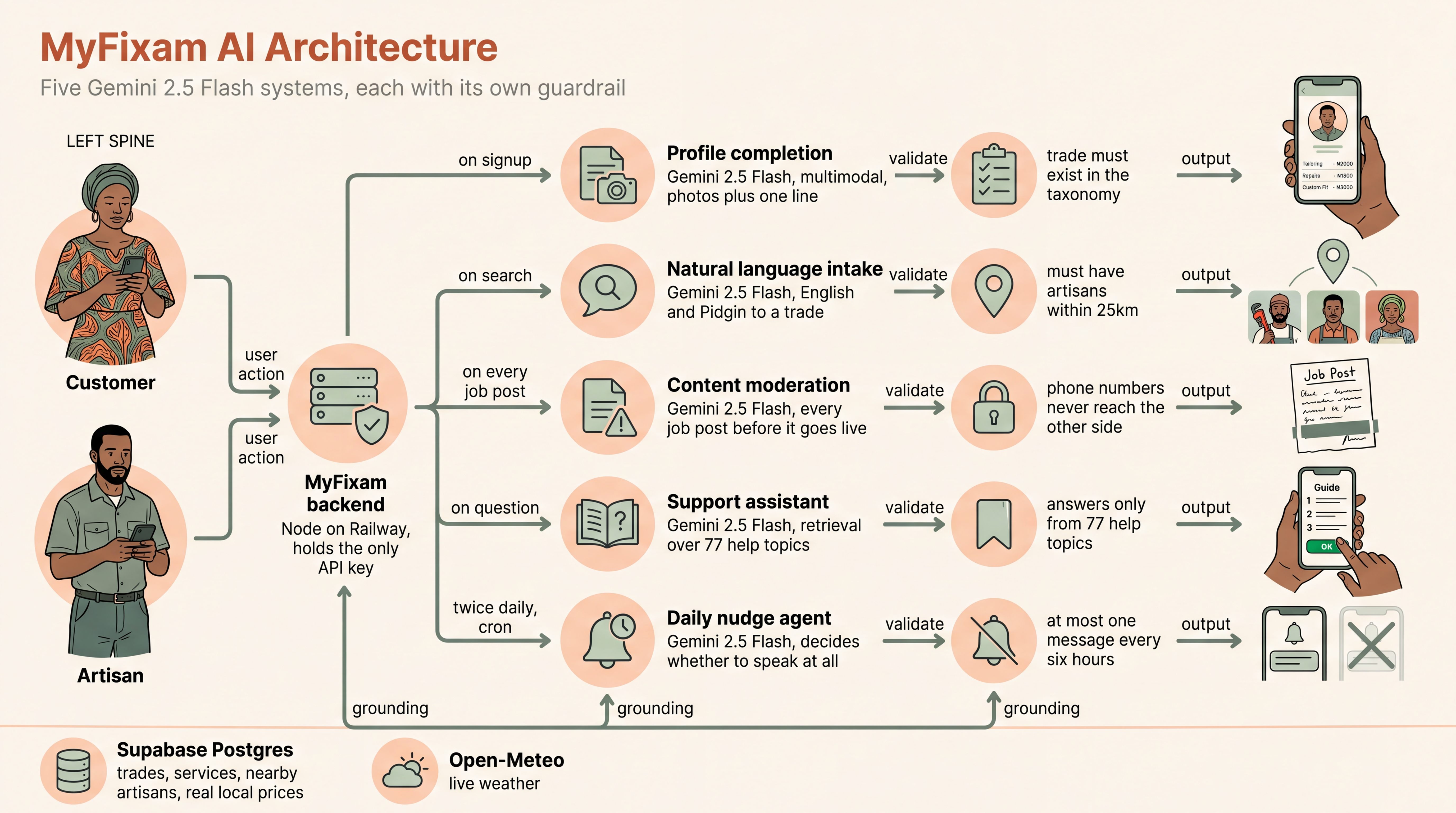
Myfixam AI Architecture
-
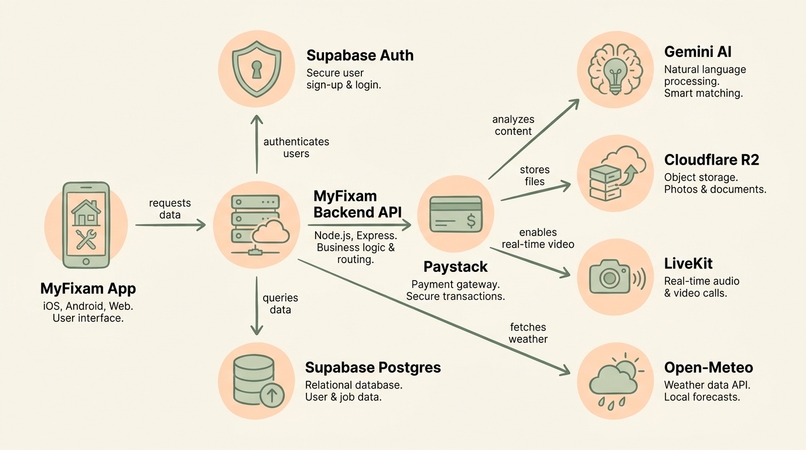
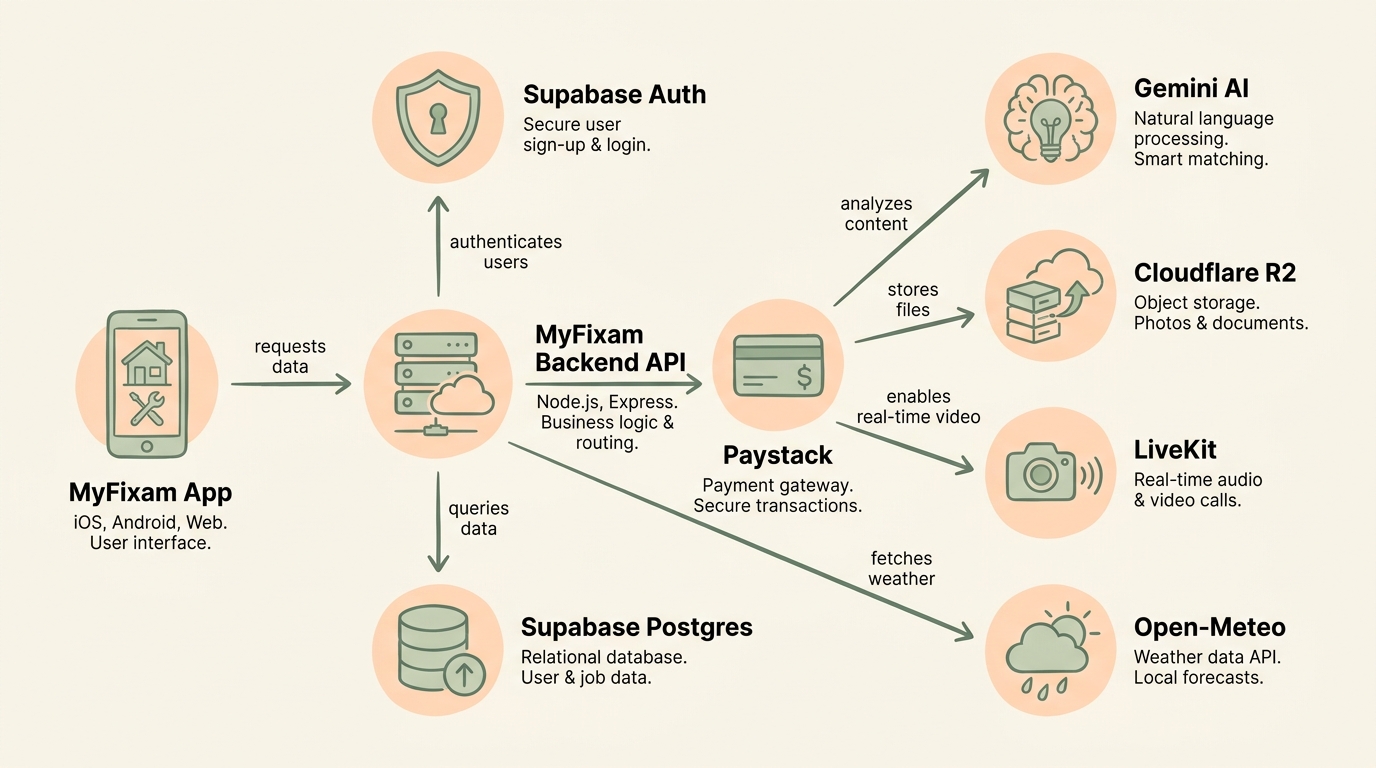
System Architecture
-
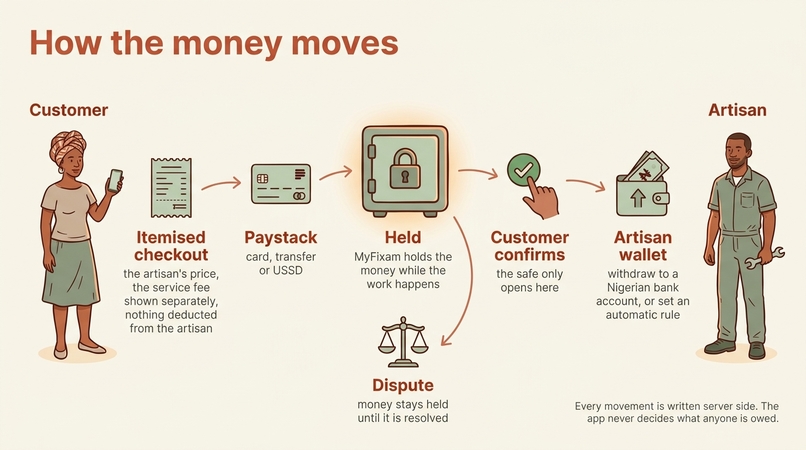
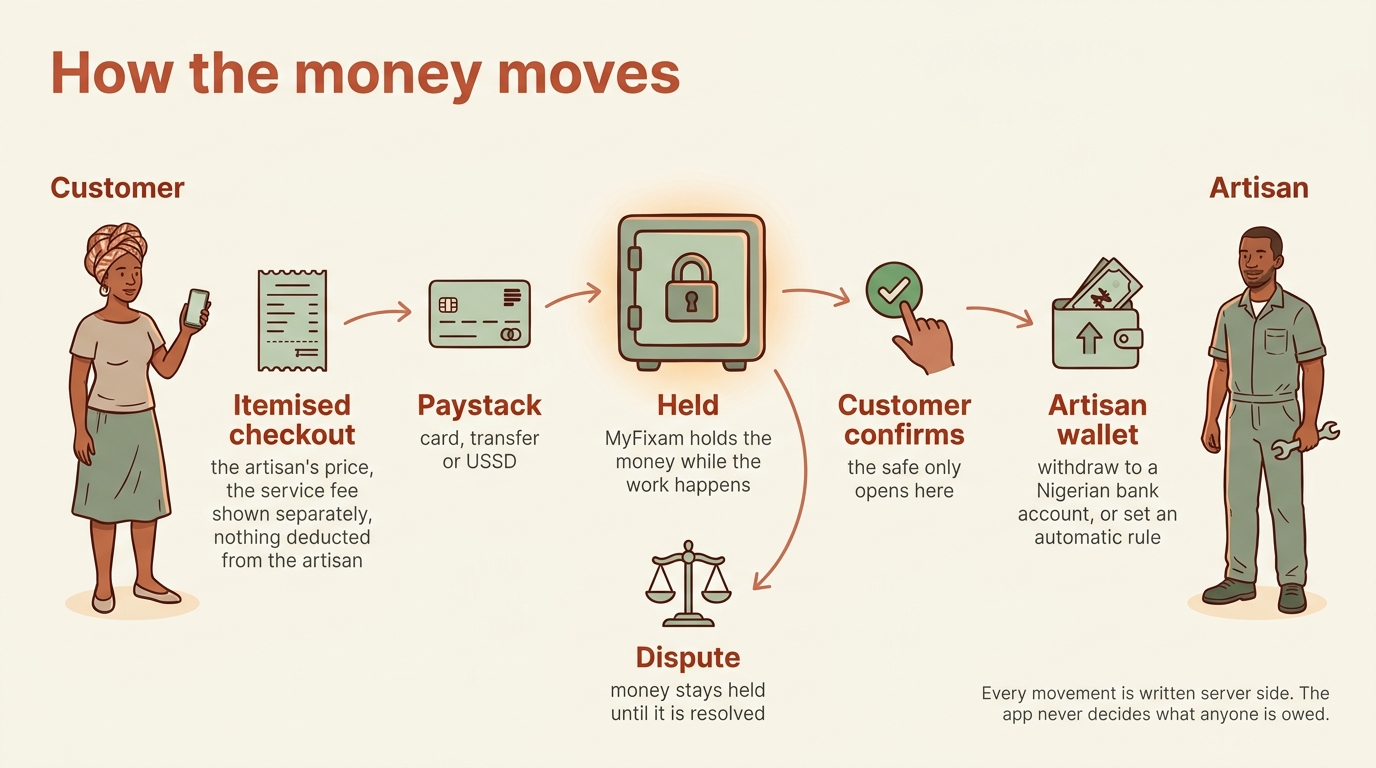
How Money Moves
MyFixam
Category: Small Business Services
Inspiration
A friend of ours moved back to Nigeria and bought a house in the capital, Abuja, and for weeks he kept asking whether we knew someone who could fix his broken sink. In the United States he would have opened TaskRabbit and had it handled that afternoon. Nigeria has 230 million people and no such infrastructure.
We assumed the missing piece was discovery, so we offered vendors exposure and nobody replied. The ones who did said they did not need to be found, they needed to be paid. A baker with a million followers on Instagram explained that she receives over a hundred orders a day through WhatsApp, has to scroll through every chat to work out who has actually paid, and regularly loses money to customers who send fake bank transfer receipts.
What it does
Customers find verified artisans near them across 29 trades and book through the app. They pay upfront, we hold the money, and the artisan is paid once the customer confirms the job is done. We take 10% of every completed booking.
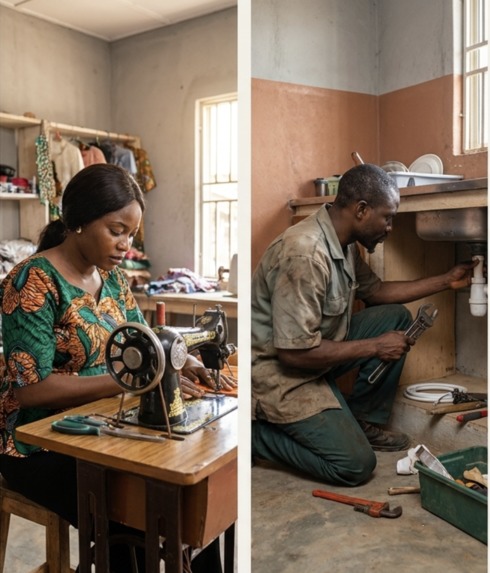
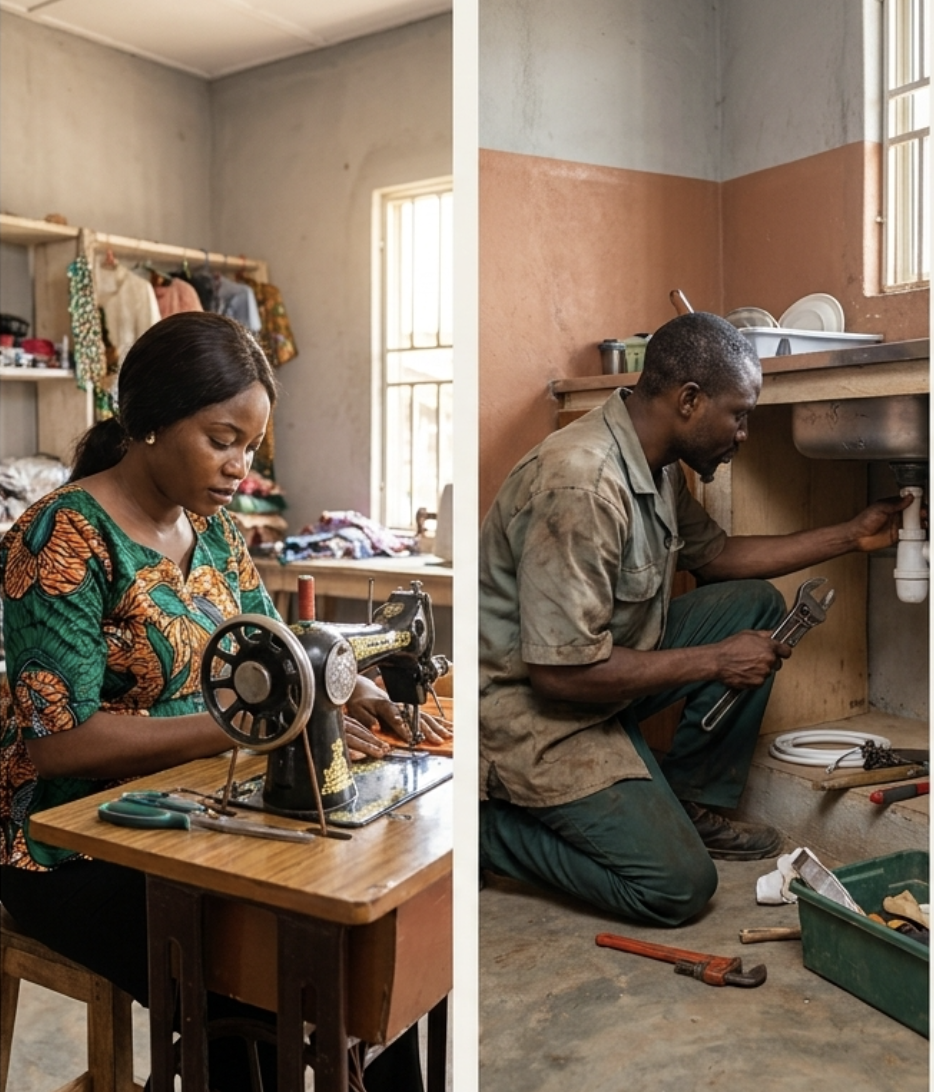
93% of employment in Nigeria is informal, and artisans make up most of it. These are small businesses with no verification process, payment protection, or even a record of anything they have earned. MyFixam gives them a professional profile, a verified identity, guaranteed payment and customers beyond word of mouth.
How we built it
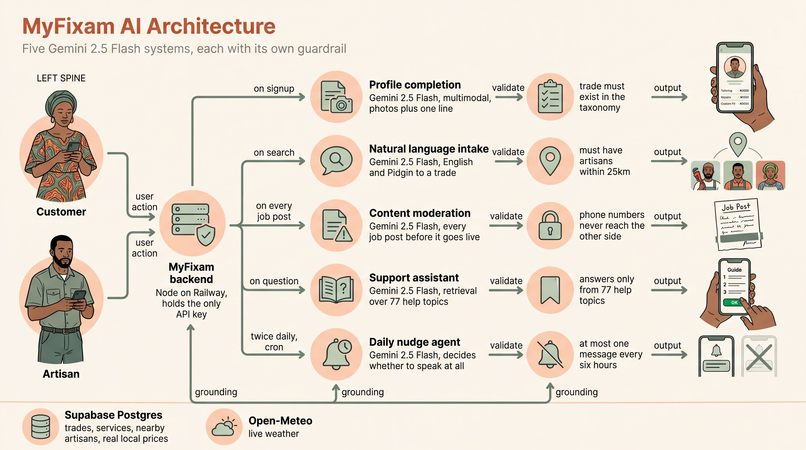
Gemini 2.5 Flash runs server side across five systems in production, against real users and real money, and every call writes an audit row and a server log line. AI is load bearing rather than decorative here, because the two things blocking adoption could not be solved by better interface design.
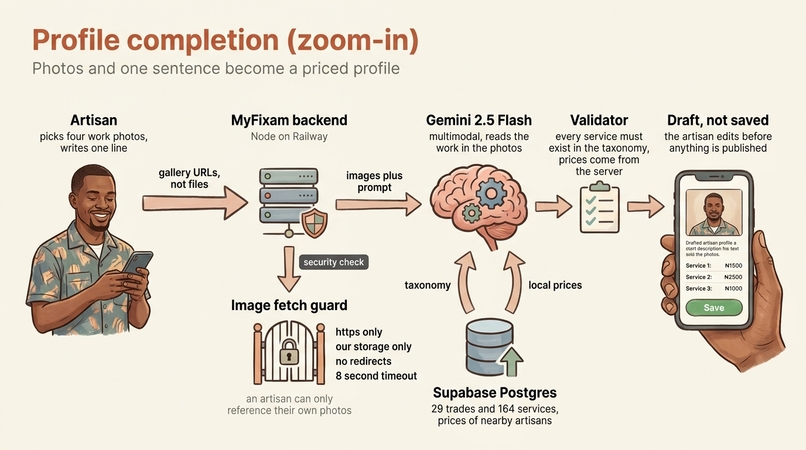
The first was that artisans abandoned their profiles halfway through, leaving the form empty with no description, services or prices, and a profile like that is invisible to customers. Shortening the form did not fix it. Now, an artisan can upload a few photos of their work and one line about what they do, and Gemini drafts the entire profile, including trade, description, services and prices, for them to review and save. What took twenty minutes now takes thirty seconds.
The second was that customers do not search the way a database expects. Nobody types "Plumbing Services"; they type "my sink is leaking". Our intake system reads that plain language description, works out which trade is needed, judges how urgent it is, and routes the job to the right artisans nearby.
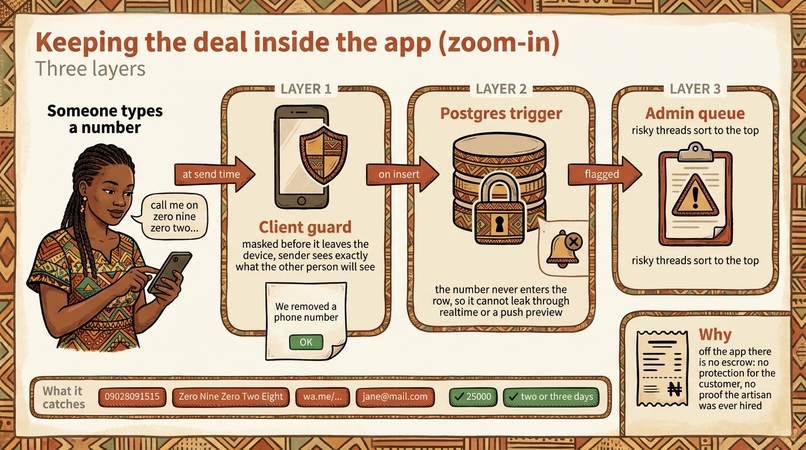
Content moderation reads every job post and artisan bid before it goes live, looking for abuse, self-promotion, and contact details meant to divert the booking off the platform. If a message saying "just send the money to my account, it is faster" gets through, the customer loses their payment protection and we lose the transaction. Gemini catches what a simple text filter misses, including phone numbers spelled out in words, numbers buried inside a sentence, and invitations to continue elsewhere. No human moderator is on duty.
A support assistant answers user questions using retrieval over a knowledge base built from the app's real screens, so it names the actual button a user needs rather than inventing a plausible one and escalates to a person when it cannot find an answer.
We also run our marketing through AI. A daily notification agent decides what to say to each user, and whether to say anything at all. Each day it receives that user's location, the live weather there, the point in the local calendar, what they have booked before, and which trades have available artisans within 25 kilometers of them, then reasons from that context to a suggestion. If it has been raining in a neighborhood all afternoon, it works out that people are indoors and will not go out to buy things, so it suggests a delivery rider. In late December, when Nigerians hold large weddings and parties, it suggests caterers, tailors and makeup artists. A customer who booked a cleaner five weeks ago and has not returned is prompted to book the same person again. On most days, it stays quiet.
Most of the engineering here is constraint rather than prompting. The model can never invent a category, and it can never set a price, because a made-up price in a marketplace costs a real person money, so the server uses the median of nearby artisans in the same trade instead.
Humans retain responsibility for trust and judgment. Our team visits markets and workshops in Abuja and Lagos to verify artisans face to face, and disputes are resolved by a person. We wrote the constraints above to prevent the model from fabricating prices for a wedding gown it has never seen.
Challenges we ran into
In Nigeria, approvals to move money take a long time, and some providers required us to show a physical storefront before enabling payment features. We fixed this by incorporating as a private limited company, which unlocked what we needed. International payments are still locked, because Stripe does not serve Nigerian businesses yet.
Accomplishments that we're proud of
We launched on 2 July 2026 and grew to over 370 users across 29 trades. MYFIXAM LTD is registered in Nigeria with a corporate bank account.
The average Nigerian worker earns around 100,000 naira monthly, roughly $70. A single booking on our platform can be worth up to 90,000 naira (about $64), so the money moving through MyFixam is significant to the artisans.
Artisans now have a channel that pays them securely. Our platform has also created paid work for our in-person outreach team, for ambassadors who earn commission on referrals, and for delivery riders who help fulfill orders. A single booking now feeds several people.
What we learned
Assumptions can often be wrong. We sold exposure for weeks to people who did not need it. Our in-person outreach tested our hypothesis and showed us what people really needed.
What's next for MyFixam
The larger opportunity is the financial identity we are building. Every booking creates a verified record of what an artisan earned and how reliably they delivered it. Most working Nigerians are invisible to lenders, not because they are a bad credit risk but because there is no record anywhere for a lender to look at. As that record accumulates, it becomes the basis on which an artisan can borrow to grow their business, which is what Shopify Capital and Stripe Capital do for online merchants. We want to apply this to a population that no lender currently serves.
Built With
- agents
- android
- aws-rekognition
- dojah
- escrow
- expo.io
- fintech
- gemini-2.5-flash
- generative-ai
- google-gemini
- ios
- kyc
- livekit
- marketplace
- multimodal
- nigeria
- node.js
- ocr
- open-meteo
- paystack
- postgresql
- rag
- railway
- react-native
- supabase



Log in or sign up for Devpost to join the conversation.