-
-
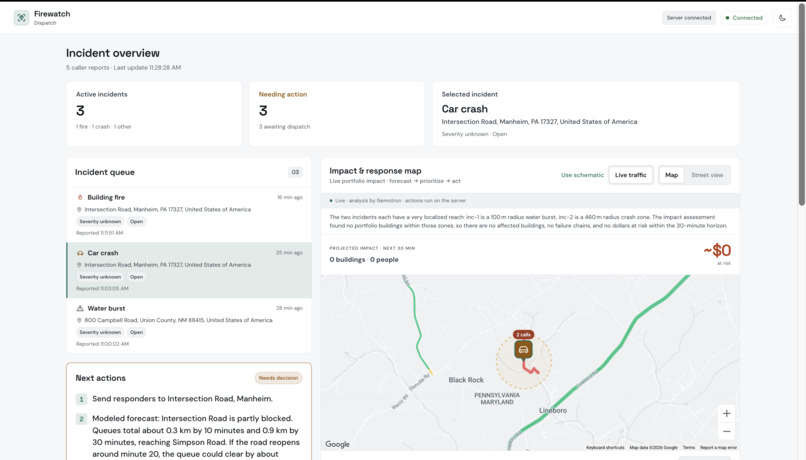
Every emergency, one map. See the next 30 minutes before they happen.
Inspiration
Emergency reports arrive in pieces: a rushed call, a text about smoke, an unclear address. We wanted to help operators bring those pieces together and understand what might happen next, even before responders reach the scene.
We also wanted to look beyond the immediate incident. A crash could block a data center’s fuel delivery, or floodwater could reach a building’s electrical room.
What it does
Firewatch turns calls and texts about fires, crashes, floods, and other disruptions into a shared view for emergency teams and building operators.
- Places phone reports on a live map.
- Lets operators explore a 30-minute forecast and nearby buildings that could be affected.
- Suggests actions and shows how simulated interventions change estimated exposure.
- Provides a Quest experience for exploring building smoke spread, evacuation routes, and city-level incidents.
Our building demo also supports room-level reports through iMessage and a QR form.
How we built it
We used Node.js and TypeScript for the server, WebSockets for live updates, React and Google Maps for the console, and Meta’s Immersive Web SDK for the Quest.
NVIDIA Nemotron interprets reports and uses tools to locate incidents, run forecasts, and suggest next steps. Photon handles iMessage and routes phone calls to our ElevenLabs voice agent.
Geoapify, OpenStreetMap, Open-Meteo, and Street View provide location and scene context. Our simplified forecasts use factors such as wind, road connections, and terrain slope, with assumptions included in the results.
Challenges we ran into
AI responses were sometimes too slow for live calls, so we added a rule-based fallback. We also had to handle repeated reports, unclear locations, and callers correcting themselves.
Getting the Quest connected over venue Wi-Fi took troubleshooting and a Cloudflare tunnel. A late pivot from one building fire to multiple incident types also made coordination harder.
Accomplishments that we're proud of
We connected a real phone call to a live map and forecast, with the same incident state updating both the console and headset.
We’re also proud that the workflow keeps running when the AI is slow, and that operators can review recommendations before taking action.
What we learned
A working fallback matters as much as a good model. Clear assumptions matter more than precise-looking predictions. And when four people are building quickly, shared types help—but frequent check-ins still matter.
What's next for Firewatch
Our forecasts, building data, and financial estimates are illustrative, and actions are simulated. Next, we want to validate the models with real incident data and feedback from responders.
We’d also like to connect dispatch and building systems, bring text and QR reports into the multi-incident map, and add incident history, accounts, and permissions.
Built With
- cloudfare
- elevenlabs
- geoapify
- google-maps
- meta
- node.js
- nvidia-nemotron
- openstreetmap
- photon
- react
- sip
- typescript
- vite
- websockets
- webxr
