Inspiration
Millions of small businesses make products that could sell abroad: a hand-carved teak table, single-origin coffee, a hand-drawn batik scarf. Existing export tools answer one question: which country imports this product category? That matters, but it says nothing about who will love the product, where those people live, or how to reach them.
We wanted to give a small maker the kind of market insight big brands pay agencies for, in a couple of minutes, starting from nothing more than a product name.
What it does
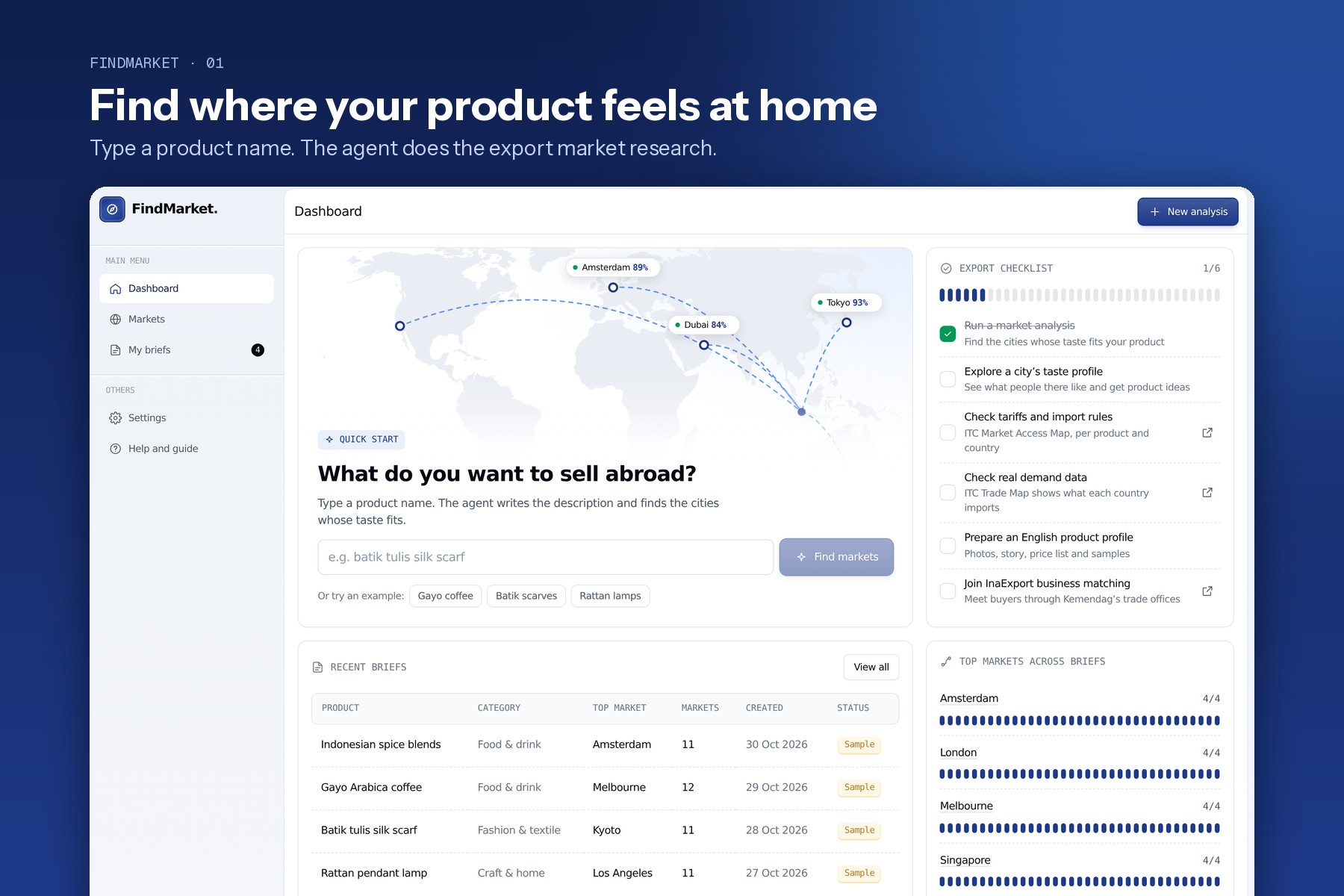
A user types a product name. FindMarket's agent then:
- Writes three product descriptions to choose from, using only facts in the name.
- Reads the product's taste in Qloo: turns it into Qloo tags and reference brands, chooses the right tag types, and ranks up to 30 destinations by audience affinity.
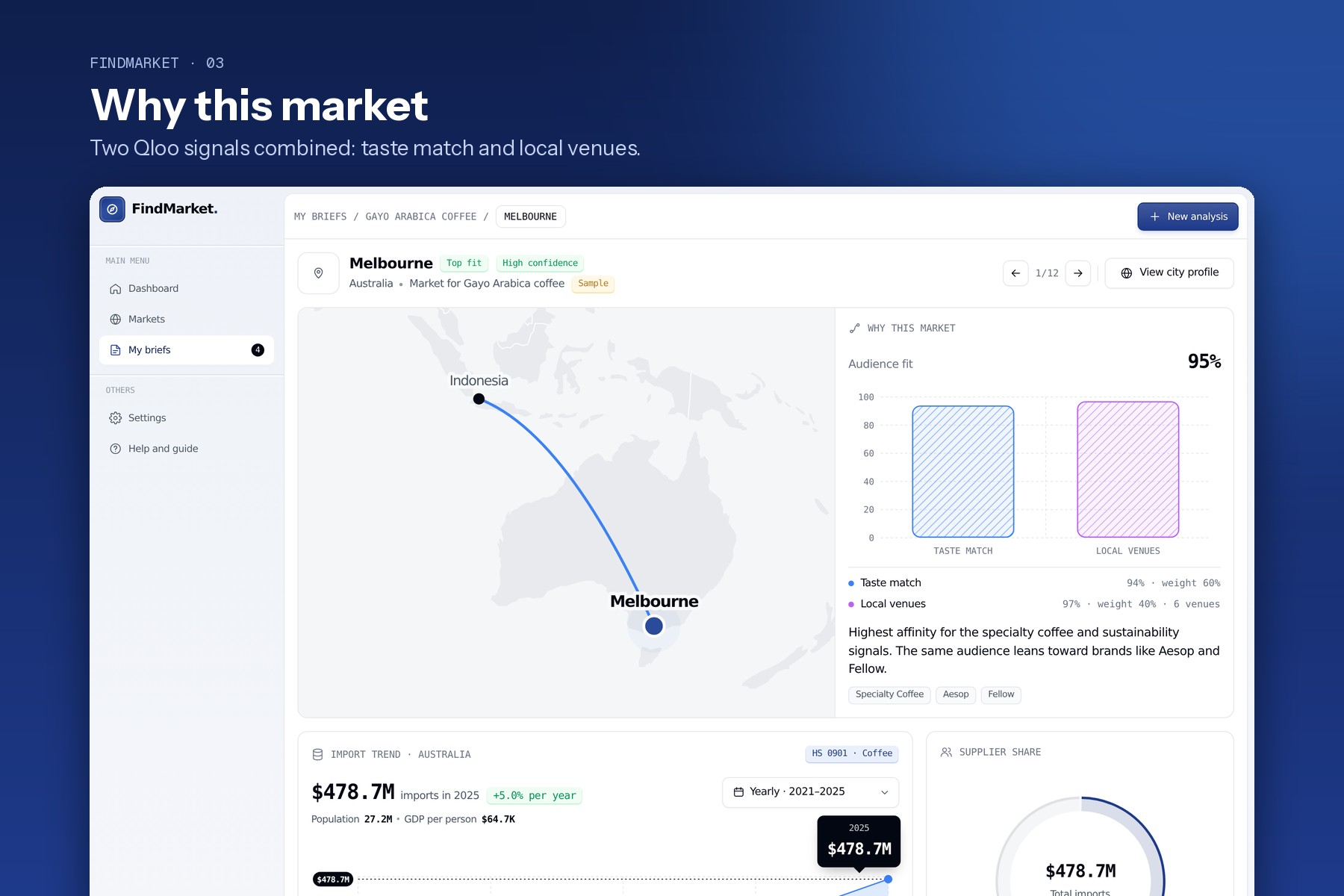
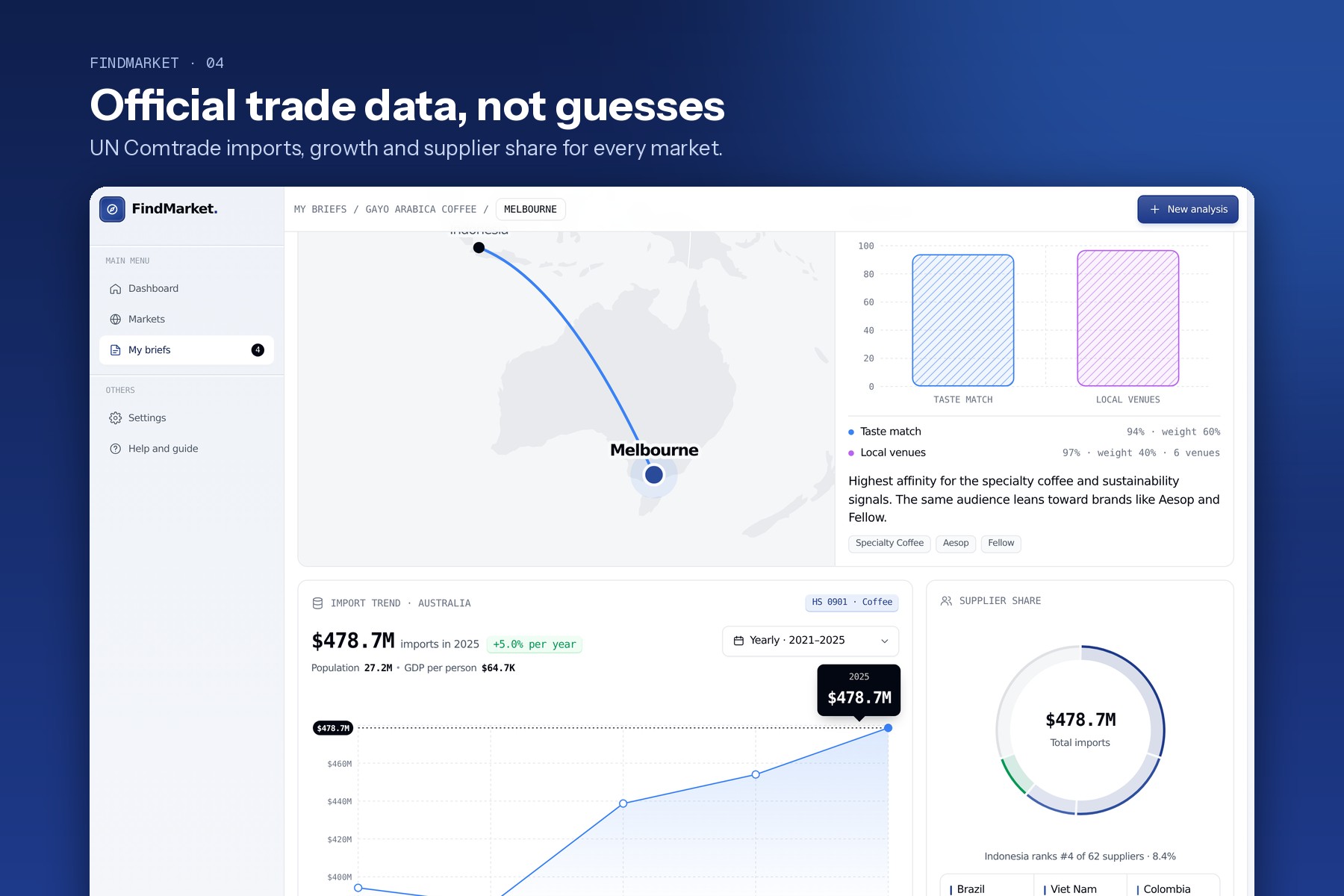
- Scores each recommended city with two Qloo signals: taste match (destination affinity) and local venues (how well the city's shops and places match the product), combined into one audience fit score.
- Checks official data for each country: UN Comtrade imports of the product's HS code (yearly and monthly trend, growth, top suppliers and the user's own country's rank) and World Bank population and income.
- Writes an export brief that only uses names Qloo returned, then verifies every recommended city against Qloo's results.
The result is a brief with:
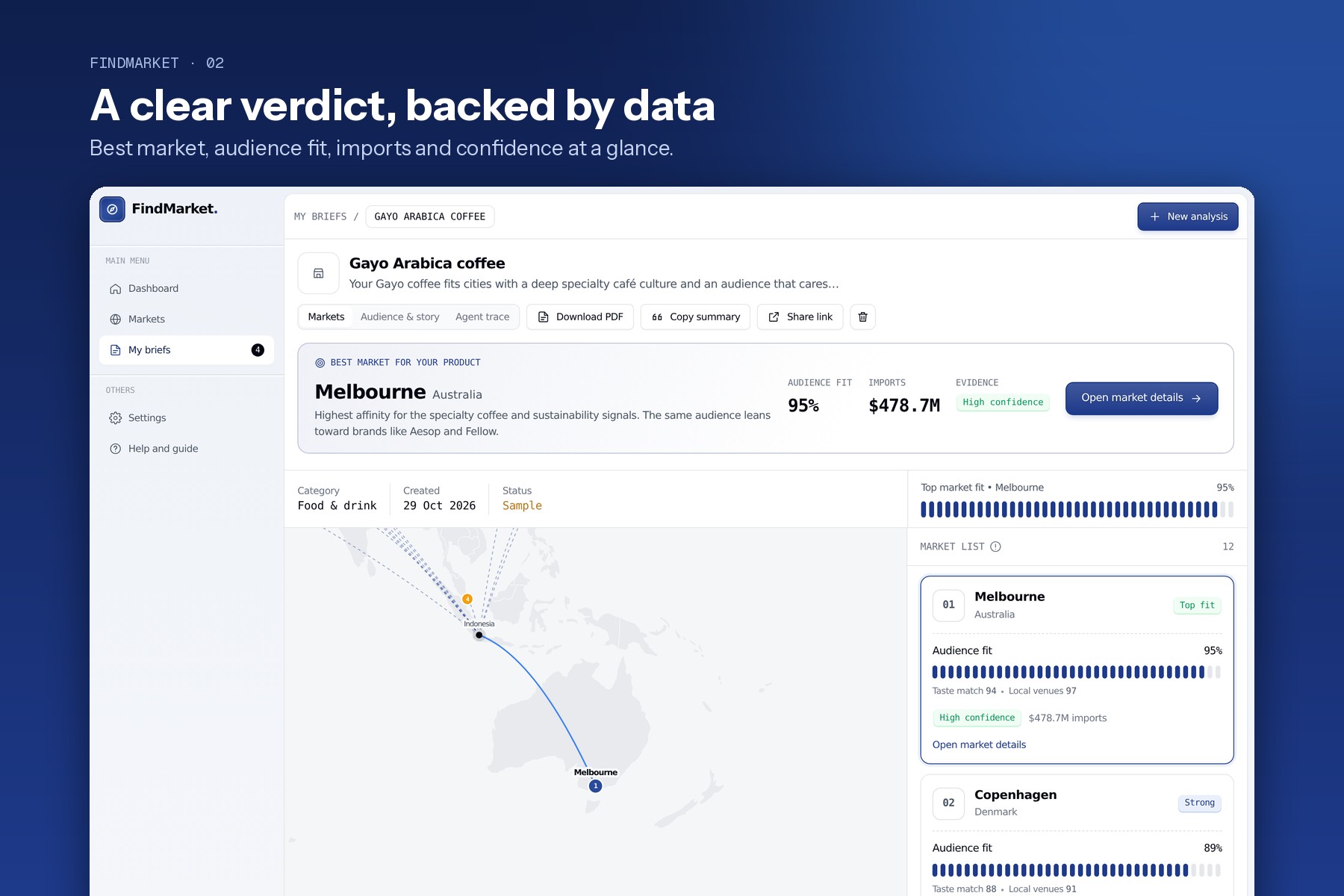
- A best-market verdict with fit, imports and a confidence level.
- A world map of 6 to 10 recommended cities, plus every other match Qloo found, ranked by fit.
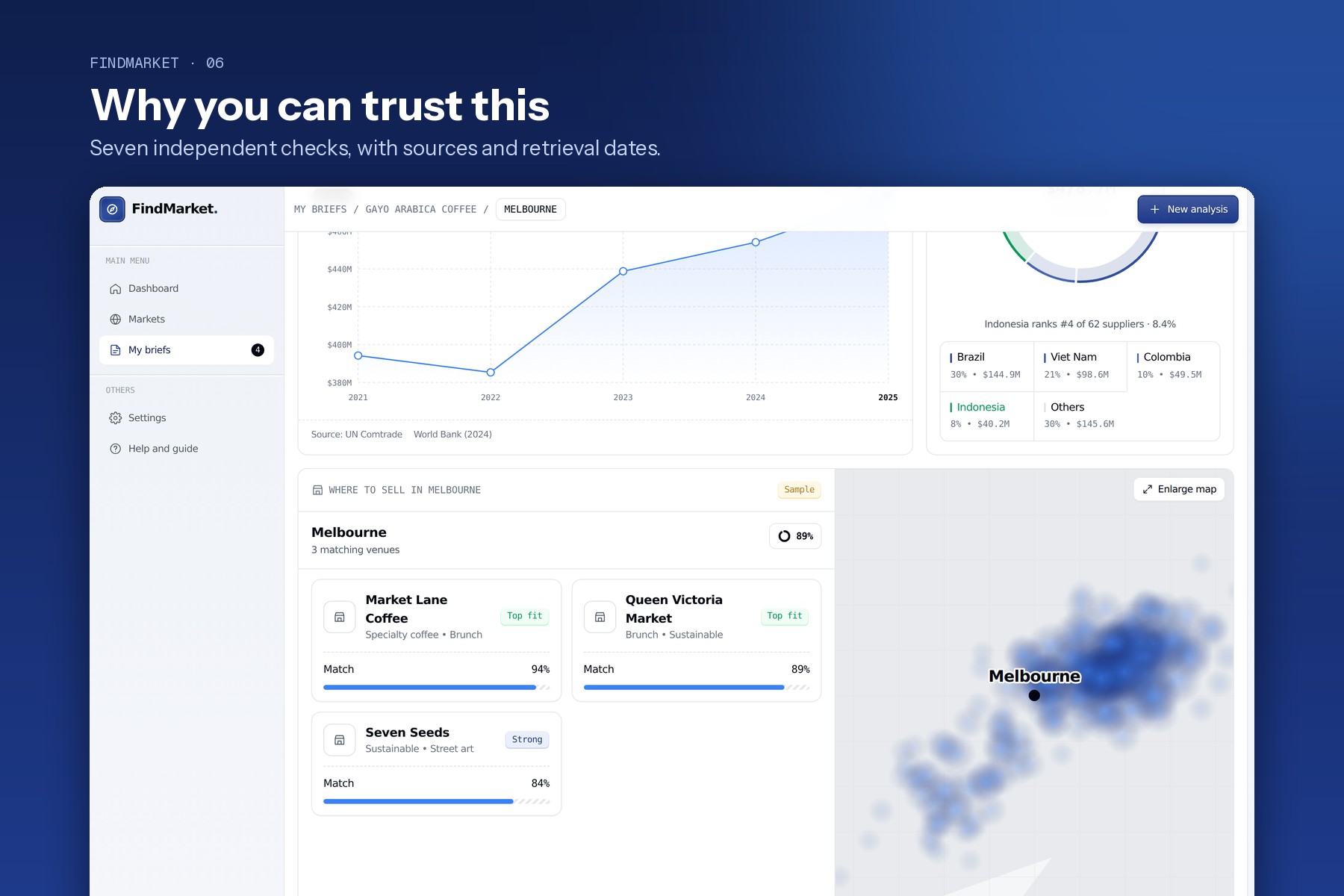
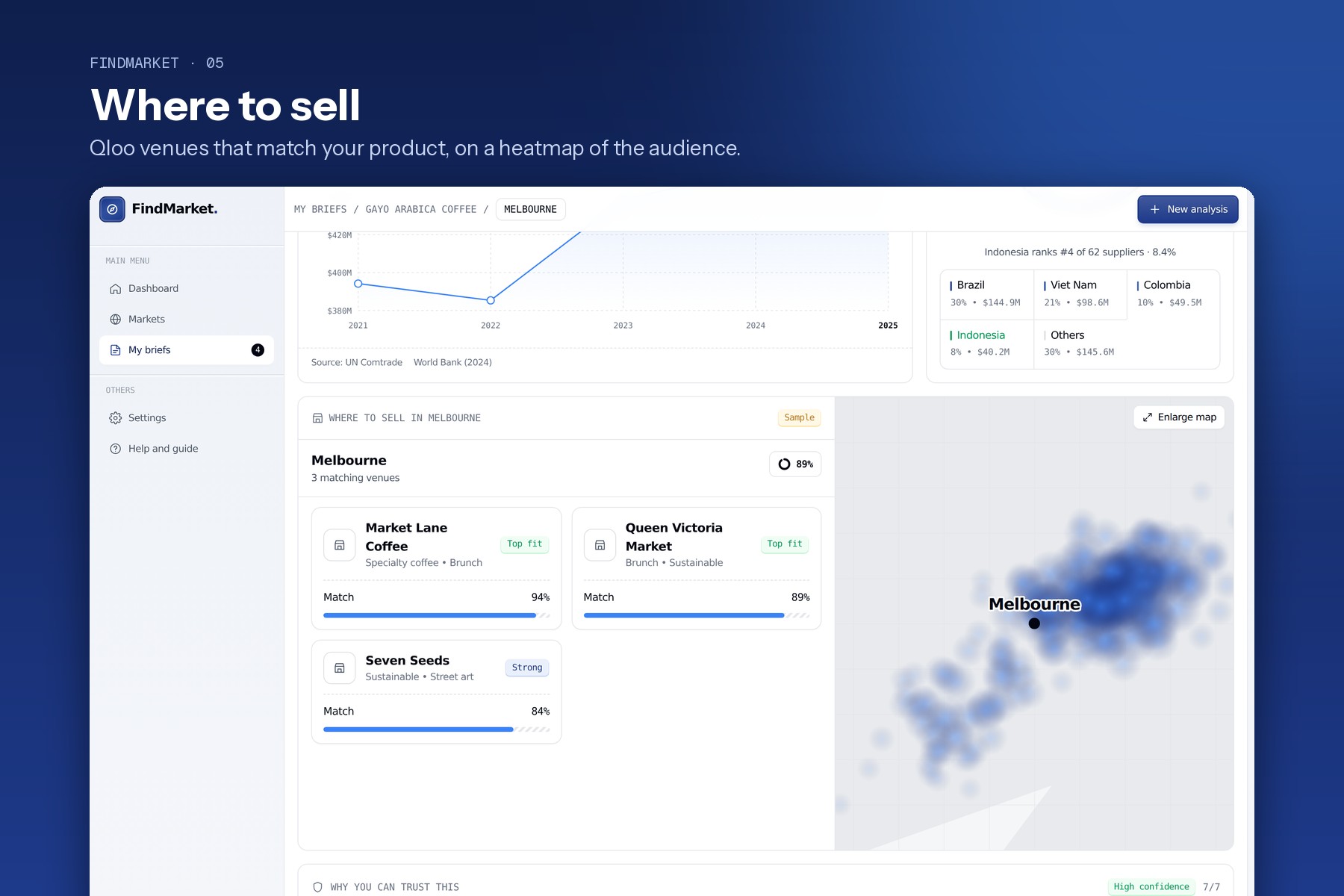
- For each city: why this market, an import trend and supplier share, where to sell (Qloo places on a street map with a Qloo heatmap of where the audience concentrates), who the audience is (Qloo demographics by age and gender), how to pitch and next steps.
- A "Why you can trust this" panel: seven independent checks with sources and retrieval dates.
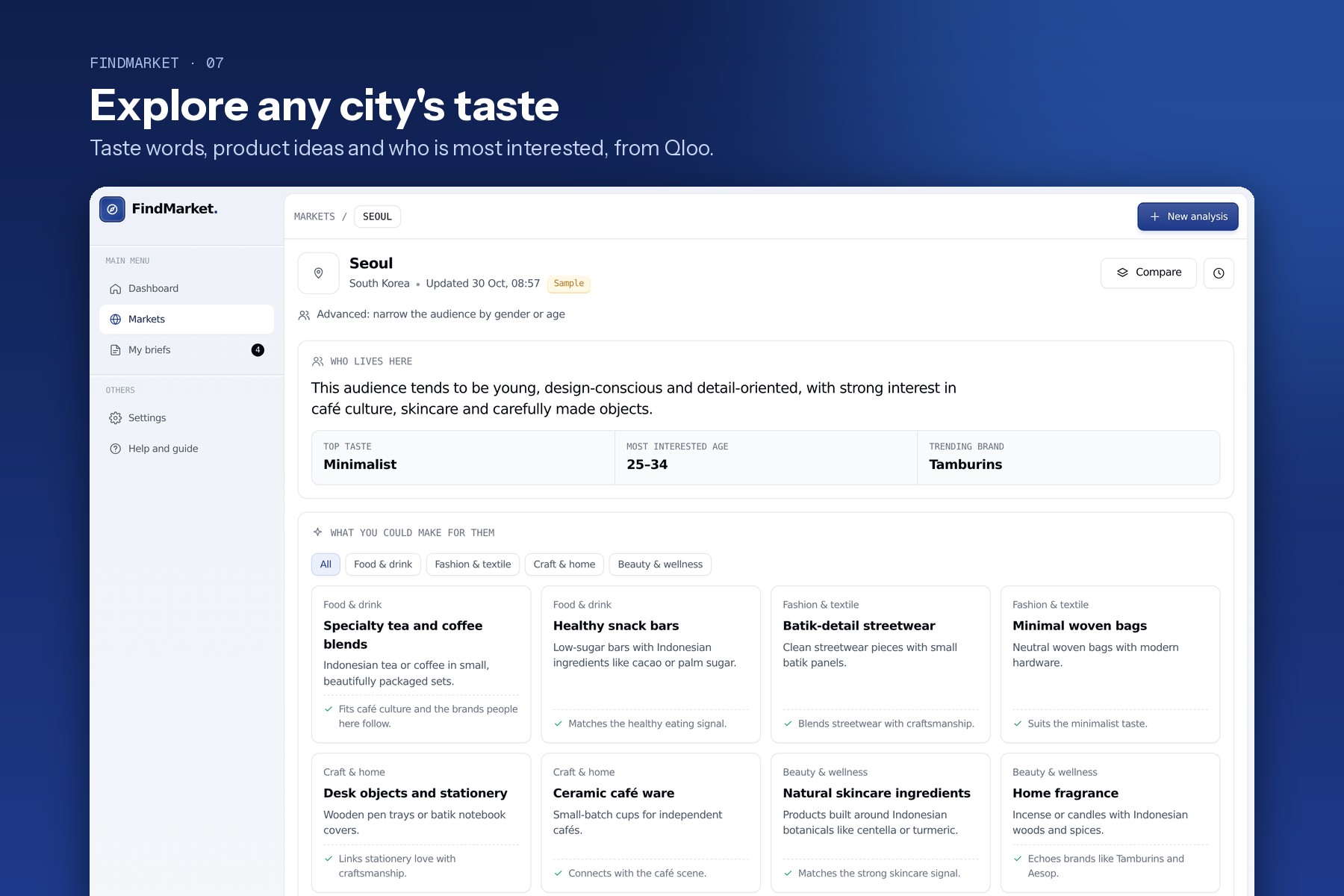
Users can also explore any city's taste profile (taste words, product ideas, and the podcasts, TV shows and books its audience loves), compare up to three cities side by side, download a brief as PDF and share it as a link.
FindMarket works for exporters anywhere: it detects the user's country, starts map routes from there, skips home-country cities and shows the user's own position among a market's suppliers.
How we built it
- App: Next.js 14 (App Router), deployed on Vercel with Fluid Compute. All API keys stay on the server.
- Taste data: Qloo Insights API (
/v2/tags,/search,/v2/insights) for destinations, brands, artists, tags, places, demographics, heatmaps, podcasts, TV shows and books, with location and demographic signals. - AI: Claude (Anthropic) for understanding the product, choosing Qloo tag types and writing the brief. Answers come back as structured tool calls, so the agent always receives valid data.
- Official data: UN Comtrade (imports by HS code) and World Bank (population, GDP per person).
- Maps: Natural Earth for the results map; Leaflet with an English-label basemap and OpenStreetMap boundaries for city heatmaps.
How we use Qloo
- Resolve: product keywords become Qloo tags and reference brands become entities.
- Decide: the agent picks the right tag types for the product; code drops any ID Qloo did not return.
- Rank:
urn:entity:destinationinsights rank cities by audience affinity. - Explore: brands, artists, taste tags and demographics for the same audience shape the portrait and pitch.
- Locate:
urn:entity:placewith a location filter finds venues in each city that match the product. - Map:
urn:heatmapshows where in each city the audience concentrates. - City profiles: location signals give each city's taste words, brands, places and cross-domain picks.
Every brand, city and taste word in a brief comes from Qloo results, and each recommended city is verified against Qloo's destination list.
Challenges we ran into
- Tourism-shaped destinations: Qloo destinations lean toward travel spots, so we request more candidates and instruct the agent to prefer trading cities spread across countries.
- Flat or generic signals: some scores came back identical, and venue categories like "Restaurant" crowded taste lists. We use Qloo's own ranking when scores are flat and push venue categories below real taste words.
- Trust: one affinity score wasn't enough for an exporter to act on, so we added a second Qloo signal, official trade data and a transparent confidence panel.
- Real-world APIs: rate limits, partly reported trade years and inconsistent response shapes. The agent queues and retries calls, ignores incomplete years and validates every response.
Accomplishments that we're proud of
- A full agentic pipeline, from a product name to a sourced export brief, built on Qloo.
- Recommendations an exporter can verify: every number shows its source and date.
- Taste data and trade data in one view, which existing export tools don't offer.
- A product that works for exporters in any country.
What we learned
- Taste data is most persuasive alongside hard numbers: together they answer "will people love it?" and "do they already buy it?"
- Guardrails matter: keeping the AI to names Qloo returned made briefs far more credible.
- Real data is messy; showing confidence honestly builds more trust than hiding gaps.
What's next for FindMarket
- Short share links and team workspaces.
- Tariff and import-rule data per product and country.
- Buyer and distributor matching, starting from the venues Qloo already finds.
- More languages for the interface and briefs.
Try it
Open the live demo and choose See an example for an instant brief, or Analyse my product to run the agent (about one to two minutes). Taste data shows group tendencies, not individual behaviour, and no personal data is sent to Qloo.
Built With
- anthropic
- claude
- javascript
- leaflet.js
- nextjs
- openstreetmap
- qloo
- react
- un-comtrade
- vercel
- world-bank


Log in or sign up for Devpost to join the conversation.