-
-
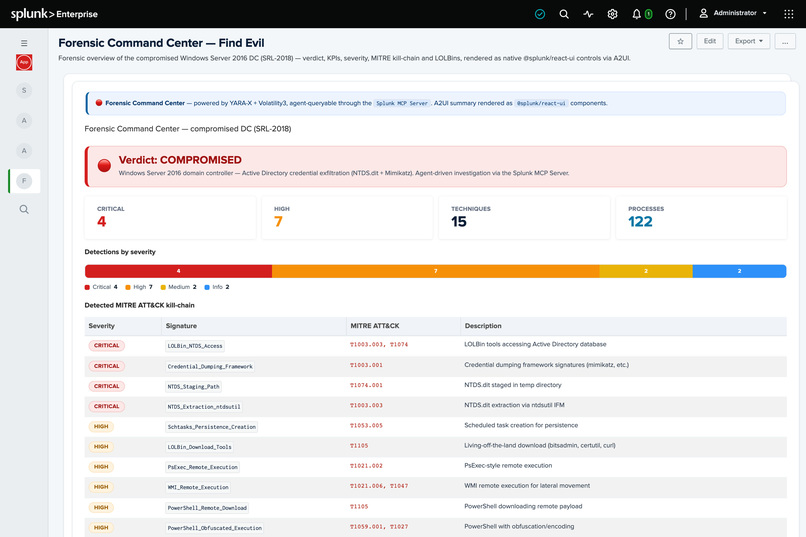
Running inside Splunk: the splunklib.ai agent's verdict rendered as native @splunk/react-ui controls via A2UI.
-
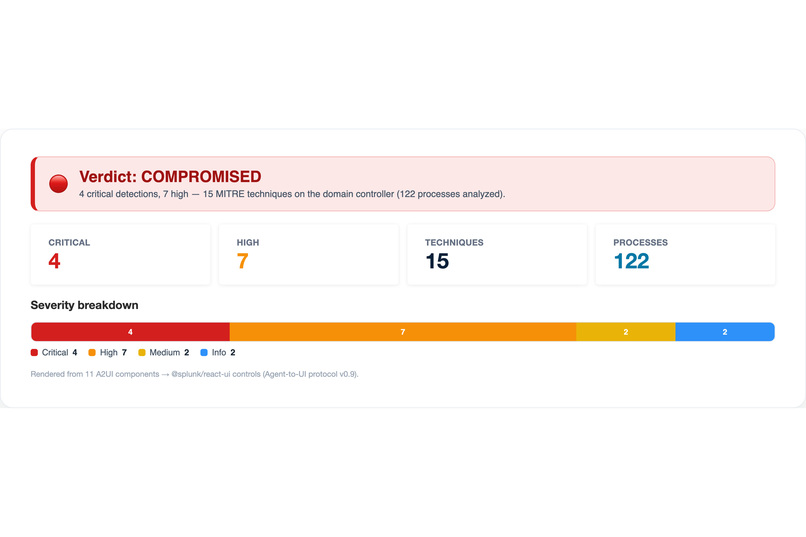
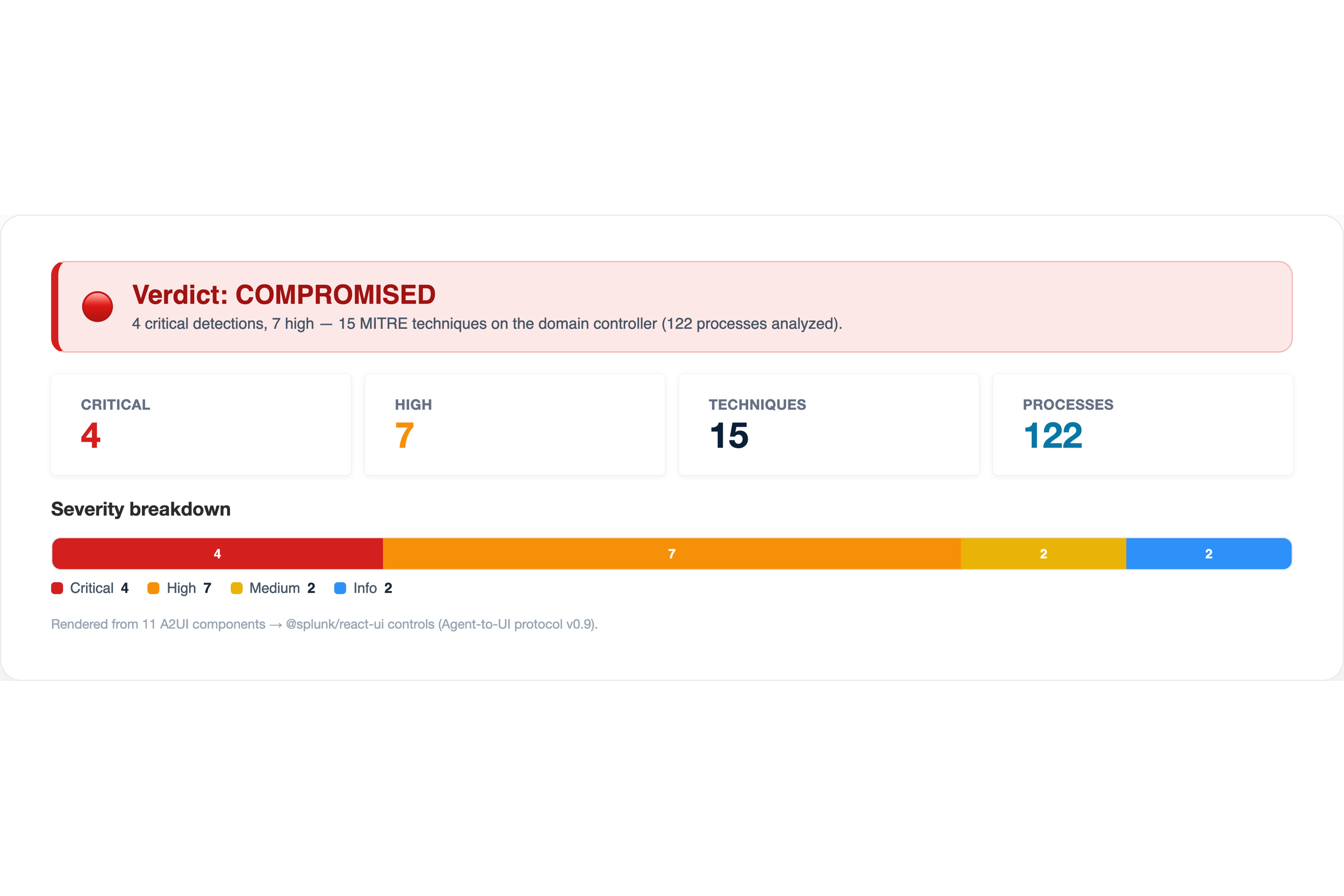
Verdict at a glance — COMPROMISED: 4 critical, 7 high, 15 MITRE techniques, as A2UI VerdictBadge, KPI cards and severity bar.
-
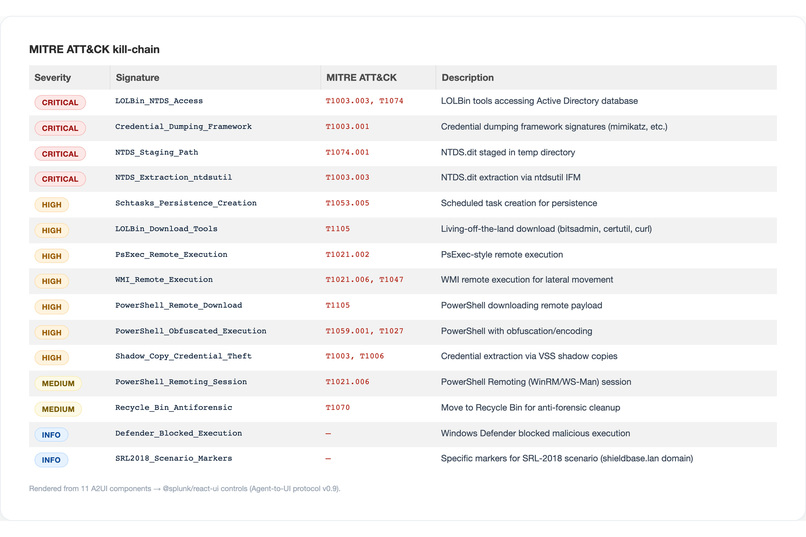
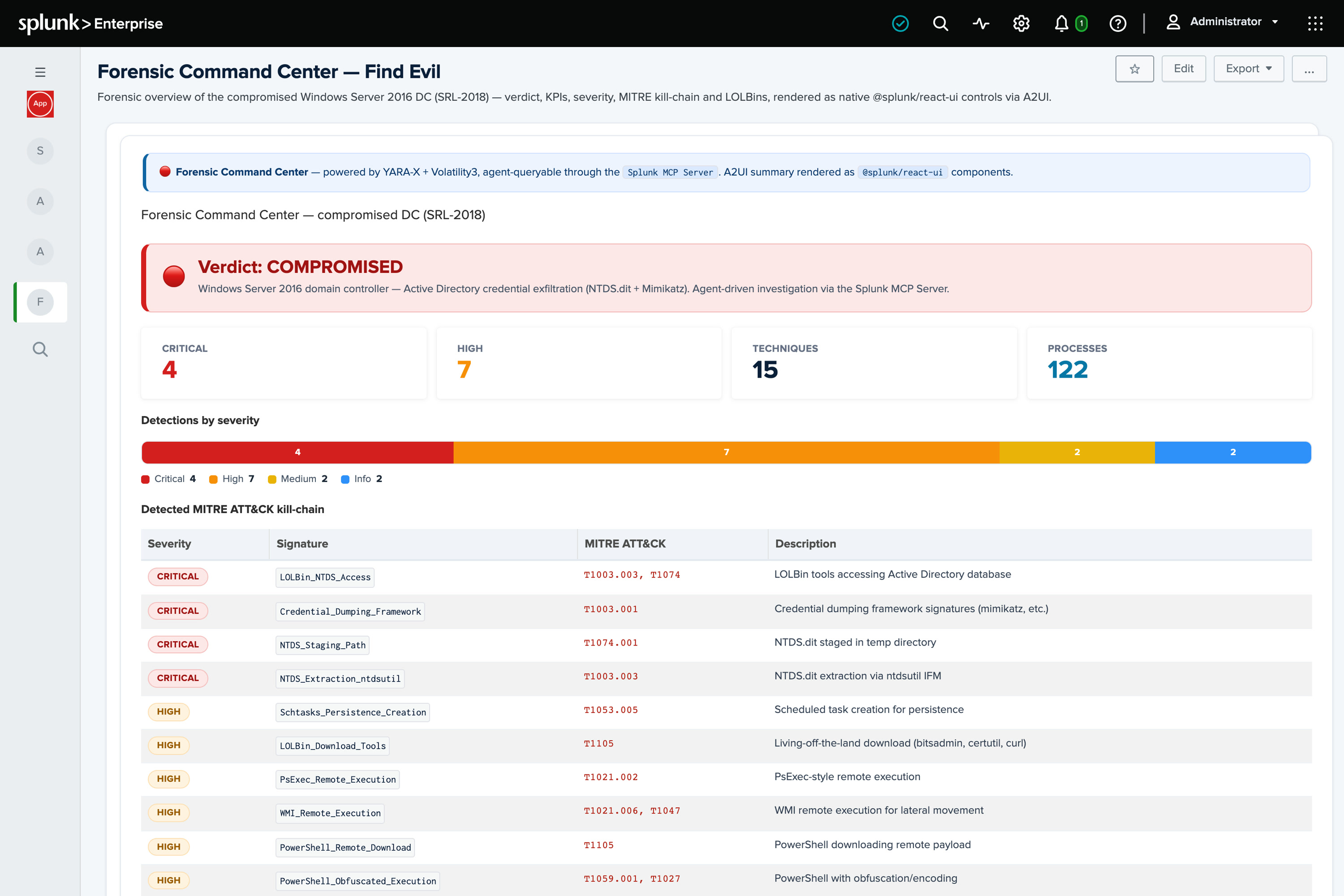
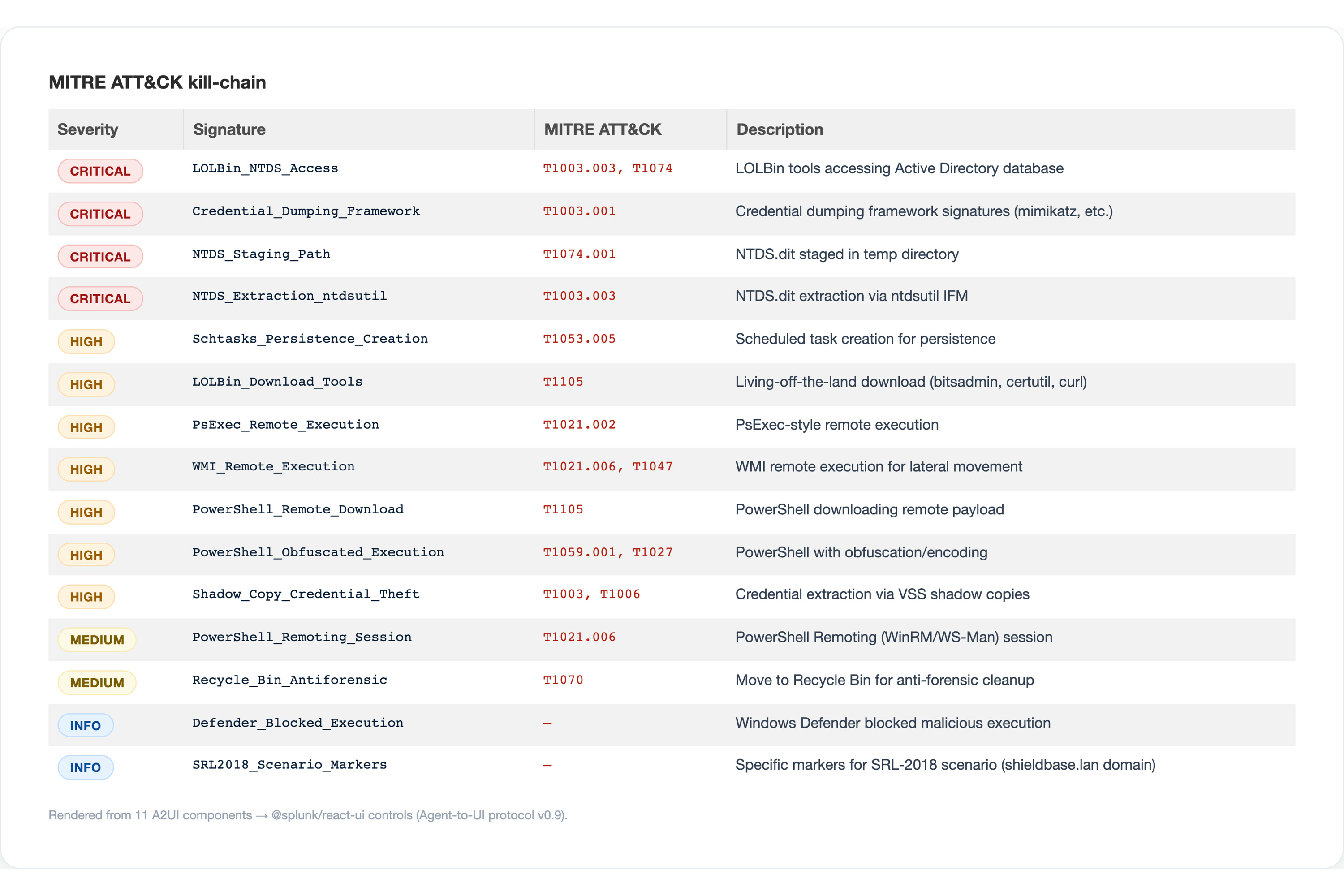
The reconstructed MITRE ATT&CK kill-chain: every YARA detection with severity chips and T-codes, as a native A2UI table.
-
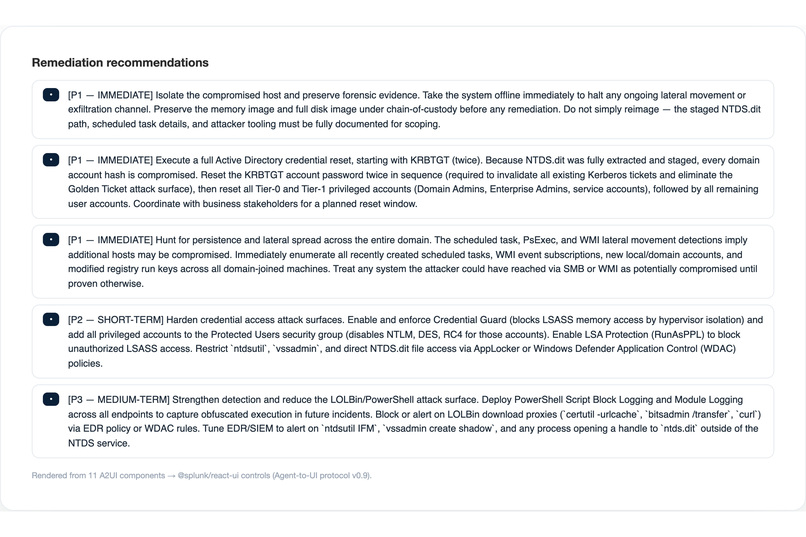
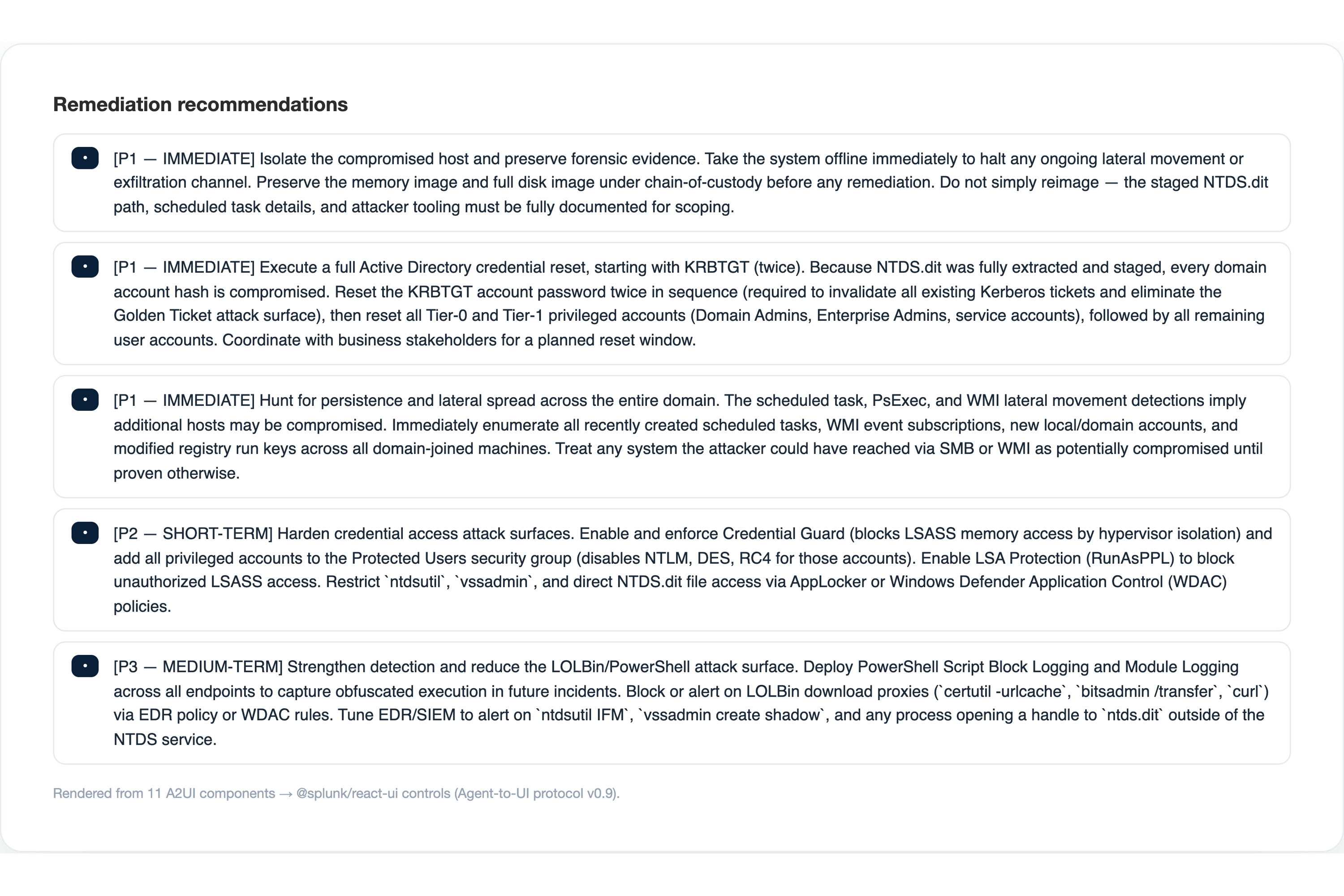
Prioritized remediation the agent recommends — isolate the DC, reset krbtgt, hunt lateral movement — as native cards.
-
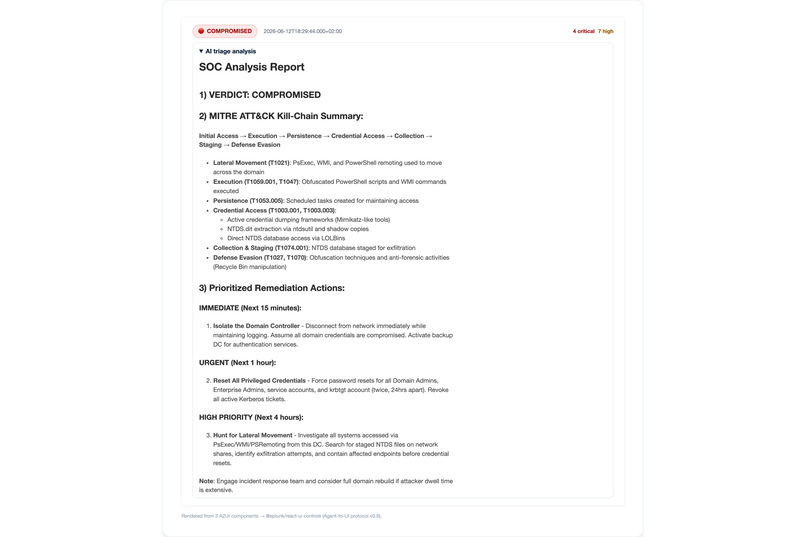
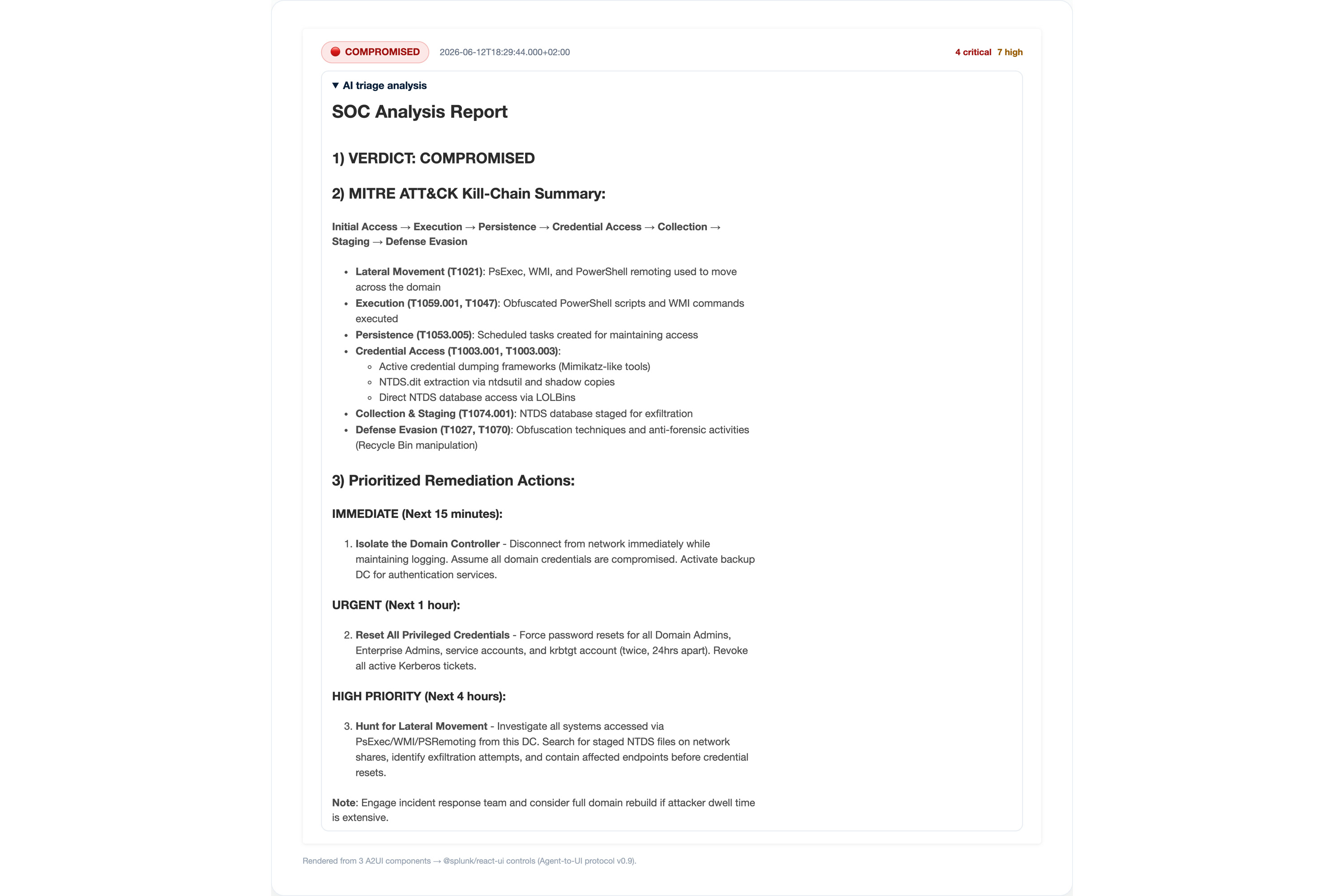
Hands-off SOC workflow: detect, then | ai triage, then a notable incident — the AI analysis is generated inside SPL.
-
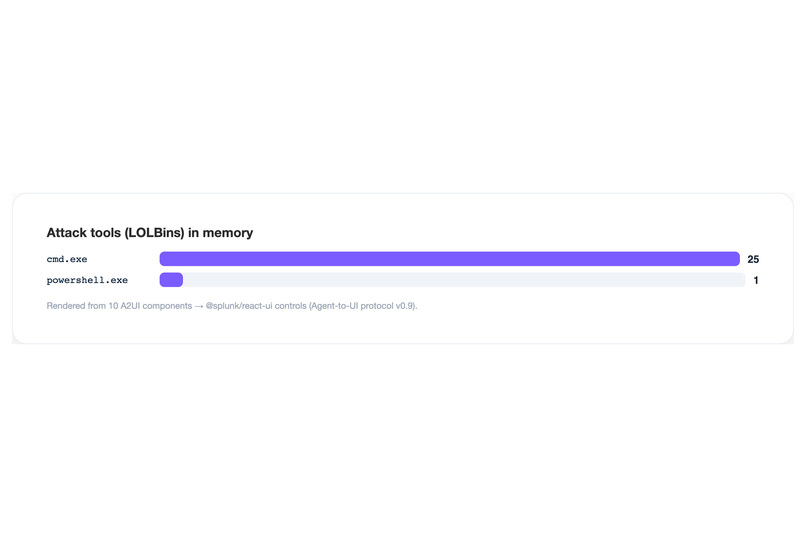
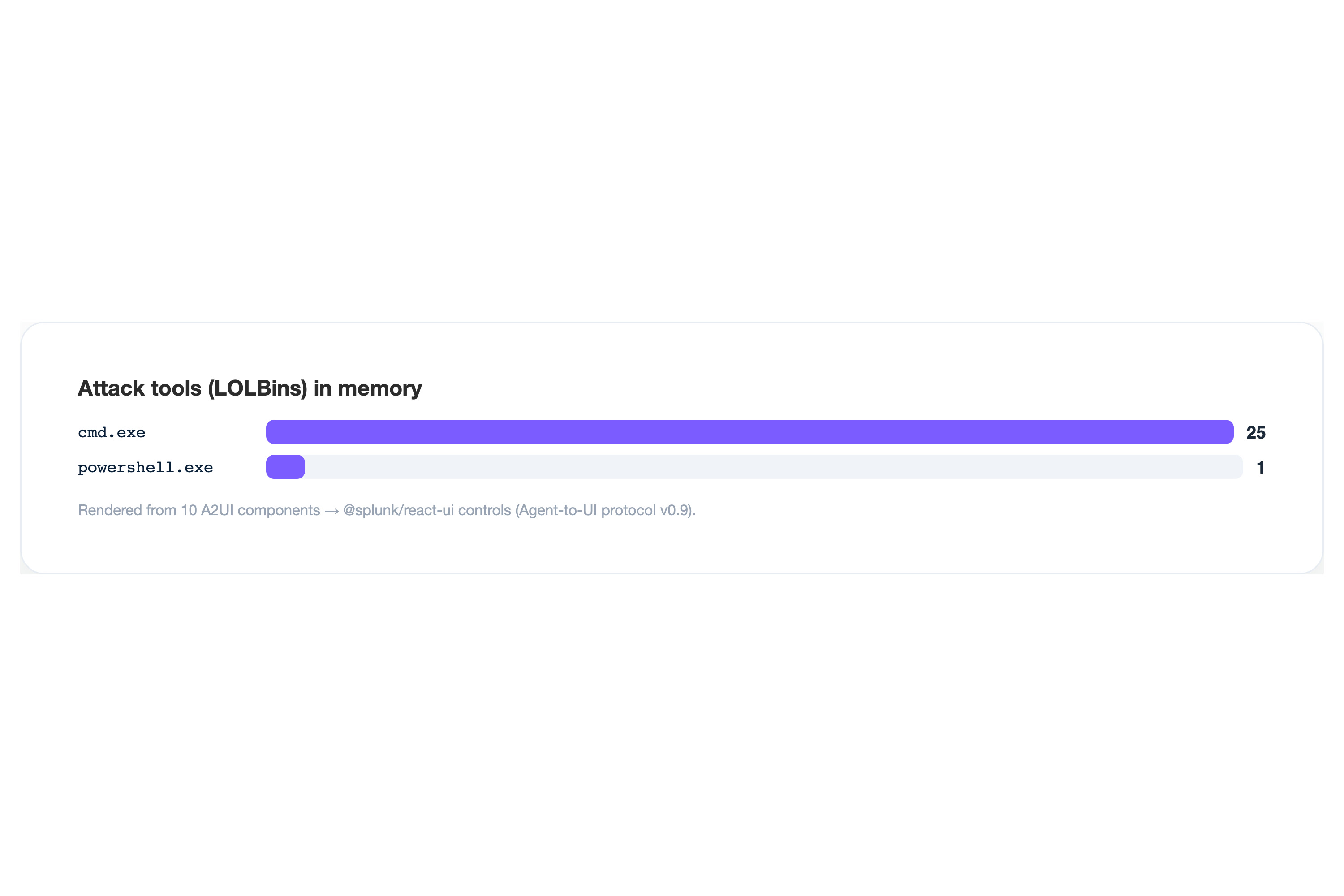
Living-off-the-land binaries carved from memory (PowerShell, cmd, ntdsutil, PsExec) — Volatility3 data in the forensics index.
Find Evil — Project Story
💡 Inspiration
Memory forensics is slow, manual, and reserved for experts. When a domain controller is breached, an analyst has to mount a multi‑gigabyte memory dump, run Volatility, scan it with YARA, and then manually correlate hundreds of processes and detections — all while the attacker is busy exfiltrating NTDS.dit, the crown jewels of Active Directory.
I wanted to find out: could an AI agent run that entire investigation — and deliver an incident verdict — in seconds, without ever leaving Splunk? Not a chatbot bolted on the side, but an agent that lives inside the search platform, queries it through real tools, and respects its security model.
🔎 What it does
Find Evil turns Splunk into a forensic database that an AI agent can investigate in natural language. Starting from a real memory image (base-dc-memory.img, a Windows Server 2016 DC from the public SRL‑2018 scenario), it:
- Extracts artifacts with YARA‑X (15 custom APT rules) and Volatility3 (124 processes / 122 distinct PIDs).
- Ingests them into a
forensicsindex via the official splunk‑sdk‑python streaming API, with a CIM‑aligned add‑on. - Exposes 5 purpose‑built forensic tools through the official Splunk MCP Server.
- Investigates with the official
splunklib.aiAgentic SDK: the agent auto‑discovers those tools, reasons with Claude under Splunk RBAC, and — through theai_triagetool — even has the LLM reason inside SPL via the AI Toolkit's| aicommand. - Renders the result as A2UI, mapped to native
@splunk/react-uicontrols (verdict badge, KPI cards, severity bar, MITRE table with chips, remediation list) across all four dashboards. - Automates a SOC loop: a scheduled alert detects → triages with
| ai→ writes a notable incident.
On the demo image, the verdict is COMPROMISED — 4 critical / 7 high detections — reconstructing the full AD credential‑exfiltration kill‑chain (T1003.003 ntdsutil, T1003.001 mimikatz, T1074.001 staging, T1021.002 PsExec, T1047 WMI…).
🛠️ How I built it
- Forensic extraction: YARA‑X (Python bindings + 15 scenario‑tuned rules) and Volatility3 → JSON artifacts.
- Data plane: a dedicated
forensicsindex fed bysplunk-sdk-python(index.attached_socket), plus a versioned TA for the index and CIM‑aligned sourcetypeprops.conf. - Control plane: the official Splunk MCP Server, where I registered 5
forensics_*tools as safe, frozen SPL templates via/services/mcp_tools. - Agent: real
splunklib.aiagents (SDK 3.x) running as app scripts — tool auto‑discovery, Claude reasoning, and Pydantic structured output. - UI: an enriched A2UI v0.9 catalog + one reusable React renderer that drives every dashboard from JSONL snapshots — produced either by the LLM agent or by a fast deterministic generator.
- Delivery: a Terraform module (
splunk/splunkprovider) that packages the apps into.spland installs them + the index — validated end‑to‑end and idempotent.
🧗 Challenges I ran into
- Getting the AI Toolkit's
| aicommand to actually run on local Splunk Enterprise (macOS Apple Silicon): the right Python‑for‑Scientific‑Computing build, removing macOS quarantine on the embedded Python (Gatekeeper wasSIGKILL‑ing it), grantingapply_ai_commander_commandvia themltk_adminrole, and wiring the Anthropic connection. - Designing an A2UI catalog rich enough to produce dense, useful Splunk‑native UI instead of generic cards or raw Markdown.
- Loading the React bundle from a dashboard's
script=under Splunk's RequireJS — a UMD dependency kept registering an anonymousdefine()and breaking the dashboard until I shadoweddefine/module/exportsin the bundle. - Keeping the agent strictly inside Splunk's RBAC (no sidecar that bypasses auth) while still getting full tool auto‑discovery.
- Small but sharp data issues: 2018‑era timestamps rejected by
MAX_DAYS_AGO, search‑time JSON re‑extraction causing duplicate fields, and Anthropic strict mode rejecting the MCProw_limiter's integer bounds.
📚 What I learned
The combination of the MCP Server, the Agentic SDK (splunklib.ai), and the AI Toolkit (| ai) genuinely enables a production‑shaped agentic loop inside Splunk: the agent discovers purpose‑built tools, the model can reason either from the SDK or natively in a search, and RBAC is enforced throughout. A2UI turned out to be a clean bridge from agent reasoning to polished Splunk UI — no custom visualizations from scratch. And the Terraform delivery proved that even an AI + forensics app can be treated as plain infrastructure‑as‑code.
🚀 What's next
Run the | ai path behind a local open‑source security model (e.g. Foundation‑Sec‑8B) for a no‑egress / air‑gapped posture, extend the tools to disk forensics (E01), and make the A2UI catalog reusable across other Splunk AI use cases.
Built With
- a2ui
- anthropic
- claude
- esbuild
- javascript
- model-context-protocol
- node.js
- pydantic
- python
- react
- spl
- splunk
- splunk-ai-toolkit
- splunk-mcp-server
- splunk-react-ui
- splunk-sdk-python
- splunklib.ai
- styled-components
- terraform
- volatility3
- yara-x

Log in or sign up for Devpost to join the conversation.