-
-
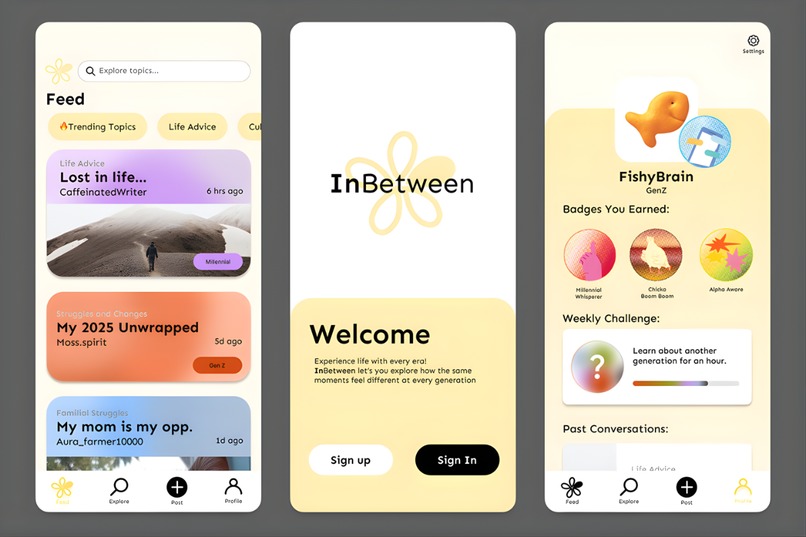
Featured Screens
-
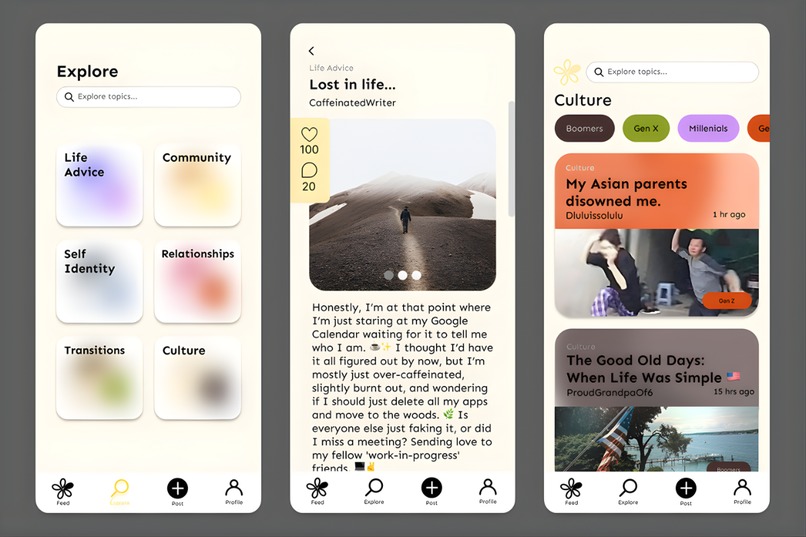
Featured Screens pt.2
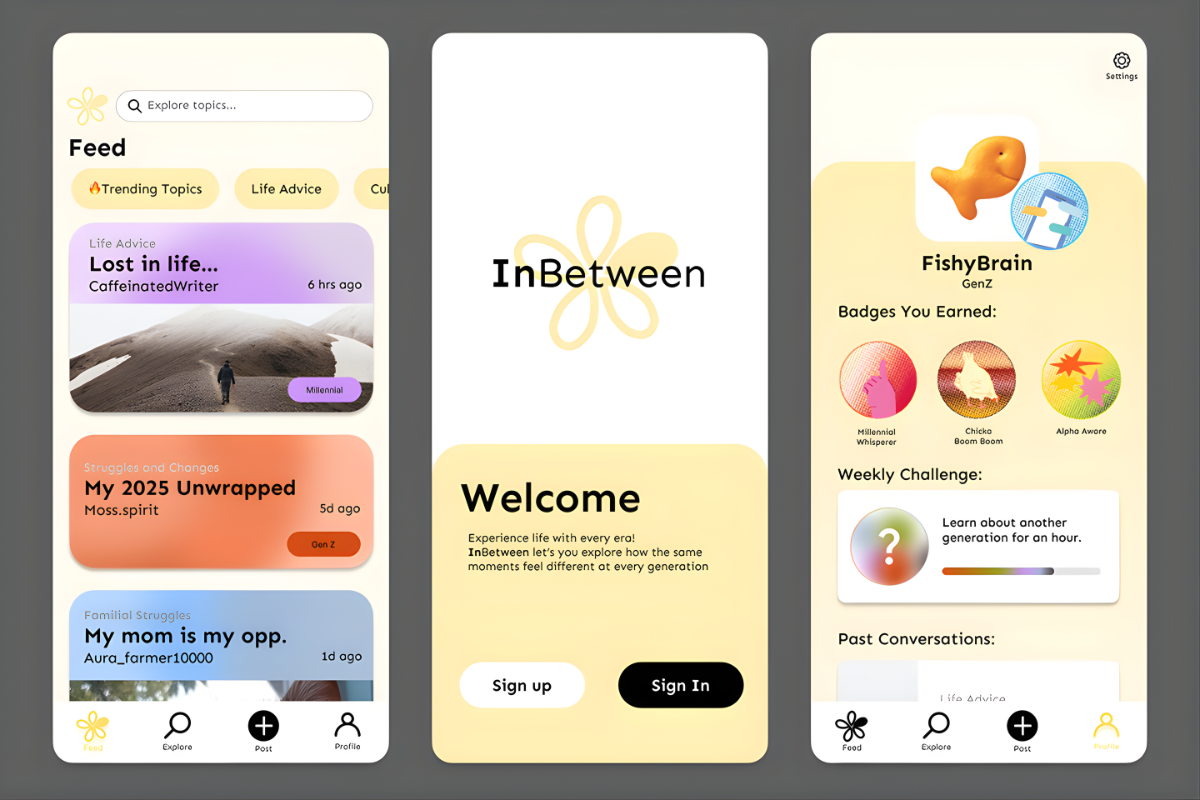
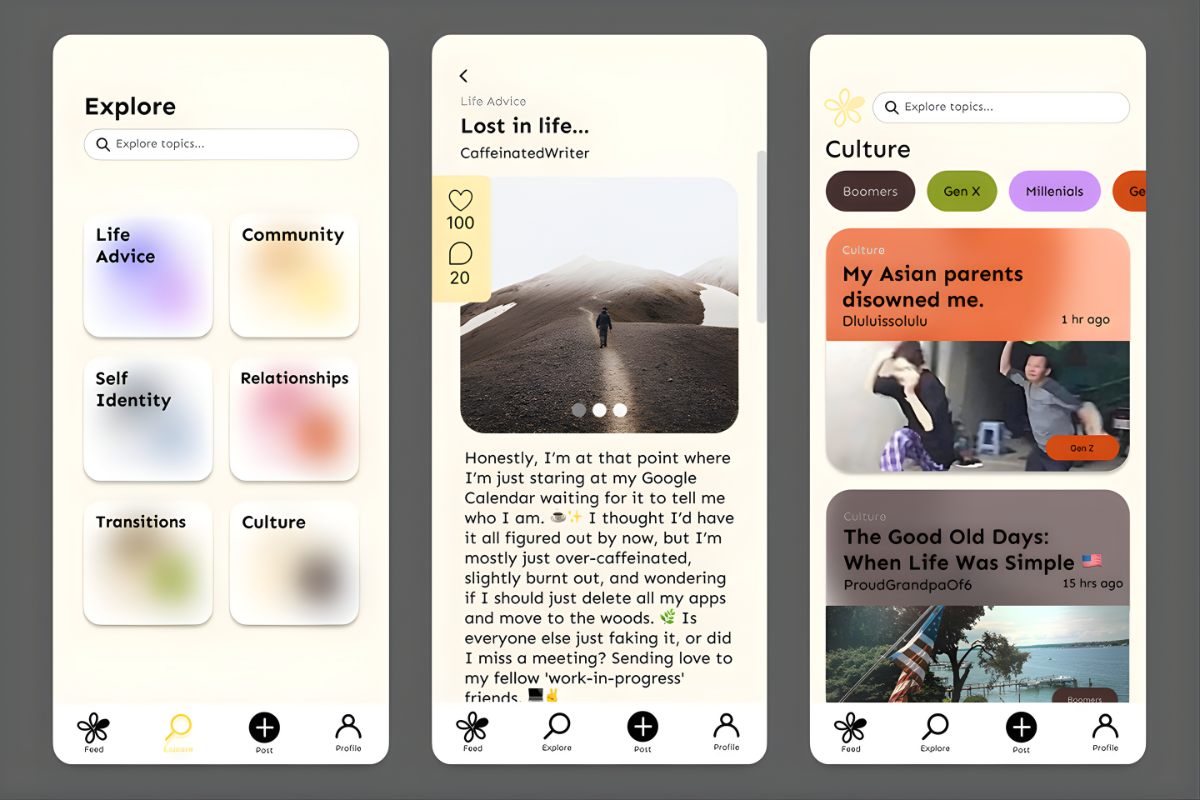
Prototype link:
Describe your project
inBetween is a social platform designed to foster empathy and understanding across generational divides. It can be difficult to grasp how a person's era and life experiences shape their worldview, often leading to disconnects in how we communicate and relate to one another. Our project explores this concept by allowing users to step outside their own bubble and see what other age groups are interested in and posting about.
Through an anonymous, judgment-free interface, users can toggle between generational feeds to see how people of different ages respond to the same topics. This provides a unique window into the distinct life stages and ways of speaking that define each group. By stripping away the pressure of identity, inBetween helps bridge the communication gap, turning generational friction into a tool for genuine connection and perspective-shifting.
Describe your research process and findings.
Our research process focused on identifying the specific barriers that prevent meaningful cross-generational dialogue. We conducted a primary survey via Google Forms, gathering 47 responses across diverse age groups to assess their understanding of generational terms, digital comfort levels, and feelings of social isolation.
Key Survey Findings:
The Misunderstanding Gap: 78.2% of respondents feel frequently misunderstood by other generations, and 65.2% admit they are afraid of being judged or misinterpreted when posting online.
Privacy vs. Expression: While 63% expressed concern over who sees their personal stories, 58.3% remained comfortable sharing anonymously. This validated our decision to prioritize an anonymous, text-based interface to reduce social pressure.
Content Preferences: 87% of users favored written forms of communication. Respondents identified humor, values, and communication styles as the top three areas of generational friction.
Knowledge vs. Connection: Interestingly, while 76.1% of people recognize generational labels (e.g., Boomer, Gen Z), they still struggle to connect. Participants cited "moral differences," "outdated thinking," and "slang" as primary drivers of incomprehension.
Learning Interests: Our data showed a strong desire for mutual mentorship. Users want to share their career experiences and life transitions, while they are most interested in learning from others about life advice, stress management, and cultural traditions.
Secondary Research: Bridging the Communication Gap Our secondary research confirmed that generational divides are often rooted in medium and tone. While Baby Boomers and Gen X favor face-to-face interaction, Millennials and Gen Z are more comfortable with digital expression. However, digital text often strips away facial expressions and vocal tone, leading to the "tone-deaf" misunderstandings we aim to solve. By providing a platform that explicitly labels the generational "lens" of a post, inBetween adds the necessary context that standard messaging lacks.
Survey: Link
Describe your most important design decisions.
When designing In Between, we had to decide what kind of space we wanted it to be. Serious? Funny? Somewhere in between. When we think about past conversations across different opinions or generations, they often turn into debates, arguments, or moments where someone leaves feeling offended. That’s exactly what we wanted to avoid. Instead, In Between is designed as an easy, casual place to explore different perspectives without pressure. Our goal is to make conversations across generations feel more like listening to someone talk in real life, not reacting to a post online.
Our survey results confirmed that different generations prioritize vastly different topics. To address this, we introduced topic tags and color-coded generations, allowing users to instantly filter feeds and understand where a specific perspective originates. To encourage consistent empathy, we added gamification, such as weekly goals and profile badges, rewarding users for the time they spend engaging with views outside their own. We intentionally designed the interface to be primarily text-based. By focusing on written responses rather than heavy media, we make the platform more accessible for older generations and more reflective for younger ones. Furthermore, while users can revisit their history, we removed the ability to "curate" or "save" posts. Much like a real conversation, the experience is meant to be felt and reflected upon in the moment—something you carry with you, rather than something you collect.
Describe how you utilized AI in your design process in detail.
AI served as a supporting medium in our design process, helping us refine our concepts and ensure the various elements of our project fit together cohesively. During the conceptualization phase, it helped us arrive at the name inBetween, perfectly reflecting our goal of exploring the interconnected space between generations. Since our personal circles primarily consist of Millennials and younger generations, we used AI tools like Gemini for background research to better understand users from different age groups, such as Gen X, Boomers, and Gen Alpha. This allowed us to design beyond our own lived experiences and accurately portray the characteristics and perspectives of those we don’t know as closely. Ultimately, AI acted as a grounding tool for our ideas, allowing us to prototype with a wider, more authentic range of generational voices.
Built With
- adobe-illustrator
- figjam
- figma
- procreate

Log in or sign up for Devpost to join the conversation.