-
-
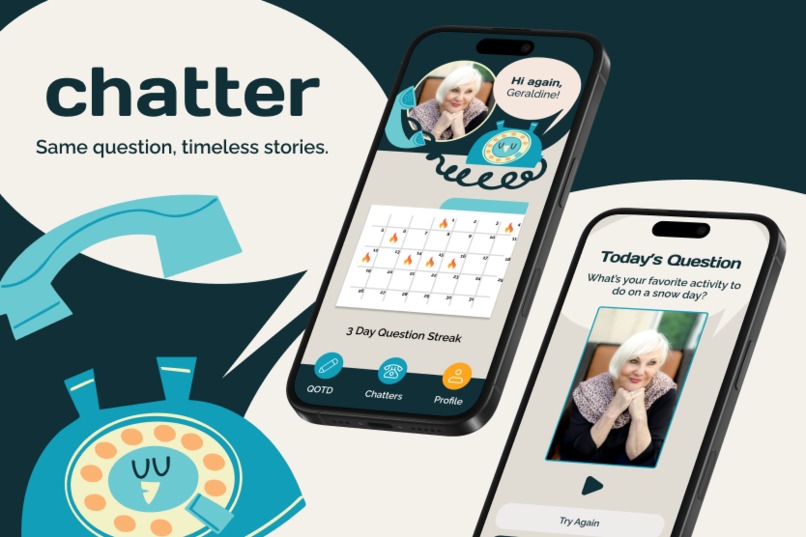
thumbnail :)
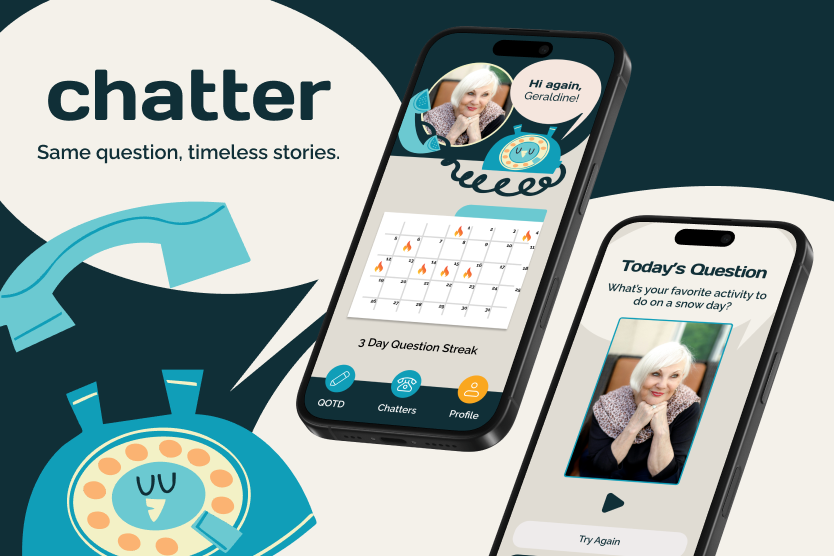
Describe your project (Max 150 words)
A story is a powerful artifact to bond over. To really know someone, you have to understand their journey. There are rich experiences and relationships that we may never know unless we ask. However, telling stories about yourself isn't easy. Some stories only feel right to tell in certain situations. A good prompt goes a long way, and they are essential for remembering specific stories and uncovering details within them. As we age, there is less and less time to share. In fact, by the time you graduate high school, you've already spent about 93% of the time you have with your parents in your lifetime ("The Tail End" from Wait But Why).
Chatter serves as a way to bridge the gap (between people, and between memories) through daily video prompts that create a slow-growing, lasting archive of shared human experiences.
Describe your research process and findings. If you conducted any surveys or interviews, please include the survey form and/or interview questions here. If you conducted secondary research by pulling from online sources, please include a link to your sources. (Max 500 words)
When looking at the generational gap, we realized quickly that a survey alone wouldn't truly encompass the nuance of a problem of this complexity. There are different pain points, perspectives, and needs to consider for each user and their background. Our research process consisted of insights from online forums, studies, and narrative inquiries instead of hosting a survey early on.
One particularly of note was of a researcher developing a class focused on storytelling. "By hearing the stories they told of themselves in their presentations," noted one elderly student in his class, "I have a very different view about them" (Yu, 2015). On an individual level, both younger and older people benefit from sharing their stories, said Robyn Fivush, a professor of psychology at Emory University (American Press Institute, 2025).
But how do we get users to share their stories? Anonymity has been a proven strong contender, but a Reddit user online had another great answer: "One thing that helped me with participation on a similar project was giving very specific prompts". This aligned with the engagement patterns we've found from BeReal, whose daily single-prompt model eliminates decision fatigue. Users don't have to think about what they want to share, they just have to respond. When everyone answers the same question, it creates immediate common ground.
These overall insights come together to define our vision: Chatter succeeds by making storytelling specific, structured, reciprocal, and time-bound. It changes an intimidating act with multiple barriers into a daily ritual that bridges generations naturally.
Describe your most important design decisions. What research findings and/or user testing results led you to make these decisions? (Max 500 words)
WHY ONE DAILY PROMPT?
As mentioned earlier, the best way to facilitate storytelling is to use specific prompts. We didn't know how effective one right question could be until we realized the patterns for engagement on other platforms (BeReal or Instagram Stories) all start with a simple, direct prompt that the user can answer.
VISUAL IDENTITY
We were inspired by 'chat', and how itss different connotations (chatterbox, 'chat' in relation to modern Twitch streams, and even how AI models start with a conversation, i.e ChatGPT) can still unify a diverse background of users.
Icons were found on Flaticon, and we used Adobe Illustrator to match the colors of one Flaticon sticker to the rest of the assets we found (also on Flaticon). Colors were meant to be simplified (hence monochromatic) so that differences would be easy to discern (only on shade changes and contrast, not on color alone).
WHY VIDEO + AUDIO FORMATS?
Physical presence has been highly sought after. Especially with AI-generated content rampant on social media, having real people talk is refreshing. It's why Reddit is just as searched for as your normal Google search -- people want to talk to, see, and hear other real people.
Note: AI was not used at any point in this design process. As the point of the project was to foster human connection, it did not seem necessary to involve AI in this process.
Built With
- adobe-illustrator
- clipchamp
- figjam
- figma
- flaticon
- obs


Log in or sign up for Devpost to join the conversation.