-
-
Cover: Fanpoint fills open dates between booked shows
-

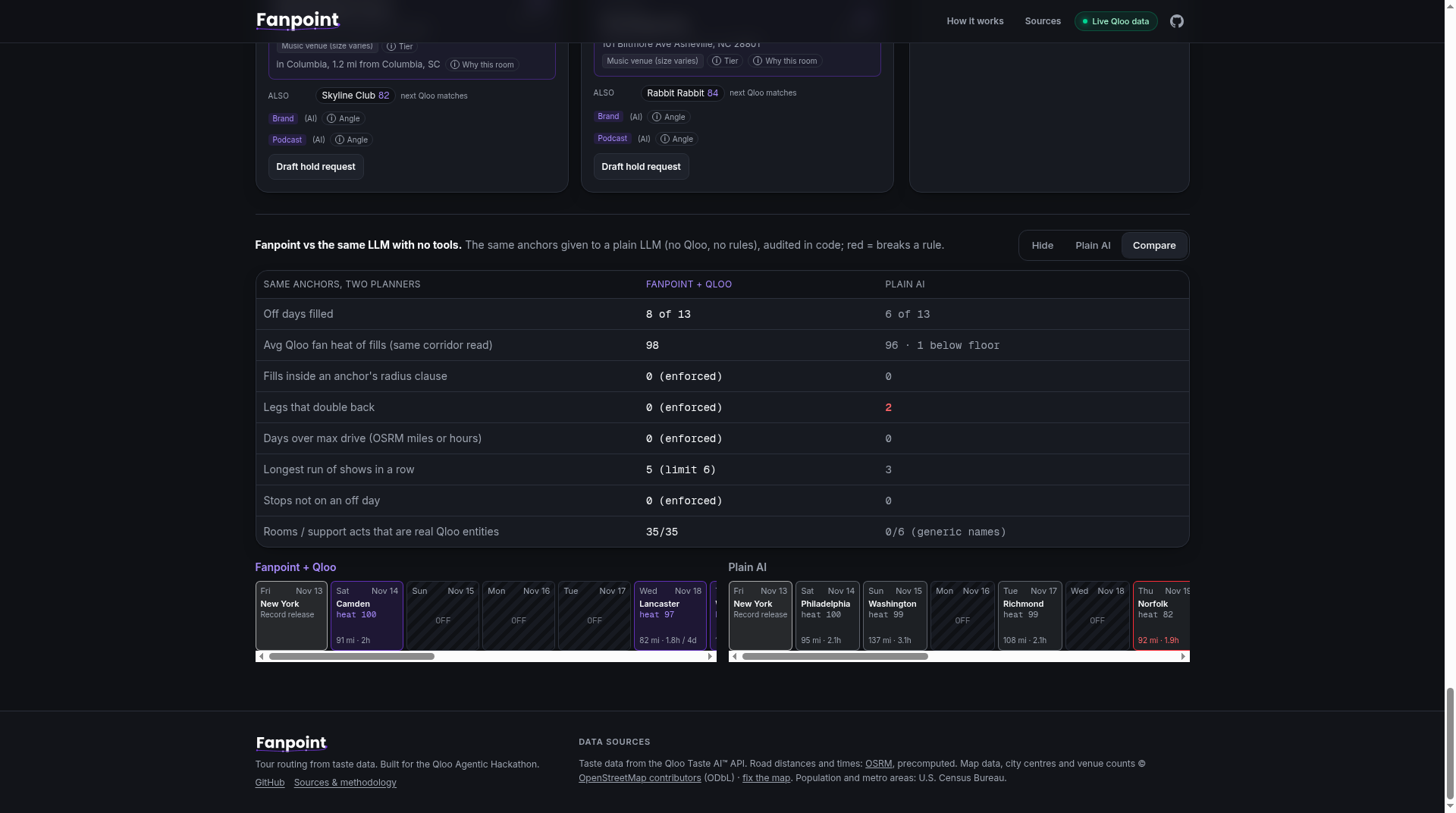
Fanpoint vs plain AI: nights booked and rule breaks
-
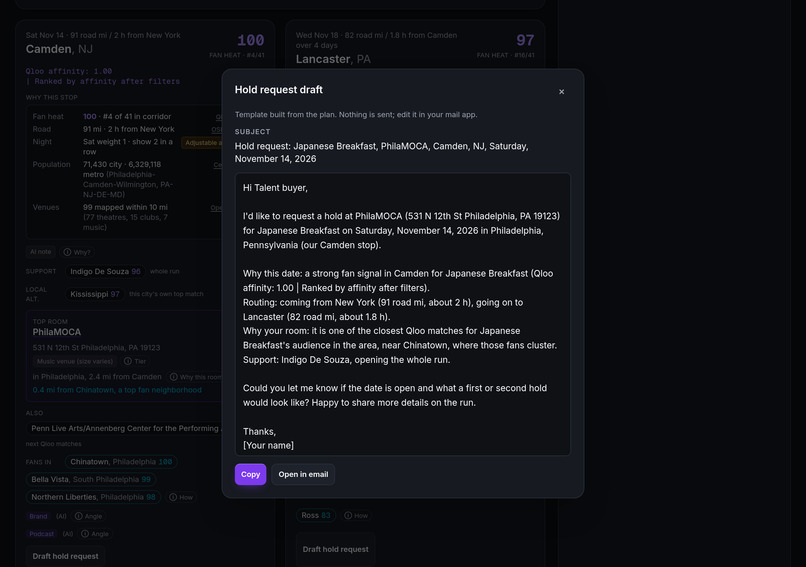
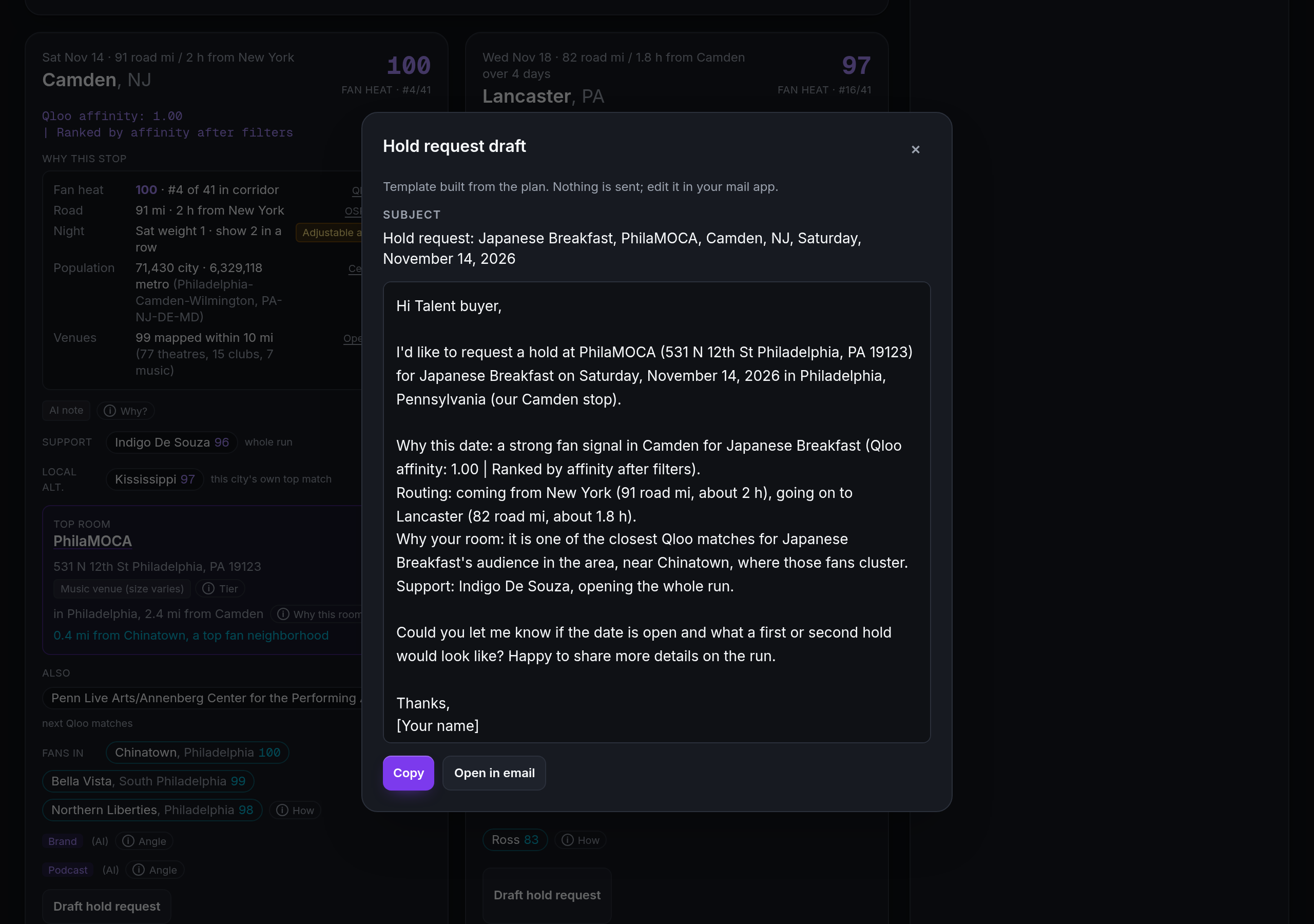
Hold request email draft for the Camden stop
-
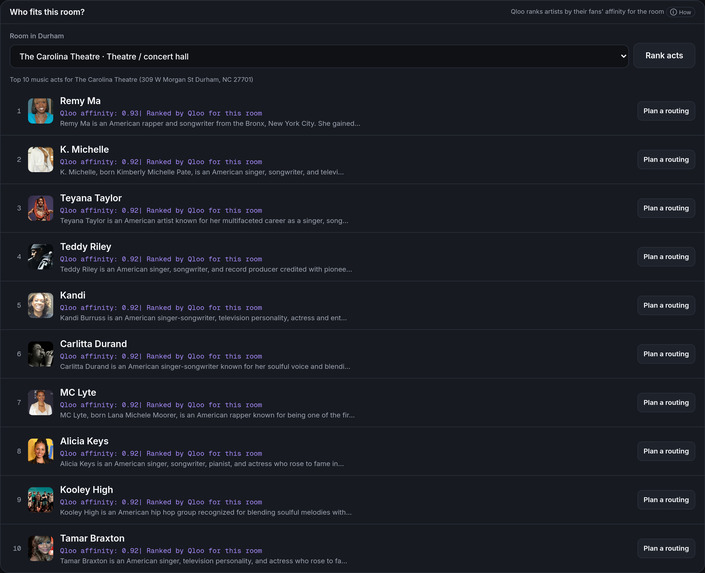
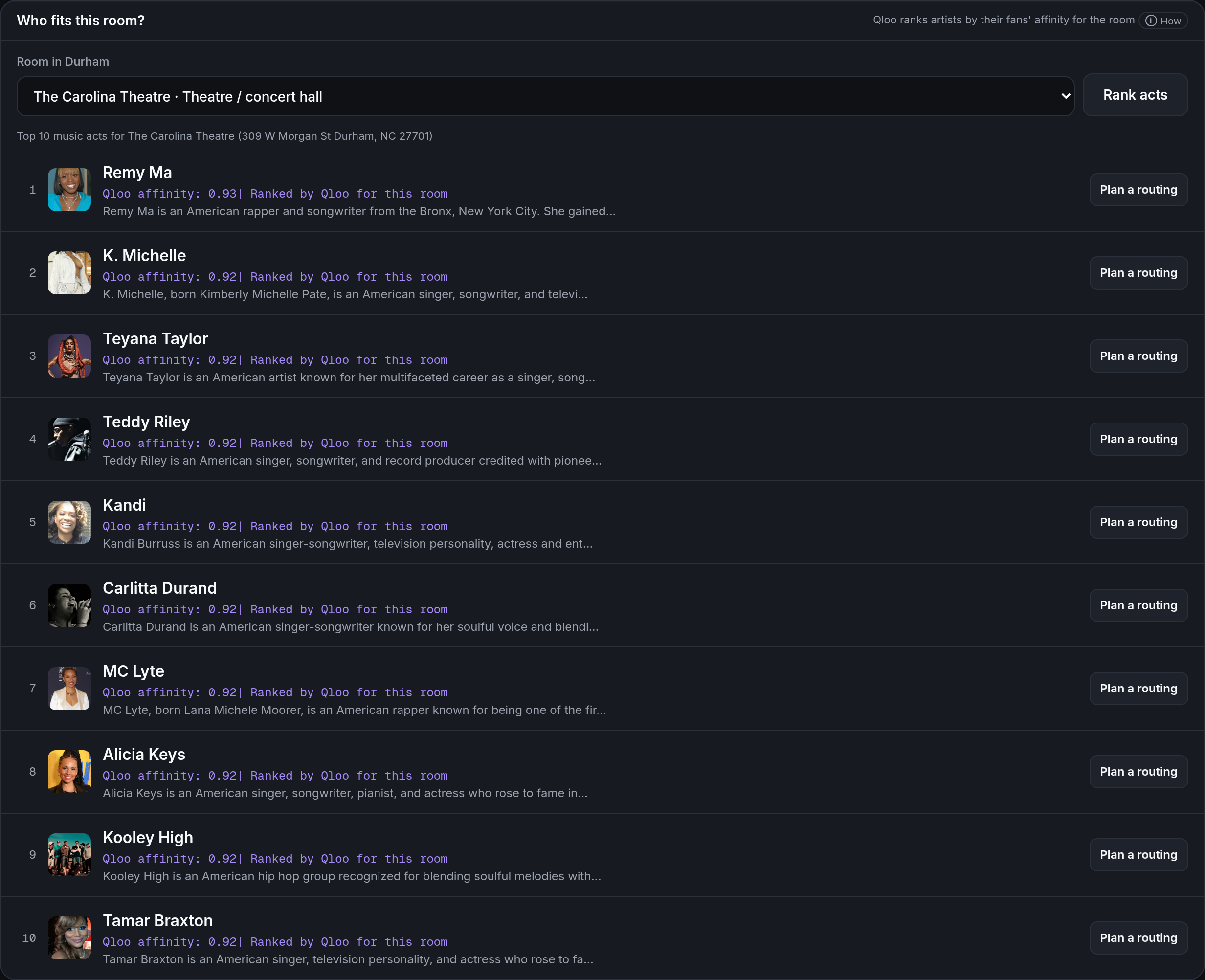
Top 10 acts ranked for The Carolina Theatre
-
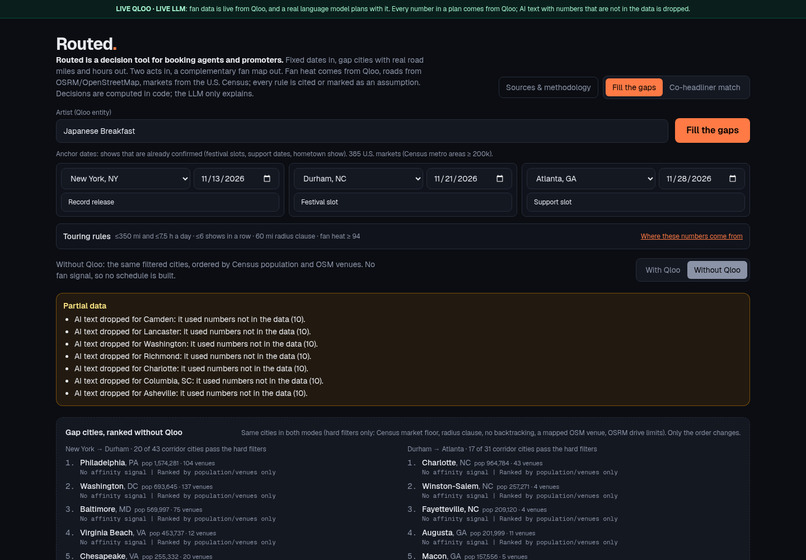
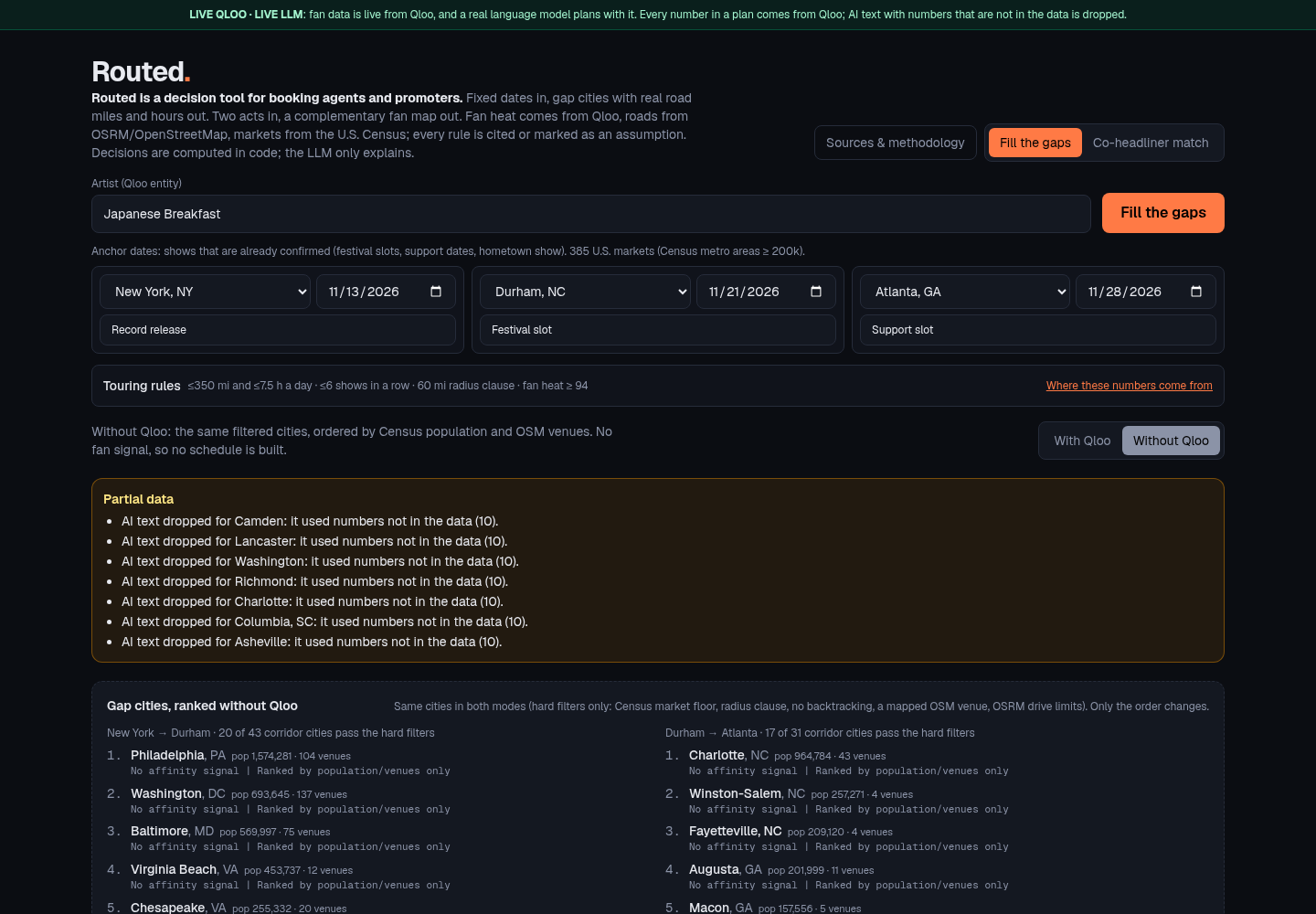
Without-Qloo view: gap cities ranked by population and venues
-
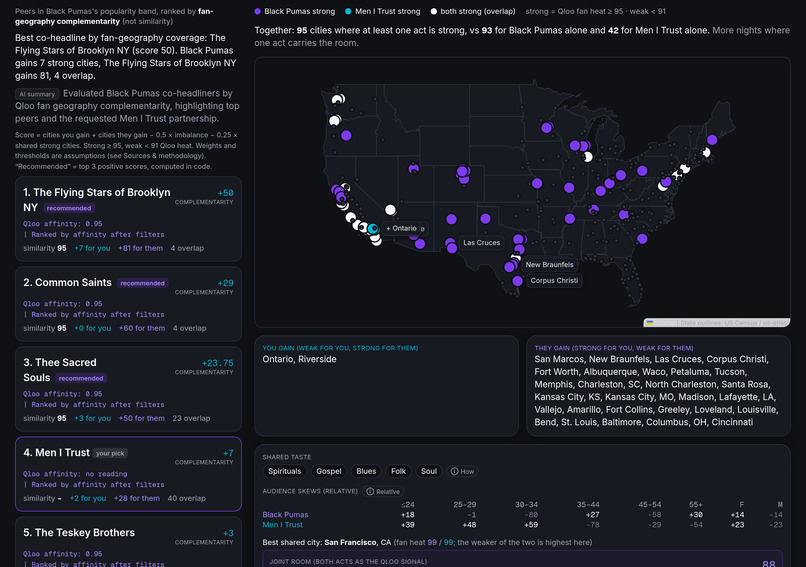
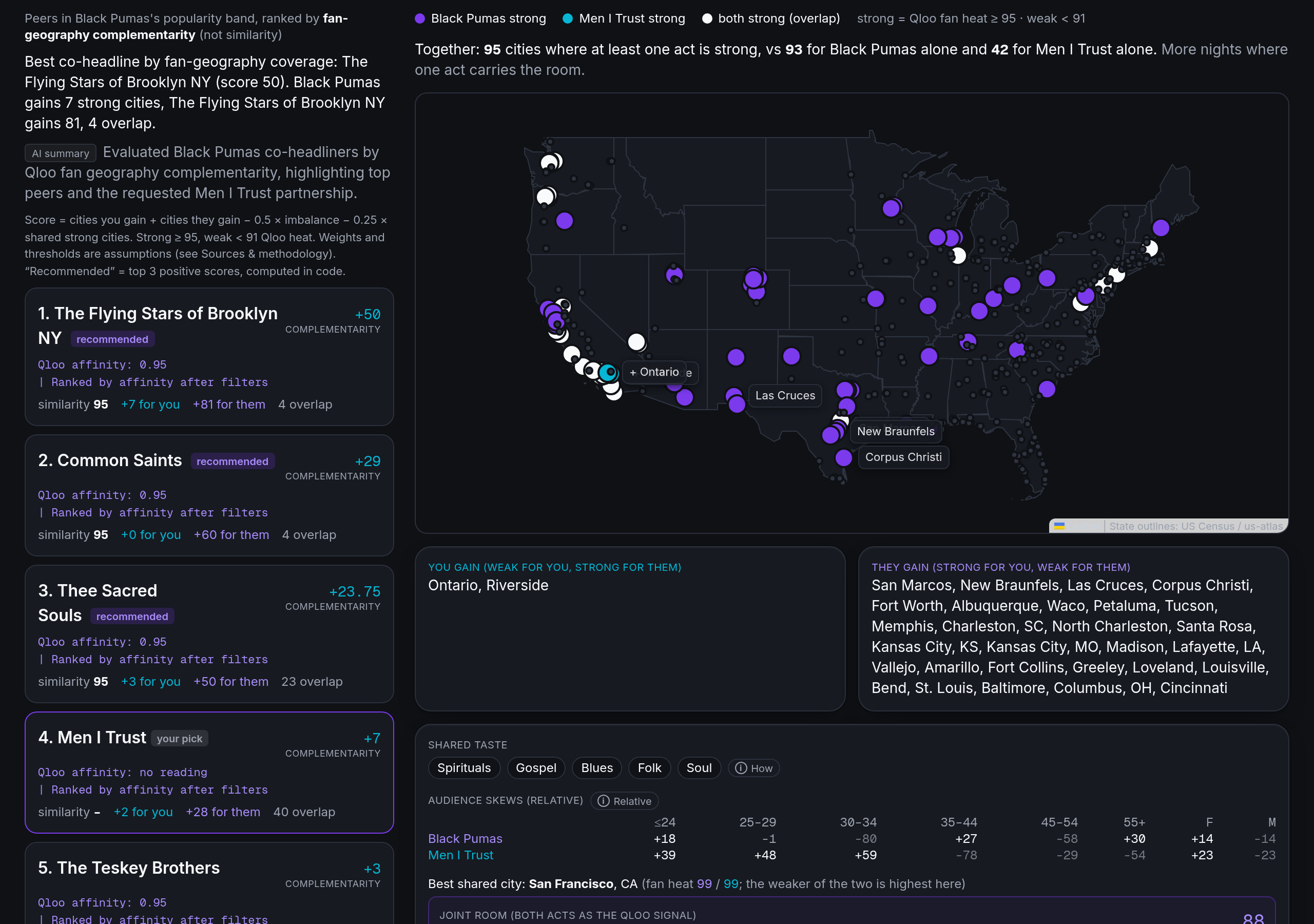
Co-headliner match: map of strong cities for two acts
-
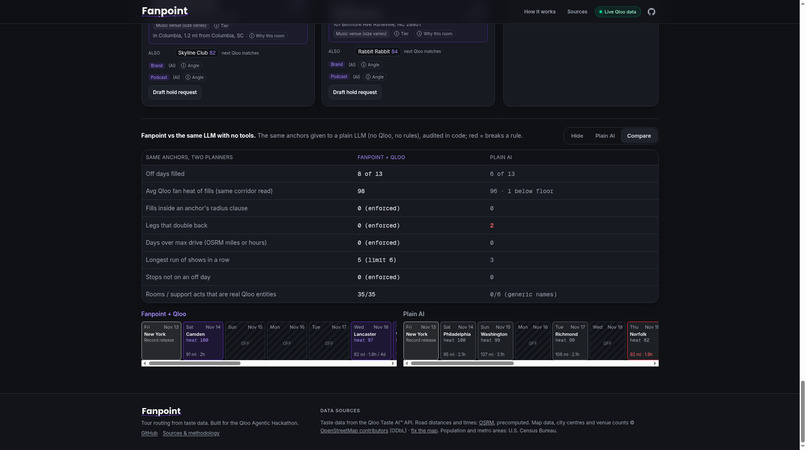
Side-by-side table: Fanpoint vs plain AI
-
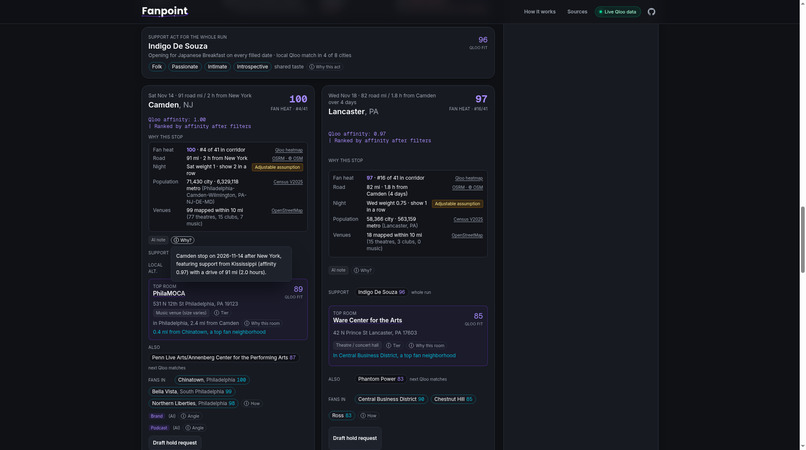
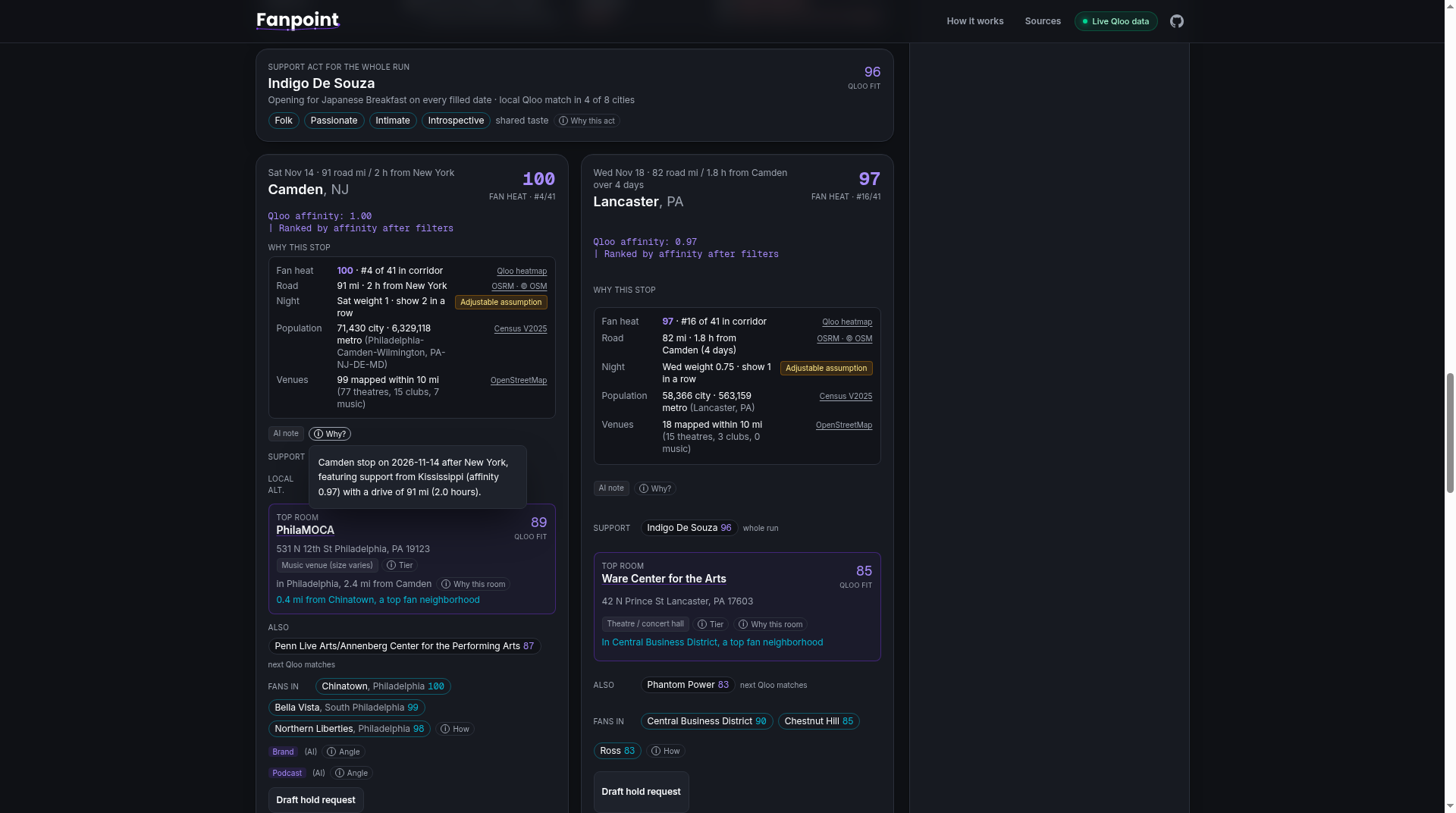
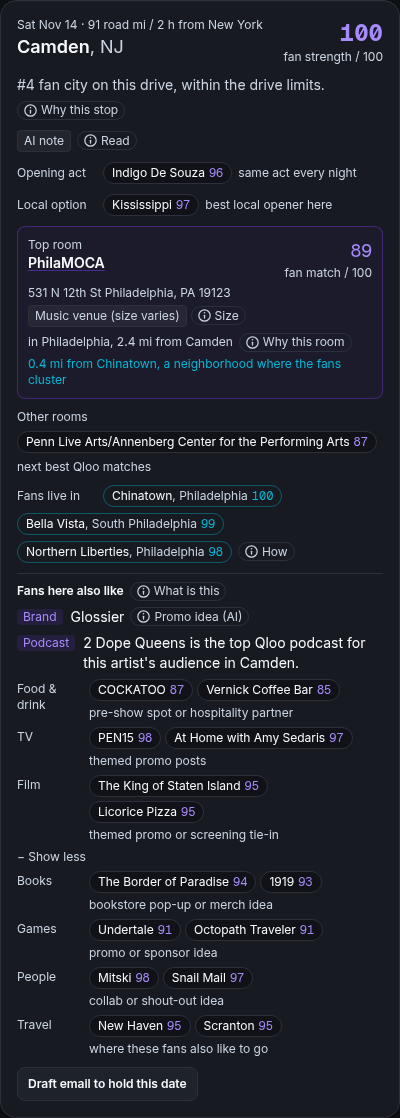
Camden and Lancaster stop cards with support act
-
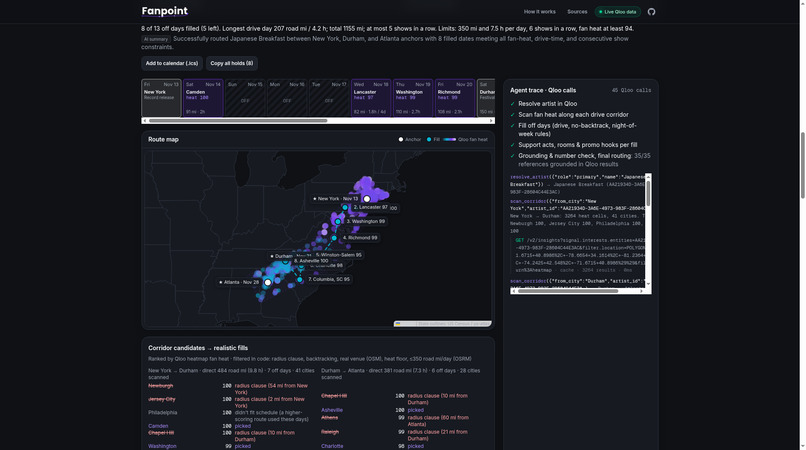
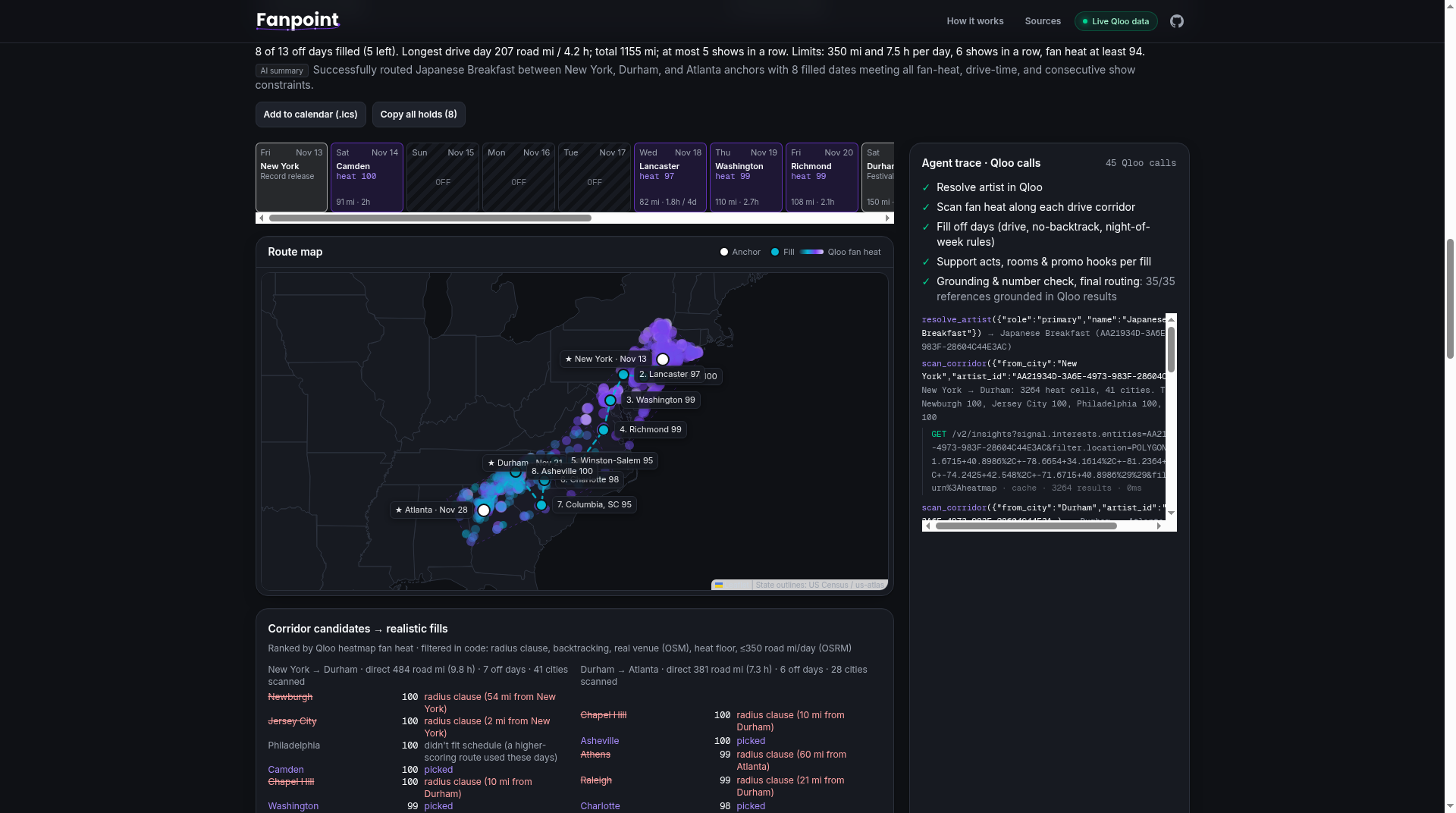
Route map with filled stops between booked dates
-
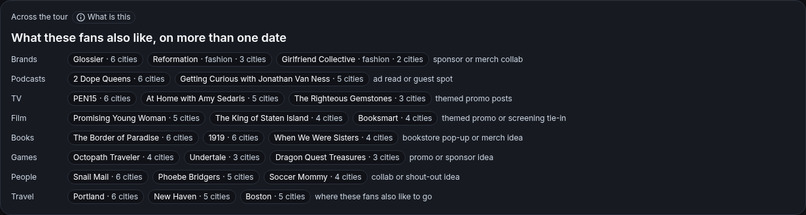
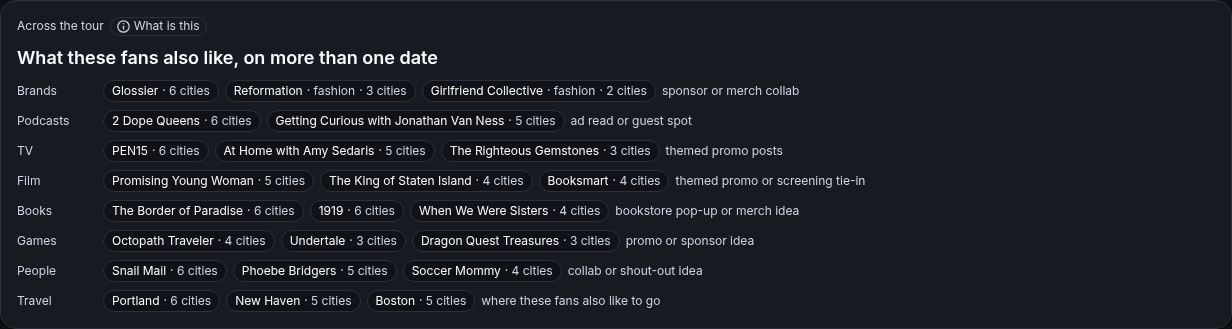
Across the tour: picks shared by fans in several cities
-
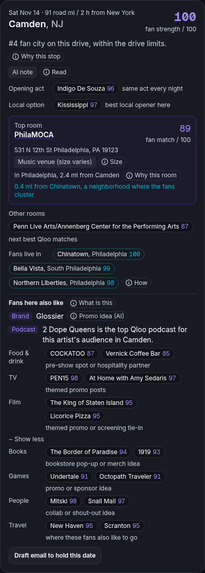
Fans here also like: Qloo cross-domain picks for one stop
-

Cost card: what the empty nights would have cost
-

Export: CSV, calendar file and hold emails
-
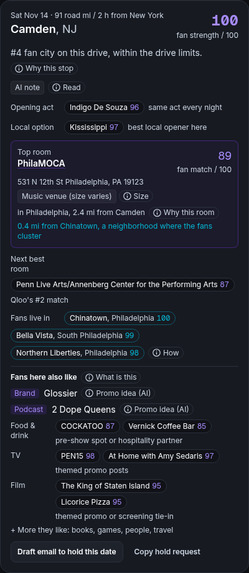
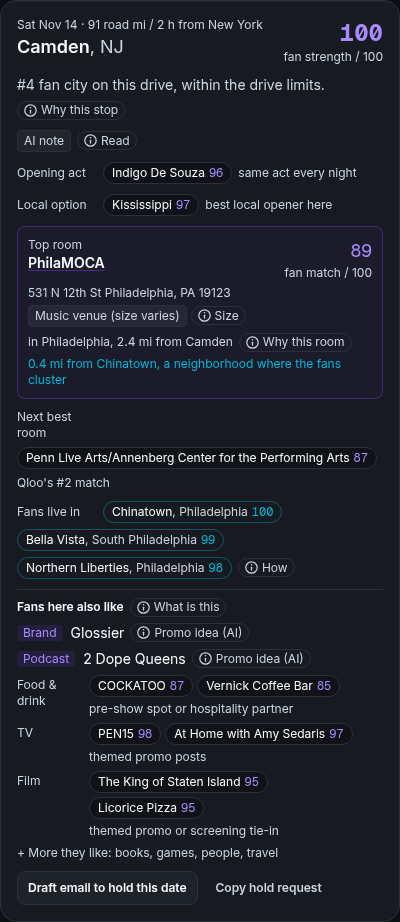
Stop card: top two Qloo rooms and Copy hold request
-
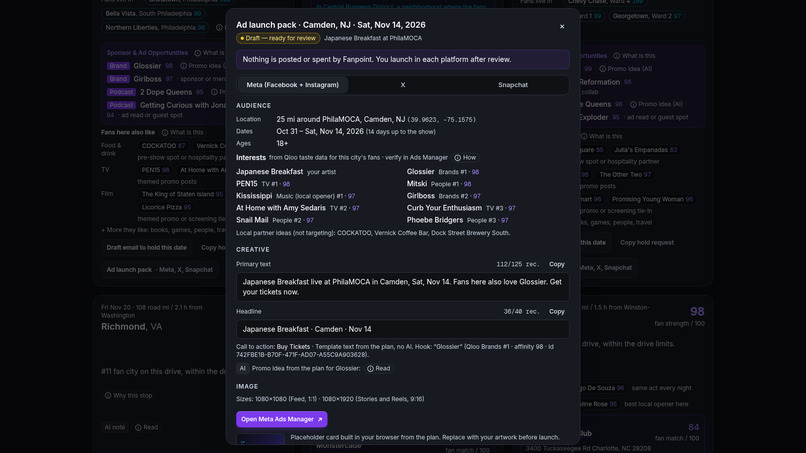
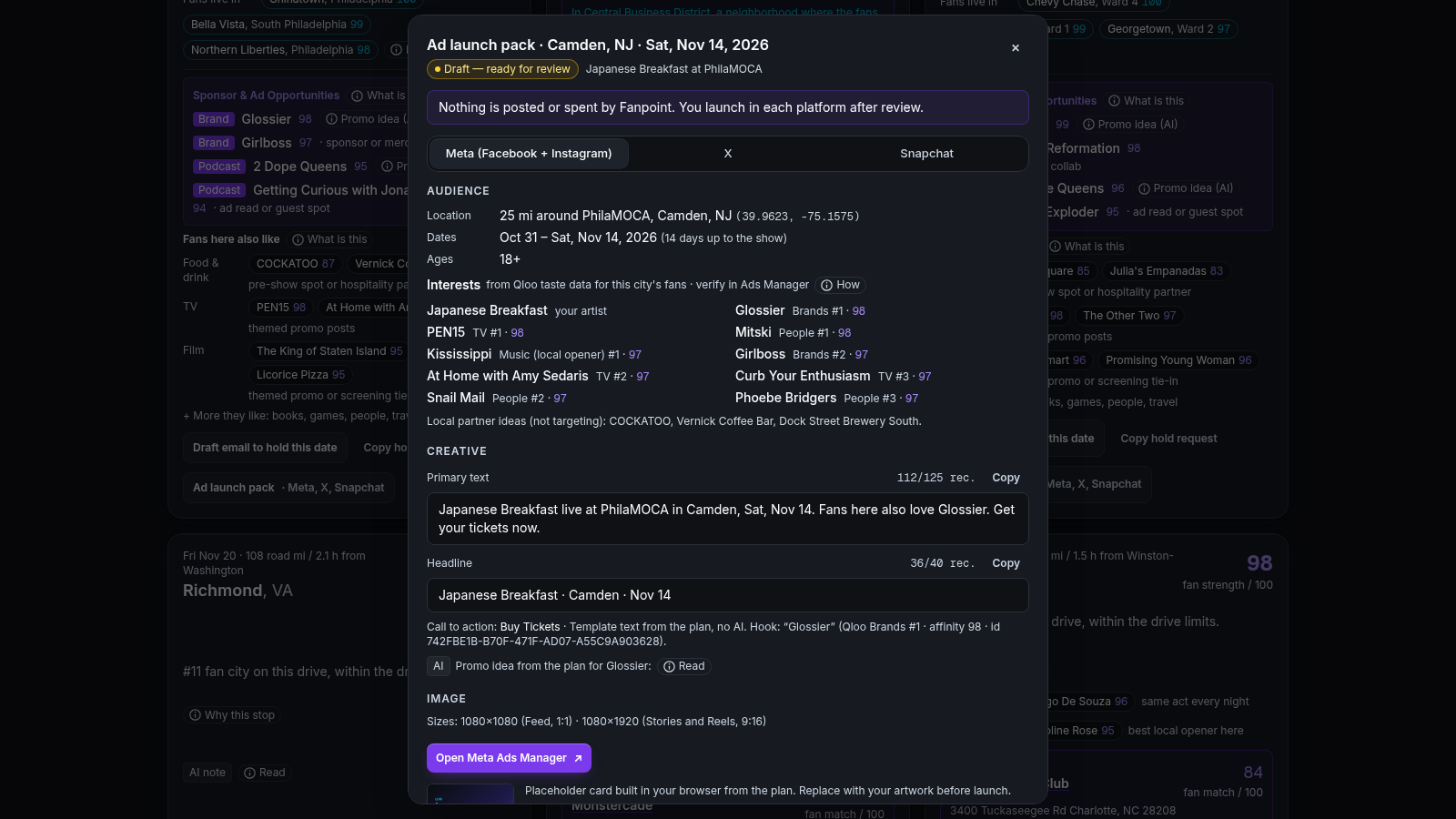
Ad launch pack for one stop (live Qloo data): Meta, X, Snapchat tabs, interests with Qloo source and score, copy sized to limits. A draft.



Inspiration
Booking agents and regional promoters route tours by hand. An act lands a festival slot or a support date, and somebody has to decide what goes in the open nights around it. An empty night on the road still costs hotel rooms, per diems and fuel, and earns nothing. Most indie acts can't pay a researcher to find the right cities, so the gaps get filled by guesswork, or left empty. A general LLM guesses too. Qloo's taste graph can show where one specific act's audience is strongest, so I built Fanpoint as a routing desk around that.
What it does
Fanpoint is a tour routing desk for booking agents and promoters, not a fan-facing tour finder. You enter an act and two to four confirmed dates. For each drive between them, Fanpoint asks Qloo where that act's fans are along the route. Code then drops any city that breaks a touring rule, such as the 60 mile radius clause, doubling back, or more than 7.5 hours of driving in a day, and schedules the rest into the open nights.
Each stop shows a Qloo-matched room and the next best one, an opener, the neighborhoods where the fans cluster, and a "why this stop" card with a source on every line. It also shows what that city's fans like outside music, straight from Qloo: brands (fashion brands marked), podcasts, food and drink, TV, film, books, video games, people and travel, each with a plain-English use such as a sponsor, merch, ad read or pre-show idea. A tour-wide card lists the picks that come up in two or more cities.
Then the desk closes the loop. A cost card shows what the empty nights would have cost: nights filled times hotel rooms and per diems, minus fuel for the extra miles, with every default visible and editable. One click exports every stop to a spreadsheet (room, opener, fan neighborhoods, cross-domain picks and a ready hold email), and each stop has a Copy hold request button. Nothing is sent for you. Promoters get the other side: the acts a city's fans love most, and a co-headliner view that finds a partner strong where you are weak.
- Ad launch packs: each stop gets a draft ad pack for Meta (Facebook + Instagram), X and Snapchat: location and date window around the show, 18+, interests from that city's Qloo taste data (each with its Qloo receipt; sensitive categories filtered in code), and copy within each platform's character limits, with Copy all, JSON/CSV download, Open Ads Manager and an organic X post link. Nothing is posted or spent by Fanpoint; you launch in each platform after review.
Why this isn't another tour app
Tour apps show fans where an act is playing. Fanpoint decides where the act should play next, for the person who books it. Every pick is made in code from Qloo data: the cities from Qloo heatmaps, the rooms and openers from Qloo matches. The touring rules are enforced in code and shown when they rule a city out. The output is what an agent works with: dates, the empty-night cost avoided, a CSV, hold requests, and cross-domain sponsor and promo hooks per city.
How I built it
Qloo decides where the show goes. Code enforces the rules. The LLM (Gemini) only calls the tools and explains the result, and any note with a number that isn't in the data is thrown out. A run makes about 65 to 100 Qloo calls, from corridor heatmaps to venues, support acts and cross-domain taste, and every call is listed in the Receipts section of the app. The cross-domain lookups run in code after the routing, so they add no AI turns and can't change a pick. Drive times come from OSRM and the 385 markets from the U.S. Census. 411 tests run in CI.
How it maps to the judging:
- Design: one complete workflow, from booked dates to a calendar, stop cards, cost, export and hold emails. Plain-English labels, sources behind info buttons, readable on a phone.
- Potential impact: a real cost (empty nights) for a real buyer (agents and promoters), shown in the demo with the nights filled and the cost avoided.
- Qloo use and the problem space: Qloo heatmaps choose the cities, Qloo matches choose the rooms and openers, and Qloo cross-domain taste gives sponsor and promo hooks. All of it sits inside real touring constraints: radius clauses, drive limits, days off.
Accomplishments I'm proud of
- Demo route (New York, Durham, Atlanta): 8 of 13 open nights booked with Qloo, 0 without it. With the default assumptions (4 rooms at $150, 6 people at $50 per diem, $0.60 a mile) the live Japanese Breakfast plan shows about $7,000 of empty-night cost avoided, net of 290 extra road miles. Those dollar figures are my assumptions, not Qloo data, and you can change them in the app.
- 10 artists on live Qloo, same dates: a median of 7 nights booked versus 5 for the same LLM without Qloo, and 0 of 10 plans broke a touring rule versus 3 of 10.
- With and without Qloo, the top 5 cities on a leg were identical on only 2 of 34 legs.
- Cross-domain taste on live Qloo: in a Japanese Breakfast run, Glossier, 2 Dope Queens and PEN15 each came up for fans in 6 of the 8 cities filled. That gives one sponsor, podcast or promo theme for most of the run.
Challenges I ran into
The hardest part was keeping the LLM from making decisions. I moved every pick into code so each result traces back to Qloo, and wrote tests where the model invents numbers and the code overrides it. Qloo's heat scores also bunch up near the top, so I recalibrated the thresholds on live data from 10 acts.
What I learned
The most similar act tends to rank low as a co-headliner, because you already share the same cities. Fan heat is an audience signal, not a ticket forecast, and the cost card says so: it counts costs covered, not ticket income.
What's next
Importing holds from an agency calendar, adding show income to the cost card, using the cross-domain picks to draft sponsor and promo outreach, and a pilot with a few independent agents and promoters.
Built With
- docker
- gemini
- leaflet.js
- next.js
- openstreetmap
- osrm
- overpass-api
- qloo
- react
- render
- tailwindcss
- typescript
- us-census
- zod

