-
-
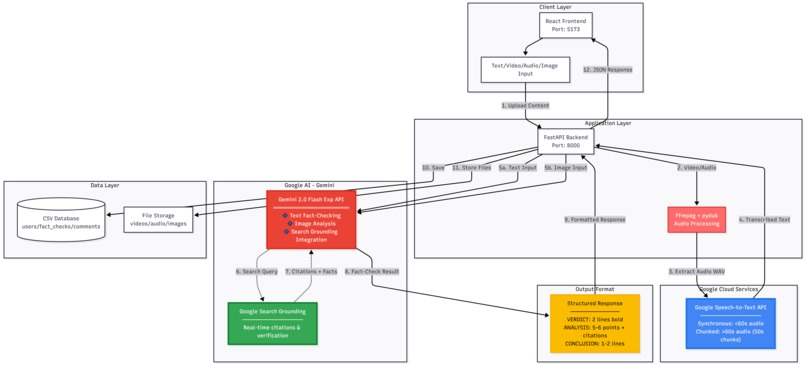
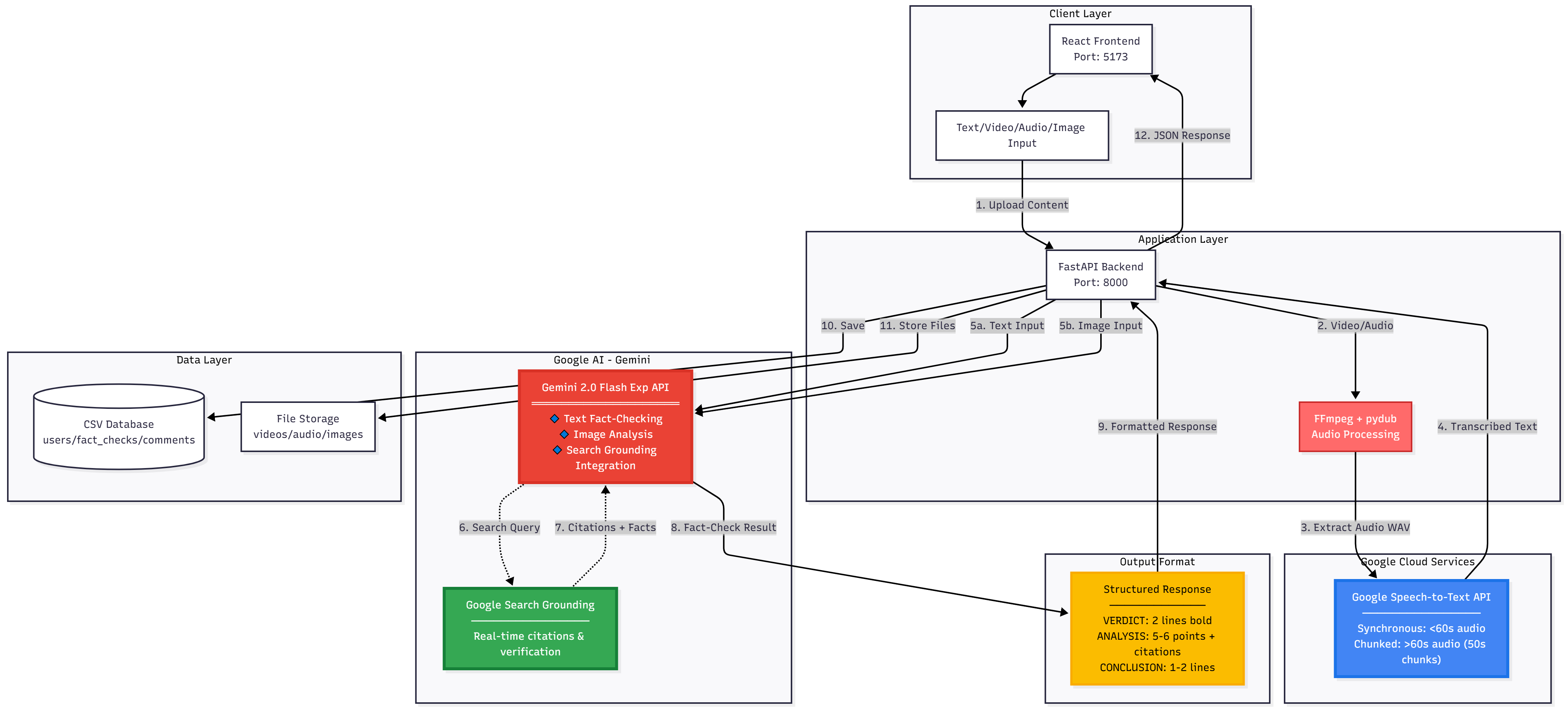
Architecture Diagram
About the Project — Fact Checker
Inspiration The rise of misinformation—especially through short videos, edited images, viral audio clips, and AI-generated content—motivated us to build Fact Checker. In today’s world, anyone can create convincing multimedia, and traditional text-based fact-checking tools are not enough. I wanted to create a tool that empowers everyday users to quickly verify the authenticity of the content they consume.
What it does Fact Checker is a multi-format fact-checking web application that allows users to upload videos, audio files, images, or text and instantly receive:
• AI-generated fact-check analysis
• Verified answers grounded in live Google Search results
• Citations and evidence sources
• Extracted transcripts for audio/video
• A complete history of all fact-checks
Admins get a dedicated dashboard for reviewing user submissions and adding expert comments.
How we built it
• Backend: FastAPI (Python) for processing, authentication, and file handling
• Frontend: React + TypeScript + Vite
• AI Engine: Gemini 2.5 Flash with Google Search Grounding
• Speech Processing: Google Cloud Speech-to-Text for converting video/audio to text
• Media Processing: FFmpeg
• Storage: CSV-based lightweight database + local file storage
• Authentication: JWT with role-based access (User/Admin)
The project is fully modular, with separate backend and frontend services and clear routing, services, and model layers.
Challenges we ran into
• Integrating Google Cloud Speech-to-Text with video extraction pipelines
• Managing large file uploads and ensuring stable FFmpeg processing
• Designing a clean UI that supports multiple file types
• Handling API errors from Gemini when grounding or parsing complex outputs
• Designing both user and admin flows within one application
• Keeping everything lightweight while still offering reliable storage and history features
Accomplishments that we're proud of
• Successfully building a complete end-to-end multimedia fact-checking system
• Implementing real-time search-grounded fact verification
• Creating a clean user experience with clear citations and explanations
• Designing an admin dashboard for reviewing and commenting on fact checks
• Handling videos, images, texts, and audio with a unified workflow
• Completing a full-stack project within hackathon constraints
What we learned
• How to integrate multiple Google Cloud services with FastAPI
• Best practices for handling large file uploads and processing pipelines
• Designing multi-role authentication securely using JWT
• Implementing AI fact-checking grounded in real search data
• Frontend–backend communication for real-time status and results
• How challenging and important it is to design truthful AI systems
What’s next for Fact Checker
• Add support for URLs (fact-check web articles directly)
• Deploy to cloud infrastructure for public access
• Replace CSV storage with PostgreSQL / Firestore
• Add a browser extension for instant fact-checking
• Improve verification algorithms with cross-source consensus logic
• Introduce fake-media detection tools (deepfake detection, image metadata analysis, etc.)
• Build mobile apps for quick fact-checks on the go


Log in or sign up for Devpost to join the conversation.