-
-
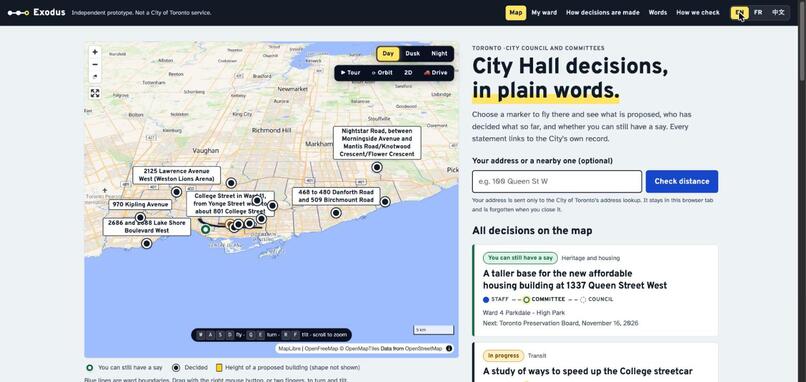
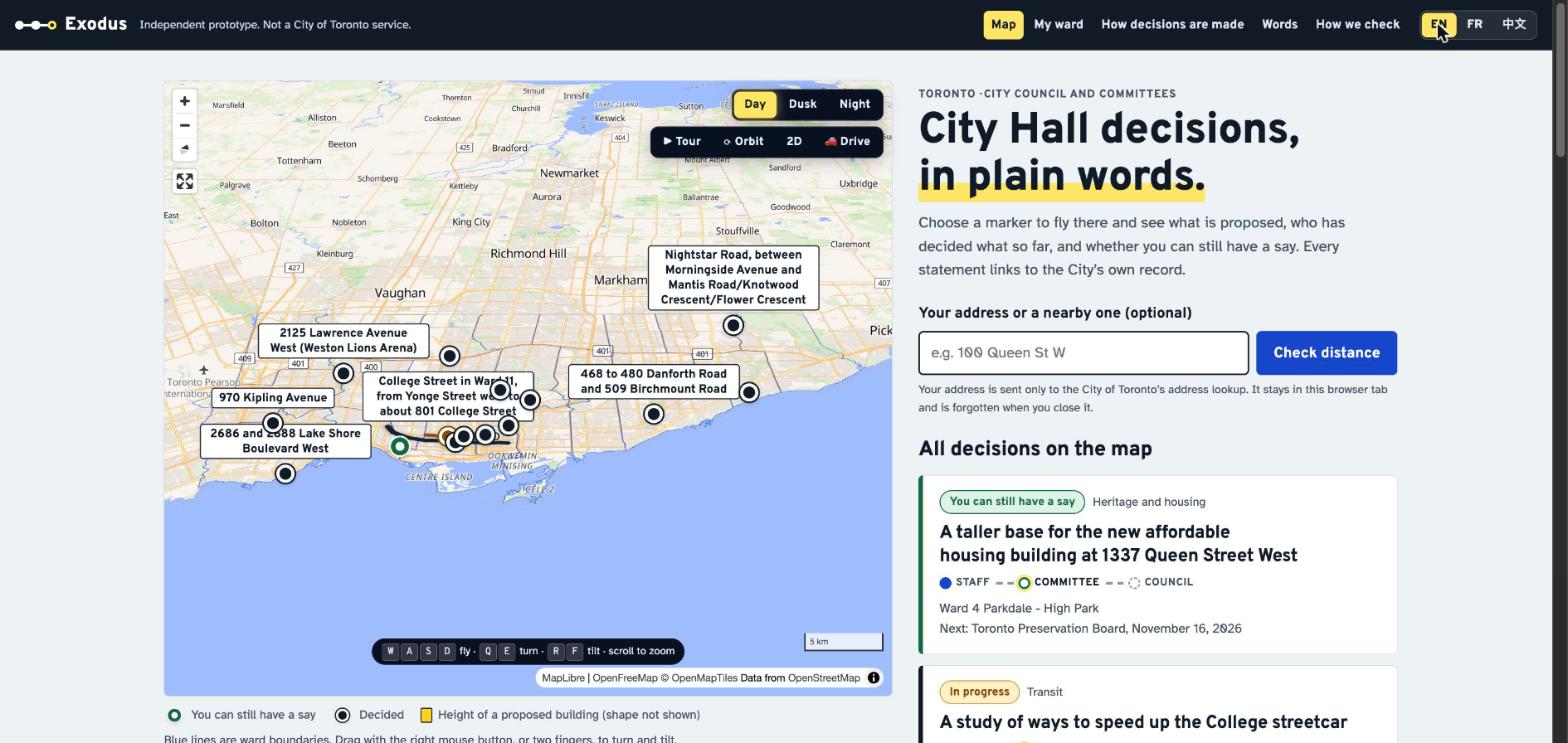
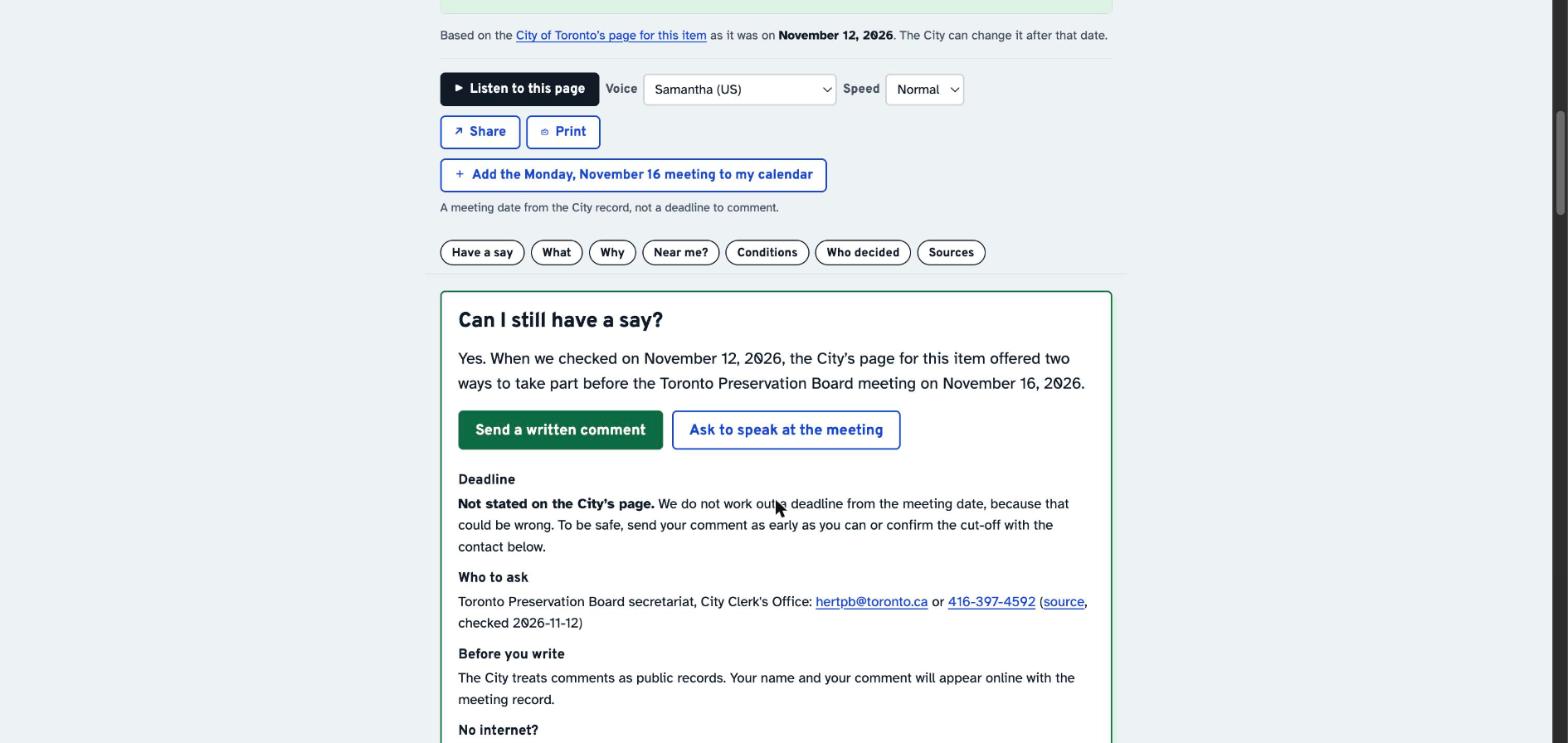
Every decision on one city map, with an optional address to check distance.
-
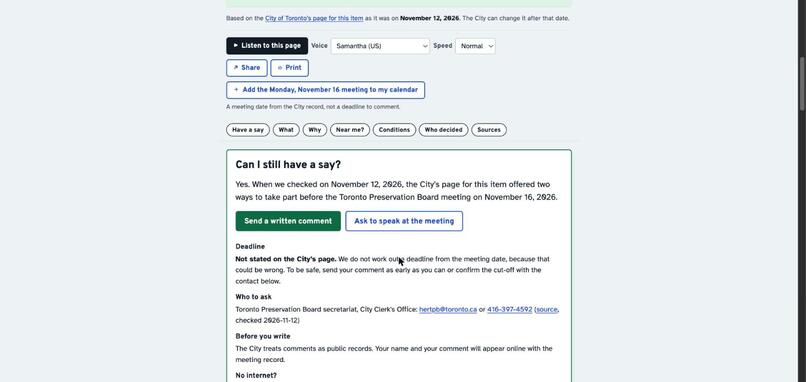
How to have a say, from the City's own page. No deadline is guessed.
-
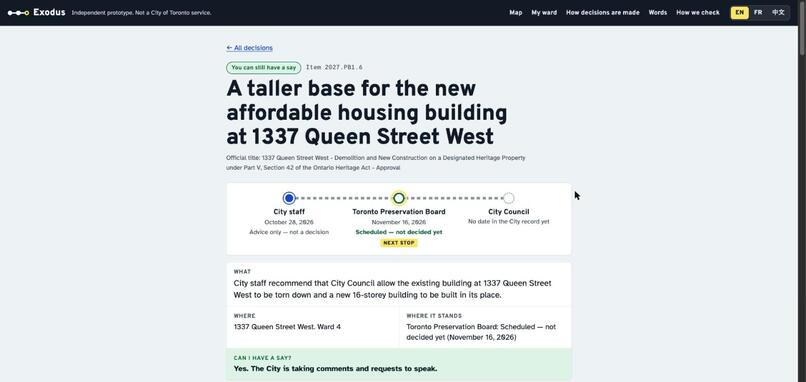
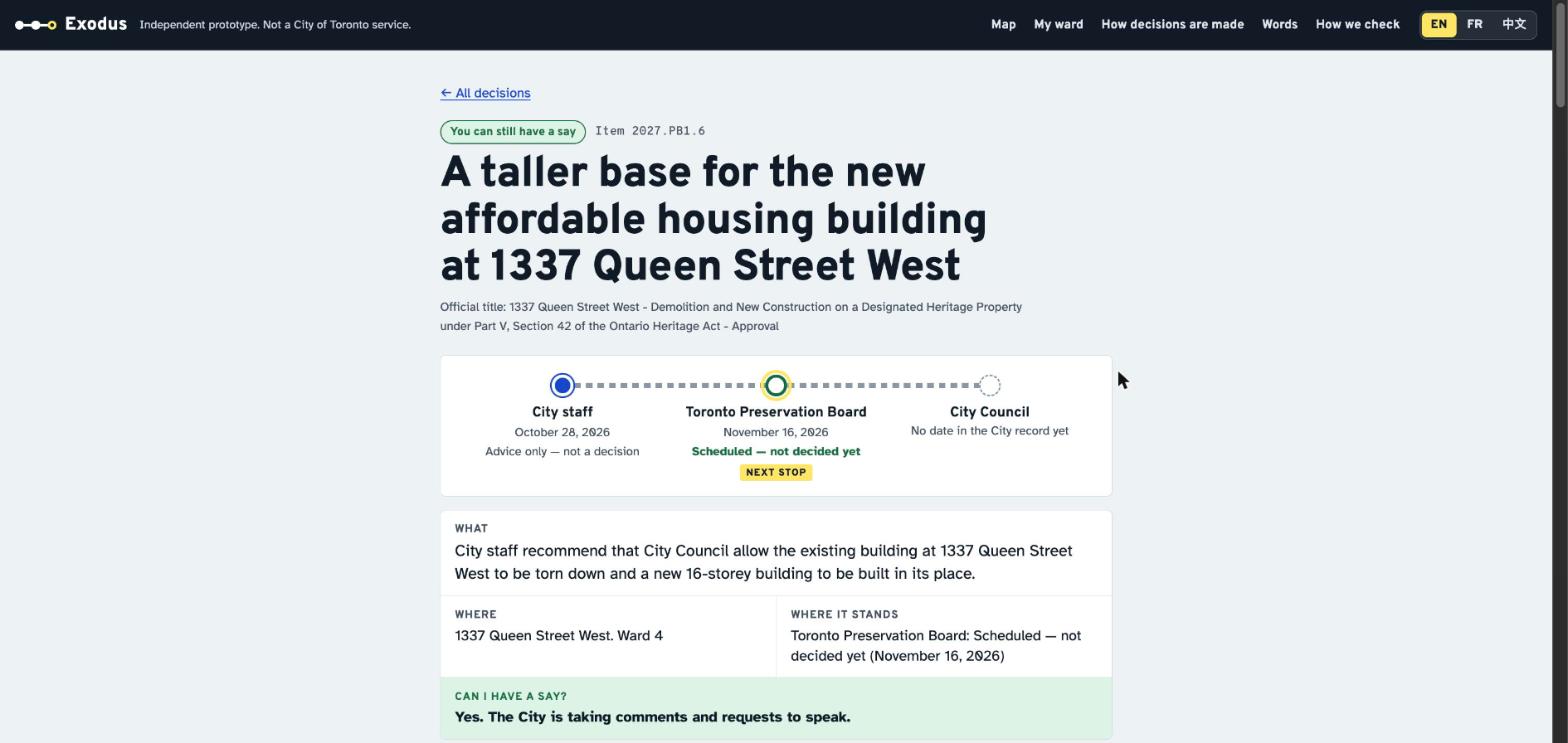
One item, one page: staff, committee and Council stages kept apart.
Inspiration
A council agenda item can run across three meetings and a 30-page staff report. A resident who wants to know "is this near me, has it been decided, can I still say something?" has to read planning language to find out, and most never do. The CIVIC Hack challenge asked how to help residents understand a proposed municipal decision, how it could affect them, and when they can have a say. We built for the people the brief named first: renters, newcomers, youth, seniors, and anyone who does not follow City Hall. Also for the clerks and councillors' staff who are asked to explain these items.
What it does
Exodus turns one agenda item into one page:
- What is proposed and why, in a four-line plain-language summary
- Is it near me? A map with the ward and the distance from an address you choose
- Who has decided what so far. Staff advice, committee recommendations and Council's final decision are never blended
- Can I still have a say? Only what the City's own item page offers, with the date it was checked. If the City does not state a comment deadline, the page says so and does not guess one from a meeting date
- Where every statement comes from. Each sentence shows the exact quoted passage, the document, its date and a link
It works today on 15 real City of Toronto items from all four parts of the city. Around them: a 3D city map with each proposed building drawn storey by storey beside what is there now, a guided tour and a drive mode that invites you to visit every decision; pages that explain how City Hall decides and what its words mean; a ward page; read-aloud and add-to-calendar on every item; an interface in English, French and Chinese; offline use and a print view for neighbours who are not online.
How we built it
- Pipeline (Node, build time): a rule-based parser reads saved copies of the City's TMMIS item pages (stages, decisions, motions, votes, documents; no AI). pdf.js extracts staff reports page by page. A build step joins everything, checks every quoted passage word for word against its source, adds deep links, and refuses to publish if any quote cannot be found.
- App (React + TypeScript + Vite, no server): MapLibre GL JS with OpenStreetMap tiles for the 2D and 3D maps, the City's geocoder for "is this near me?", and simple rules that turn the record into a staff / committee / council timeline.
- Data: City of Toronto Open Data (Report Request Log, Council Voting Record, ward boundaries) plus the City's public agenda pages and reports.
- The design document in the repo has UML (use cases, class, sequence, state diagrams), architecture rationale, a scalability plan and full references.
Use of AI (disclosure)
The plain-language summaries were drafted with an AI model (Claude, by Anthropic), and much of the code was written with AI assistance (Claude Code). Every summary sentence is tied to verbatim quotes that a program checks against the City's record, and a human review sheet puts each sentence beside its sources. The live site uses no AI.
Challenges we ran into
- Agenda pages and staff reports are inconsistent, so parsing had to be strict and fail loudly rather than guess.
- Keeping summaries neutral and exact: a summary that mis-states a decision is worse than no summary, which is why the word-for-word quote check blocks publishing.
- Modelling the timeline honestly: never inferring a submission deadline from a meeting date, and keeping amendments and conditions visible.
- Balancing personalization ("near me") with data minimization: a typed address goes only to the City of Toronto's own geocoder; Exodus has no server, accounts or tracking.
Accomplishments that we're proud of
Every sentence on every page links to the passage it rests on, and the build will not ship a quote it cannot find. The tool explains itself well enough for a municipal leader to use it without us in the room.
What we learned
How a decision actually moves through Toronto's system, from staff report to committee to Council, and how much meaning lives in the conditions and amendments that summaries usually drop.
What's next for Exodus
Automatic intake from a city's own meeting system, a review screen where a clerk signs off each summary, explanations reviewed in other languages, and a phone channel. Only the page reader is specific to Toronto, so a city on eSCRIBE or Legistar needs one adapter.
Built With
- cheerio
- claude
- maplibre-gl-js
- node.js
- openstreetmap
- pdf.js
- react
- toronto-open-data
- typescript
- vite
