
Inspiration
My oldest daughter, Ruby, has autism. She is 12 years old and is still working on mastering basic living and hygiene skills. We love her and have relied heavily on therapies since she was two to try and help her develop and be as independent as possible. We want for her what every parent wants. For her to have dignity, build and maintain deep relationships, and have purpose in her life. It is very challenging for her to gain skills that come naturally to most, like brushing her teeth or packing a lunch. As she is getting older, I want her to be as independent as she can be, even if she will live with us forever. She just needs more support.
As I think about our future, the difference between my daughter being able to be independent in personal hygiene and other daily tasks like showering herself and dressing herself makes a huge difference in what our future looks like. If Ruby is still needing support in these areas, we would be less likely to be able to get away as a married couple, because who could we trust to help her with that in her adult years to that level? Even a night out is in jeopardy if she is not independent in getting herself dressed and ready for bed. Limited independence in living skills truly limits opportunities for couples to spend time alone and recharge. Even if the parents are at home with the child, if they need substantial support getting ready for bed, that takes time and energy away from other children, other things that need to get done, or just spending time as a family. And for families with children with more severe autism, this could be a lifelong struggle. My daughter falls into this category, and I really started to think about what could help her truly master those independent skills so that she and we as a family could enjoy the freedom that comes with independence in our future life.
Ruby had a very special relationship with my dad, who passed away five years ago from brain cancer. There was no one who could reach her quite like my dad. He was her person. This past summer, my mom gave us Grandpa's old iPad for Ruby. I wanted this iPad not to be something she played with, but a functional iPad, something that would help her gain more independence with dignity. Like Grandpa was here helping her.
Visual Supports
Picture supports are used quite commonly with children with autism to help support gaining independence skills. It helps to break down tasks like brushing their teeth or putting on their shoes into manageable steps, often with pictures for each step to help the child understand exactly how to complete it successfully and avoid getting lost in the process. We weren't always great about using them because of how many she had, and they tended to get spread throughout our house, which led to us not utilizing the supports as much as we could.
My idea was to somehow have all of her visual supports in one place, digitized so she could access them as needed without needing to carry around large amounts of laminated picture supports.
The App Idea
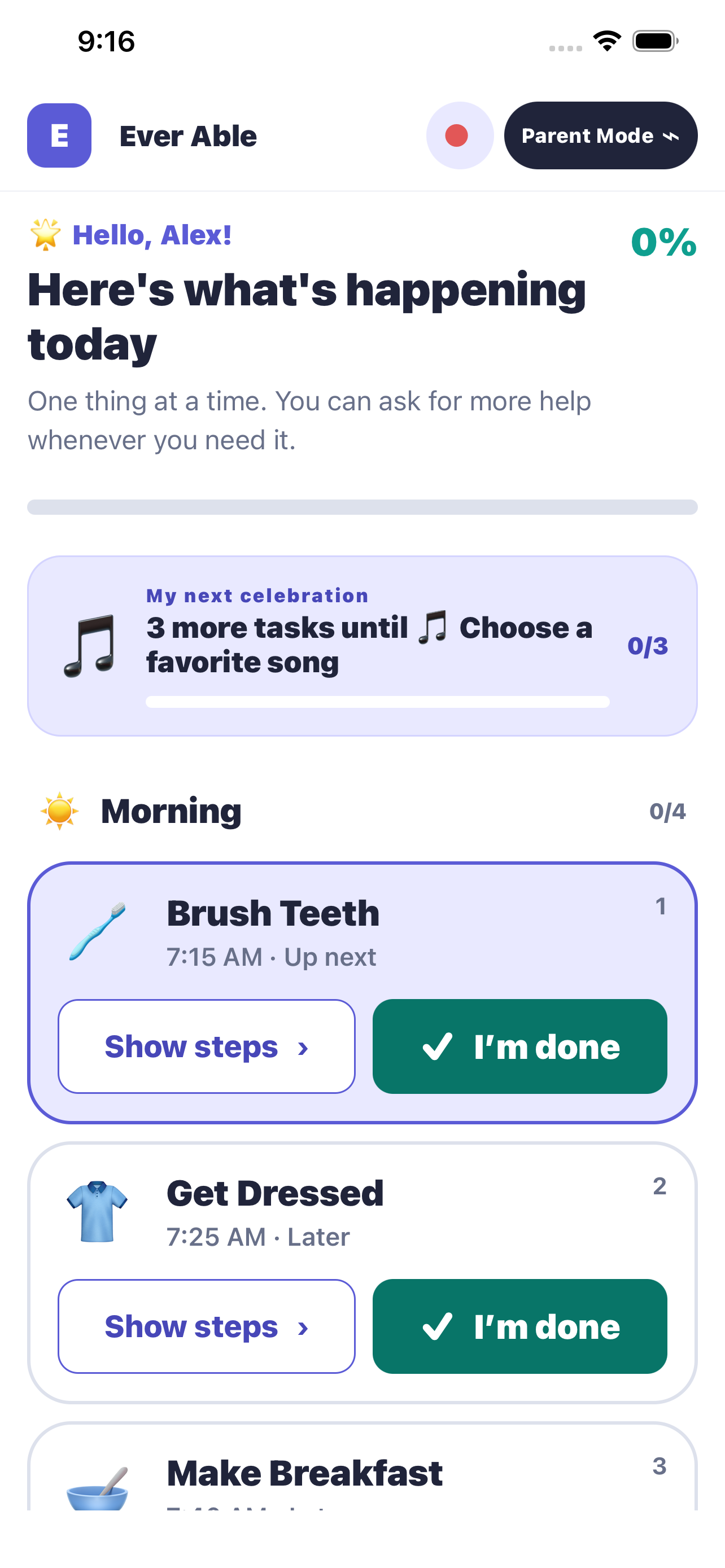
I thought of a visual schedule that could list all of her tasks in one place, but that could offer more support as needed. For example, if she had brushing teeth on her list, but she was still mastering the skill of successfully brushing her teeth independently, she could click on the task and then all of the steps for the task could pop up. Then a third layer of support would be a button she can click on "I need more help", and a video that I had pre-recorded of her successfully brushing her own teeth would pop up. This is powerful not only because it visually shows her the steps, but it shows her doing them. It reminds her that she has done this before and can do it again.
When I looked at the app store, I couldn't find anything like this. There were visual schedules, most of them with a monthly fee, which is very challenging for families with special needs children who are already spending money on therapies. But these apps didn't have all the task breakdowns or the video modeling that would really help Ruby. So, I contacted an old friend who is a coder, and we got to work on Ever Able!
What it does
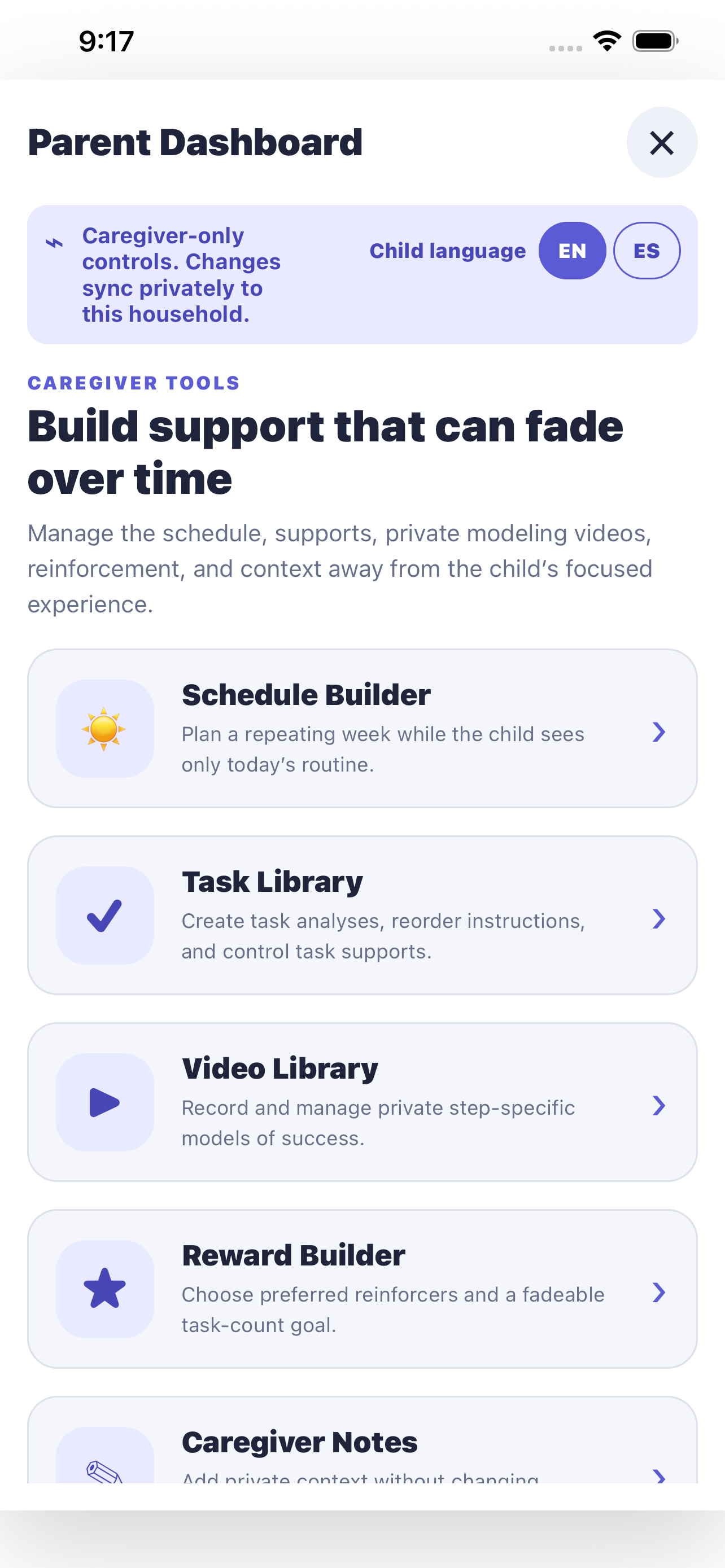
Ever Able is designed to support the independence of children with autism who are still working on independence skills. This app is more than just a visual schedule. It helps support independence for individuals who need that extra support, like Ruby. This app holds the daily schedule of an individual, which can be built out a week at a time, and has repeating weeks so you don't have to start from scratch each week.
Very easy to modify, this app has a clear sequence of tasks, with morning, afternoon, and evening schedule sections. If a person needs extra support to complete the task successfully, they can simply click the task, and the predetermined steps will pop up, with each step broken down to the level they need. There is also a button, "I need more help", and when pushed, a pre-recorded video will pop up of the individual or trusted person completing the task themselves.
The app is so easy to customize in the app or on the website. There are many amazing features in the parent mode of the app. You can create new tasks or have AI draft a task for you that you can customize. This is especially handy as it gives the caregiver an idea of what those broken-down steps could look like. Not everyone really thinks about all the steps involved in packing a lunch, but the AI task draft can give the caregiver a jumping-off point.
To learn more about creating the schedule, I have a YouTube tutorial here link
The Data
There is also a reports section that shows the tasks, how often they were completed, and what level of support was used. This is especially neat as the parent or caregiver can see how many of the tasks were completed, and what level of support was needed to successfully complete the task. As the child increases their independence skills and needs less support, the report can show this, and the parent can actually see independence increasing over time.
Fadeable Supports
The purpose of this app is to fade the support over time. We want individuals to be as independent as possible and not rely on support if they are not needed. This is why there is a feature that can hide the extra supports, like the videos. The app automatically suggests hiding the support for a specific task if the individual has successfully completed the task 10 times in a row without the extra support. I also love that those supports can be turned back on because regression does happen, and those supports may be needed again in the future.
Rewards
Another cool feature is the rewards feature. Rewards can be very motivating for children and help them get through tasks they don't prefer so they can earn something they love. The caregiver can set a reward after a specific number of tasks are completed. My daughter loves My Little Pony, so one of her rewards is "5 minutes of My Little Pony" after she completes 5 tasks. At the top of the app, my daughter can see a box that says "5 tasks until 5 minutes of My Little Pony". My goal is to increase the number of tasks she needs to complete before she gets her reward so that eventually she doesn't need a reward to complete the tasks. She does it because that's what she needs to do.
How we built it
We began with Ruby’s actual routines and visual supports. Instead of building a general productivity app, we designed every screen around one question: What is the least amount of support someone needs to complete the next task successfully?
Ever Able’s mobile app is built with React Native, Expo, and TypeScript, allowing us to create a native experience for both iPhone and iPad. We also built a React web app so caregivers can manage schedules, tasks, videos, and reports from a larger screen.
Firebase provides caregiver authentication, synchronized schedules, activity data, and private video storage. Firestore and Storage security rules keep each household’s information isolated, while Firebase App Check helps ensure requests come from the real app. The app also maintains a local cache and activity queue so a temporary connection problem does not interrupt the individual’s routine.
The AI task-drafting feature runs through a secured Firebase Cloud Function using OpenAI. Only the caregiver’s generic routine description is sent to the model—never the individual’s profile, diagnosis, notes, videos, or activity history. The response is validated and returned as an editable draft. Nothing is saved until the caregiver reviews and approves it.
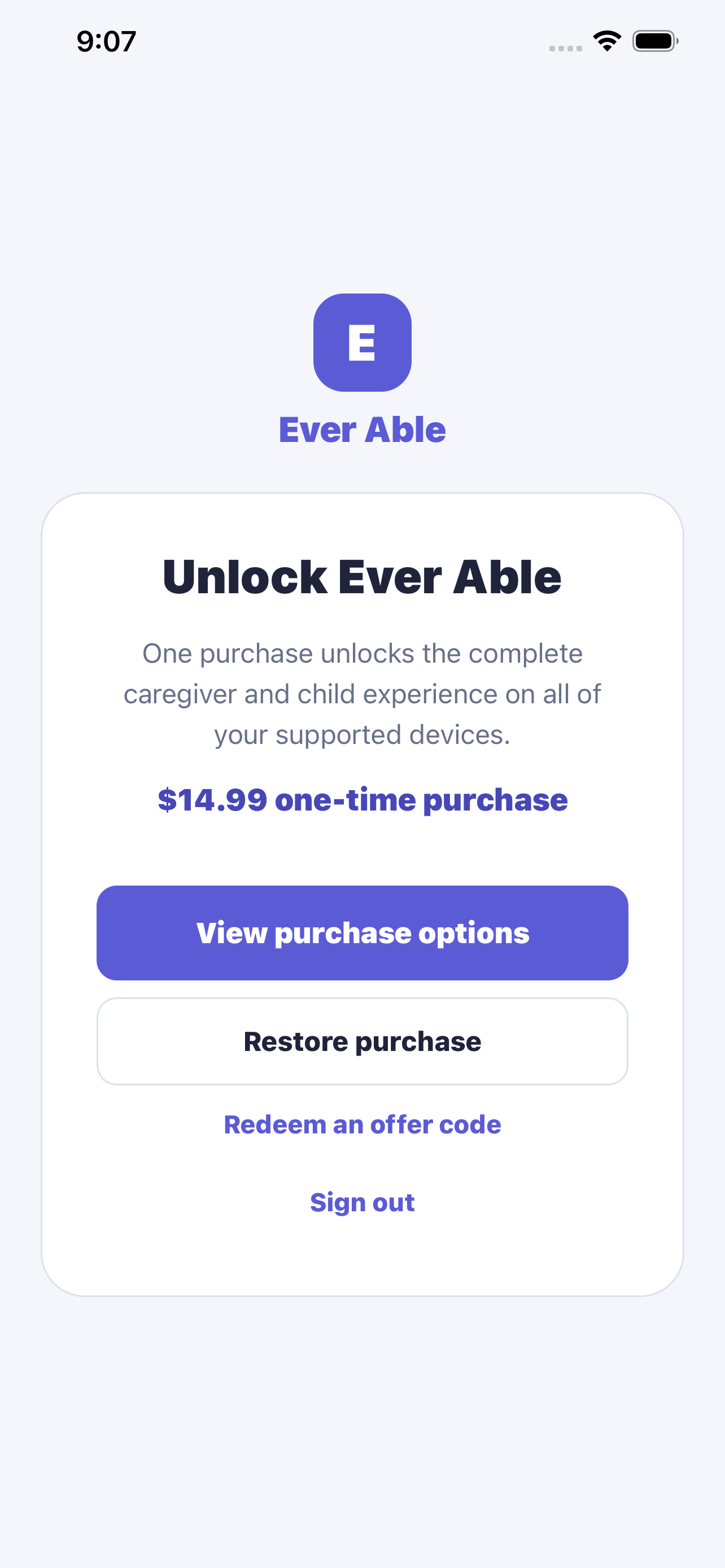
We integrated RevenueCat to manage Ever Able’s one-time lifetime purchase. RevenueCat verifies access, presents the purchase experience, supports restoring purchases, and connects purchase status to the caregiver’s authenticated account. We intentionally chose a one-time purchase instead of another monthly subscription because families supporting individuals with disabilities already carry significant recurring expenses.
Challenges we ran into
Our biggest challenge was balancing independence with support. Too little guidance can leave someone frustrated, but too many screens, questions, and choices can become another obstacle. Watching Ruby use the app showed us where the interface was creating unnecessary cognitive load. We simplified task completion, added immediate positive feedback, and returned her directly to the schedule instead of asking her to navigate additional screens.
Supporting both iPhone and iPad also required much more than simply scaling the same layout. Larger AI-generated tasks needed scrollable editing, schedules had to remain usable across screen sizes, and controls needed large, predictable touch targets that would not be obscured by the keyboard or device safe areas.
Private video modeling was another significant technical challenge. We had to record and preview native video, upload it reliably, secure it to one household, and make it available again across devices without exposing it publicly. We also had to handle unreliable networks without letting failed synchronization erase a caregiver’s unsaved schedule changes.
Finally, connecting Firebase authentication, App Check, native iOS builds, App Store in-app purchases, and RevenueCat required careful testing. A failure in any one of those systems could prevent a family from reaching the part of the app they depend on.
Accomplishments that we're proud of
Our proudest accomplishment is that Ever Able is already helping Ruby. She enjoys seeing what is coming next, feels reassured by having her day laid out, and can move through routines with less uncertainty and prompting. That means more to us than any individual technical feature. We have seen a reduction in her overall anxiety. Sometimes she could ask repeatedly what was next, or when something was happening that day. Now she can simply turn on her iPad and see for herself. There is real comfort for her in just knowing and having that information in her hands. There has also been an increase in her independence in doing the next thing on her list without being reminded, and doing it more successfully. Her lunch packing skills, brushing her teeth, and making sure she has everything she needs in her backpack for school have all improved. And that not only makes our mornings easier, but also helps her take more responsibility for herself and what she needs to get done.
We are also proud that Ever Able provides layers of support without making those supports permanent. An individual can complete a task directly from the schedule, open its step-by-step instructions, or watch a private video of themselves succeeding. As their confidence grows, caregivers can hide supports without deleting them and bring them back if they are needed again.
We built a complete working system rather than only a prototype: a native TestFlight app, a caregiver web interface, weekly scheduling, reusable tasks, private videos, completion and support tracking, caregiver reports, AI-assisted task drafting, offline resilience, and secure household data synchronization.
We are especially proud that the AI remains a caregiver-reviewed tool instead of making decisions for the family. It is there to support families, but what is generated can be easily customized to fit their child's needs. And importantly, RevenueCat gives us a sustainable one-time purchase model without requiring families to take on another subscription. We don't want any families who could benefit from this app to be priced out.
What we learned
We learned that independence is not all-or-nothing. It often comes from giving someone exactly the support they need in that moment—and then thoughtfully fading that support when they are ready. Every child can learn, and given the right supports, thrive.
We also learned that watching a real person use the app is more valuable than making assumptions about what should work. Features that seemed logical to us sometimes created extra decisions for Ruby. Her behavior taught us to reduce the number of screens, make actions obvious, celebrate success without demanding another response, and let the interface get out of her way.
AI is most useful here as a starting point, not an authority. It can help a caregiver think through the many small steps hidden inside an everyday routine, but the caregiver still knows the individual best. That is why every generated task remains editable and requires review before it is saved.
Technically, we learned how much work goes into making a product reliable outside a controlled demo: responsive layouts, native camera behavior, secure media uploads, offline synchronization, account protection, purchase restoration, and App Store distribution. Most importantly, we learned that building alongside families—not merely for them—leads to a much more respectful and useful product.
What's next for Ever Able
This idea started with my daughter, but since starting this competition, we have been thinking bigger.
I have already seen the positive impact this app has had on my own family. It has not only helped Ruby increase her independent skills but also helped me be more intentional in supporting her on that journey. I hope to get Ever Able into the hands of the families who need it the most, especially those raising children with autism, so they can have this extra layer of support that has already blessed our lives.
The next step is reaching those families.
I plan to connect with companies and providers who work directly with children with autism, including ABA providers, therapy practices, developmental centers, and other organizations that support families. As my daughter has been utilizing therapy for over 12 years, we already have a jumping-off point. I also want to build relationships with autism organizations, parent communities, and influencers who specifically focus on autism and helping children develop greater independence to reach those families.
And I want to keep improving it.
As more families use Ever Able, I want to hear their experiences and learn what they think would make the app even better. This will help shape what comes next. I can imagine expanding the Task Library, adding more ways for caregivers to personalize the experience, continuing to improve the tools that support independence, and eventually expanding Ever Able beyond autism to serve other children and adults who benefit from visual support and step-by-step guidance.
What excites me most is the possibility of seeing Ever Able move from something I built because my family needed it into something that helps thousands of other families.
Every time a child uses Ever Able to complete something they couldn't do independently before, that's the impact I am hoping to create.
The vision is simple: help more children become more independent, give families a practical tool they can actually use, and keep building Ever Able alongside the people it was created to serve.
I can't wait to see where it goes.
Built With
- ai
- firebase
- react
- react-native
- revenuecat

Log in or sign up for Devpost to join the conversation.