-
-
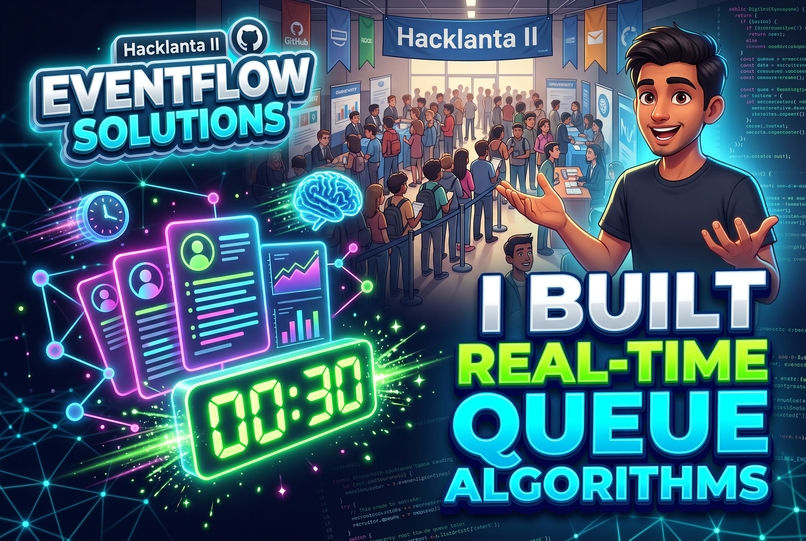
EventFlow Solutions - Let's turn event's chaos into predictive flow.
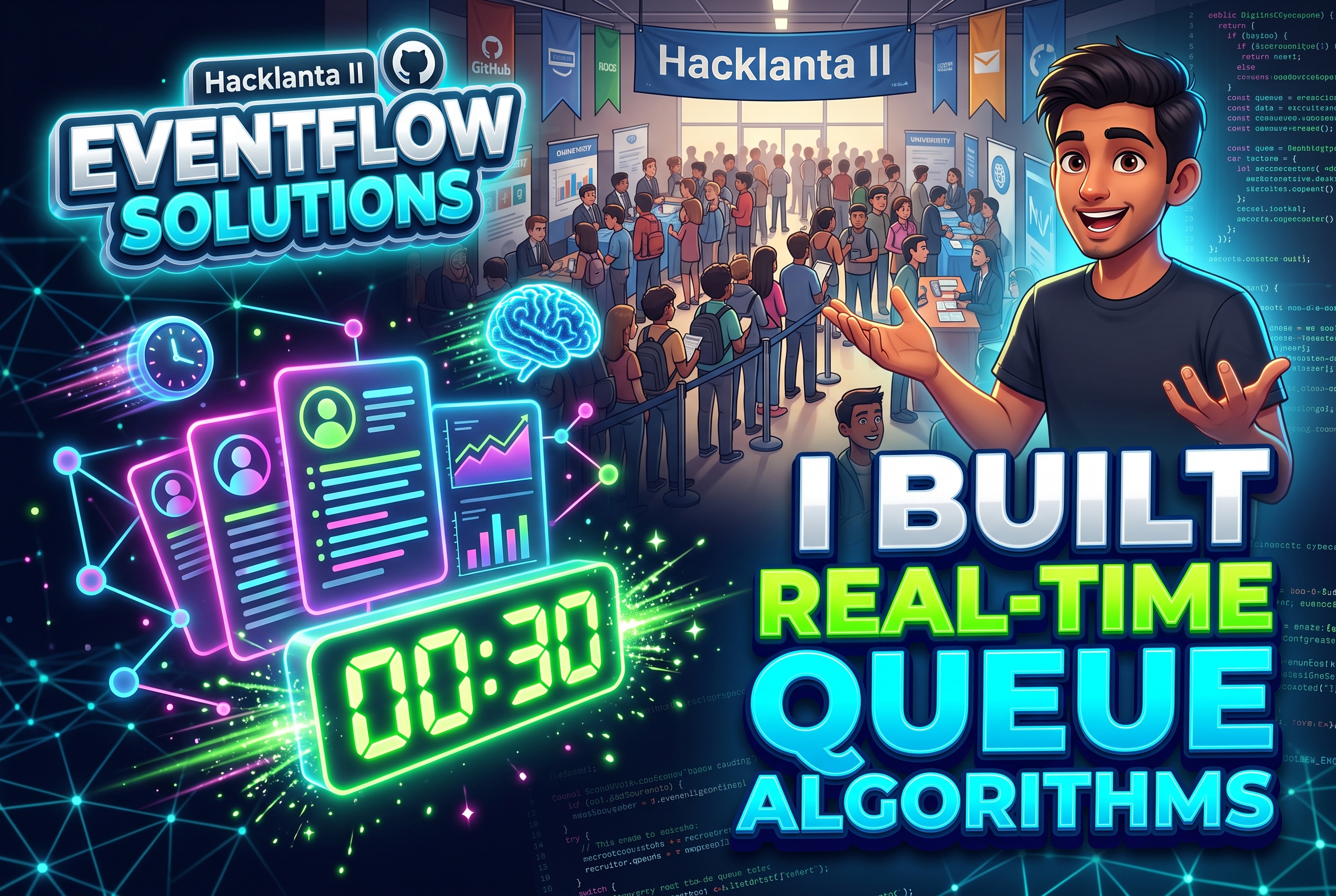
Inspiration
Anyone who has navigated a massive collegiate networking event or career fair knows the frustration of the line bottleneck. Candidates waste hours standing in physical queues, and recruiters are too overwhelmed to manage the crowd. Looking at this unstructured chaos through the lens of applied mathematics and data analytics, a clear solution emerged. I realized that by digitizing the queue, we could not only give students their time back to actually network, but also capture valuable interaction data to optimize event flow dynamically.
What it does
EventFlow Solutions completely digitizes the career fair queueing experience. Instead of standing in a physical line, candidates check into a digital Live Queue Buffer from their phones and instantly receive an estimated wait time.
On the other side, recruiters manage the flow from a dedicated dashboard. When they are ready, they click "Select Random Candidate," which pulls a student from the buffer and stages their profile (name, major, and desired role) on the screen. Once the introduction starts, the recruiter initiates the 30-Second Challenge which is a timer that guarantees the candidate a focused, uninterrupted window to deliver their elevator pitch while preventing any single interaction from bottlenecking the rest of the queue.
How we built it
EventFlow Solutions is a full-stack, real-time networked dashboard engineered to run locally across devices during an event.Frontend: We developed a responsive, dark-mode UI using Next.js and Tailwind CSS, highlighting the Live Queue Buffer and the 30-Second Challenge. Backend: We built the core predictive logic and API using Python and FastAPI, serving it locally via Uvicorn.Database: A lightweight SQLite database maintains the state for candidate profiles, target companies, and queue order.To manage the predictive line flow, the backend actively calculates estimated wait times based on queue depth. The expected wait time $E[W]$ for a new candidate joining a queue of $N$ people is modeled simply as the sum of expected interaction times:$$E[W] = \sum_{i=1}^{N} \mu_i$$Where $\mu_i$ is the allocated time for the $i$-th candidate. By strictly enforcing the 30-Second Challenge, we mathematically cap the maximum service rate $\mu$, preventing extreme variance in wait times and keeping the event floor moving.
Challenges we ran into
Building a full-stack application under a ticking hackathon clock guarantees friction, and our biggest hurdle hit during the final UI integration. While polishing the dark-mode aesthetic, our local Next.js compiler started throwing fatal PostCSS parsing errors because of a malformed CSS directive. With the submission deadline rapidly approaching and the local build failing, I had to act fast. We bypassed the local compiler entirely by injecting the Tailwind CSS CDN directly into layout.tsx file's . This immediate pivot restored our styling across the network IP, allowing us to record the final demo exactly on time.
Accomplishments that we're proud of
I incredibly proud to have built a stable, fully networked application from scratch over a single weekend. The frontend seamlessly pulls real-time queue data from the FastAPI backend. Seeing the 30-Second Challenge timer synchronize perfectly with the candidate selection logic complete with the UI was a huge win for the team.
What we learned
This project reinforced the absolute necessity of pragmatic, deadline-driven engineering. Beyond expanding our technical stack specifically bridging a Python FastAPI backend with a modern React framework, we learned that delivering a functional, core-value prototype matters more than a flawless development environment. I learned how to triage critical bugs under pressure, bypass broken dependencies, and keep our focus purely on demonstrating the solution.
What's next for EventFlow Solutions
Digitizing the queue is just the foundation. By capturing candidate arrival rates ($\lambda$) and actual interaction times ($\mu$), I generating a rich dataset (Synthetic for this prototype using Google Gemini). The next phase of EventFlow involves applying statistical machine learning models to these metrics, allowing event organizers to predict floor bottlenecks, dynamically identify understaffed booths, and optimize future layout architecture in real-time.


Log in or sign up for Devpost to join the conversation.