The problem
In times of crisis, SME's struggle with maintaining themselves. They often lack the tools, people and expertise to adapt their business model to the new situation, with periods of financial difficulty and the threat of bankruptcy as a result, only worsened by some crises' indefinite nature: without knowing when a crisis will stop when compared to when the reserves will run dry, SME's must be able to adopt new and resilient business models to not only endure in times of crises, but sustain themselves. It is of course not always possible to make something out of nothing, but for many SME's, having better insight in their situation will help them get their act together and improve their business model. And considering there are over 25 million SME's in Europe, 99% of all European enterprises, a tool for this will be very valuable.
The solution
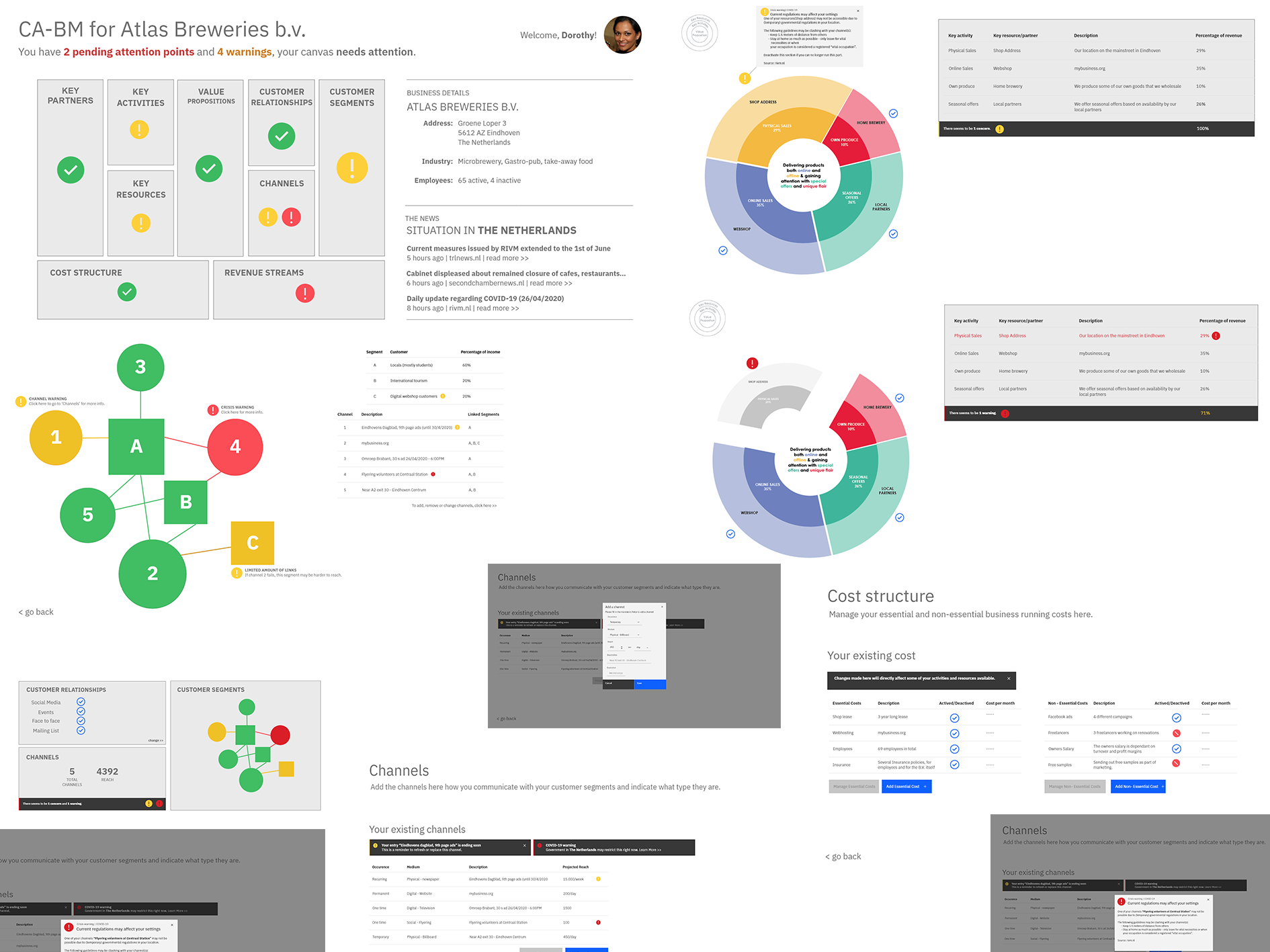
The Crisis-Aware Business Model Canvas (CABMC) is a worksheet that expands on the classical Business Model Canvas (BMC; Osterwald, 2010) by adding dynamic elements and interdependencies throughout the whole. Next to the well-known, boxed layout, the CABMC adds several contemporary interfaces that allow SME's to fill in their BMCs with much more eye for detail. These interfaces are dynamically linked together, meaning that a change in one interface (for example the loss of a Key Activity) will automatically update all associated boxes (a loss of Revenue Streams). There are three main changes to the classical BMC that the CABMC adds:
Value Proposition A circular interface built from rings. The outer ring corresponds to the Key Partners and Key Resources boxes. Here, any related partner or resource (or a combination of several of either) can be filled in and in the inner ring, an activity from Key Activities can be added. This way, every key activity follows from its prerequisite partners or resources. Each key activity is also attributed a percentage (or estimate) of the SME's revenue streams, and in the very center is the company's Value Proposition, which follows from all its key activities and is, much like with a classic BMC, at the center of it all. Should any of a key activity's prerequisites disappear due to (for example) a crisis, users can indicate this in their CABMC and that key activity will be greyed out. Its revenue stream will be halted, alerting the BMC's owning SME that their business model has been destabilized. This can lead to an error message in cost structure saying that, with the lessened revenue streams, perhaps the cost structure needs revisiting. This way, the entire CABMC is interconnected and -dependent, meaning that a change in any of its boxes will immediately impact the boxes related to it, alerting SME's of the consequences of crises or other shifts in their corporate situation.
Customer Segments An interface like the one from Value Proposition in function, though different in aesthetic. It involves the Channels, Customer Relationships and Customer Segments boxes of the BMC. Here, the visual elements of Channels and Customer Relationships come together to create the joint element of Customer Segments. If a channel is lost or a relationship deteriorates or simply becomes impossible to sustain due to the crisis, users can indicate this in the interface. This will not only be reflected in the Customer Segments element, but also in the Value Proposition element, if due to the loss of a customer segment a significant part of the Value Proposition is lost, and in the Revenue Streams (and potentially the Cost Structure: if a certain relationship becomes unsustainable, any associated costs can also be cut).
Cost Structure This box has been split in two: Essential Costs and Non-essential Costs. Essential Costs are, unsurprisingly, the bare-bones operational costs of an SME. Without these, the SME loses either the core of its Value Proposition, or its ability to sustain itself. For a web-based company, these would be the costs for hosting the website and for an ice cream truck, the electricity costs of the freezer. Any other costs go into Non-essential Costs, and costs can be moved between the two. In times of plenty, ventures like marketing and attracting new employees can be considered Essential Costs for staying ahead of the competition, while in times of crisis, these would be moved to Non-essential Costs as the SME focuses on surviving and securing its assets rather than trying to reach out. Finally, costs such as sponsorship deals for partners may disappear from costs entirely if the aforementioned relationship falls away.
Other Finally, as one of the project's own revenue streams, the CABMC's website contains references to partnered consultancy agencies. Consultancy agencies can partner with the CABMC for no cost, and instead pay a nominal fee whenever a SME or entrepreneur approaches them after finding or using the CABMC. This will cover most of the very minor running costs of the CABMC, which requires only yearly webhosting and minor moderator work once development is finished. If necessary, CABMC can resort to advertisement revenue to cover its costs. It is not non-profit per se, but neither is the aim of it to make money. Its services will be offered for free (with clients being given the choice to contact a consultancy agency, which puts them out of the CABMC's purview), and the business plan's main goal is to break even, so that no further investments need to be made once the platform is live. For the initial development, an up-front financial boost may be required.
All of this has been built in Adobe XD with visuals from the IBM Carbon Design Kit. Early iterations of the design have been made using Adobe Illustrator and collaboration was made possible through Microsoft Teams and Google Jamboard.
During the weekend
We started from scratch as the hackathon began, so, in order, we roughly did the following:
- Ideation about what to do within the area of "New and Resilient Business Models".
- Get inspired by research on responses to other worldwide crises.
- Once the decision to go for the CABMC was made, we set up a plan about what had to be done to realize the idea, and when to do what. All of this was supported by visualized brainstorming in Google Jamboard.
- After the first Checkpoint, we were told to define the business plan for our venture, so that was done immediately after.
- That same day, we defined what exactly would have to be added to or changed in the classic BMC to reach the CABMC. This was done with joint brainstorming and back-and-forth discussion.
- First iterations the visual layout of the CABMC were made in Adobe Illustrator.
- The CABMC was realized on Sunday in Adobe XD, throughout the whole day.
- Around mid-day, we had our business model checked and verified by one of the Skills Mentors who specialized in Business Model Innovation.
- That afternoon, both the written and video pitch were planned out and made.
Impact
The CABMC allows SME's to respond to crises in real-time and visualizes their situation as a means to help their corporate decision-making. It can also be used outside of crises, to allow businesses to sketch theoretical crises and see how resilient their business model is. It updates them of the current situation and potential pitfalls for their company, allowing them constantly plan and check if their business model holds up in the current time, proposing potential action if the situation changes.
The primary goal of the CAMBC within crises is to lessen the impact and drop of the shock phase by improving SME's responsiveness and preparation for such times, flattening the drop and allowing the SME's performance to be much more stable, if below average, for the duration of the crisi. It can also allow an SME to recover more quickly, and start growing above its former norm in the new normal quicker than if the drop had been steep, and the SME unprepared.
What's necessary to continue
Exposure and technical validity. The CABMC in its current state is not technically marketable, yet. It would require someone with more understanding of truly dynamic, responsive and interconnected platforms than we have to revamp the current construction into something of higher fidelity.
Value after the crisis
As mentioned, the CABMC can be used outside of crises as a pleasant tool to dynamically visualize one's business model and further support SME's in making and updating them. Moreoever, it can be used to simulate new crises and the losses experienced by them, so that SME's can theorize and prepare for situations wherein key elements of their business model would fall away, and how they would combat this.
What's next
The CABMC will be further developed and graded as part of a course in our Master's Degree in Industrial Design.
Built With
- adobe-creative-suite
- adobe-illustrator
- adobexd
- business
- canvas
- jamboard
- model


Log in or sign up for Devpost to join the conversation.