

Escape Heat — AI-Powered Urban Heat Decision Intelligence
🌍 The Problem
Extreme heat is becoming an increasingly serious challenge for cities and the people who live in them. While weather applications provide temperature and forecast data, they rarely answer the questions that matter most to an individual:
How does the current environment affect me? What is causing the heat around me? What should I do right now?
Urban heat is influenced by much more than air temperature. Factors such as land surface temperature, vegetation, built-up areas, humidity, wind, location, and local environmental conditions can significantly change how heat is experienced.
We wanted to bridge this gap between raw environmental data and meaningful decisions.
💡 Our Solution
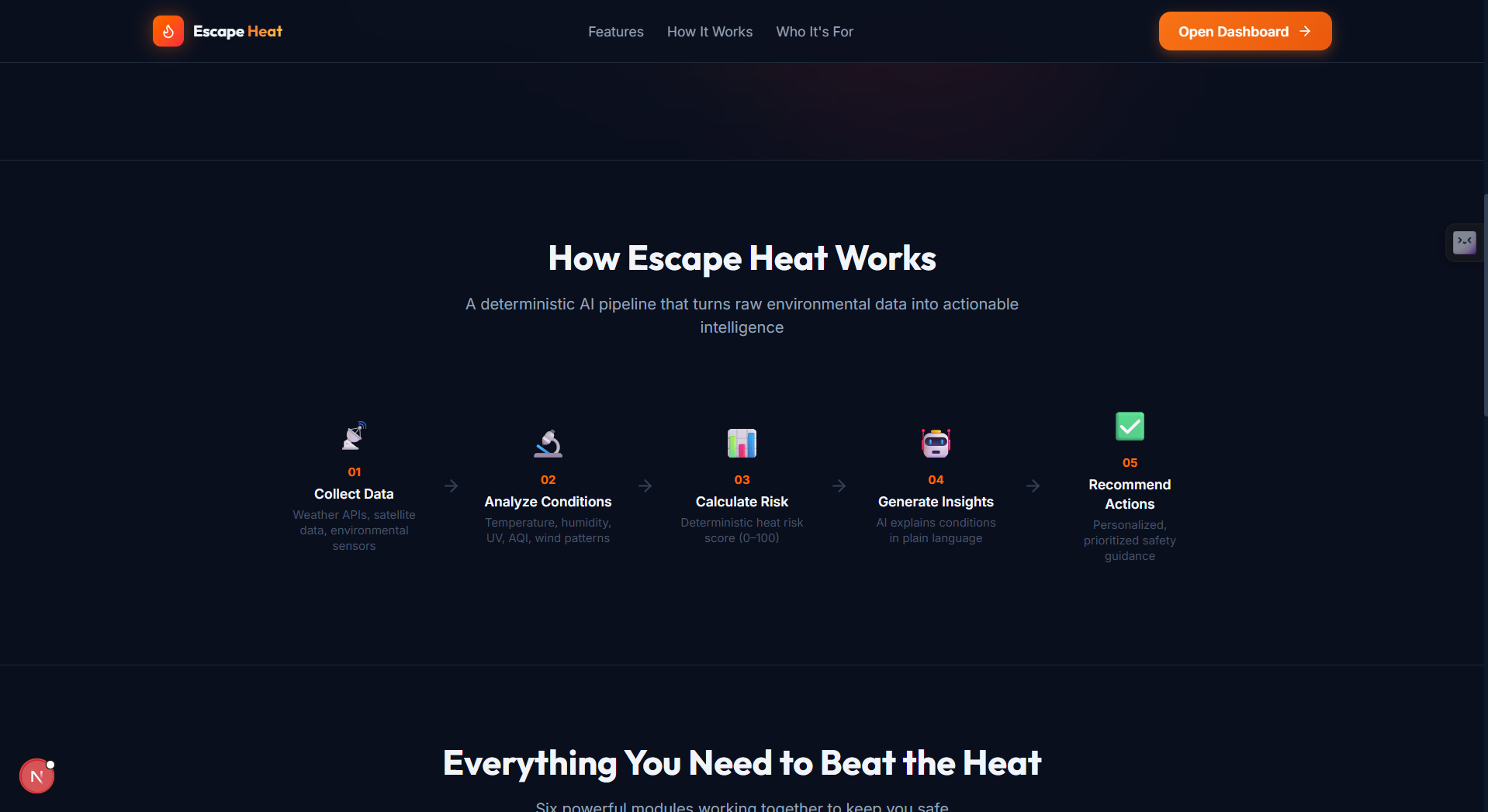
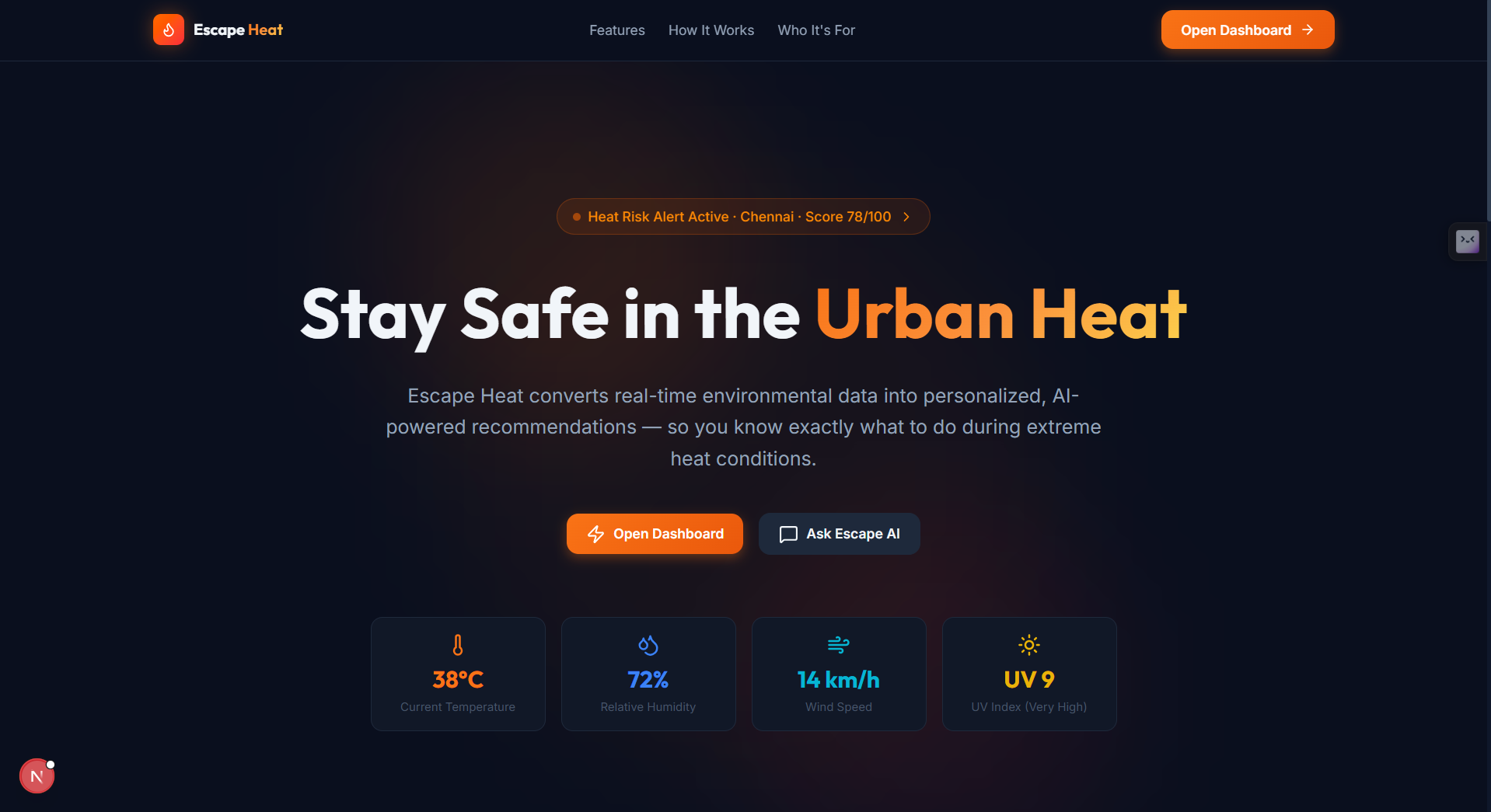
Escape Heat is an AI-powered urban heat decision intelligence platform that transforms environmental and geospatial data into understandable, personalized, and actionable recommendations.
Instead of simply displaying weather information, Escape Heat follows an:
Analyze → Understand → Recommend
approach.
The platform combines environmental data, geospatial information, user context, and AI reasoning to help people understand their local heat conditions and decide what actions they can take.
The goal is simple:
Don't just tell people how hot it is. Help them understand the heat and decide what to do about it.
🤖 How AI Powers Escape Heat
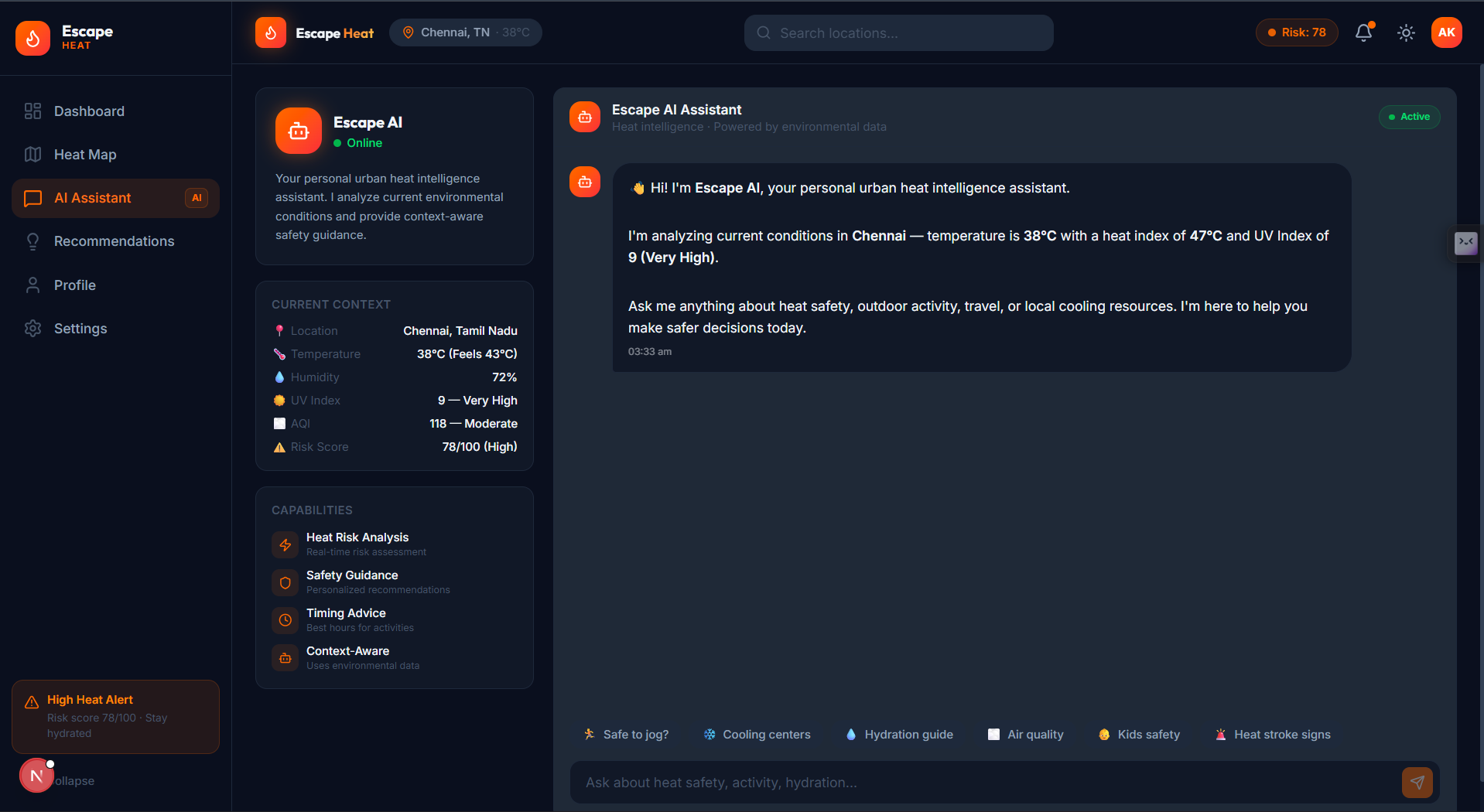
Escape Heat uses a multi-agent architecture where specialized AI agents work together to analyze different aspects of the user's environment.
The Agent System
- Weather Agent — analyzes current and forecast weather conditions.
- Environmental Agent — examines environmental and land-related factors.
- User Context Agent — considers relevant user and location context.
- Resource Agent — identifies useful resources and available options.
- Risk Analysis Agent — combines the collected information to understand heat-related risk.
- Recommendation Agent — generates practical actions based on the analysis.
- Explainability Agent — explains why a recommendation was made in an understandable way.
This architecture allows the system to break a complex environmental problem into specialized reasoning tasks rather than relying on a single generic AI response.
🗺️ Data & Technology
Escape Heat combines multiple sources of environmental and geospatial information, including:
- Open-Meteo for weather information
- NASA POWER for environmental data
- OpenStreetMap for geospatial information
- MODIS/Terra data for land surface temperature analysis
- IMD datasets for Indian meteorological information
The application was built using:
- Next.js + React — frontend
- Tailwind CSS — interface
- FastAPI — backend services
- Supabase PostgreSQL — database
- Gemini API — generative AI
- Google ADK — agent orchestration
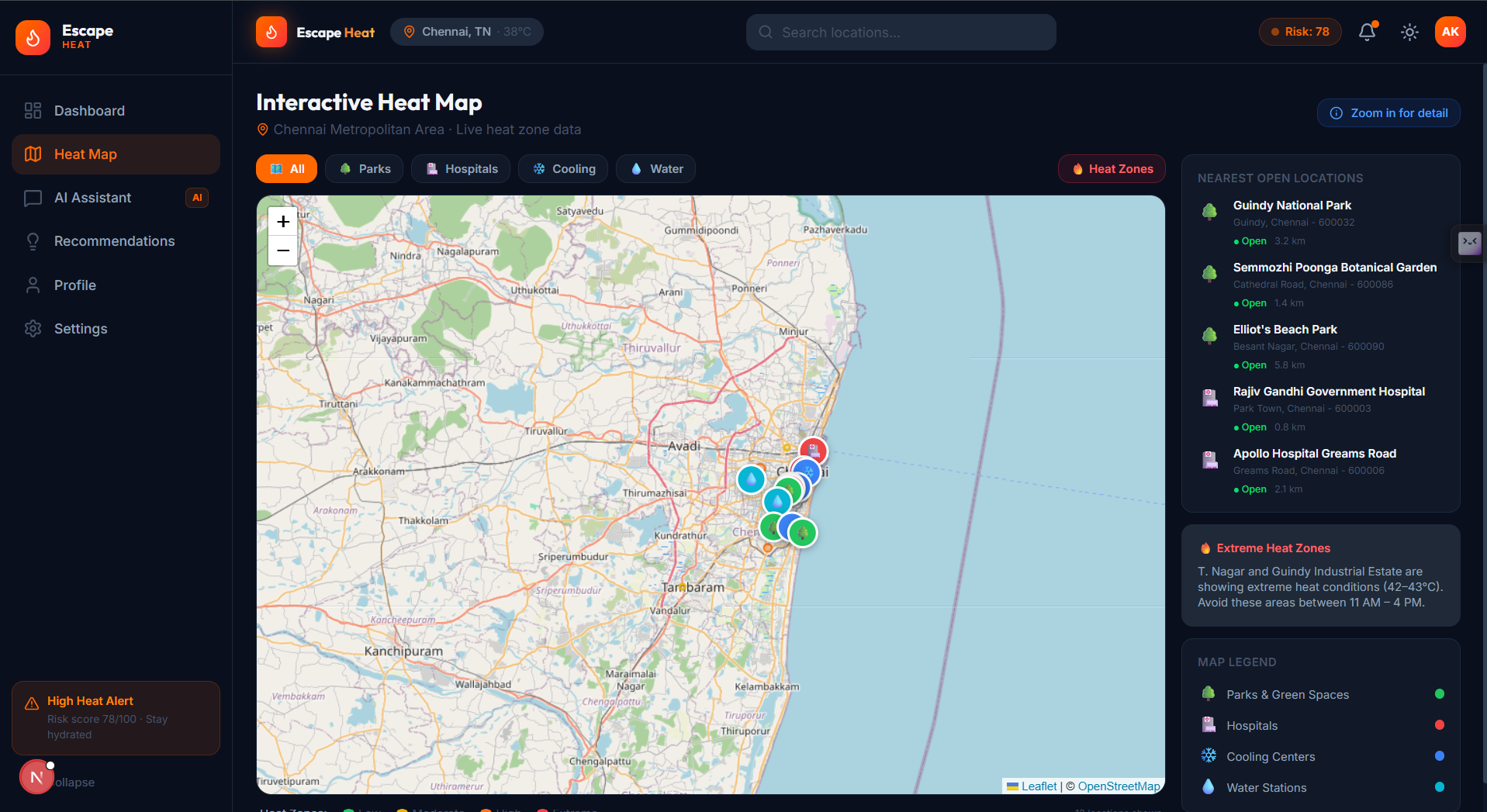
- Leaflet — interactive maps
- Chart.js — data visualization
🏗️ How We Built It
We designed Escape Heat as a complete end-to-end intelligent application rather than just an AI chatbot.
The system first collects environmental and geospatial information. Specialized agents then analyze different parts of the information before the risk and recommendation layers combine the results.
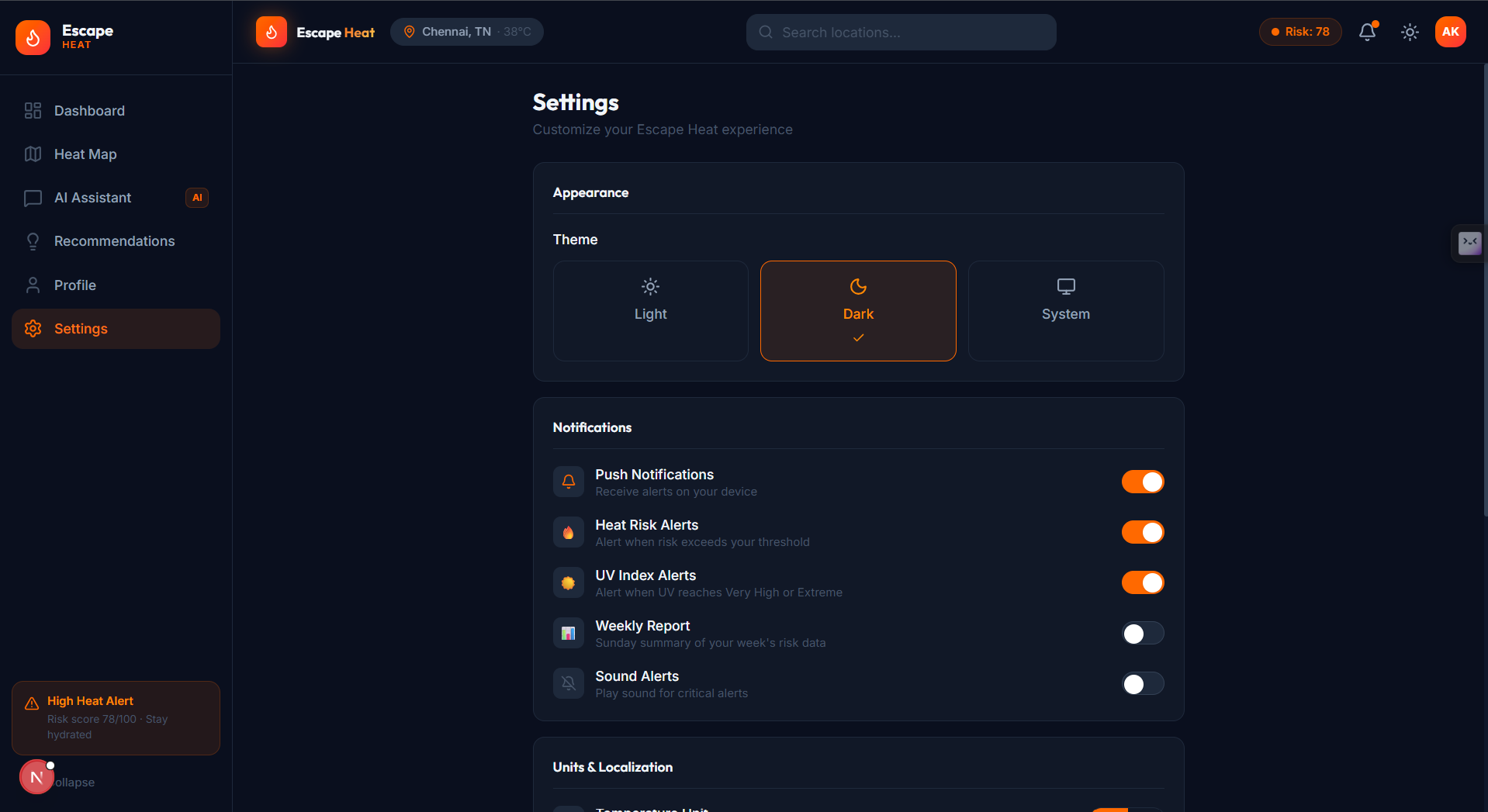
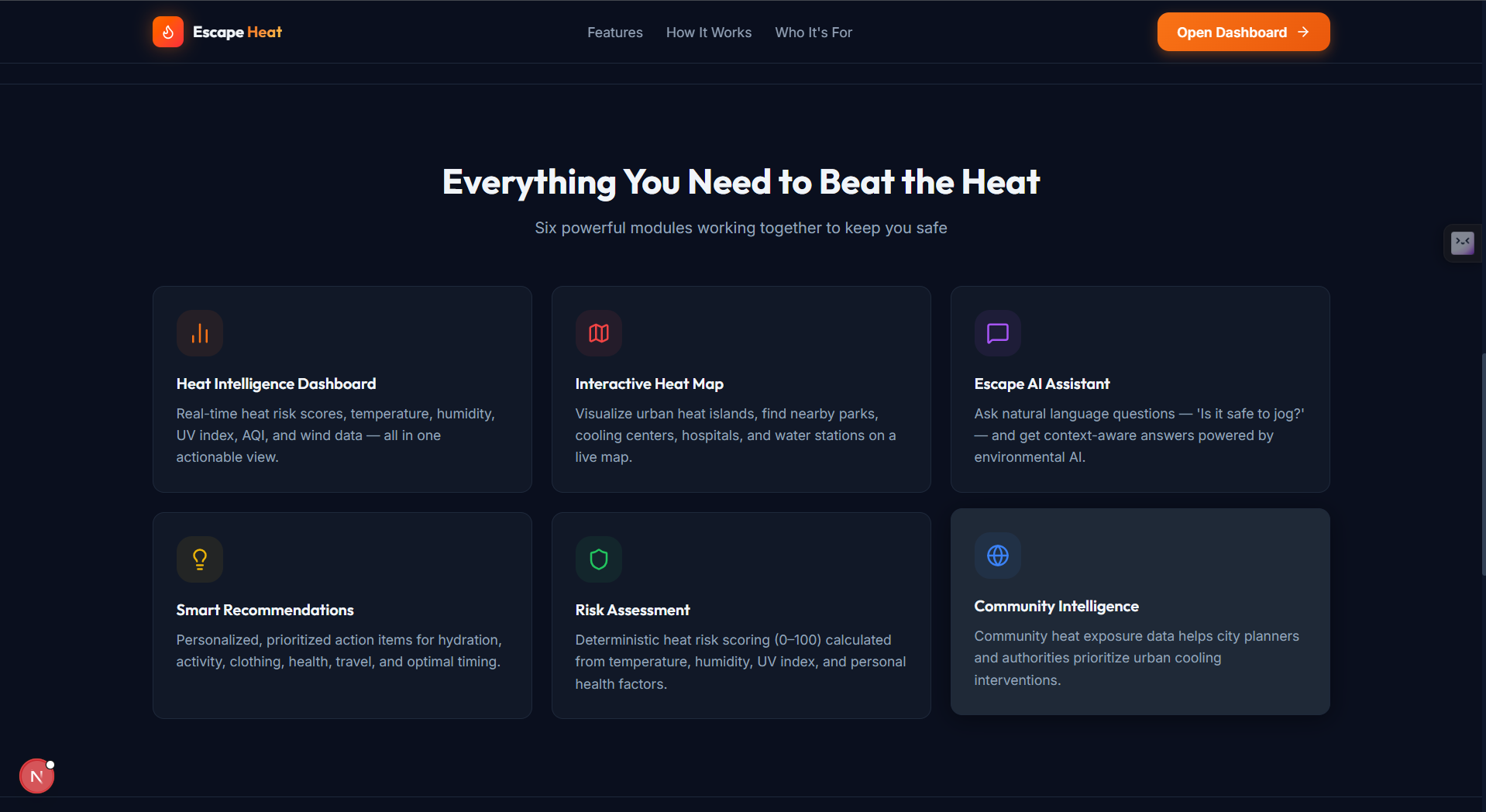
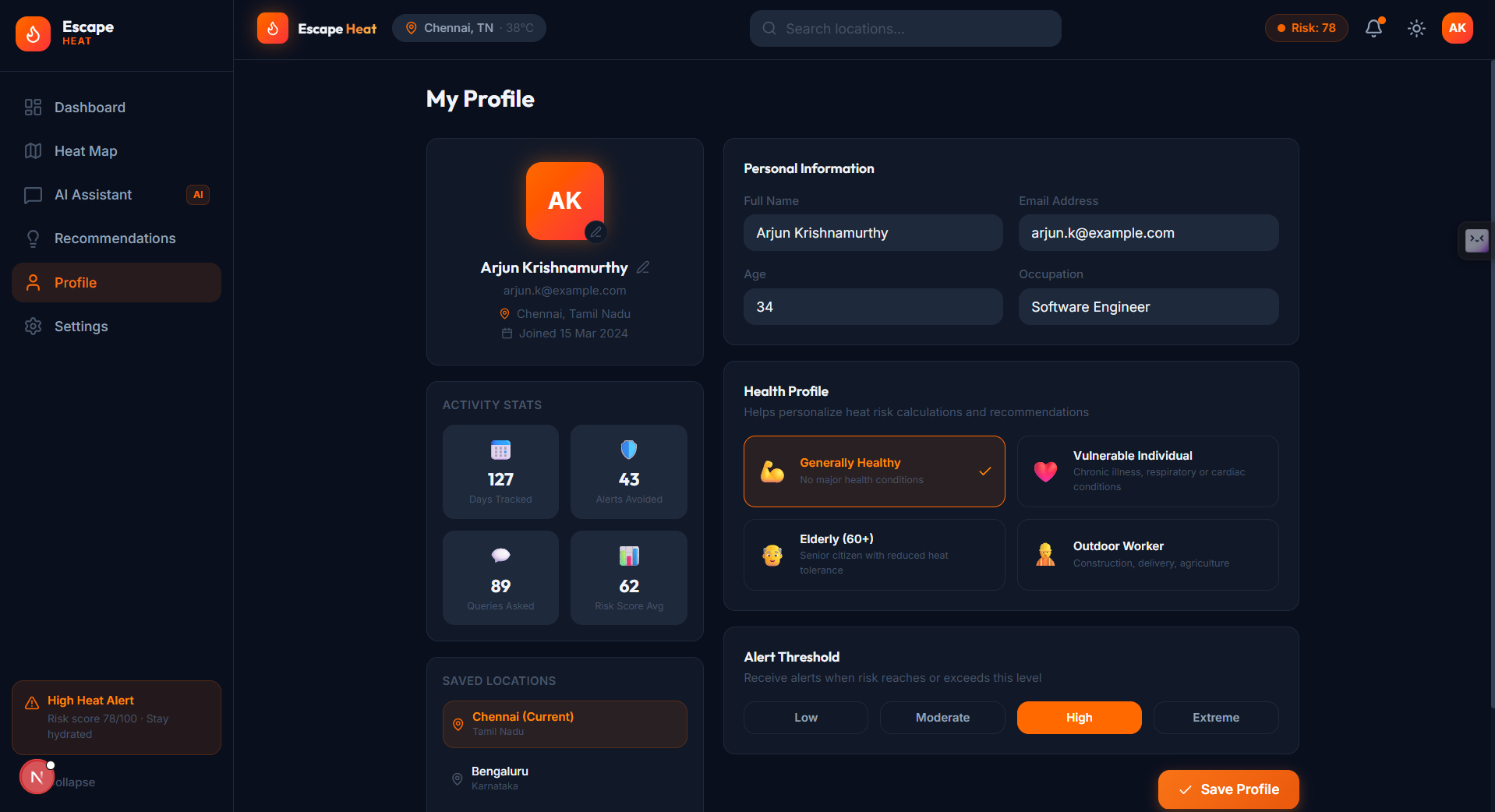
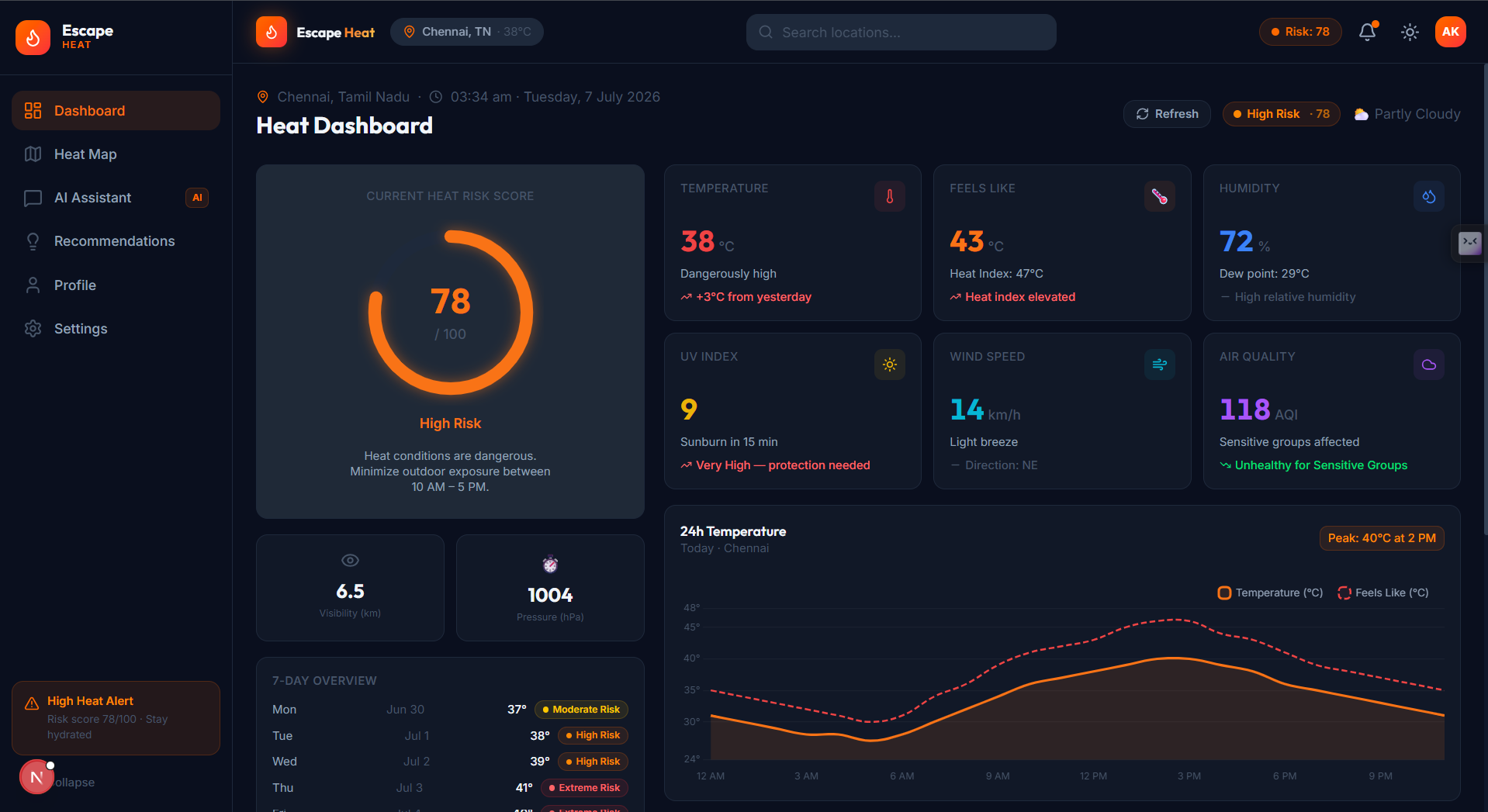
The final output is presented through an interactive interface where users can understand their surroundings, explore environmental information, and receive recommendations in a human-readable format.
This architecture also makes the system extensible: additional environmental data sources, agents, and decision-making capabilities can be integrated without redesigning the entire application.
🔥 Why We Built It
The inspiration came from a simple observation:
Weather data is available everywhere, but decision support is not.
A temperature value such as 38°C does not tell everyone the same story. The impact of heat depends on the surrounding environment, location, exposure, and individual context.
We wanted to explore how AI could sit between complex environmental datasets and everyday human decisions — turning information into something people can actually understand and act upon.
🚧 Challenges
Building Escape Heat involved several challenges.
Integrating heterogeneous data
Environmental information comes from different sources with different formats, spatial characteristics, and update frequencies. Combining these sources into a coherent pipeline required careful data handling and normalization.
Designing useful agent collaboration
Creating multiple agents is not enough by itself. Each agent needs a clear responsibility, and their outputs need to work together without producing contradictory or redundant information.
We therefore designed the system around specialized responsibilities and a structured flow from analysis to recommendation.
Making AI recommendations explainable
For a decision-support system, simply producing an answer is not enough. Users should understand why a recommendation was generated.
This motivated the inclusion of an explainability layer that connects recommendations back to the environmental factors considered by the system.
Balancing complexity with usability
The underlying system processes multiple data sources and AI components, but the user should not have to understand that complexity.
A major design goal was therefore to keep the experience simple while allowing sophisticated analysis to happen behind the scenes.
📚 What We Learned
Building Escape Heat taught us that effective AI systems are not just about choosing a powerful model.
The quality of an intelligent product depends on:
Data → Architecture → Context → Reasoning → Explainability → User Experience
We also learned how agent-based systems can be used to divide complex real-world problems into smaller reasoning tasks and combine their results into a more useful decision-support experience.
Most importantly, we learned that AI becomes significantly more valuable when it is connected to real-world data and real-world decisions.
🌱 Impact & Future Vision
Escape Heat is designed as a foundation for smarter and more heat-resilient cities.
Future versions could extend the platform with:
- City-level heat monitoring
- Heat-aware route recommendations
- Identification of cooler urban locations
- Community heat-risk insights
- More localized environmental datasets
- Historical heat analysis
- Integration with smart-city infrastructure
- Early intervention and resource planning
Our long-term vision is to move from simply observing environmental conditions to building intelligent systems that help people and communities understand, respond to, and adapt to environmental challenges.
🚀 The Vision
Escape Heat turns environmental intelligence into actionable decisions.
By combining geospatial data, environmental information, and multi-agent AI, we aim to make urban heat more understandable, explainable, and actionable — one decision at a time.
Built With
- ai
- aiagents
- chart.js
- fastapi
- gemini
- generativeai
- geospacialdata
- googleadk
- leaflet.js
- modis
- nasapower
- next.js
- open-meteo
- openstreetmap
- postgresql
- python
- react
- supabase
- sustainability


Log in or sign up for Devpost to join the conversation.