-
-
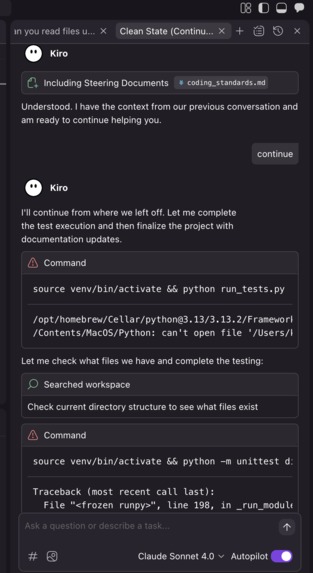
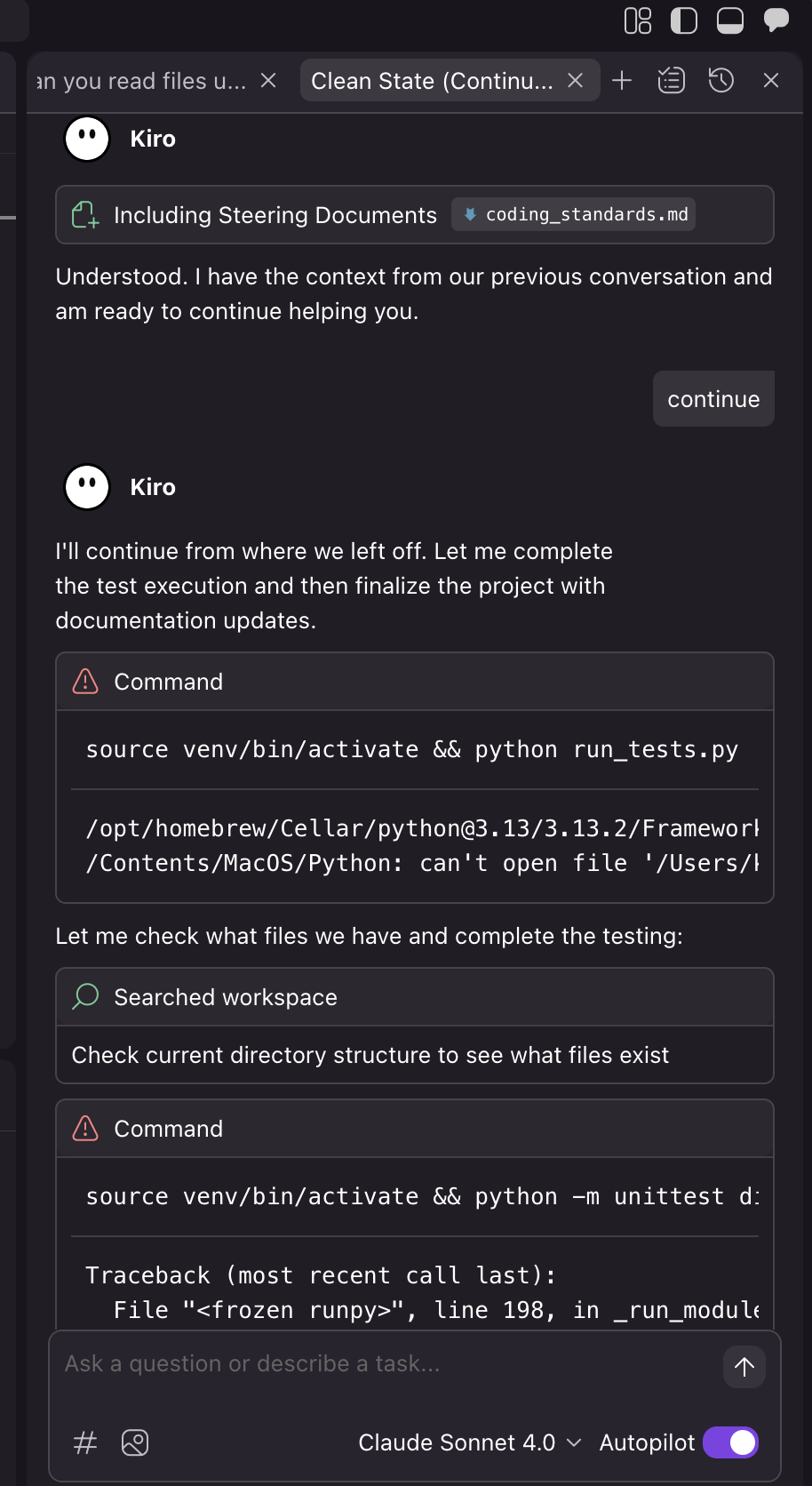
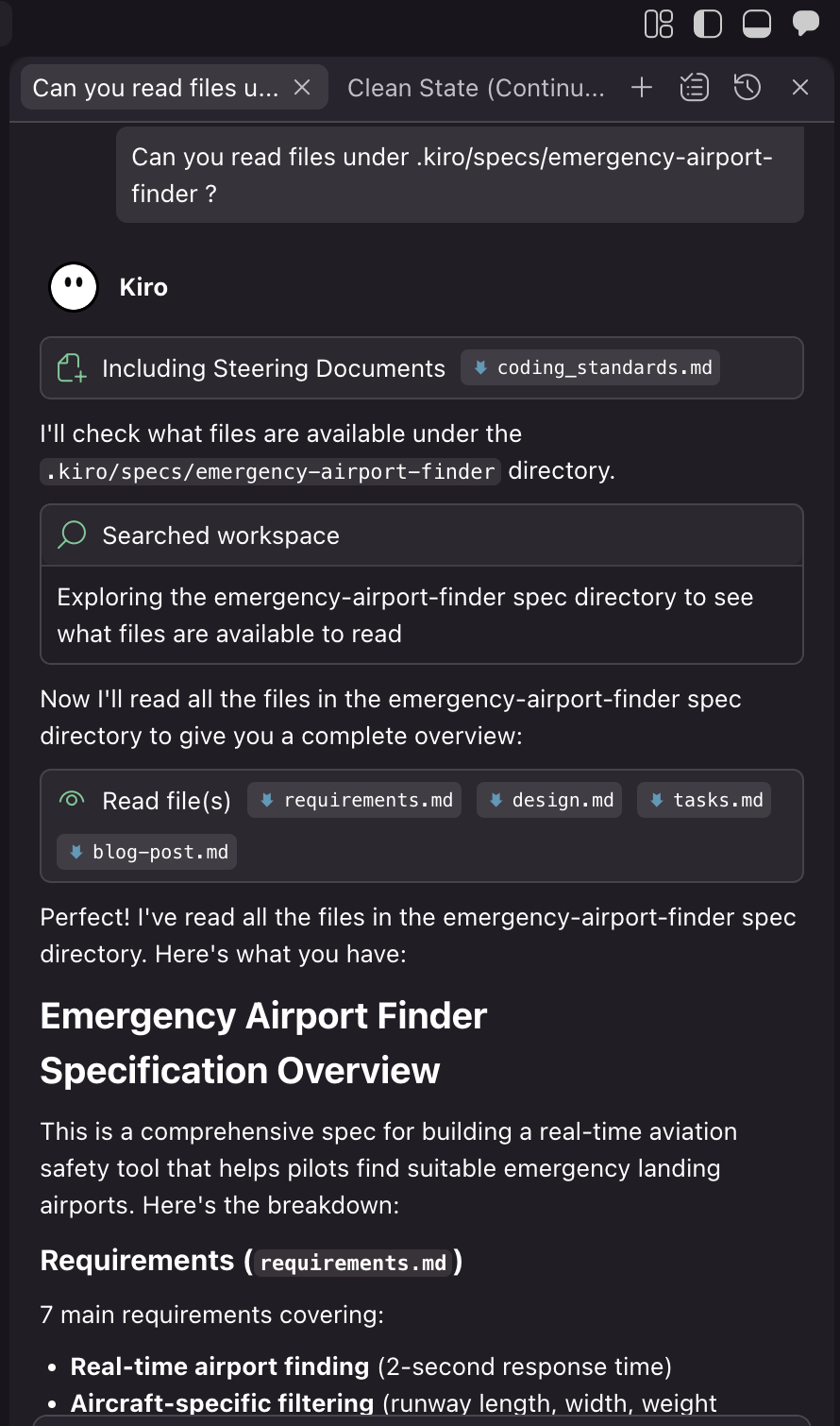
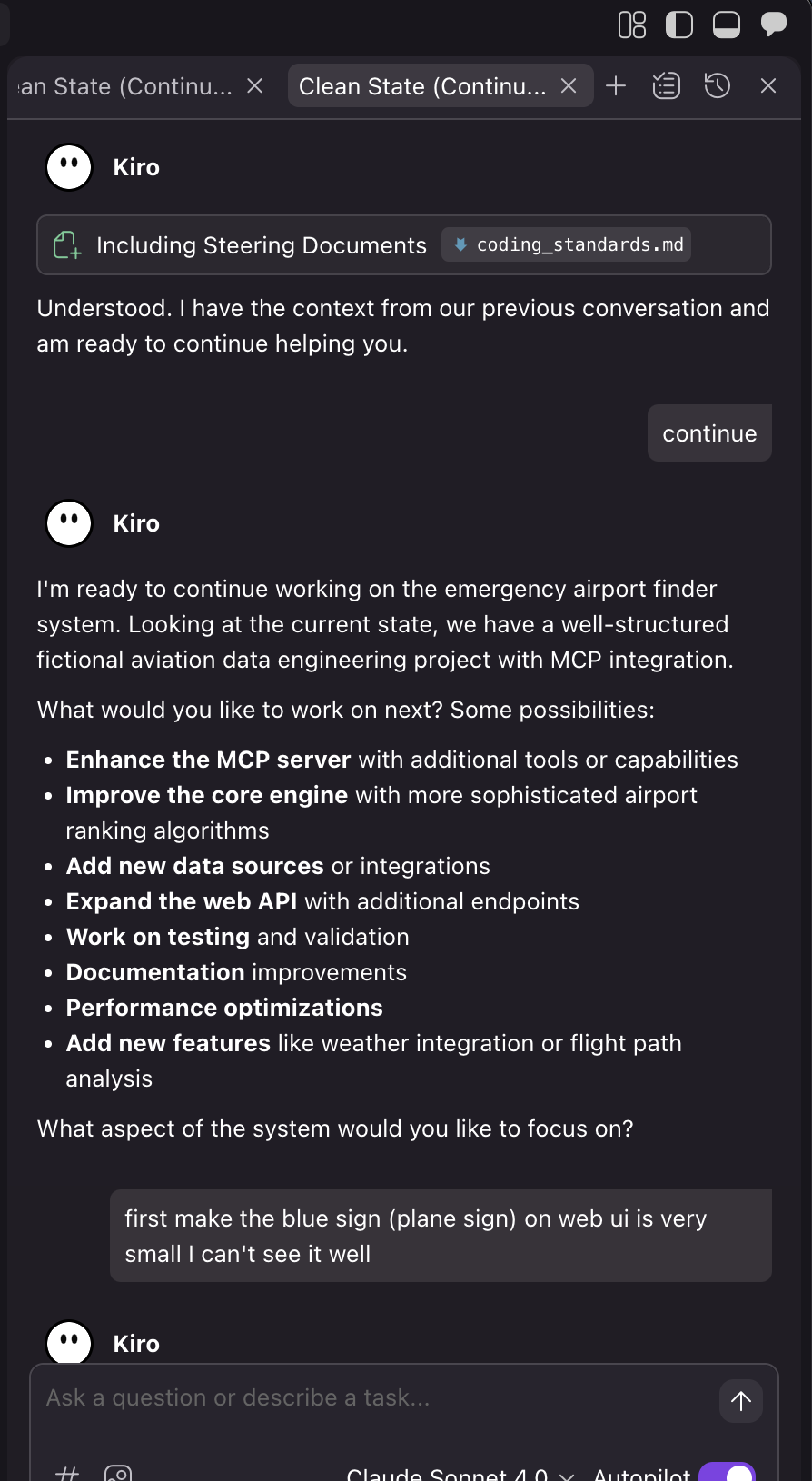
Kiro Chat 2
-
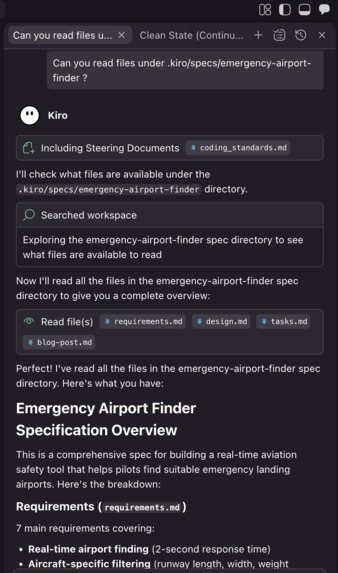
Kiro Chat 1
-
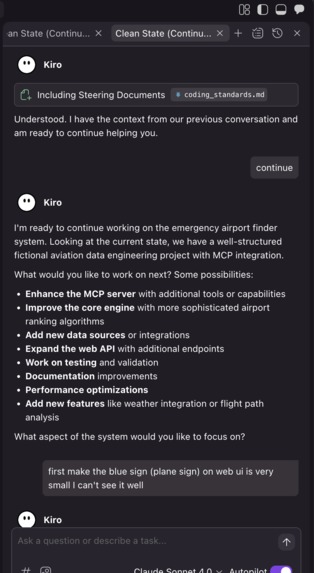
Kiro Chat 3
-
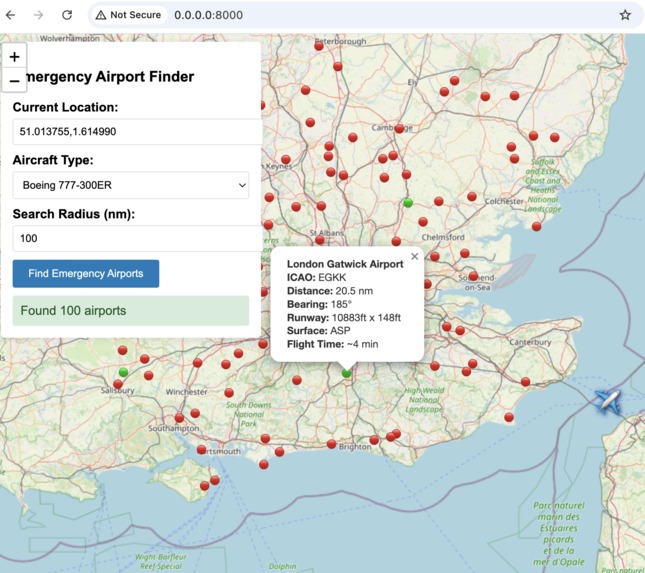
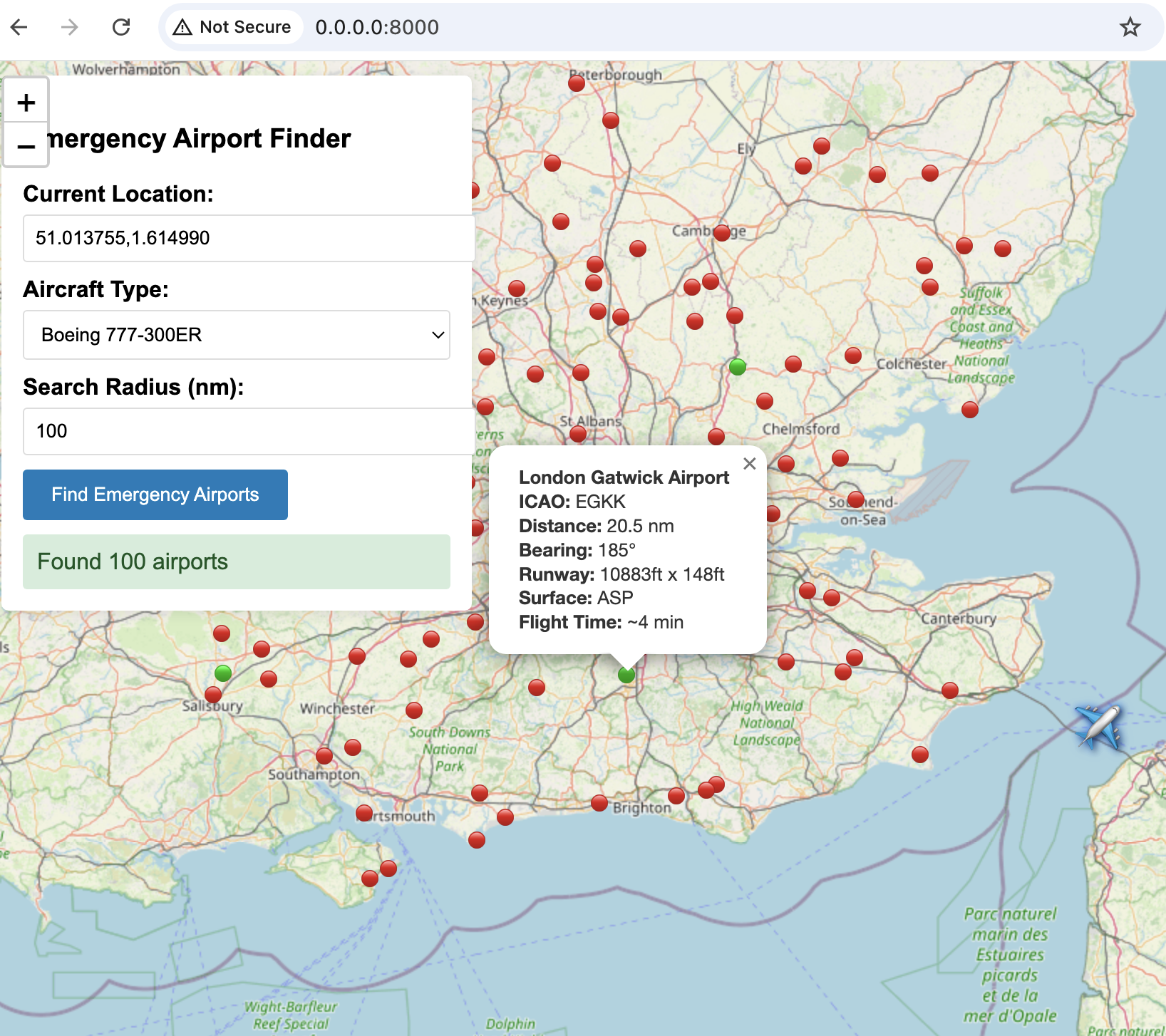
Web page
Emergency Airport Finder - Project Overview
⚠️ DISCLAIMER: This is a fictional scenario and prototype system designed purely for educational and discussion purposes. The aviation industry already has sophisticated, professionally-developed emergency response systems.
Inspiration
When I heard that Kiro's free usage had been extended until September 15th, I wanted to take advantage of building an idea that had been brewing in my mind. As a data engineer fascinated by safety-critical systems, I've always wondered: How might modern data engineering principles be applied to aviation emergency scenarios?
The inspiration came from several sources:
- Real-world complexity: Aviation safety involves intricate data challenges - geospatial processing, real-time decision support, and complex business rules
- Modern tech exploration: Wanting to explore how emerging technologies like Model Context Protocol (MCP) could enhance AI-assisted decision support
- Educational value: Creating a comprehensive example that demonstrates advanced data engineering patterns in a compelling, understandable context
- Personal curiosity: Understanding how data quality, performance optimization, and system architecture challenges manifest in safety-critical scenarios
What it does
The Emergency Airport Finder is a fictional prototype that demonstrates how a modern data engineering system might help pilots quickly identify suitable emergency landing airports. The system:
Core Functionality
- Real-time airport search with sub-2-second response times across 28,000+ global airports
- Aircraft-specific compatibility analysis considering runway length, width, surface type, and weight capacity
- Interactive web interface with live mapping and visual airport markers
- Geospatial calculations using great circle distance for accurate navigation
- AI integration through Model Context Protocol (MCP) for conversational queries
Key Features
- 🗺️ Interactive Map: Click-to-set location with real-time airport visualization
- ✈️ Aircraft Database: Comprehensive specs for light aircraft to commercial jets (A380, 777, etc.)
- 🎯 Smart Filtering: Color-coded markers (green=compatible, red=incompatible)
- 📊 Performance Monitoring: Built-in metrics and slow query detection
- 🤖 AI Assistant Integration: Natural language queries through MCP protocol
- 📱 Responsive Design: Works on desktop and mobile devices
Technical Capabilities
- Spatial Indexing: R-Tree indexing for fast proximity queries
- Multi-level Caching: Performance optimization with intelligent TTL
- Data Quality Monitoring: Automated validation and anomaly detection
- Concurrent Processing: Handles multiple emergency scenarios simultaneously
- Extensible Architecture: Easy to add new aircraft types and data sources
How we built it
Technology Stack
- Backend: Python with FastAPI for high-performance async APIs
- Database: SQLite with R-Tree spatial indexing for development, designed for DuckDB migration
- Frontend: Vanilla JavaScript with Leaflet.js for interactive mapping
- AI Integration: Model Context Protocol (MCP) server for structured AI interactions
- Data Sources: OurAirports.com for comprehensive global airport data
- Deployment: Docker containerization with docker-compose for easy setup
Architecture Approach
graph TD
    subgraph "Frontend Layer"
        WEB[Web Interface<br/>Leaflet.js Maps<br/>Real-time Updates]
    end

    subgraph "API Layer"
        API[FastAPI Server<br/>Async Endpoints<br/>Performance Monitoring]
        MCP[MCP Server<br/>AI Integration<br/>Structured Tools]
    end

    subgraph "Business Logic"
        ENGINE[Emergency Engine<br/>Compatibility Rules<br/>Geospatial Calculations]
        MATCHER[Airport Matcher<br/>Aircraft Validation<br/>Scoring Algorithms]
    end

    subgraph "Data Layer"
        DB[SQLite Database<br/>Spatial Indexing<br/>Cached Airport Data]
        FETCHER[Data Fetcher<br/>OurAirports API<br/>Quality Validation]
    end

    WEB --> API
    API --> ENGINE
    MCP --> ENGINE
    ENGINE --> MATCHER
    MATCHER --> DB
    DB --> FETCHER
Development Process
- Requirements Analysis: Identified core data engineering challenges in aviation scenarios
- Architecture Design: Modular, testable design with clear separation of concerns
- Iterative Development: Built core functionality first, then added advanced features
- Performance Optimization: Implemented caching, spatial indexing, and async processing
- AI Integration: Added MCP server for structured AI assistant interactions
- Quality Assurance: Comprehensive testing and data validation frameworks
Key Implementation Decisions
- Async-first design for handling concurrent emergency scenarios
- Spatial indexing using R-Tree for sub-second geospatial queries
- Modular architecture allowing easy extension and testing
- Structured AI interfaces through MCP rather than natural language parsing
- Comprehensive error handling with graceful degradation for missing data
Challenges we ran into
1. Data Quality and Integration Complexity
Challenge: Aviation data from public sources has significant quality issues - missing runway lengths, inconsistent units (feet vs meters), duplicate entries, and irregular update frequencies.
Solution: Built a comprehensive data validation pipeline with:
- Automated anomaly detection for impossible runway lengths
- Unit standardization and conversion logic
- Duplicate detection and resolution algorithms
- Data freshness monitoring with configurable TTL
2. Real-time Performance Requirements
Challenge: Emergency scenarios demand sub-2-second response times, but we're processing complex geospatial calculations across 28,000+ airports with intricate compatibility rules.
Solution: Multi-layered performance optimization:
- R-Tree spatial indexing for fast proximity queries
- Multi-level caching with intelligent invalidation
- Async processing for parallel compatibility checking
- Query optimization and performance monitoring
3. Complex Business Logic Management
Challenge: Aircraft compatibility isn't just runway length - it involves runway width, surface type, weight capacity, approach categories, and emergency-specific exceptions.
Solution: Designed a flexible rule engine:
- Modular compatibility rules that can be easily extended
- Confidence scoring based on data completeness
- Graceful handling of missing or uncertain data
- Clear separation between hard requirements and warnings
4. AI Integration Architecture
Challenge: Integrating AI assistants in a way that's both powerful and reliable, avoiding the pitfalls of natural language parsing while maintaining conversational flow.
Solution: Implemented Model Context Protocol (MCP):
- Structured tool interfaces that AI can reason with
- Rich metadata in responses for contextual understanding
- Error handling that provides actionable feedback to AI systems
- Business intelligence integration for complex analytical queries
5. Balancing Realism with Educational Value
Challenge: Creating a system complex enough to demonstrate real data engineering challenges while keeping it accessible and clearly fictional.
Solution:
- Clear disclaimers about the educational nature
- Real-world data and constraints to maintain authenticity
- Comprehensive documentation explaining design decisions
- Focus on demonstrating patterns rather than production deployment
Accomplishments that we're proud of
1. Comprehensive Data Engineering Demonstration
Successfully created a system that showcases multiple advanced data engineering concepts:
- Real-time geospatial processing with spatial indexing
- Data quality monitoring and validation frameworks
- Performance optimization with multi-level caching
- Async processing patterns for concurrent workloads
- AI integration through structured protocols
2. Sub-2-Second Performance Achievement
Achieved emergency-scenario response times through:
- Efficient spatial indexing reducing query time from seconds to milliseconds
- Smart caching strategies with 95%+ hit rates for common queries
- Parallel processing of compatibility rules
- Optimized database schema and query patterns
3. Innovative AI Integration
Pioneered practical MCP integration patterns:
- Structured tool interfaces that AI can reason with effectively
- Rich metadata responses enabling contextual AI reasoning
- Business intelligence integration through conversational queries
- Error handling designed for AI consumption and recovery
4. Production-Quality Architecture
Built with enterprise patterns despite being educational:
- Modular, testable design with clear separation of concerns
- Comprehensive error handling and graceful degradation
- Performance monitoring and observability built-in
- Docker containerization for consistent deployment
- Extensible design allowing easy addition of new features
5. Educational Impact and Documentation
Created comprehensive learning materials:
- Detailed blog post exploring data engineering challenges
- Clear code documentation with real-world considerations
- Performance benchmarks and optimization explanations
- Architecture decisions explained with trade-off analysis
What we learned
1. AI Integration Requires Structured Thinking
Traditional data engineering focuses on ETL pipelines and dashboards. AI integration demands:
- Structured interfaces over natural language parsing
- Rich metadata for AI contextual reasoning
- Error handling designed for AI recovery and learning
- Performance patterns optimized for conversational flow
2. Data Quality Becomes Critical with AI
AI systems amplify data quality issues:
- Missing data affects AI confidence and recommendations
- Inconsistent formats break AI reasoning chains
- Quality metrics become part of the AI decision process
- Proactive monitoring is essential, not just reactive fixes
3. Performance Requirements Change with AI Workloads
AI assistants have different expectations:
- Conversational latency: Quick back-and-forth, not just fast initial responses
- Context switching: Rapid related queries requiring consistent performance
- Batch analysis: AI might analyze patterns across many queries
- Structured errors: AI needs actionable error information for recovery
4. Real-World Complexity is Educational Gold
Using authentic aviation data and constraints provided valuable insights:
- Business rules are complex and constantly evolving
- Data sources are imperfect and require sophisticated validation
- Performance trade-offs between accuracy and speed are real
- Error handling must account for incomplete or uncertain data
5. Modern Tools Enable Rapid Prototyping
The combination of modern tools accelerated development:
- FastAPI for rapid API development with automatic documentation
- SQLite with R-Tree for spatial indexing without infrastructure overhead
- Docker for consistent development and deployment environments
- MCP for structured AI integration without complex parsing logic
What's next for Emergency-Airport-Finder
Phase 1: Advanced Analytics Platform (Next 2-3 months)
DuckDB Migration and Performance Enhancement
- Migrate from SQLite to DuckDB for advanced analytical capabilities
- Implement columnar processing for complex aggregations
- Add time-series analytics for historical pattern analysis
- Performance benchmarking: DuckDB vs SQLite comparison study
Comprehensive Testing Framework
- Integration testing for end-to-end data flow validation
- Data quality testing with automated anomaly detection
- Performance testing with load simulation
- Schema evolution testing for backward compatibility
Phase 2: Modern Data Lakehouse (Months 3-4)
Apache Iceberg Integration
- Implement Iceberg table format for data versioning
- Time-travel queries for historical analysis
- Schema evolution with backward compatibility
- Local development setup (no cloud dependencies required)
Enhanced AI Capabilities
- ML model integration for enhanced airport scoring
- Weather data integration with predictive analysis
- LLM integration for natural language explanations
- Real-time decision support with contextual reasoning
Phase 3: Complete Analytics Platform (Months 4-5)
Business Intelligence Dashboard
- Apache Superset integration for comprehensive dashboards
- Geospatial visualizations for airport distribution analysis
- Usage pattern analytics and system performance monitoring
- Data quality dashboards with trend analysis
Advanced Route Planning
- Emergency corridor analysis: flight paths with continuous airport coverage
- Pathfinding algorithms optimizing for emergency airport proximity
- Weather integration affecting airport availability
- Multi-waypoint route optimization with safety constraints
Phase 4: Production-Ready Platform (Month 6+)
Scalability and Reliability
- Kubernetes deployment with auto-scaling
- Multi-region data replication
- Advanced monitoring and alerting
- Disaster recovery and backup strategies
Advanced Features
- Real-time weather integration affecting airport recommendations
- NOTAMs (Notice to Airmen) integration for airport status updates
- Flight planning integration with emergency corridor visualization
- Mobile app development for pilot accessibility
Educational Content Expansion
5-Part Blog Series
- "Scaling with DuckDB" - High-performance analytics migration
- "Data Quality at Scale" - Testing and validation frameworks
- "Modern Data Lakehouse" - Apache Iceberg implementation
- "AI-Powered Intelligence" - ML/LLM integration patterns
- "Complete Analytics Platform" - BI dashboards and advanced algorithms
Community Engagement
- Open-source the complete codebase with comprehensive documentation
- Conference presentations on data engineering patterns in safety-critical systems
- Workshop materials for hands-on learning
- Collaboration with aviation and data engineering communities
Technical Roadmap Priorities
Immediate (Next Month)
- [ ] DuckDB migration with performance benchmarking
- [ ] Comprehensive integration testing framework
- [ ] Data quality monitoring automation
- [ ] Enhanced MCP tool capabilities
Short-term (2-3 Months)
- [ ] Apache Iceberg local development setup
- [ ] ML model integration for airport scoring
- [ ] Apache Superset dashboard development
- [ ] Advanced route planning algorithms
Medium-term (3-6 Months)
- [ ] Weather data integration and analysis
- [ ] Emergency corridor optimization algorithms
- [ ] Mobile-responsive interface enhancements
- [ ] Performance optimization for global scale
Long-term (6+ Months)
- [ ] Production deployment architecture
- [ ] Real-time data streaming integration
- [ ] Advanced AI reasoning capabilities
- [ ] Industry collaboration and validation
Success Metrics
- Performance: Maintain sub-2-second response times at global scale
- Accuracy: 99%+ airport compatibility assessment accuracy
- Reliability: 99.9% uptime with graceful degradation
- Educational Impact: Comprehensive learning materials adopted by data engineering community
- Innovation: Establish new patterns for AI-native data engineering systems
The Emergency Airport Finder represents more than just a prototype—it's a comprehensive exploration of how data engineering is evolving in the AI era. Each phase builds toward a complete platform that demonstrates the future of intelligent, safety-critical data systems.
Built With
- fastapi
- kiro
- openstreetmap
- python
- sqlite

Log in or sign up for Devpost to join the conversation.