-
-
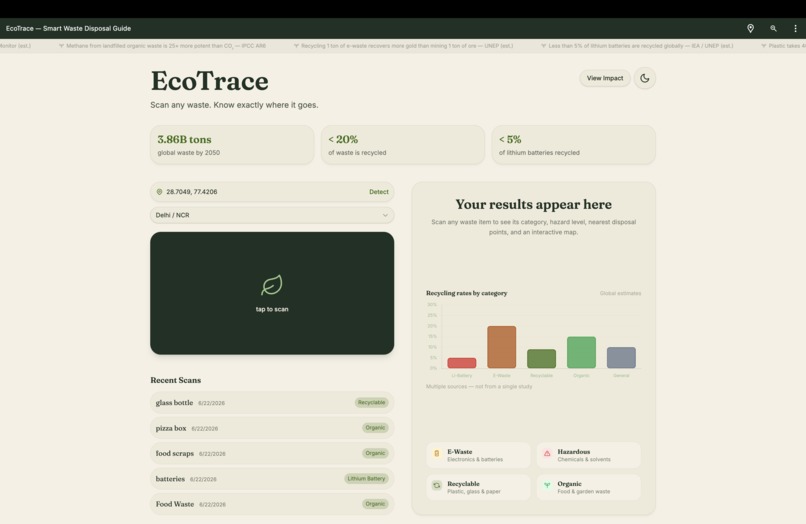
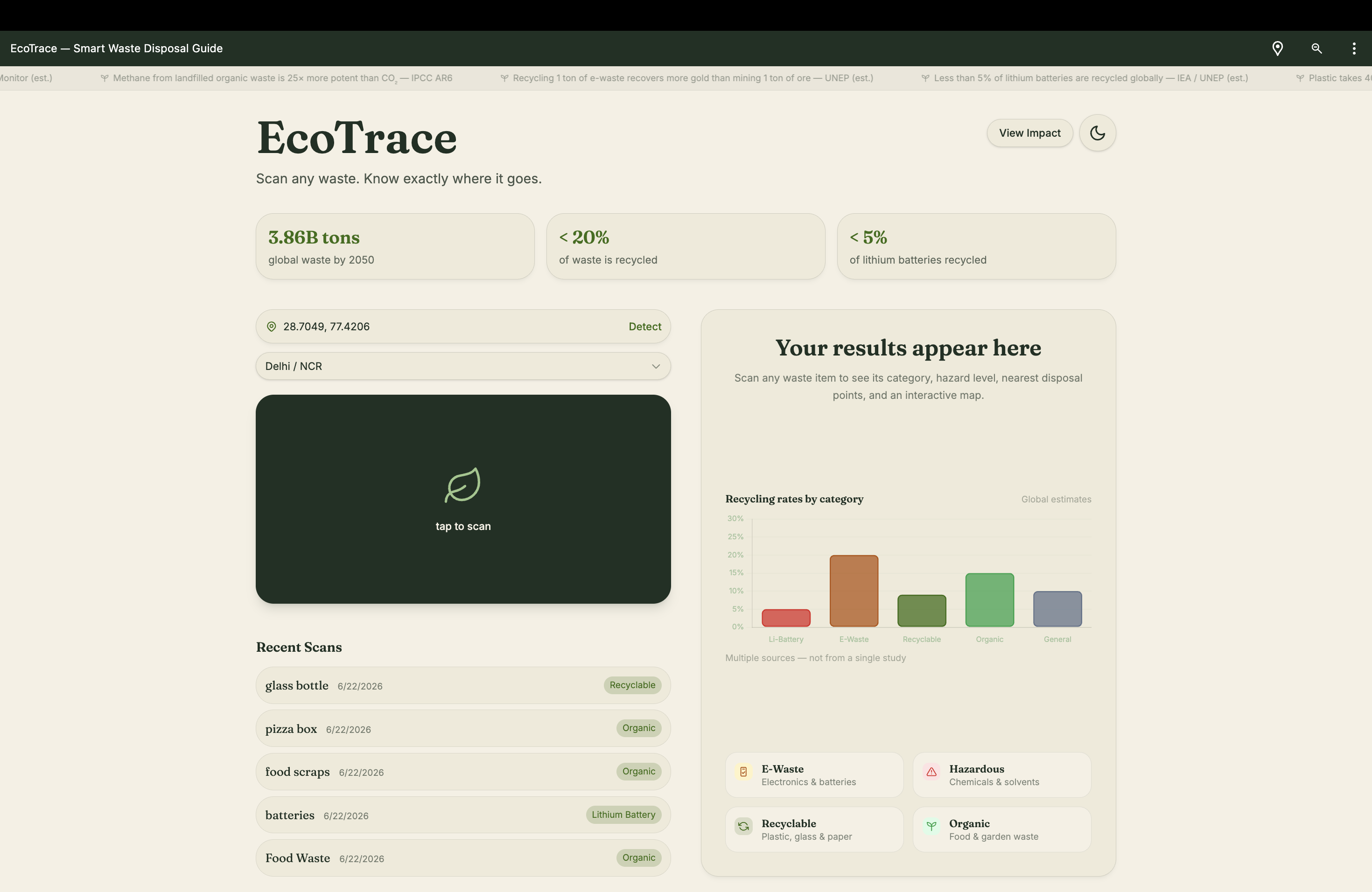
AI waste classifier with live location, scan interface, recent history, and global waste stats in one view.
-
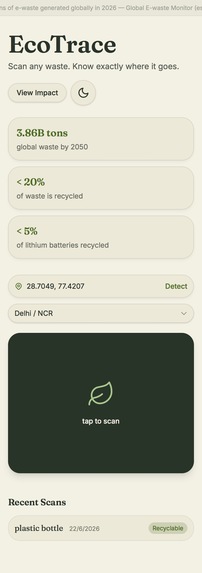
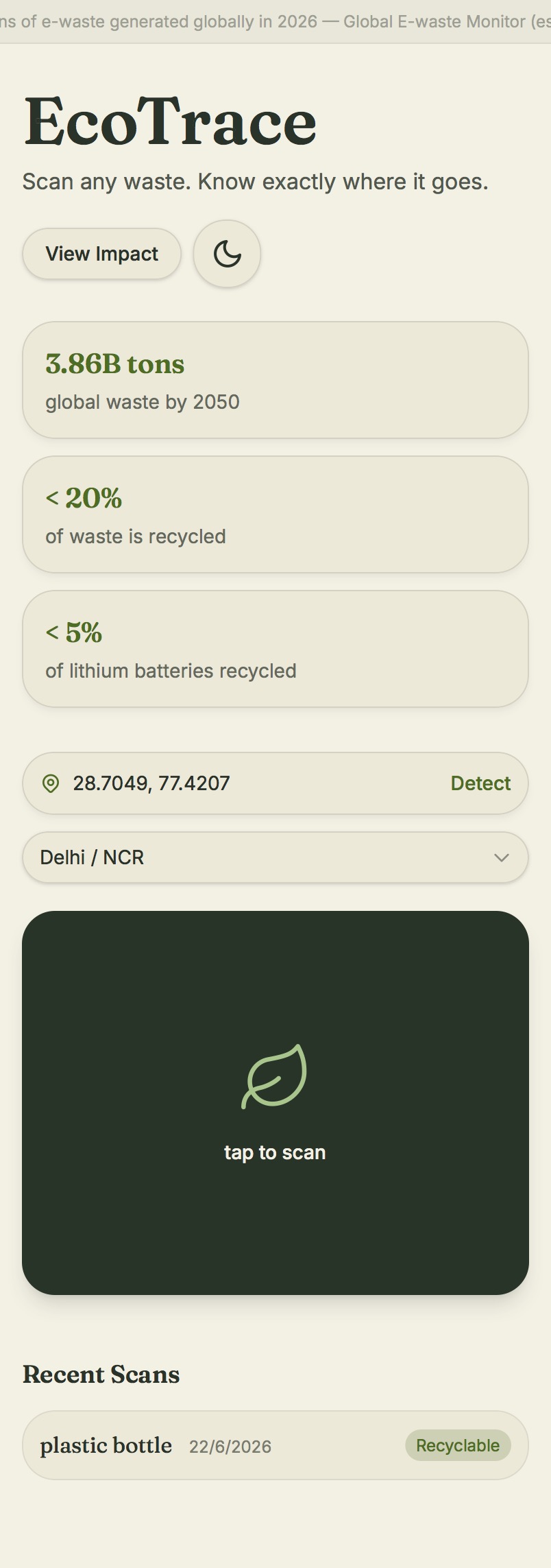
EcoTrace installed as a PWA on mobile — full native app experience, no app store needed. Live location detection and one-tap scanning.
-
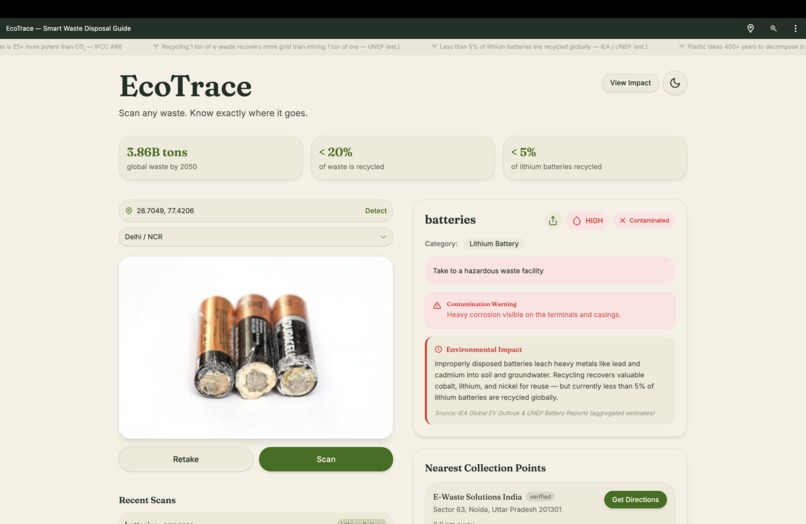
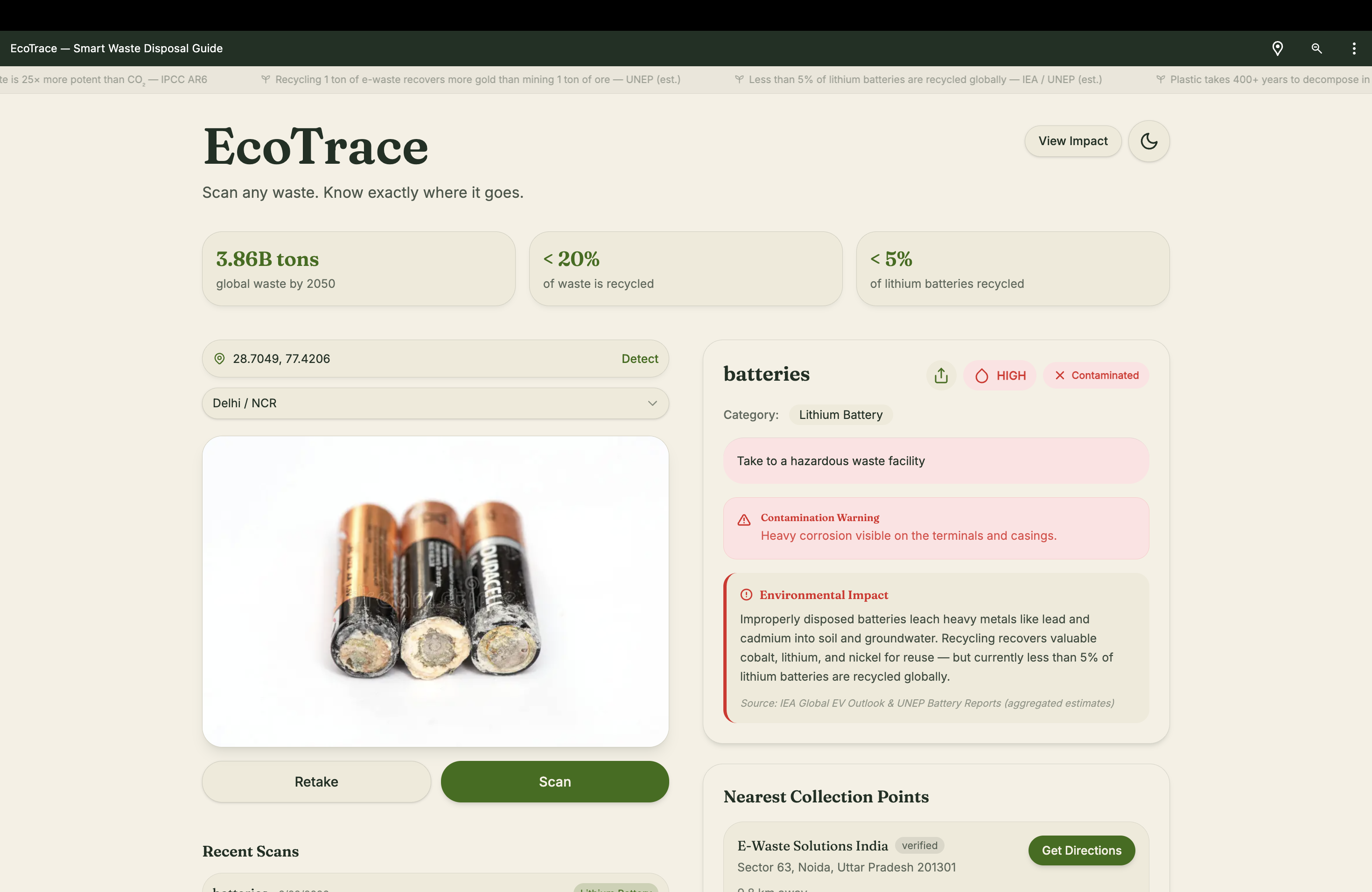
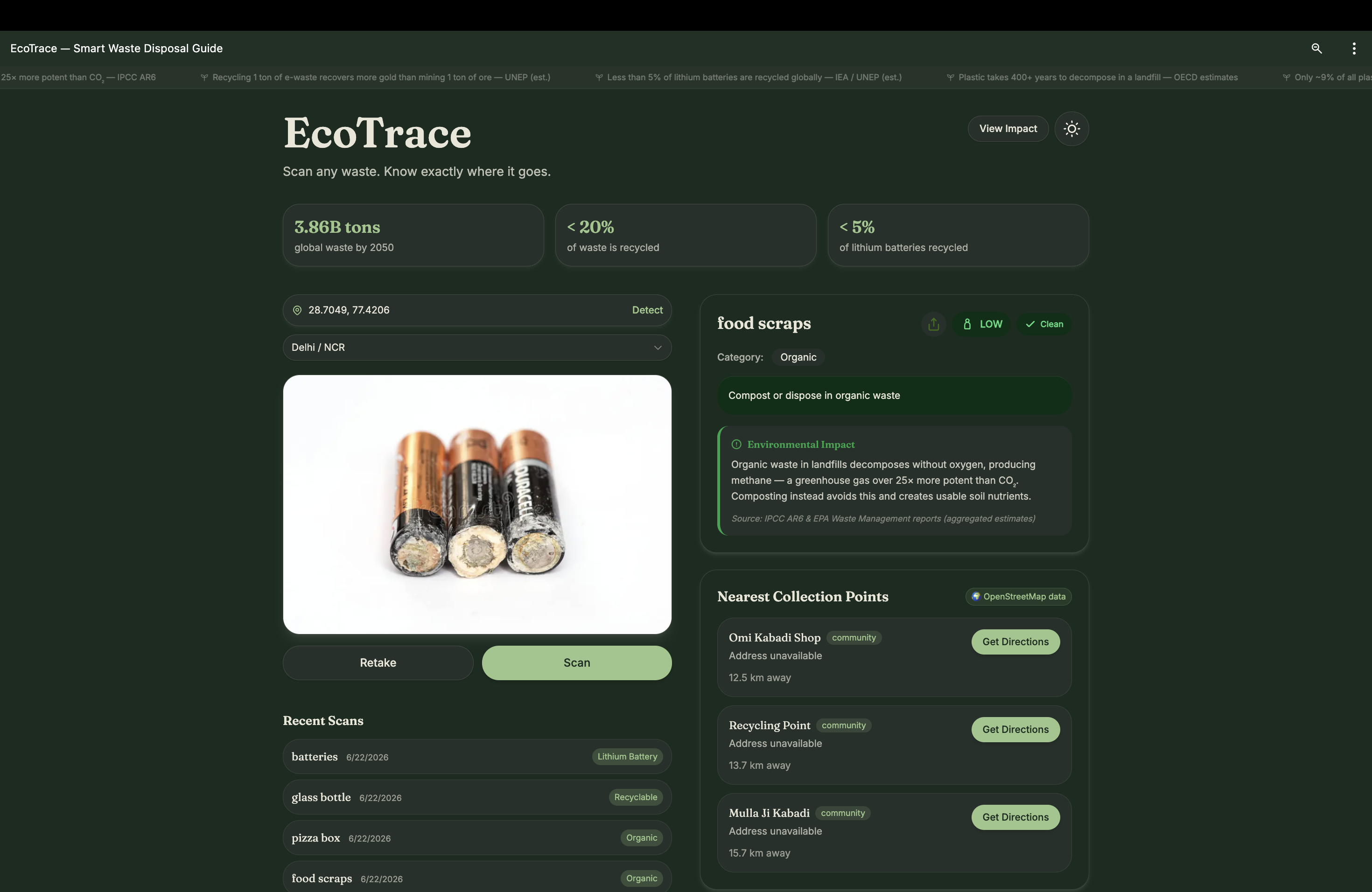
Corroded batteries: High Hazard, Contaminated. Disposal instructions, impact data & nearest verified collection points — instantly.
-
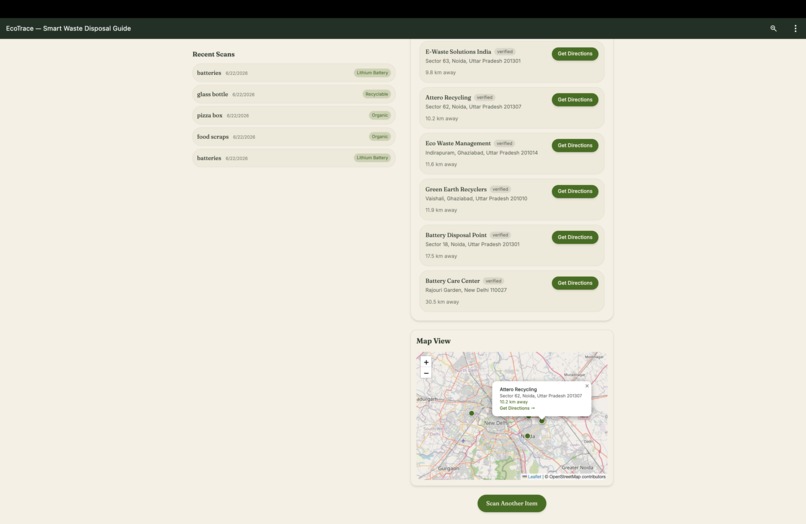
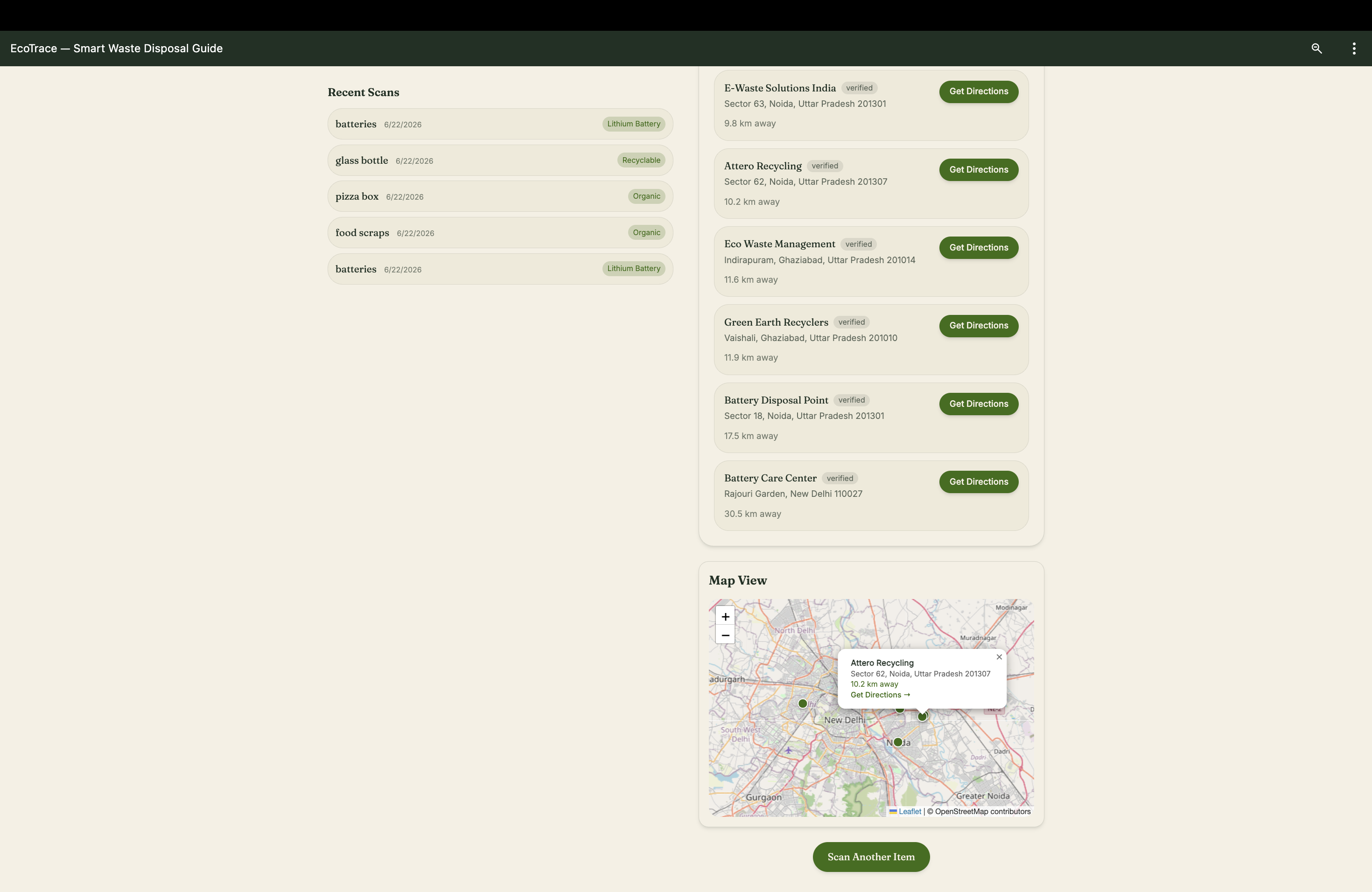
Verified collection points sorted by distance, one-tap directions, and an interactive map showing all nearby drop-off locations.
-
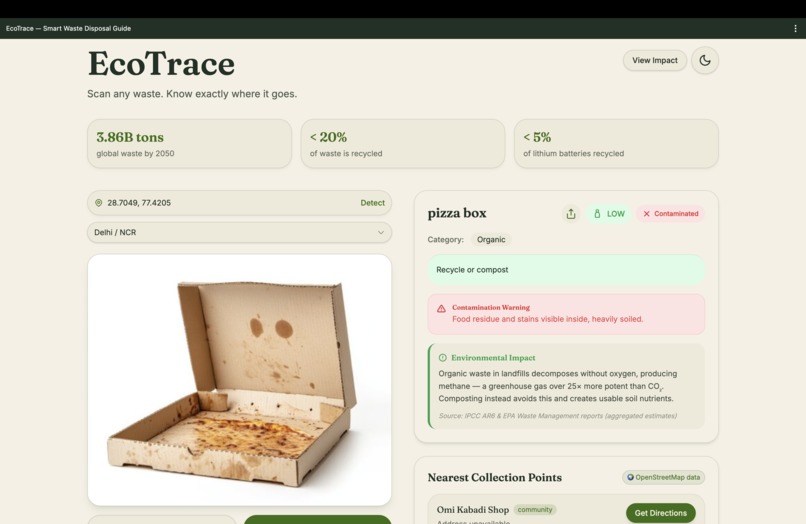
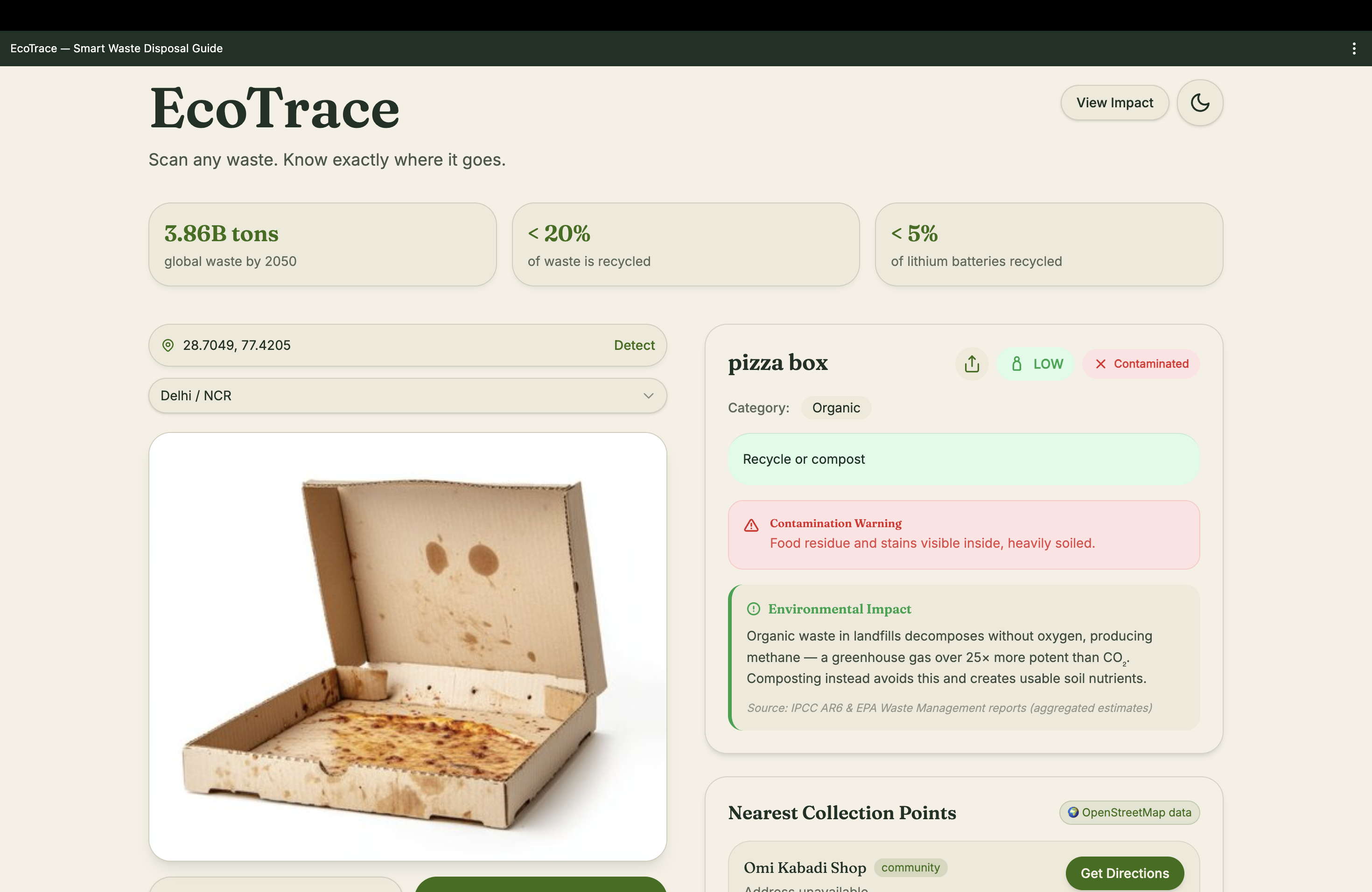
Contamination detected on a greasy pizza box — food residue flagged before it reaches a facility and ruins an entire recycling batch.
-
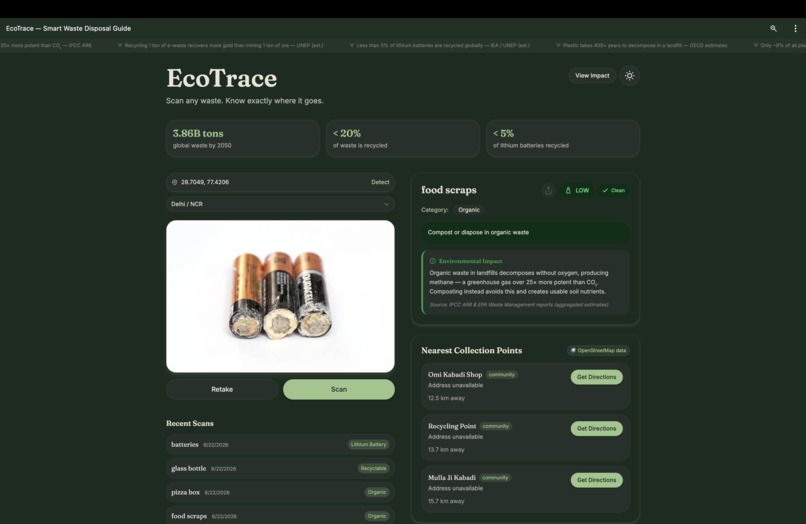
Dark mode: food scraps — Organic, Low Hazard, Clean. Composting guidance shown with OpenStreetMap community collection point fallback.
-
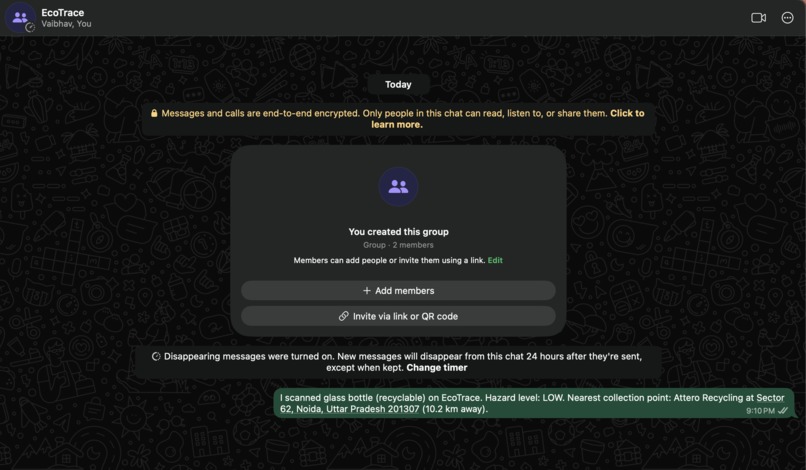
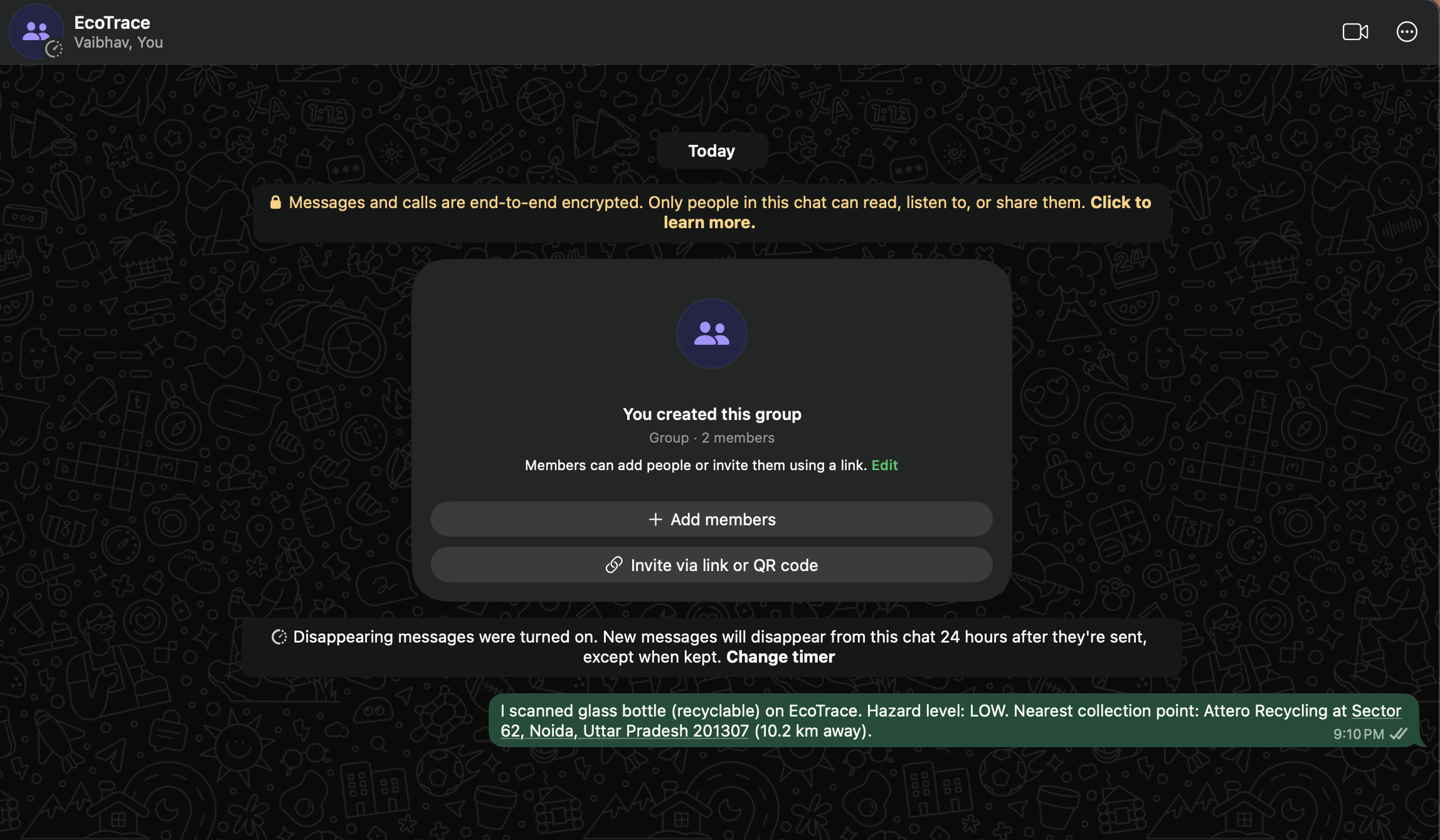
Scan results shared to WhatsApp via Web Share API — pre-filled with item, category, hazard level, and nearest collection point.
-
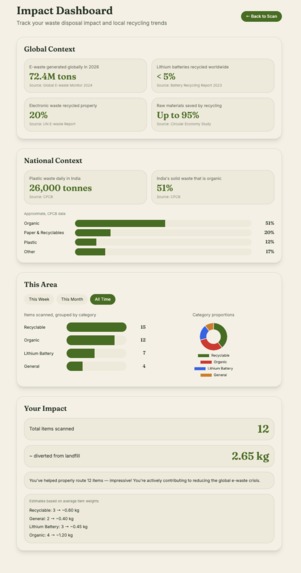
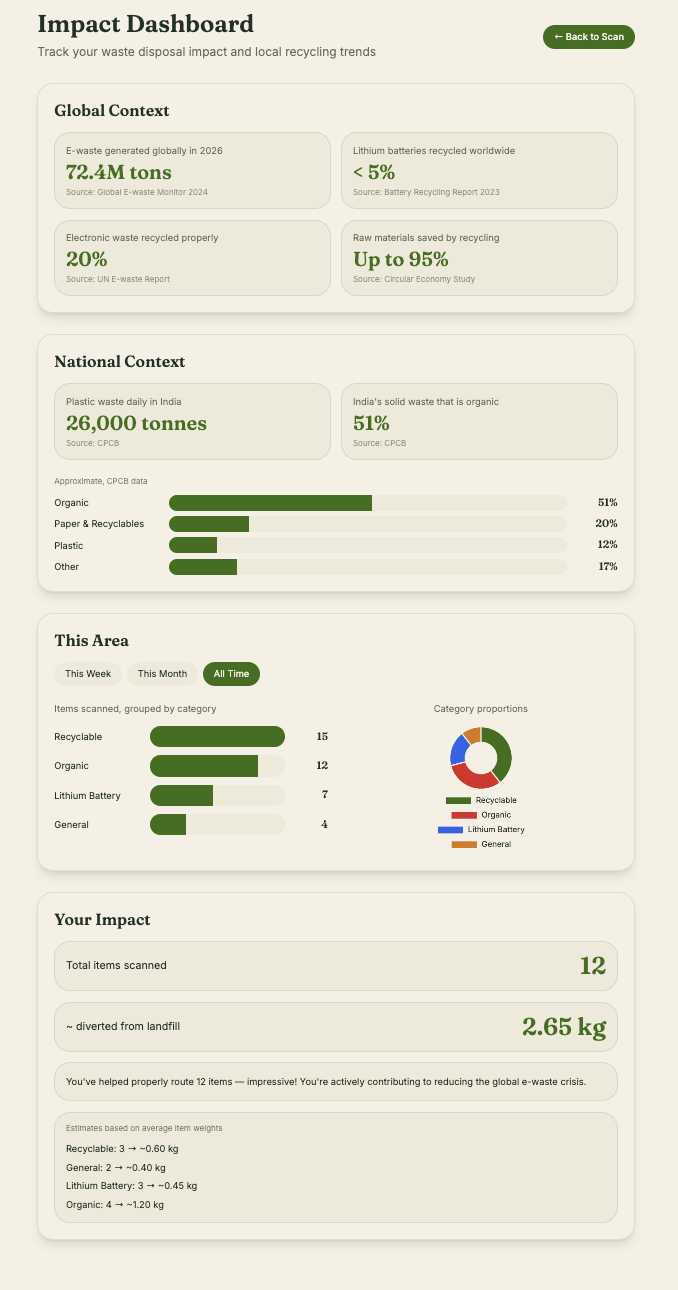
Impact Dashboard Global stats, India CPCB data,area scan breakdown & personal impact 2.65 kg diverted from landfill across 12 items scanned.
Inspiration
Every year, 62 million tonnes of e-waste is generated globally — yet less than 22.3% is formally recycled. In India, the situation is worse: the country generates 160,038 tonnes of solid waste daily, with a formal e-waste recycling rate of just 1% compared to 42.5% in Europe.
The problem isn't that people don't care. The problem is they don't know where to go.
There is no open, accessible registry of certified waste collection points in India. CPCB maintains a list of registered recyclers, but it's buried in compliance portals — not something a regular person can use at the moment they're holding a dead phone battery wondering what to do with it.
We also noticed something most waste apps ignore: contamination. A single greasy pizza box can cause an entire batch of recyclables to be rejected at a facility. People don't know this — and there's no tool that tells them.
EcoTrace was built to solve the last-mile disposal problem — for every category of waste, not just e-waste.
Problem Statement
India generates 160,038 tonnes of solid waste every single day, yet formal e-waste recycling sits at just 1% — compared to 42.5% in Europe. The gap isn't due to apathy; it's a missing link between intent and action. Three specific failures compound the problem:
- No accessible disposal registry. CPCB maintains official recycler data, but it lives inside compliance portals — not in a format a person can use in the thirty seconds they're standing over a trash can deciding what to do with a dead battery.
- Zero classification literacy. Most people can't reliably tell hazardous waste from general waste, let alone know that a single greasy container can contaminate an entire batch of otherwise-recyclable material at a sorting facility.
- No feedback loop. Without visibility into the consequences of correct (or incorrect) disposal, there's no incentive for individuals to change behavior — recycling feels abstract rather than measurable.
The result: usable materials end up in landfills, hazardous waste leaches into soil and groundwater, and India's informal waste sector — which handles roughly 90% of e-waste — operates without the structured support it needs.
Our Solution Approach
EcoTrace tackles this as a last-mile routing problem, not just an awareness campaign. Our approach rests on four pillars:
- Remove the guesswork at the point of disposal. Instead of asking users to learn waste categories, we let a vision model do the classification in real time from a photo — collapsing "what is this and where does it go" into a single snap-and-scan action.
- Close the contamination gap. Contamination detection is built directly into the classification step, since clean segregation determines whether material actually gets recycled or gets rejected wholesale at the facility — a failure point almost no consumer-facing app addresses.
- Make the registry itself the hard part we solve, not the user. Since no open API of verified Indian recyclers exists, we manually seeded a verified database of real organizations (Attero, Saahas Zero Waste, NDMC) and layered OpenStreetMap as a dynamic fallback, so coverage doesn't collapse outside major cities.
- Turn disposal into a measurable habit. Every scan feeds a personal and area-level impact dashboard, converting an abstract "I recycled" into a concrete kilogram-level number — reinforcing the behavior with data instead of guilt.
In short: EcoTrace's solution approach is to compress identification, routing, and feedback into one frictionless action, so that the only thing standing between someone and correct disposal is a single photo.
Impact on Education
Most people misclassify waste not out of carelessness, but because waste literacy is never formally taught. Recycling rules are inconsistent and unintuitive, and static "what goes where" charts rarely stick. EcoTrace closes this gap by turning every disposal decision into a micro-lesson.
Learning through use. When a user photographs an item, EcoTrace doesn't just output a label — it explains why the item belongs to a material category and how it should be handled. Instant, contextual feedback on real objects is how durable learning happens.
Building independence, not dependence. With repeated use, users start recognizing categories on their own. The goal of any good educational tool is to make itself unnecessary — EcoTrace is designed around that principle.
Civic and infrastructure awareness. The Leaflet.js + OpenStreetMap routing layer shows users the recycling infrastructure that already exists in their neighborhoods — knowledge most residents never acquire.
Classroom-ready. Teachers can use EcoTrace in environmental science lessons: students test real objects and receive instant, explained feedback — far more engaging than memorizing bin charts.
Every scan is a lesson. Every lesson compounds into waste literacy.
What It Does
EcoTrace is an AI-powered waste classification and disposal routing platform.
The core flow:
- Snap or upload a photo of any waste item
- Groq Vision (Llama 4 Scout) classifies it — returning category, hazard level, disposal instructions, and contamination status
- The app finds the nearest verified collection or recycling point using your location
- An interactive Leaflet map shows all nearby points with directions
- Your personal environmental impact is logged and visualised on the Impact Dashboard
Six waste categories supported:
| Category | Hazard Level | Real-world impact |
|---|---|---|
| Lithium Battery | High | \(<5\%\) recycled globally — leaches lead and cadmium into groundwater |
| E-Waste | Medium | Only 22.3% formally recycled — 1 tonne of e-waste contains 140g of gold |
| Hazardous | High | Paint, pesticides, CFL bulbs contaminate soil for decades |
| Recyclable | Low | Plastic takes 400+ years to decompose — proper segregation increases recovery value by 60% |
| Organic | Low | Landfilled organics produce methane — \(25\times\) more potent than \(CO_2\) |
| General | Medium | Mixed waste is the hardest to recover — segregation is the single biggest lever |
Contamination detection — a unique feature that flags whether an item is clean, needs rinsing, or is too contaminated for recycling. This directly addresses the real-world problem of batch rejection at recycling facilities.
How We Built It
Frontend: SvelteKit + Svelte 5 (runes mode) with TypeScript and Tailwind CSS. Custom eco color palette (forest green, moss, warm paper) with Fraunces serif display font and Inter for body text. Fully responsive, PWA-ready with camera capture support.
AI Classification: Groq API (Llama 4 Scout vision model) — a single vision API call returns item name, category, hazard level, disposal instruction, contamination status, and contamination note. Robust JSON parsing with markdown cleanup and validation guards handles edge cases.
Database: Supabase (PostgreSQL) with two tables — collection_points (verified real organizations like Attero Recycling, Saahas Zero Waste, NDMC Composting Facility) and scan_history (anonymous UUID-based user tracking for impact calculations).
Location matching: Hybrid approach — Supabase verified data first, OpenStreetMap Overpass API as fallback for unlisted cities. Haversine formula for distance sorting. Nominatim for free geocoding (no API key required).
Maps: Leaflet.js with OpenStreetMap tiles — fully free, no API key. Auto-fits bounds to show all markers. Popups with name, address, distance, and Google Maps directions link.
Impact Dashboard: Chart.js visualizations showing global context (cited sources), India national data (CPCB), area-level scan aggregates filtered by time period, and personal impact with per-category weight calculations:
$$\text{Impact (kg)} = \sum_{c} \text{count}_c \times \text{avg_weight}_c$$
Where average weights are: lithium_battery = 150g, e_waste = 500g, organic = 300g, recyclable = 200g, hazardous = 250g, general = 200g.
Deployment: Vercel with auto-deploy on push to main.
Challenges We Faced
No public collection point data exists. CPCB has no open API for registered recyclers. We manually verified real organizations (Attero, Saahas Zero Waste, NDMC) and built our own seeded database, using OpenStreetMap Overpass as a dynamic fallback for cities outside our verified set.
Groq vision model response consistency. Getting the model to reliably return structured JSON with all six fields — including the new contamination detection fields — required careful prompt engineering and defensive parsing. We handle malformed JSON, missing fields, and markdown-wrapped responses gracefully.
SvelteKit SSR + Leaflet conflict. Leaflet is a browser-only library that breaks during server-side rendering. Wrapping map initialization inside onMount and guarding against server execution was a non-trivial fix.
Supabase new API key format. During setup, Supabase had recently renamed their key structure (anon → publishable, service_role → secret) which caused authentication failures until we mapped the new naming correctly.
What We Learned
- How to architect a hybrid location-matching system combining curated database data with open-source geographic APIs as a fallback
- How to design AI prompts for structured multi-field vision classification with reliable JSON output
- How to handle Svelte 5 runes mode (
$state,$props,onMount) in a production SvelteKit app - The depth of India's waste management policy landscape — CPCB's E-Waste Rules 2022, EPR frameworks, and the critical role of the informal sector (which handles ~90% of India's e-waste)
- How contamination is a bigger barrier to recycling than awareness — one dirty item can invalidate an entire batch
What's Next
- CPCB Registry Integration — pull live verified recyclers from India's official registered recycler list under E-Waste Management Rules 2022
- Full Hindi language support — UI strings translated for non-English-speaking users and informal waste workers
- Kabadiwala tools — pricing and grading assistant for India's 1.5–4 million informal waste workers
- Offline mode — service worker caching of collection points for poor connectivity areas
- Community collection points — verified user-submitted locations to expand coverage
All statistics sourced from: Global E-waste Monitor 2024 · CPCB Annual Report 2022-23 · UNITAR · Statista 2026 · IPCC AR6 · World Bank 2022 · Fortune Business Insights 2026
Built With
- chart.js
- groq
- leaflet.js
- llama-4-scout
- nominatim
- openstreetmap
- overpass-api
- postgresql
- supabase
- svelte-5
- sveltekit
- tailwind-css
- typescript


Log in or sign up for Devpost to join the conversation.