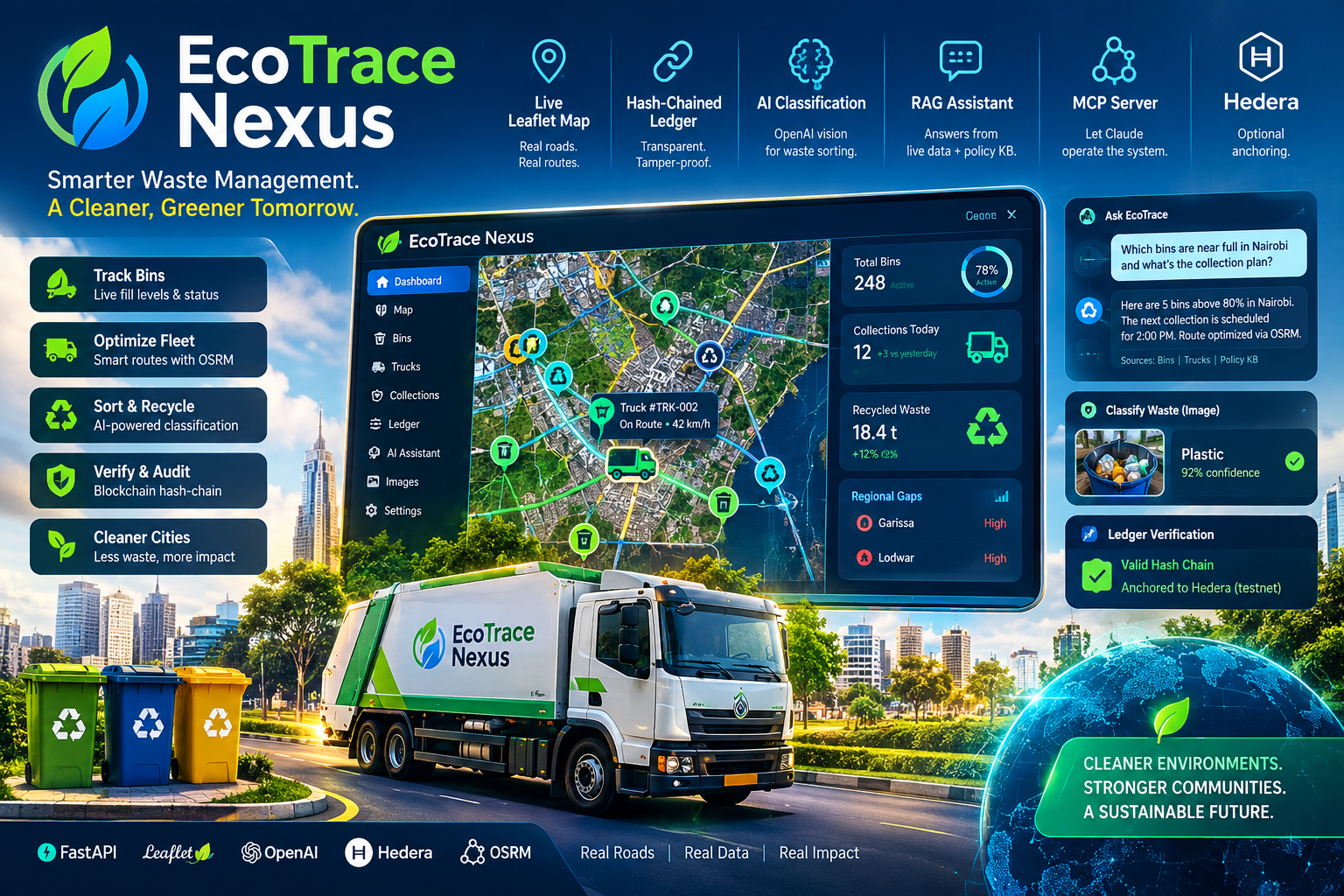
EcoTrace Nexus: AI-Powered Waste Traceability
Tagline: “Track Every Waste Journey. Verify Every Action. Build a Cleaner Planet.”
Inspiration
Waste management faces a critical challenge: once waste leaves a household, business, or collection point, tracking where it goes, how it is processed, and whether it is properly recycled becomes difficult. Limited visibility, fragmented records, inefficient collection routes, and unreliable reporting can undermine recycling efforts and environmental accountability.
We envisioned EcoTrace Nexus as an intelligent, transparent waste management ecosystem that connects waste generators, collection fleets, recycling facilities, and environmental authorities through AI, geospatial intelligence, and tamper-evident records.
Inspired by the need to transform waste management from a fragmented process into a measurable, verifiable system, we built a platform that follows waste from collection to its next recorded destination.
Our goal is ambitious: make waste traceability more accessible, help communities identify inefficiencies, and provide organizations with reliable evidence of their waste management activities.
Rather than relying exclusively on manual reporting, EcoTrace Nexus combines real-time telemetry ingestion, AI-powered waste classification, route visualization, and cryptographic verification to make waste management more intelligent and accountable.
The project is built around one fundamental principle: environmental progress should be measurable, traceable, and verifiable.
What it does
EcoTrace Nexus is an AI-powered waste collection, sorting, recycling, and auditing platform that combines geospatial tracking, intelligent classification, and tamper-evident event records in a unified dashboard. Its existing architecture includes a FastAPI backend, a Leaflet mapping interface, a hash-chained ledger, an AI assistant, computer vision, and Model Context Protocol (MCP) integration. README
1. Intelligent Waste Monitoring
The platform provides a centralized view of waste collection bins, fleet activity, collection events, and regional waste management information.
- Receives bin telemetry through an API.
- Tracks reported waste categories and bin fill levels.
- Supports simulated bin activity for demonstrations.
- Allows incoming real sensor data to replace simulated readings for individual bins.
- Provides a foundation for identifying bins that need collection.
By combining bin status with fleet information, the platform can help operators prioritize collections and reduce unnecessary trips.
2. AI-Powered Waste Classification
EcoTrace Nexus uses computer vision to classify waste from uploaded images.
The vision component connects to OpenAI's vision capabilities to analyze images and identify waste categories.
Potential applications include:
- Identifying recyclable materials.
- Supporting waste sorting workflows.
- Helping collection teams categorize reported waste.
- Assisting operators in reviewing incorrectly sorted waste.
The classification output can support operational decisions, although its accuracy depends on the input image, the model, and the materials being assessed.
3. Geospatial Fleet Tracking and Route Visualization
Using Leaflet, OpenStreetMap data, and OSRM routing, the platform visualizes waste collection activity on a geographical map.
Its mapping capabilities include:
- Displaying waste collection infrastructure.
- Visualizing truck routes along available road geometry.
- Monitoring simulated fleet movement.
- Supporting collection dispatch workflows.
- Providing a geographical context for waste management operations.
When external routing services are unavailable, the system can fall back to straight-line routes and indicate this limitation.
The result is a spatial view of collection operations that helps users understand where waste is located and how collection resources are moving.
4. Tamper-Evident Waste Traceability Ledger
Environmental reporting is only useful when records can be trusted.
EcoTrace Nexus maintains a SHA-256 hash-chained ledger persisted in SQLite. This creates cryptographic links between recorded events, making unauthorized modifications detectable through verification.
The platform supports:
- Recording waste management events.
- Verifying ledger integrity.
- Maintaining a traceable sequence of recorded activities.
- Auditing recorded collection operations.
- Optionally anchoring event hashes to a Hedera consensus topic.
The optional Hedera integration adds an external verification layer for anchored hashes.
Important distinction: Hash chaining helps detect changes to recorded data, but it does not independently prove that a physical collection occurred or that the original information was accurate. Stronger verification requires trustworthy source data and appropriate operational controls.
5. AI-Powered Environmental Intelligence Assistant
The platform includes a retrieval-augmented generation (RAG) assistant that retrieves relevant information from live system data and a policy knowledge base before generating answers.
Using TF-IDF retrieval and an OpenAI or Anthropic language model, where configured, the assistant can help users investigate operational questions.
Examples include:
- Which bins require attention?
- What collection events have been recorded?
- Which trucks are available in the current system state?
- What does the ledger indicate about a particular collection?
- Which policy information is relevant to a waste management question?
The assistant uses retrieved context and cites sources in its responses. Without a configured language model API key, the system can return matching information instead.
This approach connects conversational AI to operational evidence rather than treating the assistant as an isolated chatbot.
6. AI Agent Integration Through MCP
EcoTrace Nexus includes a Model Context Protocol server that exposes tools for interacting with a running platform.
Available tools include:
system_summarytrace_binask_systemdispatch_truckverify_ledgerclassify_waste_image
These capabilities allow a compatible AI client, such as Claude Desktop, to query the system, investigate waste records, classify images, verify the ledger, and initiate supported dispatch actions.
This transforms EcoTrace Nexus from a passive monitoring dashboard into a platform that can participate in AI-assisted operational workflows.
Actions that change operational state should be protected by suitable authorization, validation, and audit controls before deployment.
7. Waste Reporting and Operational Auditing
The platform provides API endpoints for telemetry, collection events, ledger inspection, and system health.
This creates a foundation for organizations to review recorded waste management activities and investigate discrepancies between operational reports and recorded events.
Regional unrecorded-tonnage values in the current implementation are seeded demonstration data, not verified measurements. Future versions could replace these values with validated weighbridge records, collection manifests, and recycling facility reports.
8. An Extensible Environmental Intelligence Platform
EcoTrace Nexus is designed to support future integration with:
- IoT-enabled waste bins.
- GPS-equipped collection vehicles.
- Recycling facility management systems.
- Digital weighing equipment.
- Municipal waste management platforms.
- Environmental compliance reporting systems.
- Verified recycling and recovery records.
These are potential extensions rather than claims that all integrations are currently implemented.
The long-term vision is to establish a connected waste traceability ecosystem in which each recorded event contributes to a more transparent understanding of waste movement and processing.
How we built it
We built EcoTrace Nexus using a modular architecture that connects geospatial visualization, backend services, AI capabilities, operational simulation, and cryptographic auditing.
Our focus was to create a working technical foundation rather than a dashboard consisting solely of static demonstrations.
1. Frontend and Geospatial Interface
Technologies: HTML, JavaScript, Leaflet, OpenStreetMap, CARTO.
The frontend provides the interactive dashboard and map-based visualization.
Leaflet powers the map interface, while OpenStreetMap supplies geographic data and CARTO provides map tiles. The interface communicates with the backend to retrieve system information and present fleet and waste management activity.
2. Backend and API Architecture
Technologies: Python, FastAPI, REST APIs, Uvicorn.
The backend coordinates system operations, serves the frontend, exposes API endpoints, and manages the background fleet simulation engine.
FastAPI provides endpoints for:
- Retrieving current system state.
- Inspecting truck routes.
- Dispatching collection trucks.
- Receiving telemetry.
- Recording collections.
- Querying the ledger.
- Verifying ledger integrity.
- Asking the AI assistant questions.
- Classifying waste images.
- Checking system health.
This modular structure creates a foundation for integrating additional services without rebuilding the entire application.
3. Fleet Simulation and Routing
Technologies: Python, OSRM, OpenStreetMap.
We implemented a fleet simulation that models waste bins and collection trucks.
OSRM supplies road-based routing when available, allowing simulated vehicles to follow real road geometry rather than moving exclusively along straight lines.
The simulation makes it possible to demonstrate fleet behavior and collection workflows without requiring a physical fleet or connected sensors.
We also designed a fallback for routing-service failures so the demonstration can continue when road-routing data is unavailable.
4. Cryptographic Ledger and Audit Verification
Technologies: Python, SQLite, SHA-256, Hedera.
We implemented a persistent ledger using SQLite and SHA-256 hash chaining.
Each event's cryptographic relationship with preceding records helps reveal modifications to the recorded sequence.
We also incorporated optional Hedera integration to anchor event hashes to a consensus topic.
This hybrid approach combines local persistence with the possibility of external cryptographic verification.
Hedera anchoring requires the appropriate operator credentials and topic configuration; it is an optional capability rather than a prerequisite for running the application.
5. AI and Retrieval-Augmented Generation
Technologies: Python, OpenAI API, Anthropic API, TF-IDF, RAG.
We built a retrieval layer that searches live system information and policy content for relevant context.
The language model can then use that context to generate operational answers.
This architecture helps connect AI responses to retrievable system information and provides source citations.
For the initial implementation, TF-IDF provides the retrieval mechanism. A future production-scale version could adopt embedding-based retrieval and a vector database such as PostgreSQL with pgvector.
6. Computer Vision for Waste Classification
Technologies: Python, OpenAI Vision API.
We integrated an image-classification component that sends uploaded images to a vision-capable model for analysis.
This approach avoids requiring locally downloaded model weights, simplifying initial setup.
The classifier provides a foundation for AI-assisted waste sorting and categorization. Before high-impact operational use, its outputs should be evaluated against labeled images representing different materials, lighting conditions, contamination levels, and collection environments.
7. AI Agent Interoperability
Technologies: Python, Model Context Protocol (MCP), Claude Desktop.
We developed an MCP server that exposes selected platform capabilities as tools for compatible AI clients.
This makes it possible to connect conversational interfaces to operational functions, including system summaries, bin tracing, ledger verification, image classification, and truck dispatch.
Rather than simply generating recommendations, a compatible agent can invoke supported tools to interact with the running application.
8. Security and Configuration
We incorporated optional API-key protection for telemetry and collection writes.
Environment variables are used to configure API credentials and optional Hedera integration. This keeps secrets outside the application source code.
Before public deployment, the platform still requires production-grade authentication, authorization, HTTPS, appropriate CORS restrictions, and additional operational safeguards.
9. A Practical Development Philosophy
We distinguished working capabilities from simulated data.
Real map data, road routing, ledger operations, cryptographic verification, retrieval, and image classification form part of the implementation. Bin fill levels and truck dispatches are simulated by default, while selected regional tonnage gaps are seeded demonstration values. Real sensor telemetry can be submitted through the API. README
This distinction is essential to building a credible environmental technology project.
Our objective was not simply to demonstrate what AI could look like in waste management, but to create a foundation that can progressively incorporate real operational data and verifiable records.
Challenges we ran into
1. Connecting Simulated Operations With Real-World Data
One of our key challenges was building a system that could demonstrate waste collection workflows without requiring physical sensors and vehicles.
Simulation makes development and testing accessible, but it cannot substitute for actual field measurements.
We addressed this by supporting incoming telemetry through an API and allowing individual bins receiving real readings to stop using simulated updates.
This provides a transition path from demonstration scenarios to sensor-connected deployments.
2. Maintaining Trust in Environmental Records
Waste traceability requires more than storing collection information in a database.
Records must be organized so that changes can be detected and historical events can be inspected.
We implemented a SHA-256 hash-chained ledger and verification functionality, with optional Hedera anchoring for additional external evidence.
However, we also recognized that cryptographic integrity alone cannot validate the physical accuracy of a collection event. Reliable traceability must combine record integrity with trustworthy measurements, authenticated reporting, and operational verification.
3. Routing Around External Service Failures
Road-based routing depends on external services and network availability.
When OSRM cannot be reached, the system must handle the failure without making the entire demonstration unusable.
We implemented a straight-line fallback and an indication in the trace panel when the fallback is used.
This taught us the importance of graceful degradation in applications that depend on external infrastructure.
4. Grounding AI Responses in Relevant Evidence
An environmental intelligence assistant must provide useful information without inventing operational facts.
We addressed this challenge through retrieval-augmented generation, using relevant live system data and policy content to inform answers.
The existing TF-IDF retrieval mechanism is suitable for a lightweight implementation, but larger deployments will require stronger document management, improved retrieval evaluation, and more comprehensive source coverage.
5. Handling Uncertain Image Classification
Waste materials can be difficult to classify when images are blurry, poorly lit, contaminated, or contain multiple objects.
We integrated a vision-based classifier but recognized that model output should not automatically be treated as definitive evidence of material composition or recyclability.
Future improvements will focus on confidence-aware classification, human review for ambiguous cases, and testing against representative waste images.
6. Integrating AI With Operational Actions
Connecting AI tools to dispatch and other operational functions introduces additional security considerations.
An AI agent that can read information is different from one that can initiate an action affecting a collection workflow.
MCP provides the interoperability layer, but production deployments need robust permission checks, input validation, action logging, and safeguards against unauthorized or unintended operations.
7. Balancing a Rich Demonstration With Production Readiness
We wanted to combine mapping, fleet simulation, AI, telemetry, ledger verification, and agent integration without creating an unnecessarily complicated architecture.
The modular backend helped separate these concerns.
We also identified important areas for further engineering, including persistent fleet state, user accounts, stronger access controls, and more scalable retrieval.
Recognizing these limitations helped us define a practical path from a working prototype toward a production-ready environmental platform.
Accomplishments that we're proud of
1. Building a Unified Waste Intelligence Platform
We brought multiple technologies together in a single application rather than building isolated demonstrations of AI, mapping, and blockchain-related functionality.
EcoTrace Nexus connects waste monitoring, fleet visualization, image classification, operational queries, and ledger verification through a shared system architecture.
2. Implementing Cryptographic Verification
We developed a persistent, hash-chained event ledger with verification functionality.
This provides a foundation for identifying alterations to recorded event history and supports more transparent waste management audits.
The optional Hedera integration extends this design with the ability to anchor event hashes externally.
3. Combining AI With Live Operational Context
We integrated a retrieval-based assistant that can draw on current system information and policy content.
This makes the platform more useful than a conventional chatbot by connecting natural-language questions to operational data.
4. Enabling AI-Assisted Waste Classification
We integrated computer vision into the waste management workflow, providing a foundation for identifying waste categories from uploaded images.
This creates opportunities to assist sorting teams, improve reporting workflows, and support more consistent categorization.
5. Connecting AI Agents to Real Application Tools
Our MCP server exposes defined platform functions to compatible AI clients.
This demonstrates how AI assistants can interact with application capabilities rather than remaining limited to conversation.
6. Visualizing Collection Routes on Real Road Networks
We integrated Leaflet mapping and OSRM routing to visualize collection activity using real geographic road data.
This gives the demonstration a meaningful spatial dimension and supports future development of more intelligent collection planning.
7. Creating a Path Toward Real-World Integration
The telemetry API provides an integration point for real sensor data.
By separating incoming measurements from simulated updates, the architecture offers a foundation for gradual deployment in real collection environments.
8. Prioritizing Technical Transparency
We explicitly distinguish real implementation features from simulated operations and seeded demonstration data.
This makes it easier for reviewers, developers, and potential partners to evaluate what the system currently does and what remains to be built.
Our greatest accomplishment is establishing a working technical foundation that connects waste traceability, AI-assisted operations, and cryptographic auditability in one extensible platform.
What we learned
1. Environmental Accountability Requires Reliable Data
AI and cryptographic systems are only as useful as the information they receive.
A trustworthy waste management platform needs reliable measurements, consistent event recording, authenticated data sources, and mechanisms for investigating discrepancies.
2. Blockchain-Related Technology Is Most Useful When It Solves a Specific Problem
Adding a distributed ledger does not automatically make a system trustworthy.
We learned to focus on a concrete requirement: making changes to recorded waste management events detectable and enabling independent verification of externally anchored hashes.
This keeps the technology aligned with the actual traceability problem.
3. AI Needs Evidence, Not Just Language Generation
An AI assistant becomes more useful when it can retrieve relevant operational information before answering.
Grounding answers in system data and policy documents provides a stronger basis for operational decision support than relying on a language model's general knowledge alone.
4. Simulation Is Valuable When Its Boundaries Are Clear
Simulation makes it possible to develop, test, and demonstrate a complex platform without expensive physical infrastructure.
However, simulated fleet activity and seeded regional data must not be presented as verified environmental outcomes.
Clear separation between demonstration data and measured data is essential for credible environmental reporting.
5. Interoperability Expands What AI Can Accomplish
MCP showed us how an AI assistant can move beyond answering questions and invoke defined tools within an application.
With appropriate authorization and safeguards, this approach can support operational workflows such as investigating a bin, verifying a ledger, or initiating a truck dispatch.
6. Reliability Matters as Much as Innovation
External APIs, routing services, language models, and sensor connections can all fail.
We learned that resilient environmental software must communicate limitations clearly, handle service failures gracefully, and preserve the integrity of recorded information.
7. The Next Frontier Is Verified Environmental Impact
Tracking waste collection is only one part of the problem.
A more complete solution must connect collection records with independently verifiable weighing, sorting, recycling, and final processing records.
This is the direction in which we want to take EcoTrace Nexus: from tracking waste movement toward measuring verified waste recovery and environmental outcomes.
What's next for EcoTrace Nexus?
Our roadmap focuses on evolving EcoTrace Nexus from an extensible prototype into a secure, scalable, and evidence-driven waste traceability platform.
1. Deploy Real IoT Sensors and Connected Fleets
We plan to integrate physical fill-level sensors, GPS-equipped collection vehicles, and digital weighing equipment.
This would replace simulated operational readings with real measurements and provide a stronger foundation for monitoring waste collection activity.
2. Develop an End-to-End Digital Waste Passport
We want to introduce a digital waste passport that links recorded events throughout a waste item's documented journey.
A future passport could connect:
- Waste generation and source identification.
- Collection and transport.
- Facility reception and weighing.
- Sorting and material classification.
- Recycling or recovery processing.
- Final disposal where applicable.
- Supporting evidence and audit records.
Each event would reference its source, timestamp, responsible party, and relevant supporting evidence.
The objective is to make it easier to follow documented waste movements and identify missing or inconsistent records.
3. Introduce AI-Powered Collection Optimization
We plan to explore predictive models that estimate when bins will need collection and recommend efficient routes based on fill levels, vehicle capacity, traffic conditions, and operational constraints.
Future optimization could account for:
- Predicted bin overflow.
- Vehicle availability.
- Collection priorities.
- Road network conditions.
- Distance and fuel consumption.
- Waste category and destination requirements.
These capabilities would need evaluation against baseline collection strategies to demonstrate measurable improvements.
4. Strengthen AI Classification and Human Review
We intend to improve waste classification through better evaluation datasets, confidence estimates, and human review for ambiguous cases.
Future versions could support multiple material categories, contamination detection, and facility-specific sorting rules.
We will also explore integrating classification results with recorded collection events so that material identification can be reviewed alongside its supporting evidence.
5. Expand Independent Verification
We plan to strengthen the relationship between ledger events and real-world evidence.
Potential improvements include:
- Authenticated weighing records.
- Digitally signed collection manifests.
- Facility acceptance confirmations.
- Verified recycling certificates.
- Independent audit workflows.
- Optional Hedera anchoring of selected event hashes.
This would help distinguish between a recorded claim, an authenticated measurement, and an independently verified environmental outcome.
6. Introduce Enterprise-Grade Security
Before production deployment, we plan to implement:
- User accounts and secure authentication.
- Role-based access control.
- Stronger API authorization.
- Secure deployment over HTTPS.
- Restricted cross-origin access.
- Persistent operational state.
- Comprehensive audit logging.
- Monitoring, backups, and recovery procedures.
These improvements are important for organizations handling sensitive operational records and managing distributed collection teams.
7. Scale the Intelligence Layer
As data volumes grow, we plan to evaluate embedding-based retrieval, PostgreSQL, pgvector, and more comprehensive data management.
We also want to improve the assistant's ability to explain operational anomalies, identify missing records, and support evidence-based investigations.
Any automated recommendations affecting operational decisions will need suitable validation and human oversight.
8. Build Environmental Performance Analytics
We envision a reporting layer that measures waste collection and recovery performance using validated data.
Potential indicators include:
- Waste collected by category.
- Material recovery and recycling rates.
- Collection completion rates.
- Missed or delayed collections.
- Documented landfill diversion.
- Fleet distance and fuel consumption.
- Estimated emissions associated with transport.
Environmental benefits would be calculated only when appropriate input data and transparent calculation methods are available. The platform would distinguish measured values from estimates.
9. Expand to Municipalities and Recycling Networks
Our long-term vision is to support municipalities, waste collection providers, recycling facilities, businesses, and environmental organizations through a shared traceability infrastructure.
We want EcoTrace Nexus to help these stakeholders exchange trustworthy records, identify operational gaps, and improve accountability across the waste management lifecycle.
Our ultimate vision
EcoTrace Nexus aims to make every documented waste journey more transparent, every operational decision more intelligent, and every environmental claim more verifiable.
By bringing together AI, geospatial intelligence, interoperable agents, real-world telemetry, and tamper-evident records, we are building toward a future in which waste management is not only more efficient but also more accountable.
We believe the future of sustainability depends on moving beyond reporting how much waste we collect toward establishing credible evidence of what happens to it next.
EcoTrace Nexus: From Waste Tracking to Verified Environmental Impact.
Built With
- anthropic-api
- artificial-intelligence-(ai)
- claude-desktop
- computer-vision
- fastapi
- gis
- hedera
- html
- iot
- javascript
- leaflet.js
- mcp
- node.js
- openai-api
- openstreetmap
- osrm
- python
- rag
- rest-api
- sha-256
- sqlite
- tf-idf
- uvicorn


Log in or sign up for Devpost to join the conversation.