Inspiration
We wanted to turn environmental action from something people simply hear about into something they can actively participate in. Most people carry a powerful environmental sensor in their pocket—their smartphone—but everyday observations about trees, plants, wildlife, water, and waste rarely become useful structured data.
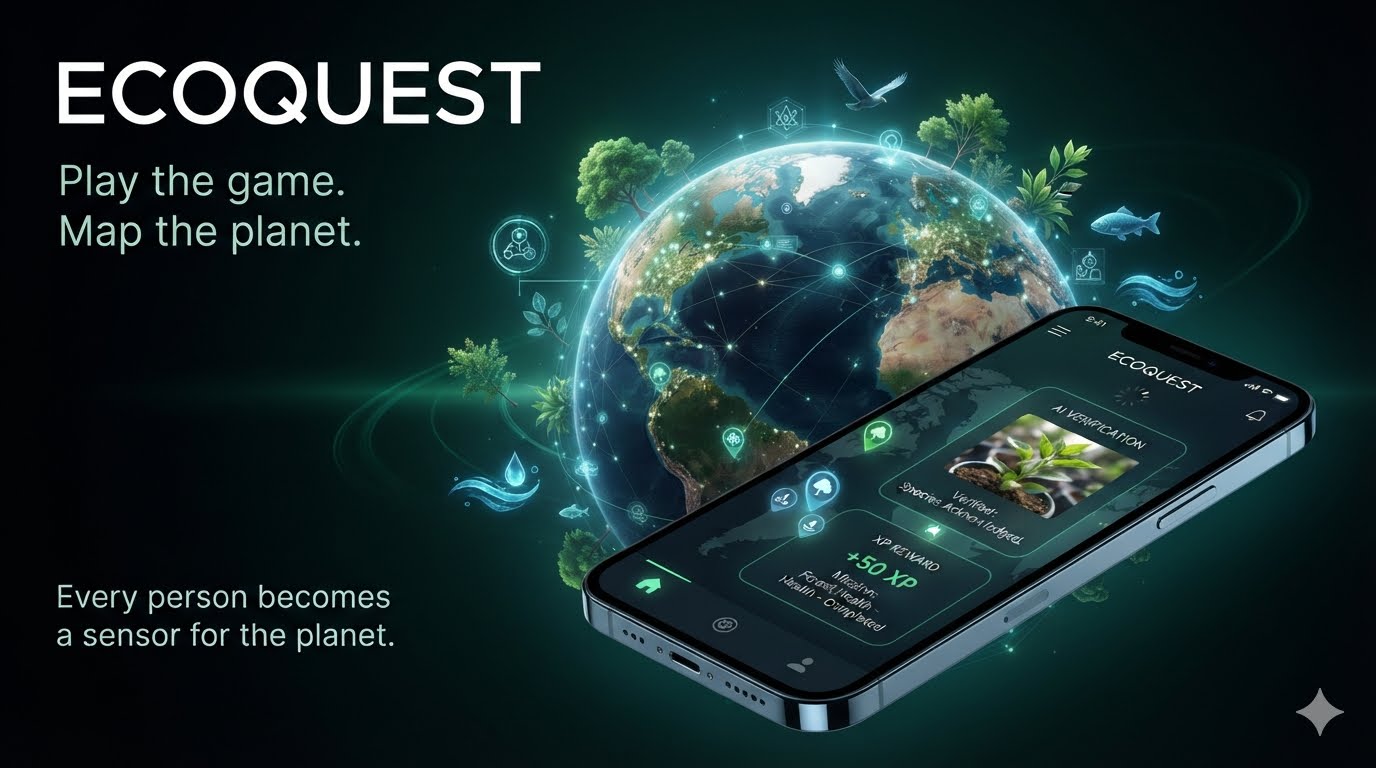
EcoQuest was inspired by the idea that every person could become a sensor for the planet.
What We Built
EcoQuest is a gamified citizen-science platform where users explore their surroundings, capture environmental observations, and submit photos with location data. AI analyzes and verifies the observation, while the map turns individual contributions into a growing global environmental dataset.
Users can earn XP, complete missions, unlock achievements, and compete on leaderboards based on meaningful environmental contributions rather than simply uploading the most photos.
The core loop is:
Explore → Capture → AI Verify → Map → Earn → Discover
How We Built It
We built EcoQuest as a modern web application using React and TypeScript, with Supabase providing authentication, database storage, user profiles, observations, missions, achievements, and leaderboard data.
The platform combines:
- AI-powered image analysis
- GPS/geospatial observations
- Interactive environmental maps
- Gamification and XP
- Missions and achievements
- Community discovery
- Environmental analytics
- Data verification and moderation
We also designed the system to distinguish between user observations, AI interpretations, verified data, and demo data, so that the platform does not present generated information as scientific fact.
What We Learned
One of our biggest lessons was that AI is most useful when it is part of a larger system rather than being the entire product.
Instead of building another chatbot, we used AI as a verification and interpretation layer inside a real-world feedback loop.
We also learned that gamification needs to reward quality rather than quantity. If users received unlimited points for uploading anything, the dataset could quickly become unreliable. EcoQuest therefore considers factors such as AI confidence, location information, uniqueness, and verification status.
Challenges
One major challenge was balancing fun, scientific usefulness, and trust.
Environmental observations can be messy. A photo may be unclear, GPS may be inaccurate, or AI may not be confident about what it sees. We therefore designed the system so that uncertain observations can be flagged for review instead of being treated as absolute truth.
Another challenge was designing the platform around a short, understandable user journey. We focused on making the central experience simple:
Take a photo → verify it → see it on the map → earn meaningful progress.
What's Next
EcoQuest could eventually grow beyond a game into a large-scale environmental observation network. With enough verified observations, the platform could help identify environmental patterns, biodiversity hotspots, waste problems, and changes in local ecosystems.
Our long-term vision is simple:
Turn everyday exploration into environmental intelligence.
Play the game. Map the planet.
Built With
- ai
- ai-image-recognition
- citizen-science
- data-visualization
- environmental-technology
- gamification
- google-authentication
- gps
- javascript
- mapbox
- postgresql
- react
- rest-api
- shadcn/ui
- supabase
- tailwind-css
- typescript
- vite


Log in or sign up for Devpost to join the conversation.