-
-
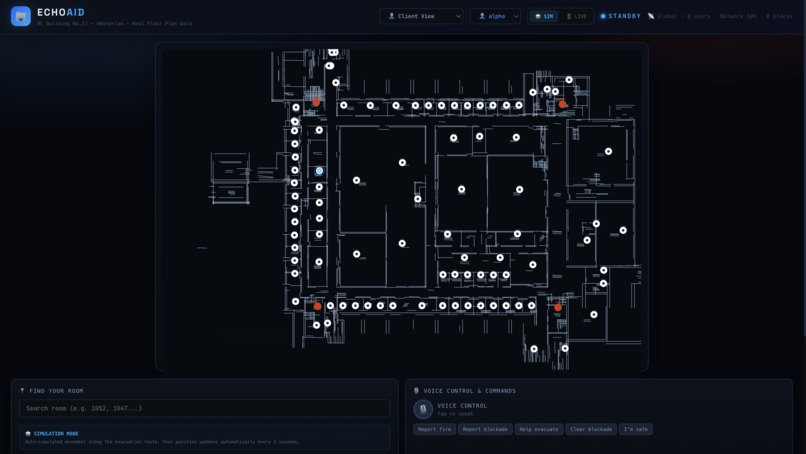
Overview
-
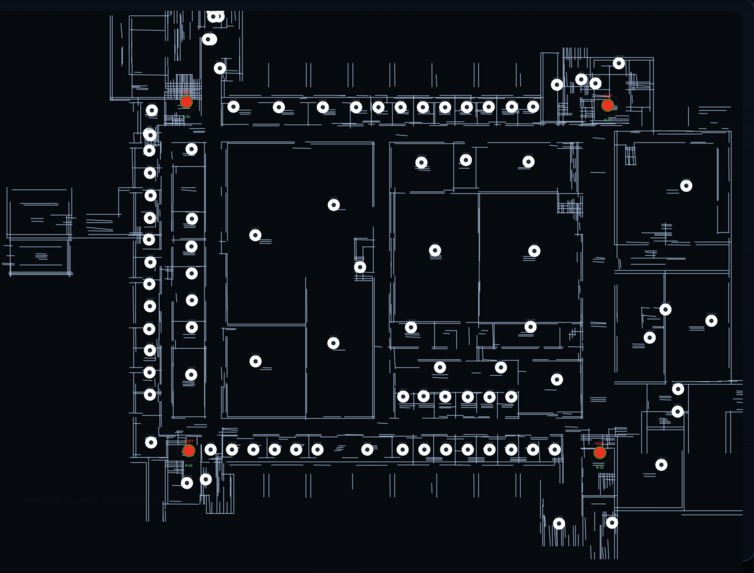
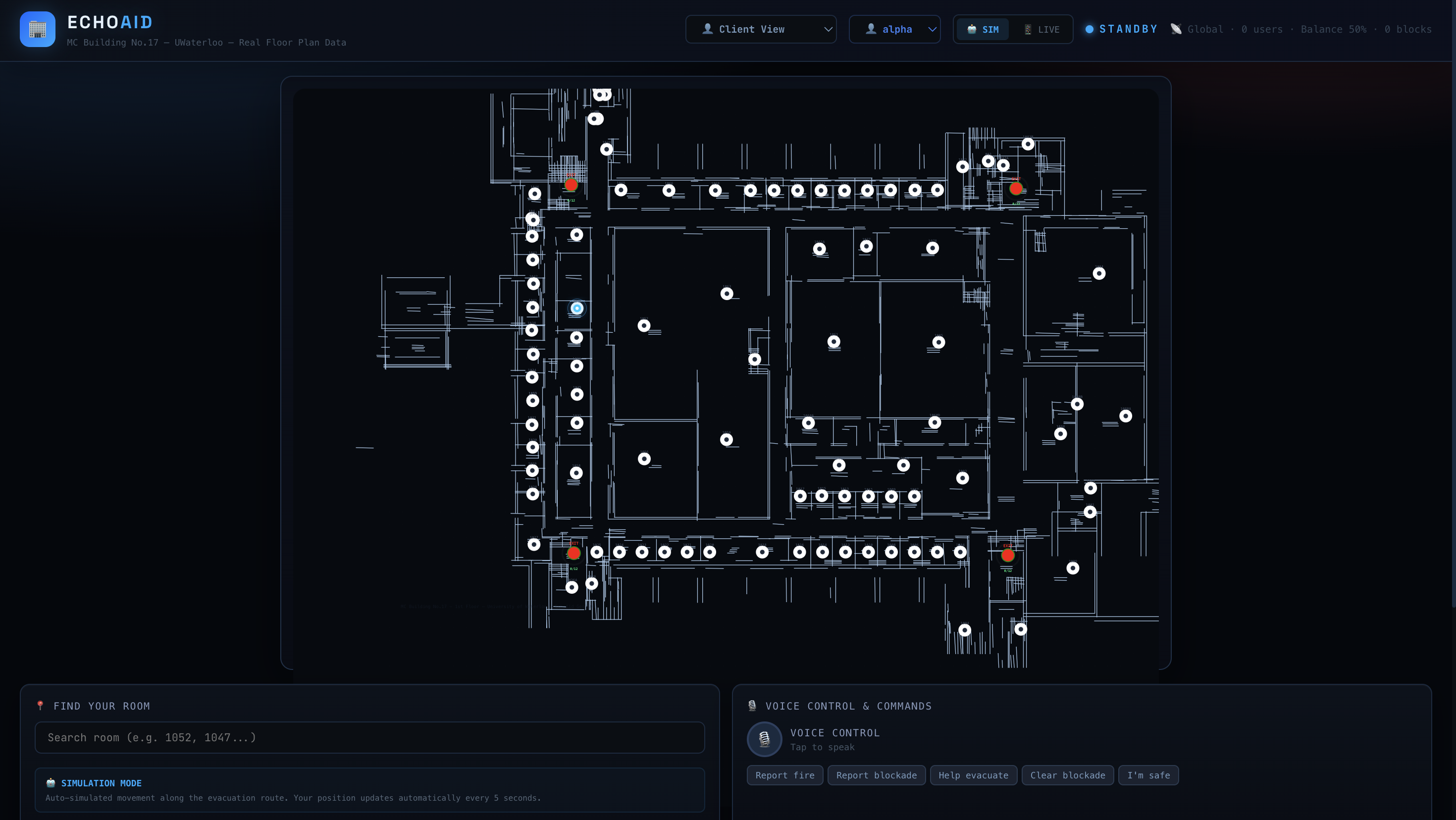
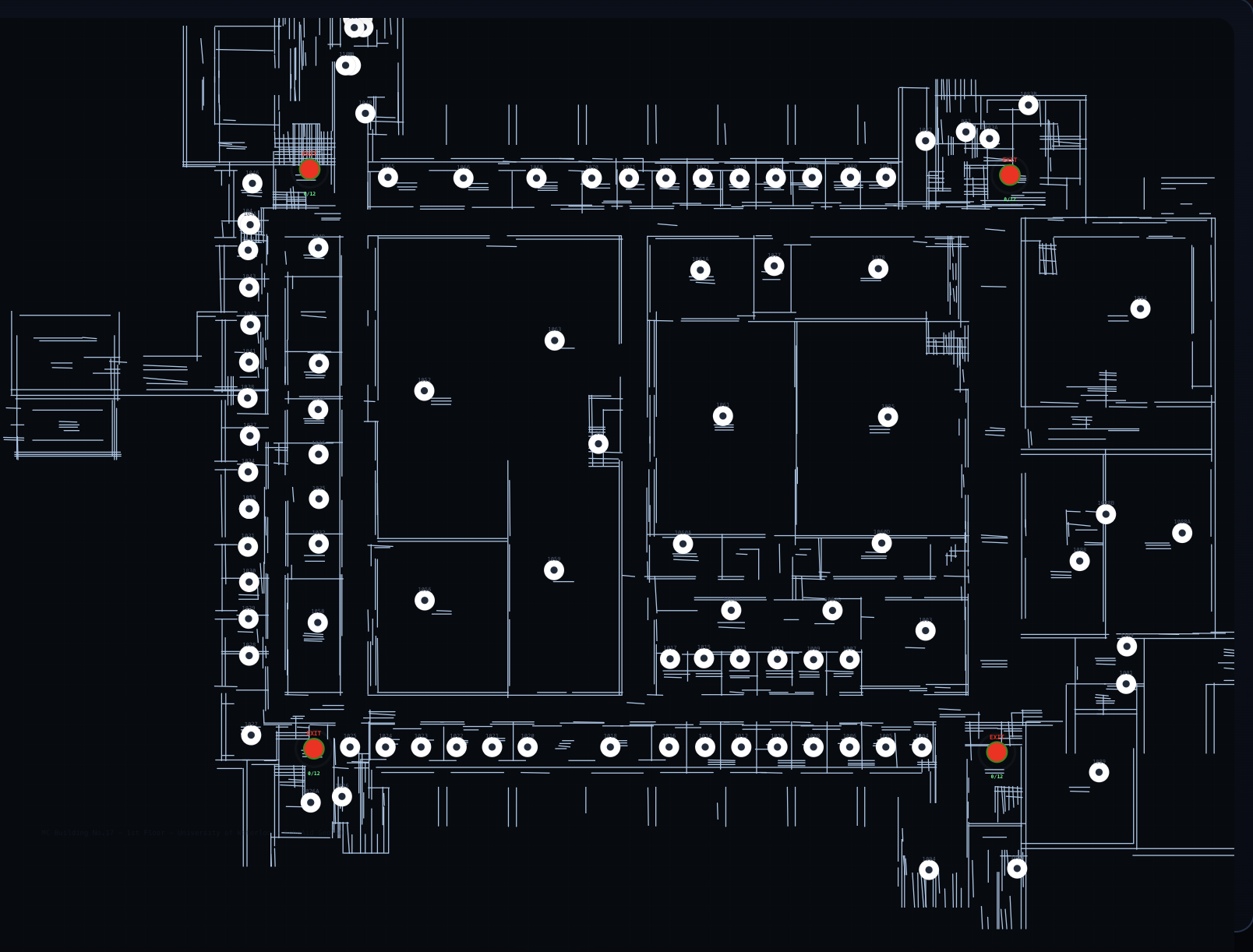
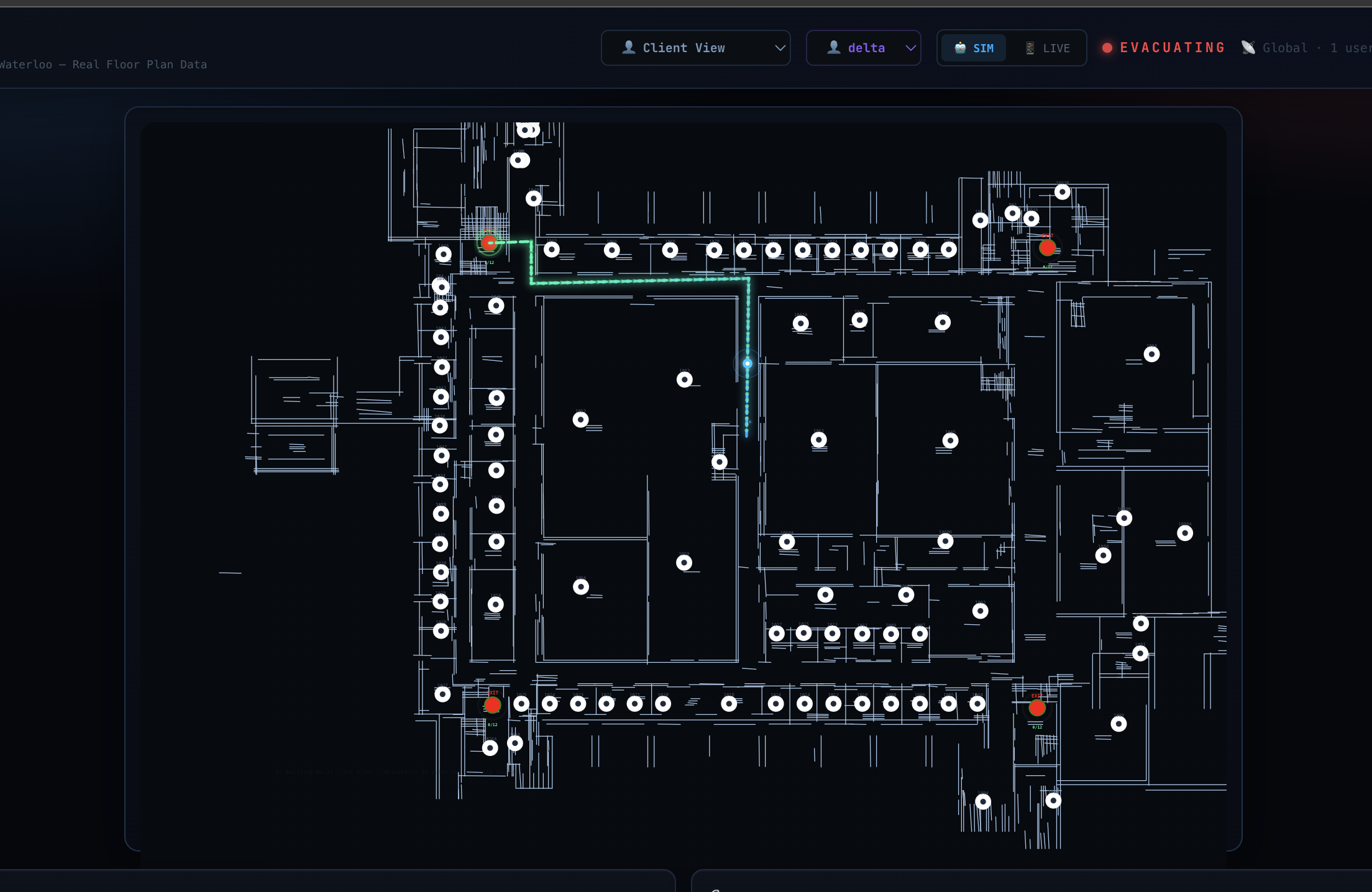
2D Evaluation Map
-
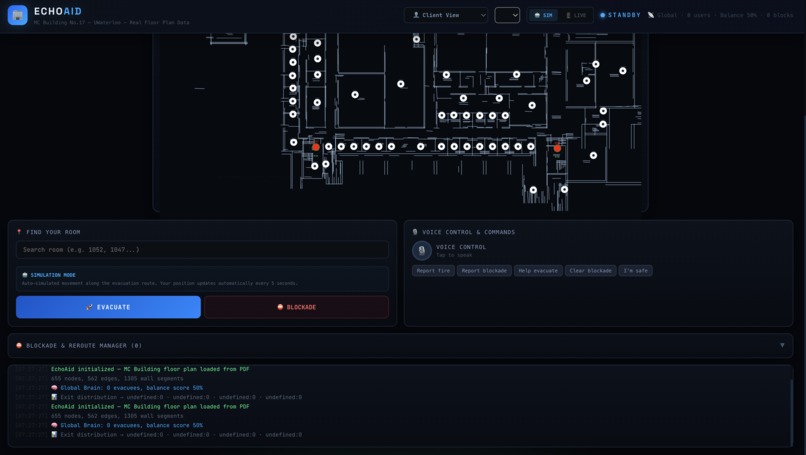
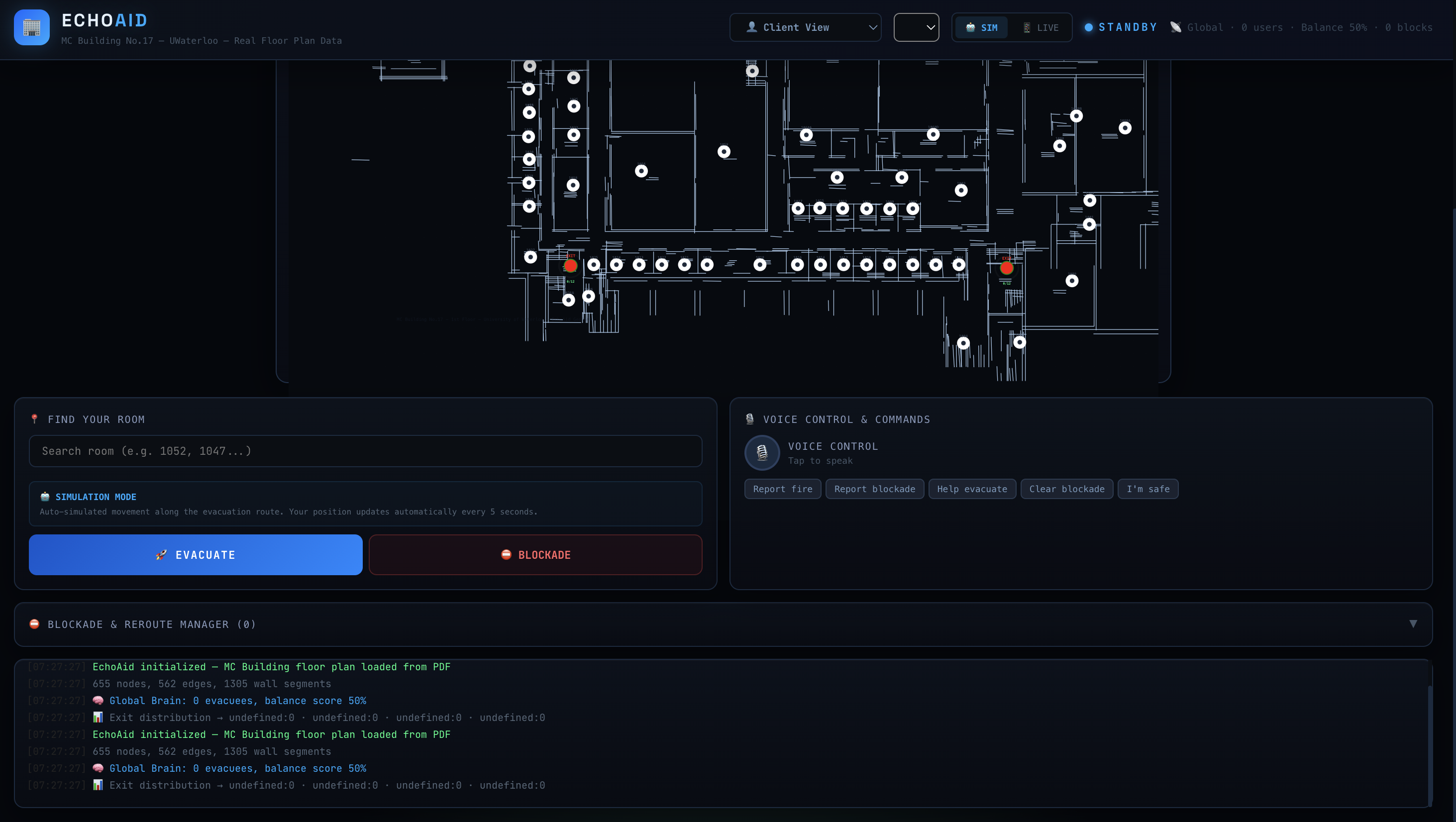
Multiple Function Menus
-
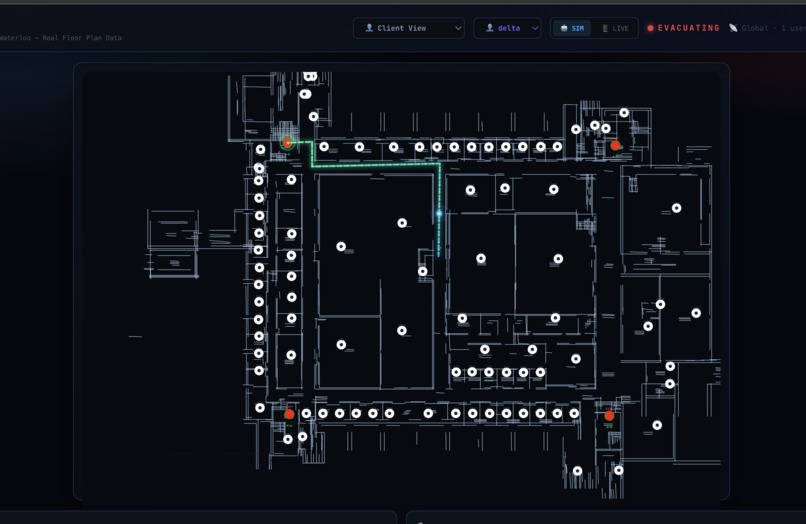
Guide the User with the Fastest Route
-
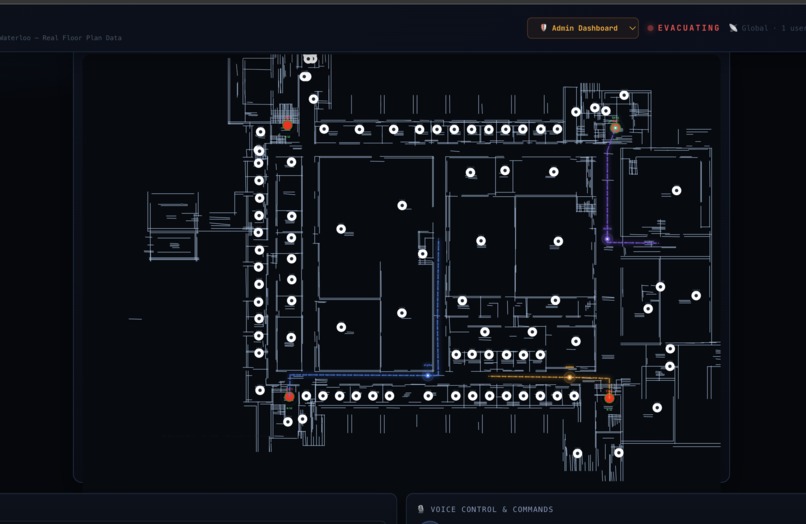
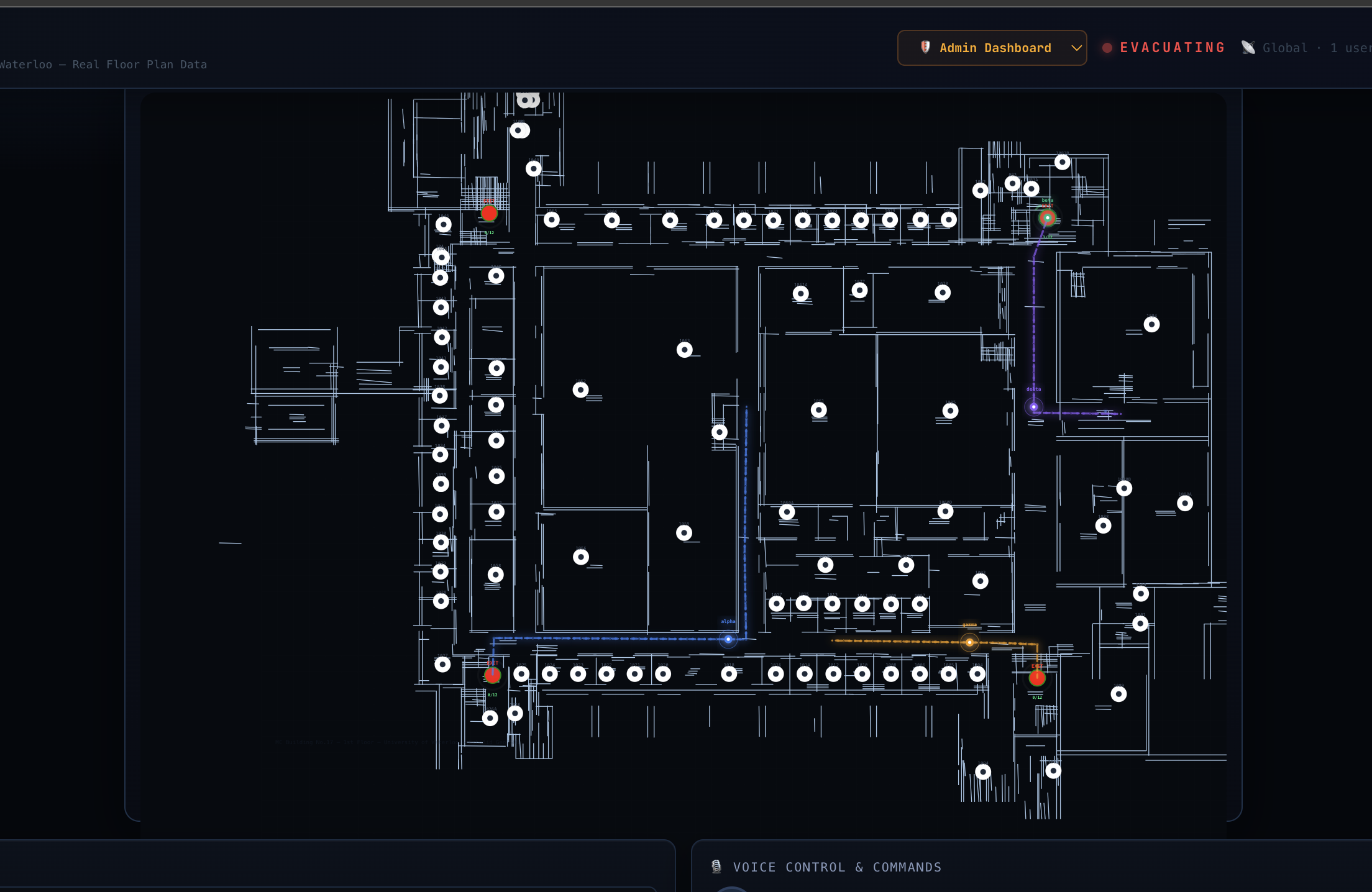
Admin Perspective shows all the Clients Movement
Inspiration
According to a research paper, approximately 350 to 500 medium-to-large scale disasters occur globally each year, a number projected to reach 560 annually by 2030. During disaster, people often feel overwhelmed even in simple, structured buildings. Under stress, familiar spaces become confusing and decision-making breaks down. In high complex buildings like MC or E7, finding a safe and correct evacuation path becomes significantly harder.
What it does
Don't worry! That's why EchoAid is here to help you! Its an AI-powered disaster evacuation software that guides users to safe exits using voice interaction and indoor navigation. Some of its features include:
Intelligent Voice Navigation - EchoAid guides users to safe exits through natural voice interaction; no need to look at your phone during a crisis. Just ask "Where's the nearest exit?" and it provides turn-by-turn directions based on your real-time location within the building.
Real-Time Hazard Awareness - The system continuously monitors building conditions through crowd-sourced reports. When users encounter blocked hallways, smoke, or other hazards, they can instantly report them, automatically triggering reroutes for everyone still evacuating. The digital map updates live, showing danger zones in red so responders know exactly where problems are.
Crowd-Aware Routing - Unlike traditional exit signs that funnel everyone to the same door, EchoAid uses congestion-aware pathfinding to intelligently distribute people across multiple exits. The system tracks how many evacuees are heading to each exit and dynamically balances the load, preventing bottlenecks and reducing stampede risks that cause more casualties than the disaster itself.
Adaptive Rerouting - When conditions change mid-evacuation, an exit becomes blocked, a stairwell fills with smoke, or a corridor reaches capacity, EchoAid doesn't just give up. It instantly recalculates optimal paths for all active users, automatically guiding them to safer alternatives without manual intervention.
How we built it
We built EchoAid as a hybrid web-based system with a dual-brain architecture designed for both performance and resilience—combining the speed of local processing with the coordination power of centralized intelligence.
Local Brain: Edge Intelligence The local brain, powered by Gemini AI, runs directly in each user's browser for instant response times and offline capability. It maintains:
Cached floor plan geometry: Complete navigation graph (145 rooms, 100+ hallway waypoints, bidirectional edges) stored locally for zero-latency access A pathfinding engine*: Pure JavaScript implementation that computes optimal routes in milliseconds without server round-trips Motion tracking: Real-time position updates using indoor positioning to track user progress along their evacuation path Voice interaction layer: Natural language processing for hands-free navigation commands This local-first approach means the system remains functional even during network instability—users can still navigate to exits using cached data and local pathfinding.
Global Brain: Coordination Hub The global brain, powered by Backboard.io and a Flask + SocketIO backend, handles system-wide coordination that requires centralized intelligence:
Multi-user synchronization: WebSocket connections maintain live awareness of all evacuees' positions and routes Congestion analytics: Tracks exit loads, edge congestion, and bottleneck detection across the entire evacuation Dynamic hazard propagation: When one user reports a blockage, the global brain instantly broadcasts it to all clients and triggers mass rerouting Load-balanced routing: Uses iterative convergence algorithms (3-pass optimization) to spread evacuees across exits based on capacity constraints and current assignments Centralized state management: Maintains ground truth for blockades, exit capacities, and crowd distribution
The Hybrid Advantage The key innovation is how these brains work together: the local brain provides instant feedback and offline resilience, while the global brain enables coordination impossible for isolated clients—like preventing 50 people from all choosing the same "optimal" exit. Clients periodically sync with the server to receive updated hazard maps and congestion data, then compute their own routes locally using this shared intelligence.
This architecture gives us both speed (local computation) and smart coordination (global optimization)—the best of edge computing and centralized orchestration.
Challenges we ran into
One of the toughest technical hurdles was digitizing the physical world. The Process:
- PDF → Image Conversion Used PyMuPDF to extract a high-resolution raster image from the floorplan PDF
- Automated Room Detection OpenCV computer vision: grayscale conversion, thresholding, and morphological closing Contour detection to identify enclosed room boundaries Calculated centroid coordinates for each room
- OCR Label Extraction Tesseract OCR automatically read room numbers from the floorplan Preserved semantic meaning (Room 1047, Exit labels, etc.)
- GeoJSON Export Converted 145 physical room locations into a structured GeoJSON format Each point includes coordinates, room ID, type (ROOM/EXIT), and label
- Navigation Graph Construction Manually added ~100 hallway waypoint nodes for corridor navigation Created bidirectional edges defining walkable paths Implemented coordinate transformation to normalize the system
Another major challenge was figuring out how to implement Backboard. Since Backboard isn't just a standard database, we had to shift our mental model from "storing rows" to "managing semantic memory." We initially struggled to integrate the Python backend with Backboard's AI-driven threads, ensuring the "Global Brain" could ingest rapid-fire hazard reports without becoming overwhelmed. Balancing the real-time speed of our local Python server with the asynchronous, intelligent analysis from Backboard required carefully architecting the API calls to prevent lag during critical evacuation updates.
Finally, solving for crowd dynamics was difficult. We realized that standard A* pathfinding is dangerous in emergencies because it sends everyone to the nearest exit, causing stampedes. We had to design a custom congestion-cost function and a 3-pass iterative convergence algorithm to balance exit loads dynamically.
Accomplishments that we're proud of
We are incredibly proud of the "God View" Simulation. The application doesn't just route one person; it simulates an entire building evacuation with 30+ agents, visualizing real-time congestion heatmaps and dynamic rerouting on the floor plan. Our backboard integration also enables synchronized awareness and updates among all users, enabling more coordinated and time-efficient evacuations.
We also successfully implemented hands-free accessibility. By integrating the Web Speech API, users can trigger evacuations or report hazards just by saying "Report Fire" or "I'm Safe," which is critical when dexterity is compromised by stress. Finally, we're proud of the hybrid architecture design; the system allows for a "Local Brain" fallback that keeps routing users even if the internet (Global Brain) cuts out during a disaster.
What we learned
We learned that hybrid approaches win: computer vision automated 80% of the room extraction using OpenCV and OCR, but human refinement of hallway waypoints and corridor connections was essential for accurate pathfinding. Trying to achieve 100% automation would have taken far longer and produced worse results.
Second, the foundation matters more than the features. All our sophisticated real-time routing intelligence, congestion awareness, and dynamic rerouting were worthless without an accurate navigation graph underneath. Small errors in coordinate transformation or missing edges cascade into completely broken paths.
Finally, real-time systems change the game. Static evacuation plans become obsolete the moment a hallway gets blocked or an exit reaches capacity. Building the infrastructure for dynamic coordination: live position tracking, instant rerouting, and load balancing, turned this from a planning tool into something that could actually save lives in a real emergency.
What's next for EchoAid
Edge AI for Offline Resilience The current system relies on a central server for pathfinding and coordination. A single point of failure during disasters, when the infrastructure fails. Our next step is implementing on-device AI that runs locally on each user's phone, enabling autonomous navigation even when the backend goes down. Each device would maintain its own copy of the navigation graph and run lightweight A* pathfinding locally.
Mesh Networking for Infrastructure-Independent Communication WiFi networks are often the first casualty in disasters. We're exploring Bluetooth mesh networking and peer-to-peer protocols to enable devices to communicate directly without requiring internet connectivity. Users could share blockade reports, coordinate congestion data, and relay evacuation status through a decentralized mesh, each phone acting as both a client and a relay node.
Distributed Consensus Without Centralization The real challenge is maintaining coordinated routing across a mesh network without a central brain. We're investigating gossip protocols and distributed consensus algorithms so devices can collectively balance exit loads and avoid congestion bottlenecks, even when they can only see their immediate neighbors in the network.
This shift from cloud-dependent to edge-first, mesh-enabled architecture would make EchoAid truly resilient, working precisely when traditional infrastructure fails and lives depend on it most.


Log in or sign up for Devpost to join the conversation.