-
-
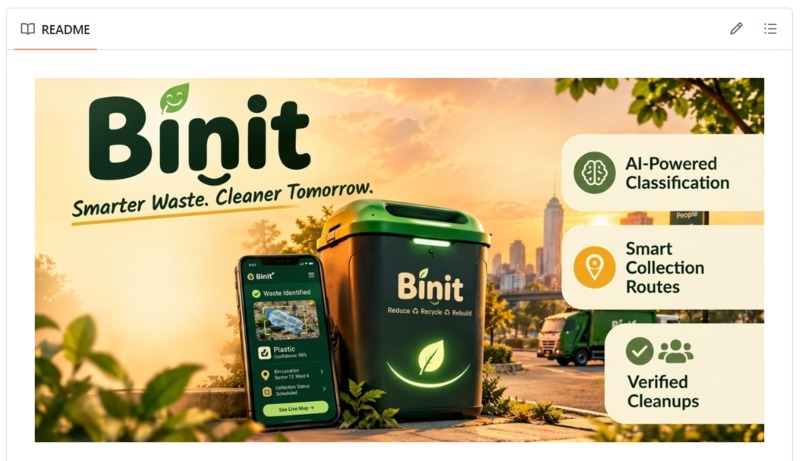
BinIt Social Banner
-
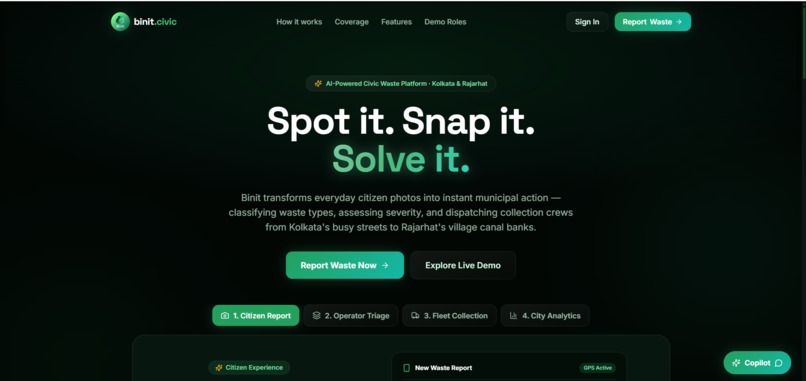
Website Landing Page
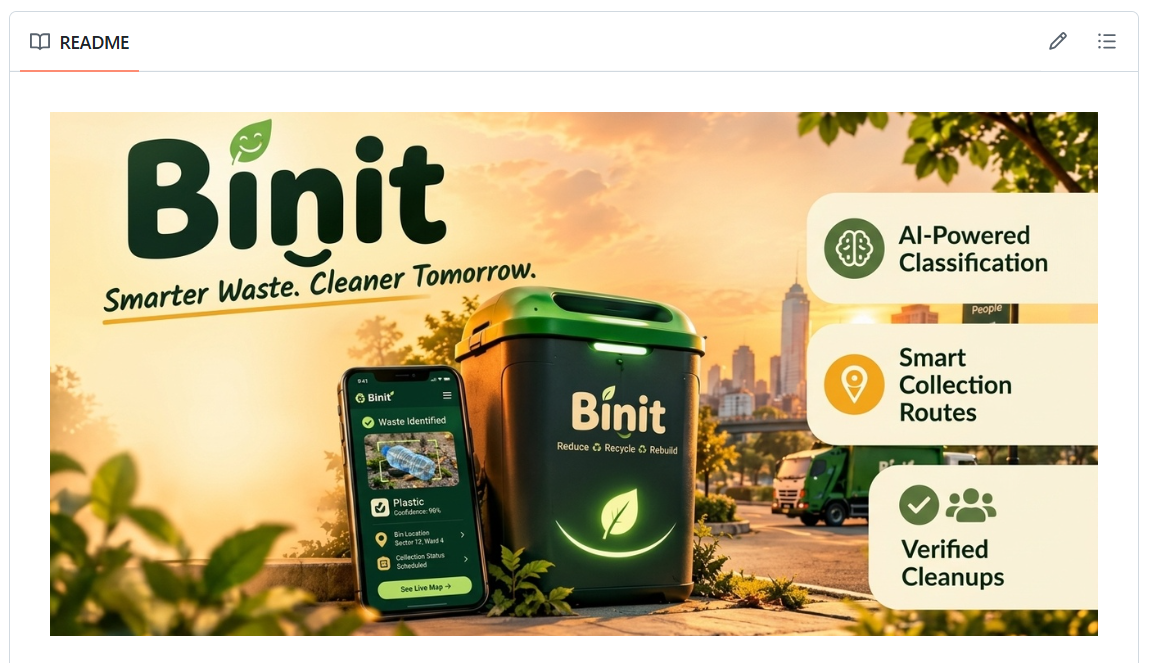
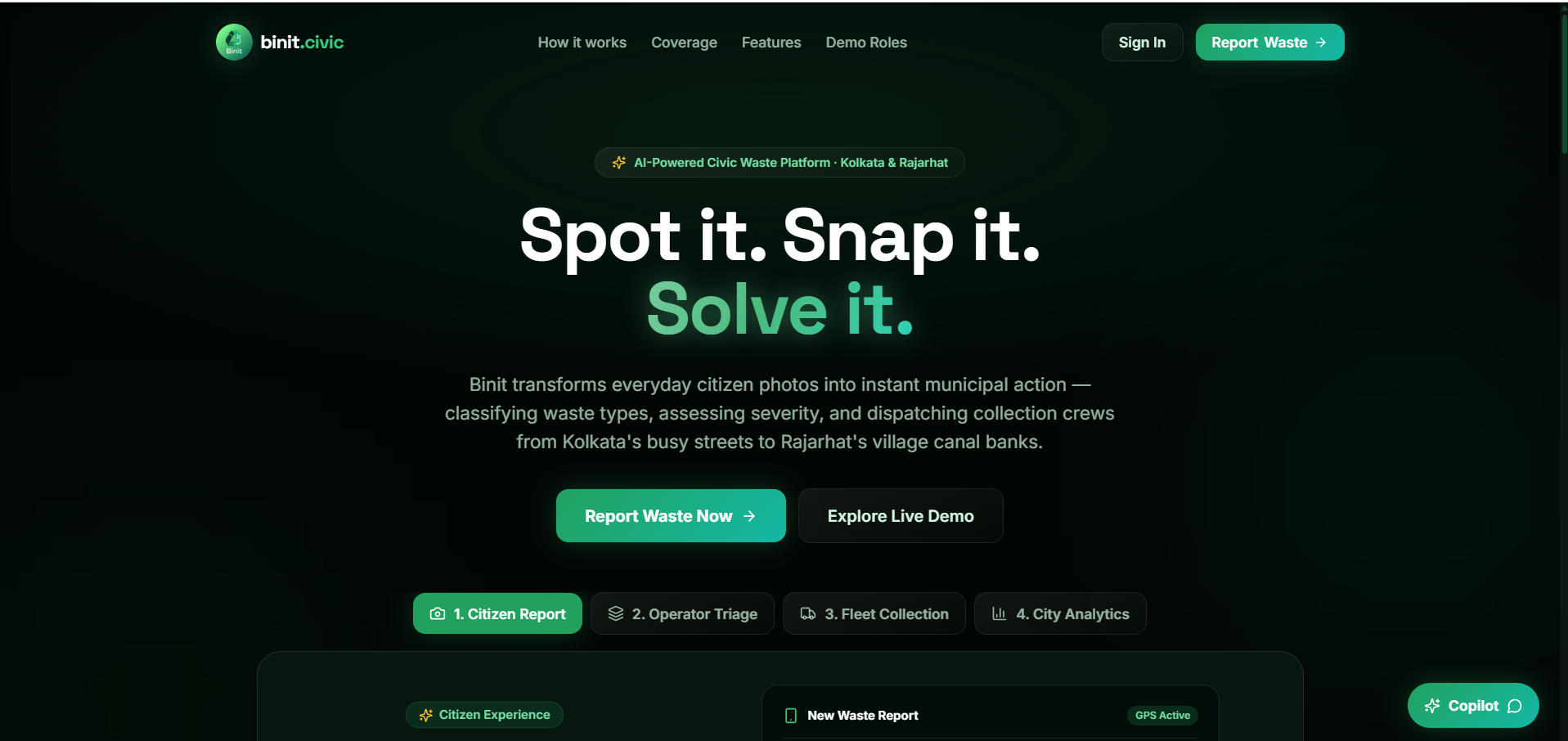
Inspiration
Waste management is one of the most visible environmental challenges in growing cities. Overflowing bins, scattered garbage, poor segregation, and inefficient collection can affect public health, urban cleanliness, and the environment.
We wanted to move beyond simply reporting waste. Our idea was to create a system that could understand waste intelligently, connect it with its location, and turn a simple photograph into an actionable solution.
That idea became Binit — Spot It, Snap It, Solve It.
Binit is built around a simple belief: if technology can help us identify a problem at the moment it appears, we can make waste management more proactive, data-driven, and sustainable.
What it does
Binit is an AI-powered smart waste management platform that helps users identify and report waste-related problems through a simple and intuitive interface.
A user can spot a waste problem, snap a photo, and submit it. Binit analyzes the submitted image using AI-powered image understanding and classifies the visible waste into relevant categories.
The platform can associate the report with its location and organize the information so that waste-management teams can better understand:
- What type of waste is present
- Where the problem is occurring
- How serious the issue may be
- Which areas are becoming waste hotspots
- Which reports require attention
- How collection activities can be planned more efficiently
Binit brings together AI, computer vision, location intelligence, data management, and visualization into one connected workflow.
Instead of treating every report as just another complaint, Binit transforms environmental observations into structured, actionable information.
How we built it
We designed Binit as a modular system where the user interface, backend services, AI processing, database, and location-based features work together.
The core workflow is:
Spot → Snap → Analyze → Classify → Locate → Prioritize → Manage → Improve
1. User Interface
We designed a clean, responsive interface that makes reporting a waste problem quick and accessible.
Users can submit waste images and provide the relevant information required for processing and tracking.
2. AI & Computer Vision
The submitted image is processed using AI-powered image analysis to identify and classify visible waste.
The system is designed to recognize categories such as:
- Plastic
- Paper
- Metal
- Organic waste
- Other relevant waste categories
This classification helps transform an unstructured photograph into useful environmental data.
3. Backend
The backend manages communication between the application, AI services, database, and other system components.
It handles information such as:
- Waste reports
- Classification results
- Locations
- Timestamps
- Status information
- User-generated data
4. Location Intelligence
Each report can be associated with geographic information, allowing waste issues to be visualized spatially.
This can help identify areas where waste problems are repeatedly occurring and support better resource planning.
5. Dashboard & Analytics
The management interface organizes incoming reports into meaningful information.
Instead of looking at individual reports separately, authorities or waste-management teams can view patterns, locations, priorities, and overall activity through a centralized dashboard.
6. Smart Collection
Location and waste data can be used to support more efficient collection planning and route optimization, helping reduce unnecessary trips and improve operational efficiency.
Challenges we ran into
Building Binit required us to think beyond simply connecting an AI model to a website.
One of our major challenges was designing a workflow that could convert real-world, unstructured waste images into reliable and useful information.
Waste can appear in different lighting conditions, backgrounds, orientations, sizes, and levels of cleanliness. This makes image-based classification more challenging than working with perfectly prepared datasets.
We also had to consider how AI results should be presented to users without making the interface complicated.
Another challenge was connecting multiple components into one coherent system. The frontend, backend, AI processing, database, location services, and dashboard all need to communicate correctly.
We also faced the challenge of balancing technical ambition with hackathon time constraints. Instead of trying to build every possible feature, we focused on creating a functional core experience that demonstrates the potential of Binit.
Accomplishments that we're proud of
We are proud of turning a simple environmental problem into a complete technology concept with a clear end-to-end workflow.
Our biggest accomplishment is the idea of connecting:
Citizen Observation → AI Understanding → Location Intelligence → Waste Management → Environmental Impact
We are particularly proud of:
- Building an AI-driven waste classification workflow
- Creating an intuitive waste-reporting experience
- Connecting waste information with location-based intelligence
- Designing a centralized management and analytics concept
- Combining AI with practical smart-city infrastructure
- Creating a solution that can be expanded beyond a basic reporting application
- Building the project around a real-world environmental problem rather than technology alone
Most importantly, Binit helped us understand how individual technical components can be combined into a system that addresses a larger societal challenge.
What we learned
This project taught us that building a meaningful technology product is not only about writing code.
We learned how important it is to first understand the problem, users, workflow, and real-world constraints before deciding which technologies to use.
Technically, we gained experience in connecting AI capabilities with application workflows, handling image-based inputs, designing backend communication, structuring data, and presenting complex information through a simple interface.
We also learned about the importance of:
- API integration
- AI reliability
- Data organization
- User-centered design
- Location-based systems
- Deployment and testing
- Team collaboration
- Git and GitHub workflows
- Building an MVP under time constraints
One of our biggest lessons was that AI should not be added just because it sounds impressive. It should solve a specific part of the problem where intelligence can create real value.
What's next for BinIt: spot it, snap it, solve it
Binit is designed as a starting point for a much larger smart waste ecosystem.
Our future roadmap includes:
Smart Bins
Integrate IoT-enabled bins with sensors to monitor:
- Fill levels
- Temperature
- Weight
- Collection status
Predictive Waste Analytics
Use historical and real-time data to predict where and when waste accumulation is likely to increase.
Advanced Route Optimization
Develop intelligent collection routes based on:
- Bin status
- Waste volume
- Location
- Traffic conditions
- Vehicle availability
- Collection priority
Real-Time Environmental Map
Create a city-wide map showing waste hotspots, collection activity, and environmental trends.
Gamified Citizen Participation
Encourage citizens to contribute through points, achievements, community challenges, and sustainability goals.
Multilingual & Accessible Reporting
Expand Binit to support multiple Indian languages and make environmental reporting accessible to a wider population.
City-Level Environmental Intelligence
In the long term, Binit can evolve beyond waste management into a broader environmental intelligence platform covering waste, pollution, water-related issues, and other urban sustainability challenges.
Our ultimate vision is simple:
Spot It. Snap It. Solve It.
With Binit, we want to turn everyday observations into smarter decisions and help create cities that are cleaner, more connected, and more sustainable.


Log in or sign up for Devpost to join the conversation.