The Missing Location Problem: When hikers go missing or emergency calls disconnect, rescuers may only have a short audio recording with no GPS coordinates.
Hidden Clues in Background Noise: Even without location data, recordings can capture useful environmental sounds, such as airplanes flying overhead.
Aircraft as Location Clues: Thousands of aircraft broadcast their positions through publicly available flight tracking data.
Our Idea: What if we could match the sound of an airplane in a recording to its flight path and estimate where the recording was made? That's how Doppler was born.
What it does
GPS-Free Location Detection: Estimates where an audio recording was made using background aircraft sounds instead of GPS coordinates.
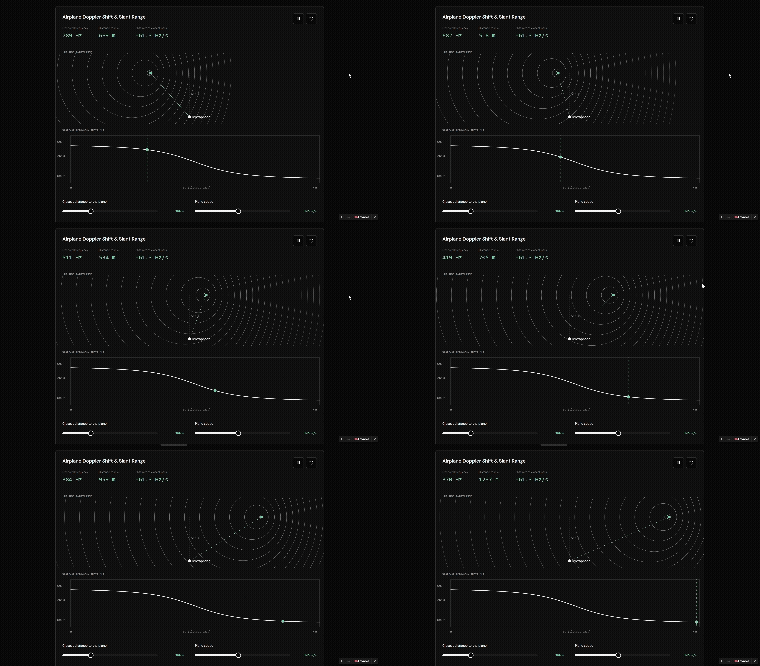
Audio Analysis: Detects changes in airplane sounds, including the Doppler effect, where an aircraft's pitch changes as it approaches and moves away.
Flight Data Matching: Compares detected sounds with historical aircraft flight paths to identify possible recording locations.
Interactive Map: Displays the estimated location, search radius, and matching aircraft trajectory.
Real-World Testing: In a test at Kitsilano Beach, Vancouver, Doppler estimated the recording location within approximately 660 meters of the actual position.
How we built it
Frontend Development: Built Doppler using React, TypeScript, Vite, and Tailwind CSS, with Lovable helping accelerate development.
Audio Processing: Used the Web Audio API to analyze recordings directly in the browser and identify potential aircraft sounds.
Flight Tracking Integration: Connected historical aircraft tracking data from ADSB.lol to compare audio recordings with real flight paths.
Location Estimation: Applied the Doppler effect and basic sound propagation physics to calculate possible recording locations.
Interactive Visualizations: Used Three.js for our rotating 3D globe and Leaflet for displaying flight paths, estimated locations, and search regions.
Challenges we ran into
Background Noise: Wind, speech, traffic, and other environmental sounds made it difficult to isolate faint airplane noises.
Detecting Aircraft Accurately: Some recordings contained sounds that resembled aircraft, leading to incorrect detections.
Connecting Audio and Flight Data: Matching sound patterns with aircraft positions required understanding unfamiliar physics and working with complex flight tracking data.
Limited Recording Quality: Short or quiet recordings sometimes lacked enough information to estimate a location reliably.
Time Constraints: Building and integrating audio analysis, flight tracking, and an interactive website within a hackathon was challenging.
Accomplishments that we're proud of
Real-World Proof of Concept: Estimated a recording's location within approximately 660 meters during our Kitsilano Beach test without using GPS data.
Learning New Technologies: Explored audio signal processing, aircraft tracking, and the Doppler effect despite having limited prior experience.
Building a Functional Prototype: Turned an ambitious idea into an interactive application in under 36 hours.
Search-and-Rescue Simulation: Created a fictional missing-hiker scenario demonstrating how Doppler could help narrow a search area.
Combining Multiple Technologies: Successfully brought together audio analysis, physics, flight tracking, and interactive mapping into one application.
What we learned
Audio Signal Processing: Learned how computers analyze sound frequencies and identify patterns hidden within recordings.
Applying Physics to Real Problems: Discovered how the Doppler effect can be used for more than explaining why passing vehicles change pitch.
Working with Real-World APIs: Gained experience retrieving and interpreting aircraft flight data.
The Importance of Testing: Learned that real-world audio is much messier than simulated recordings and that reliable detection requires careful filtering.
Rapid Development: Improved our ability to learn unfamiliar technologies, solve unexpected problems, and build a working prototype under tight deadlines.
What's next for Doppler
Longer-Range Detection: Improve Doppler's ability to detect faint aircraft sounds from greater distances, so users won't need to wait for a plane to fly directly overhead.
Better Location Accuracy: Analyze multiple aircraft simultaneously to narrow estimated locations into smaller search areas.
Real-Time Flight Tracking: Integrate live aircraft data to help locate recordings shortly after they're received.
Improved Noise Filtering: Make Doppler more reliable when recordings contain wind, speech, traffic, or other background noise.
Search-and-Rescue Applications: Explore ways to collaborate with rescue teams and eventually make Doppler available as an open-source tool.