Inspiration
Country Quest came from the idea that learning about a place should happen as you explore it, rather than just reading static information on a screen. We wanted to create an experience that gets visitors to slow down, take in the natural environment, and interact with each location through fun, simple challenges.
We also wanted to make sure Indigenous culture was approached respectfully. The prototype doesn’t make up any language or cultural stories. Any future cultural content would be developed in collaboration with the relevant Traditional Owners and knowledge holders.
What it does
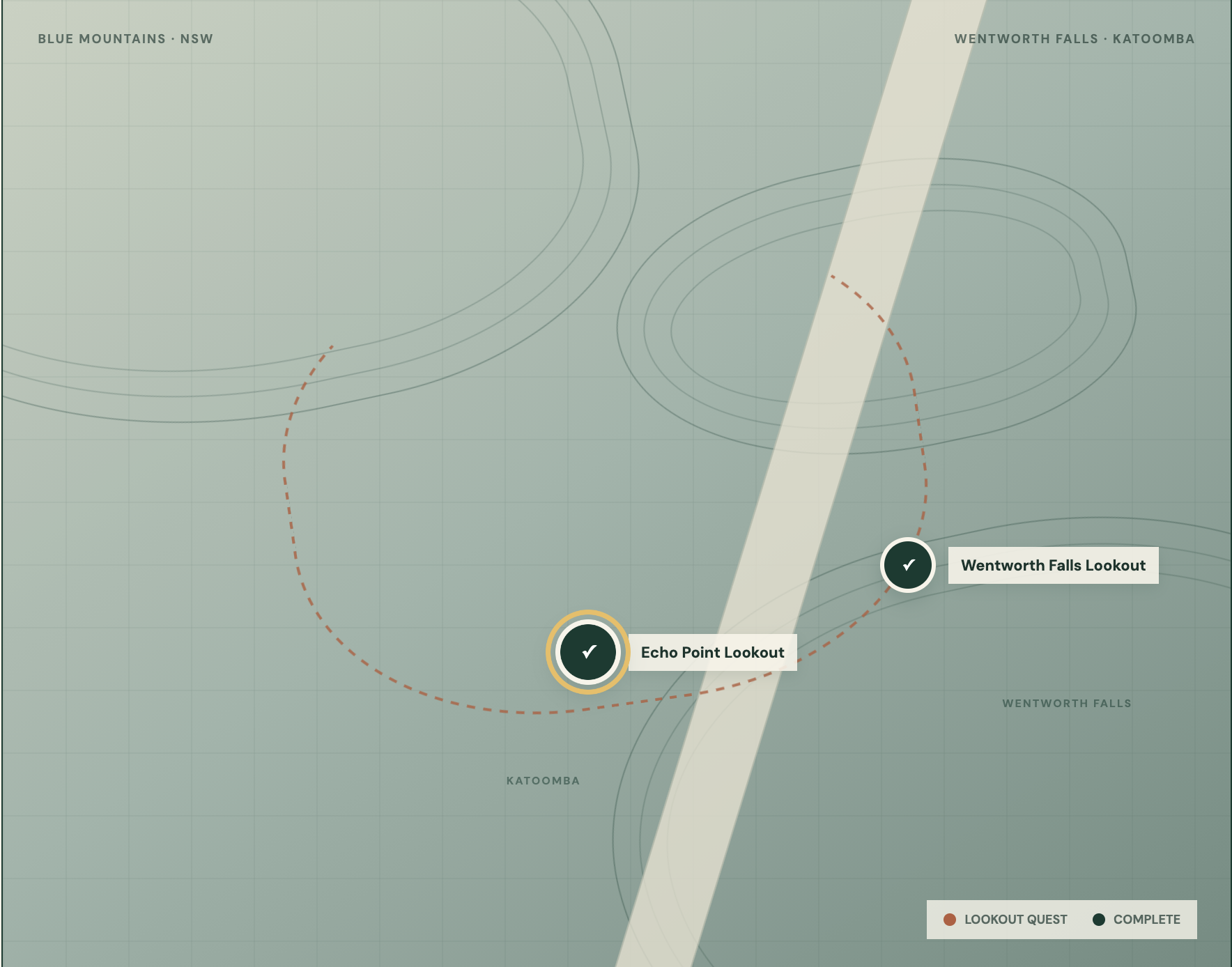
Country Quest is a location-based web game featuring various areas and key activities in the player's location. In the demo, we focus on the Blue Mountains:
- At Echo Point Lookout, players examine a zoomed-in section of the Three Sisters and guess which part of the landscape it shows.
- At Wentworth Falls Lookout, players solve a riddle by following clues about the waterfall, creek and valley. When a player completes an activity, it unlocks a field fragment in the player’s digital passport. Progress is stored locally and players can reset their location or their entire passport to replay the challenges. The separate Team Signal mode would let two teams coordinate and activate their location fragments within 60 seconds. This requires further development.
How we built it
We built Country Quest as a responsive React and TypeScript website using Vinext and Vite. The activities are built with interactive React components and custom CSS. Browser geolocation lets us check whether a player is near a lookout, while demo mode lets us test the prototype from anywhere. LocalStorage saves passport progress on the user’s device. We also use the BroadcastChannel API to synchronise Team Signal between browser tabs, so no server or user account is needed. The Echo Point activity uses an openly licensed photograph from Wikimedia Commons. The image is initially shown as a magnified mystery frame before being revealed in full.
Challenges we ran into
One of our biggest challenges was making learning about a location feel like a game instead of a traditional lesson. We tried out a few different activities before settling on the two that worked best: visual investigation and riddle solving. We also had to make sure the challenges could be completed safely at public lookouts, without requiring users to cross barriers or go off designated paths. Another challenge was making sure we handled Indigenous cultural knowledge respectfully. On the technical side, we needed to handle location checks, replayable progress and multiplayer-style synchronisation, while keeping everything local to the user’s device and avoiding the need for accounts or a server.
Accomplishments that we are proud of
We think Country Quest works well because (so far) it turns two real Blue Mountains locations into different interactive experiences instead of just using generic quizzes.
We created:
- A zoomed-in mystery image that reveals the full view at Echo Point.
- A riddle based specifically on Wentworth Falls.
- A digital passport that tracks progress and can be reset.
- A separate timed multiplayer mode.
- Optional geolocation, with a demo mode for testing.
- A privacy-friendly experience that doesn’t require accounts or photo uploads.
- A design that works on both desktop and mobile.
What we learned
We found that place-based activities work better when they actually make use of something unique about the location. We also found that keeping things simple can make the project better. Focusing Country Quest on the two activities that worked best made it easier to understand and more fun to play again. We importantly learned that Indigenous culture needs to be handled with care. Technology should not be used to make up cultural content. Any content should come from the community, with their permission and proper attribution.
What's next for DND's Project
We would like to:
- Test the activities at the actual lookouts.
- Add more locations and challenges.
- Make Team Signal work across separate phones.
- Add offline support for areas with poor reception.
- Improve accessibility and add more language options.
- Add optional modes for teachers and school groups.
- Set up clear processes for moderation, attribution and removing content before publishing any community knowledge.
Another step would be to speak with the relevant Traditional Owners, Elders and organisations about whether cultural or language content could be added, and what that content should look like.

Log in or sign up for Devpost to join the conversation.