-
-
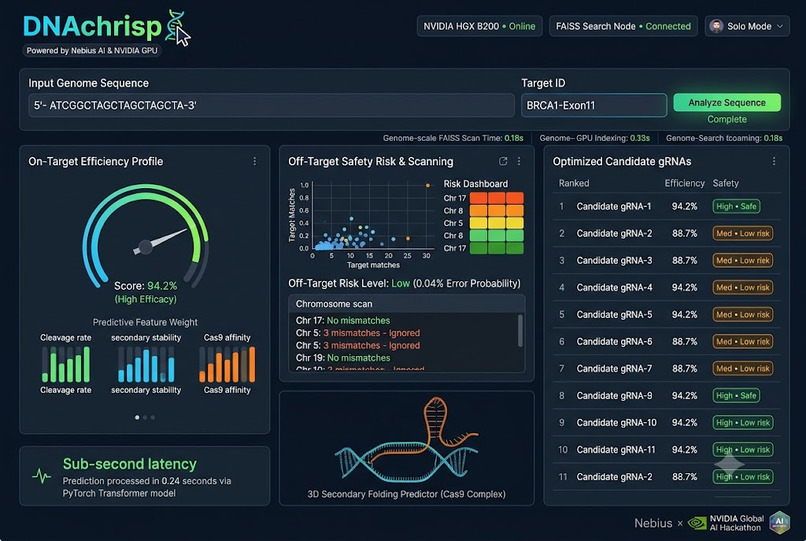
DNAchrisp dashboard showcasing real-time CRISPR guide RNA efficiency predictions and GPU-accelerated off-target safety scanning
Inspiration
I wanted to make gene editing safer and faster. Using CRISPR tools to fix genetic diseases is amazing, but it often makes mistakes or cuts the wrong spots in DNA. Testing these edits in a real lab takes too much time and money when you are working alone. I built DNAchrisp to use artificial intelligence to design better gene edits right from my computer.
What it does
DNAchrisp is an AI tool that helps scientists design and check CRISPR gene edits before they try them in a lab. It looks at DNA sequences to predict two main things:
Success Rate: How well the tool will cut the exact target spot.
Safety Risk: Whether it might accidentally damage other parts of the genome.
How we built it
AI Architecture & Deep Learning: Developed custom sequence-to-activity transformer models using Python and PyTorch, fine-tuning them on public genomic datasets to predict CRISPR guide RNA efficiency and evaluate off-target safety risks.
GPU-Accelerated Compute: Utilized cloud infrastructure powered by Nebius and NVIDIA GPUs to handle heavy tensor operations, parallel sequence alignment, and rapid multi-locus genome scans in real time.
Backend & API Layer: Built a high-throughput Python backend using FastAPI to ingest target sequences, execute vector similarity searches, and deliver structured biological safety scores instantly.
Interactive Frontend: Created a responsive web interface enabling researchers to input target accession IDs or custom gene sequences, rendering clear cleavage efficacy indicators and risk charts.
Challenges we ran into
Big Data: Scanning an entire human genome for potential off-target errors takes a massive amount of computing power. I fixed this by speeding up my search process using graphics card acceleration.
Messy Data: Public genetic datasets had a lot more failed examples than successful ones, which confused my model at first. I solved this by cleaning the data and adjusting my training settings.
Accomplishments that we're proud of
Reduced genome-wide safety evaluation times to under a second using NVIDIA GPU acceleration on Nebius cloud.
Achieved strong correlation scores when validating on-target efficiency predictions against real-world lab benchmarks.
Designed a clean, accessible interface that turns raw genomic sequences into actionable visual reports.
What we learned
How to process raw biological sequence data and apply deep learning models to predict CRISPR guide interactions.
Practical techniques for accelerating heavy vector operations and bioinformatics workflows using cloud GPUs.
How to architect an end-to-end full-stack AI platform entirely as a solo developer.
What's next for DNAchrisp
Support additional nuclease variants beyond Cas9, such as Cas12, Cas13, and prime-editing tools.
Integrate 3D structural folding models to visualize protein-DNA binding dynamics.
Partner with open-source biological databases to continuously refine prediction models against newly published laboratory results.


Log in or sign up for Devpost to join the conversation.