-
-
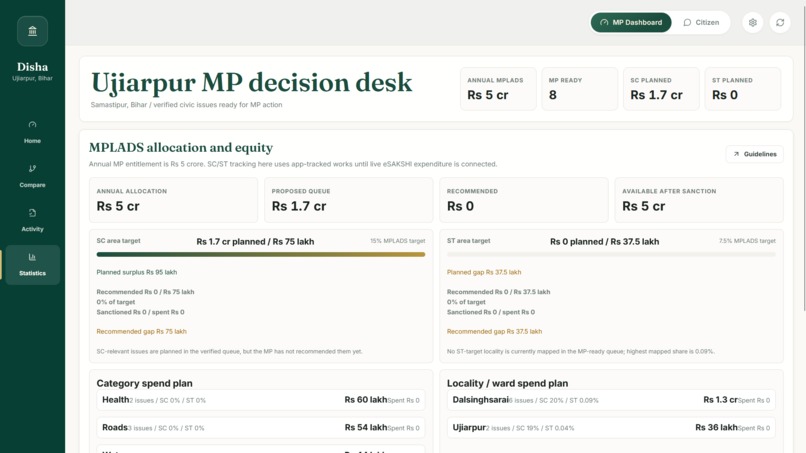
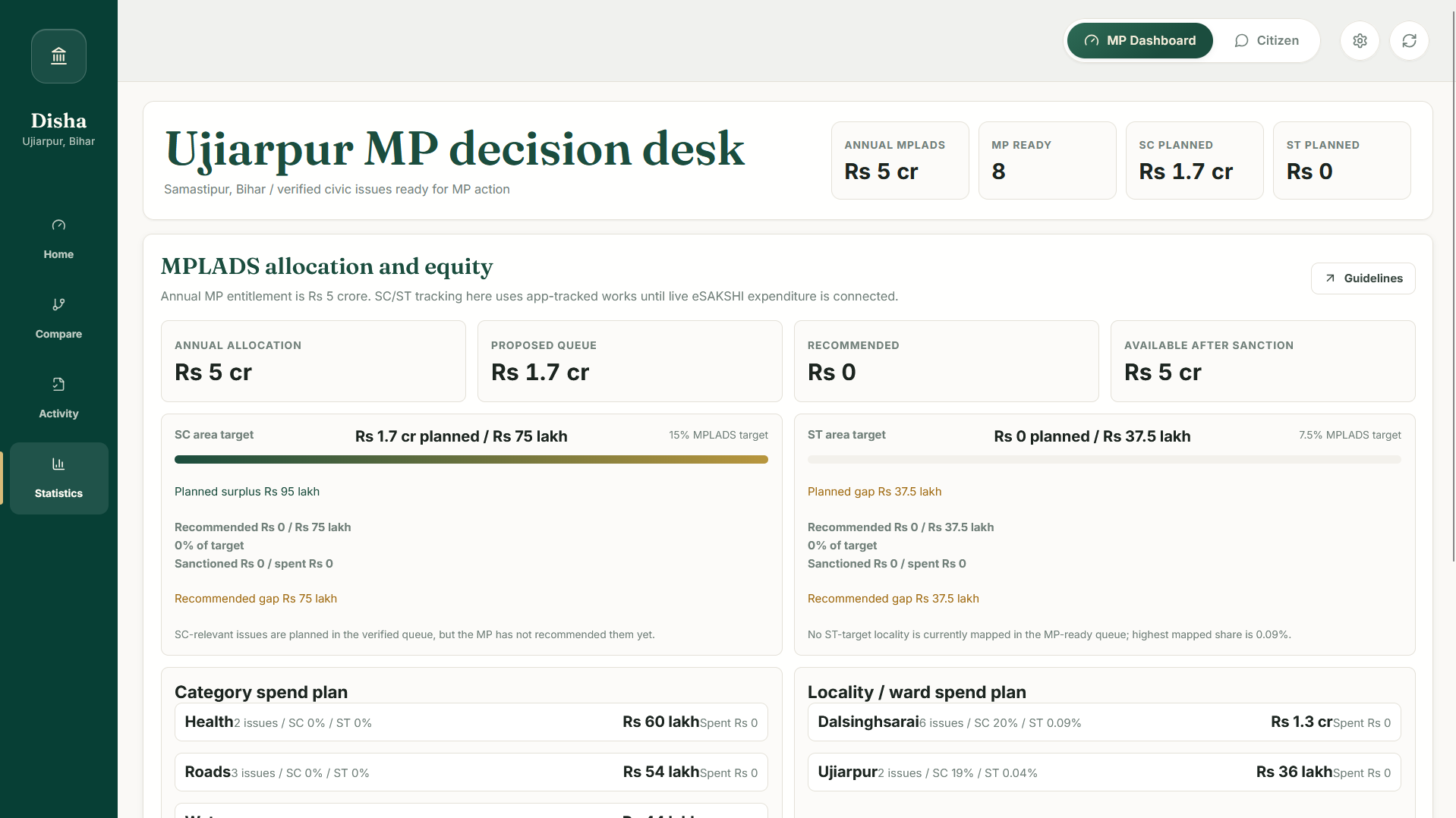
MP Dashboard, statistic section
-
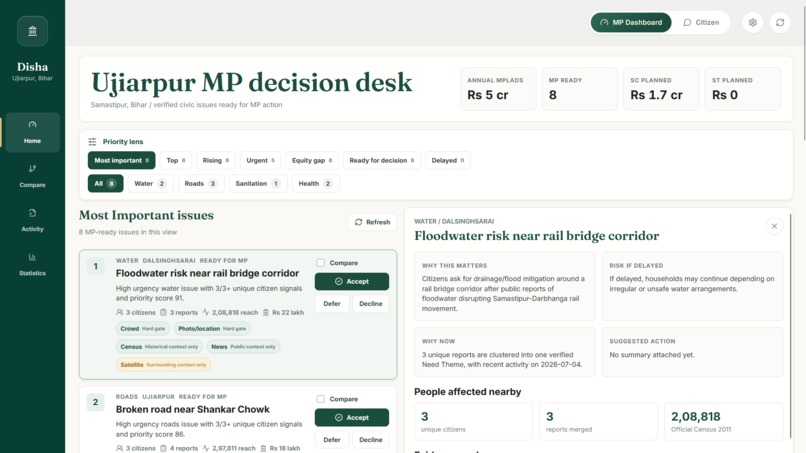
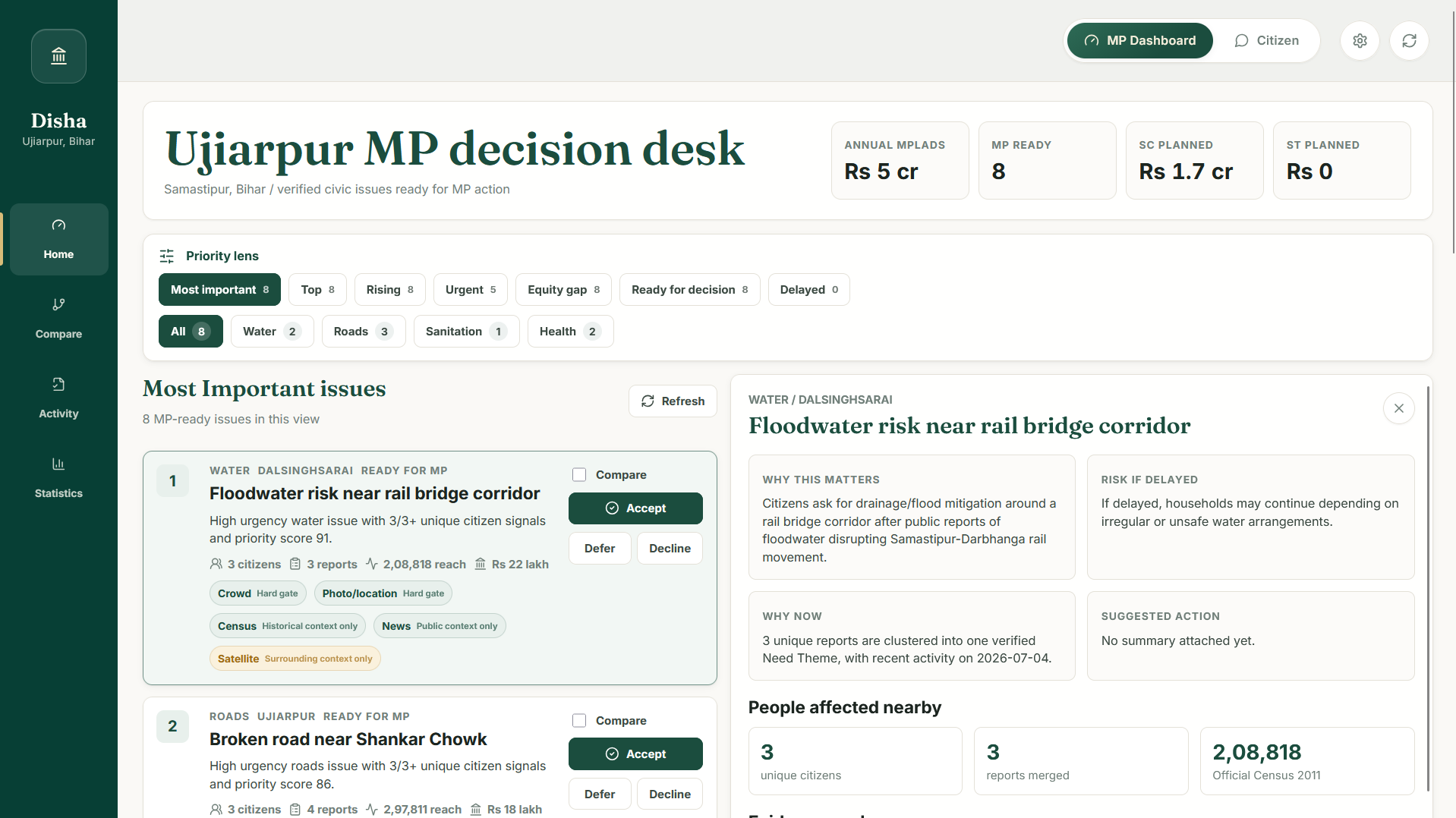
Mp dashboard , Home page
-
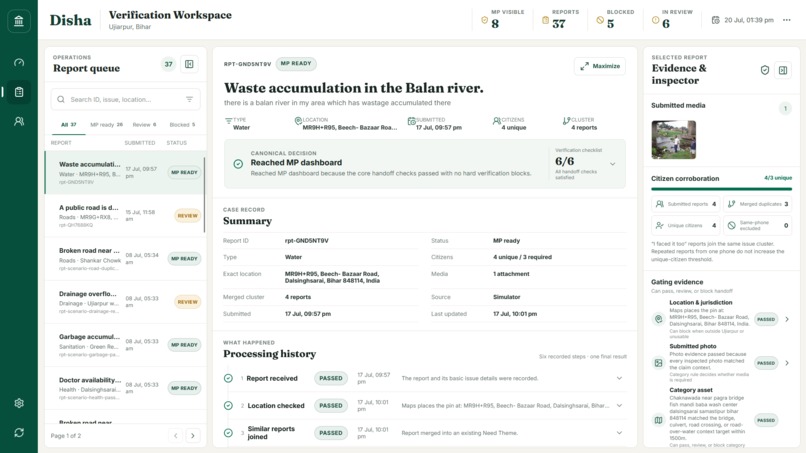
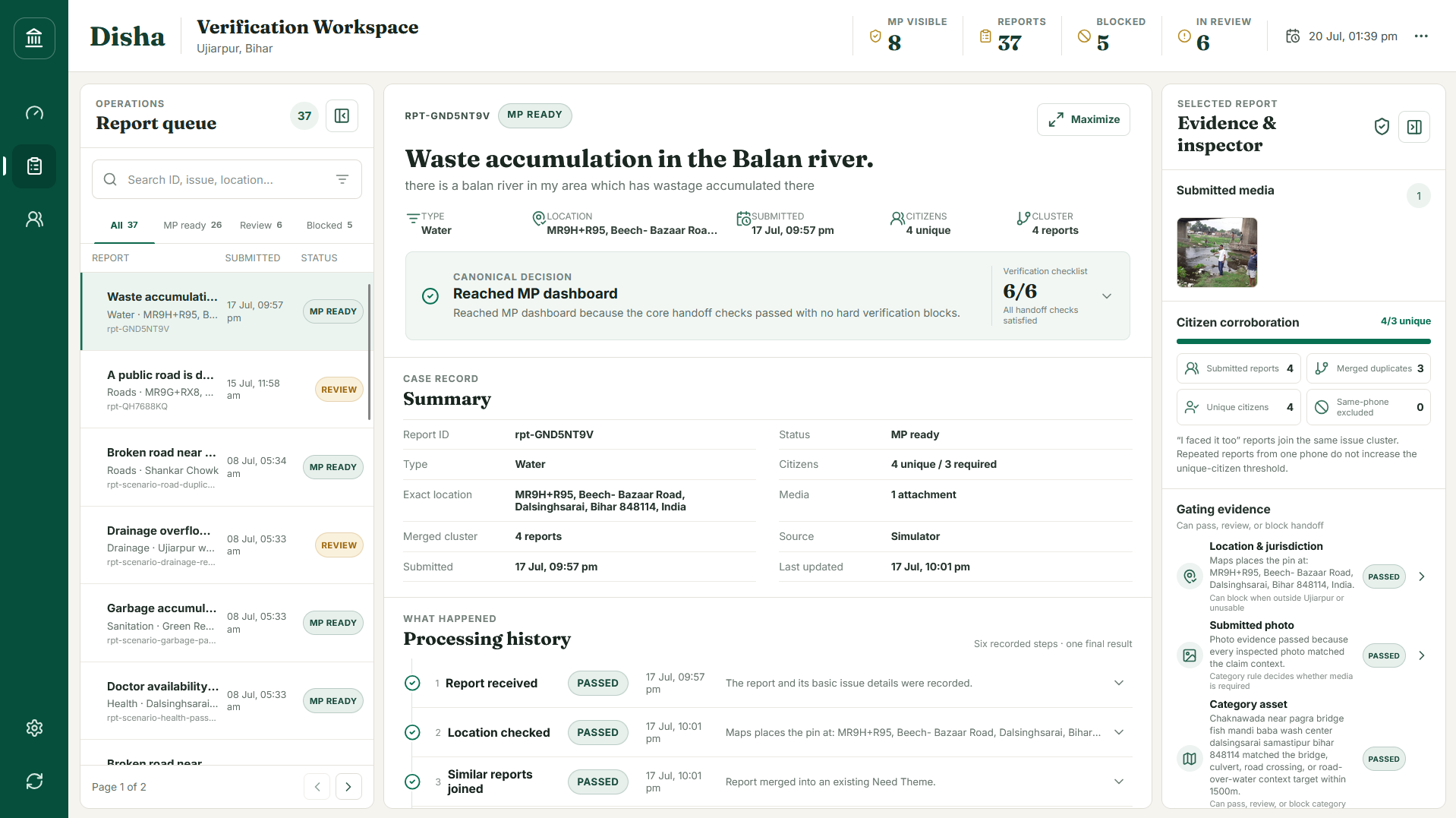
admin pannel
-
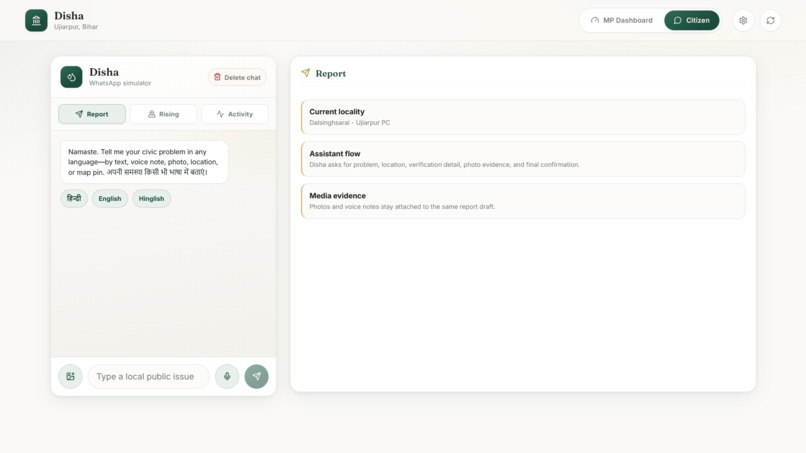
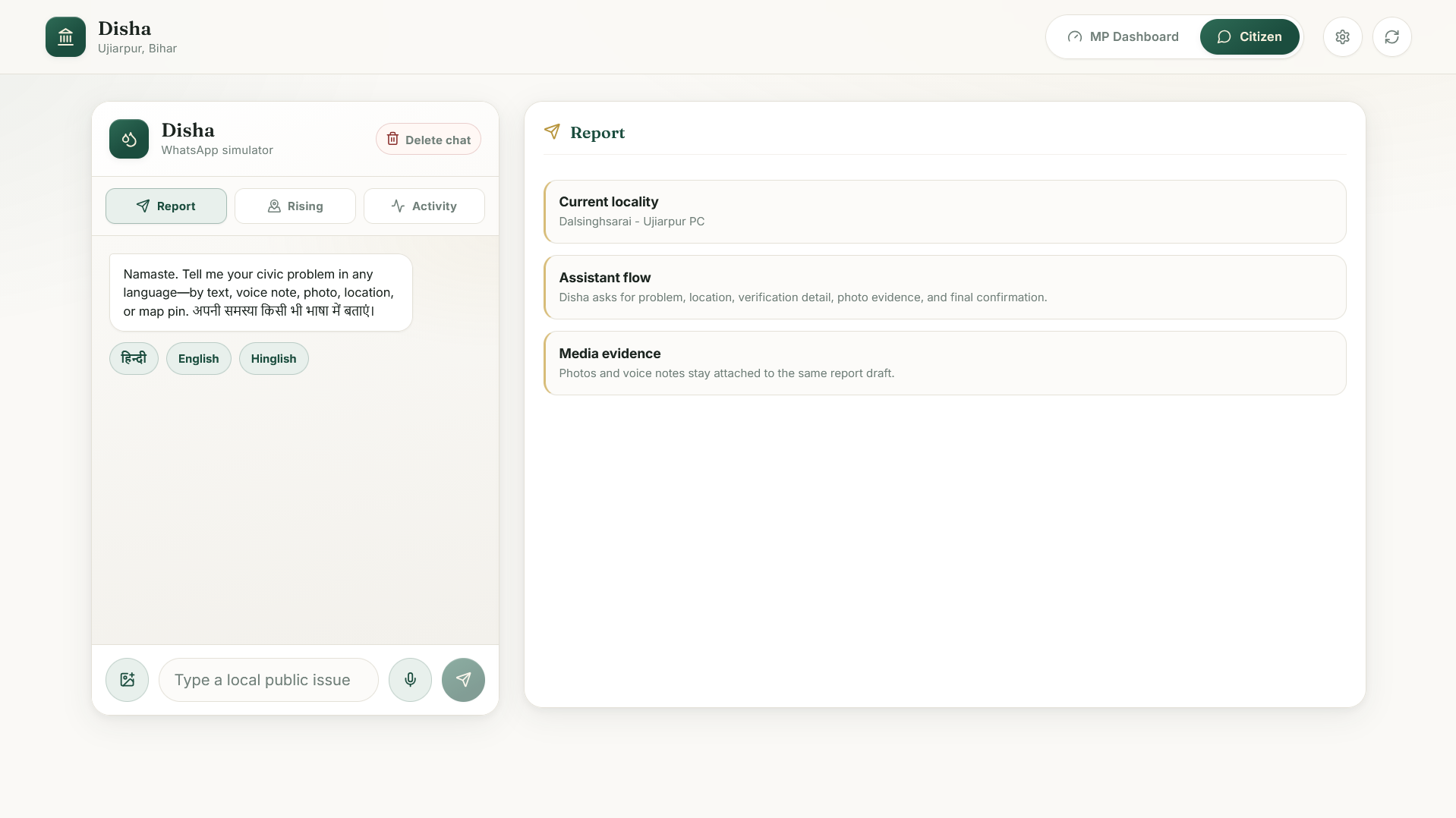
Citizen side , whatsapp simulation
-
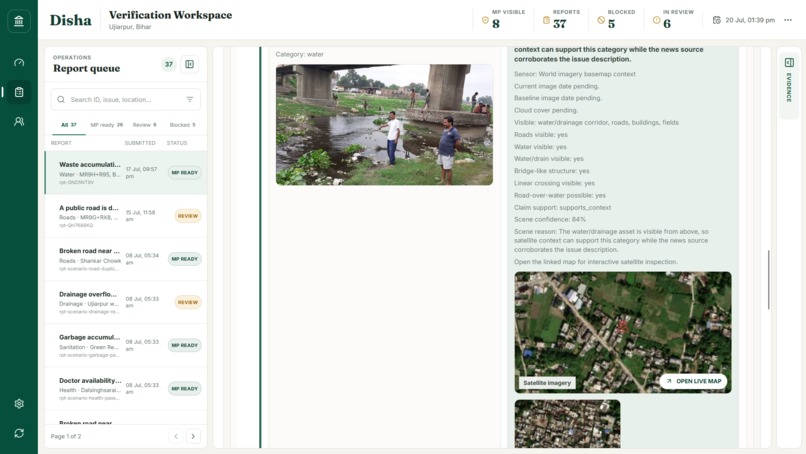
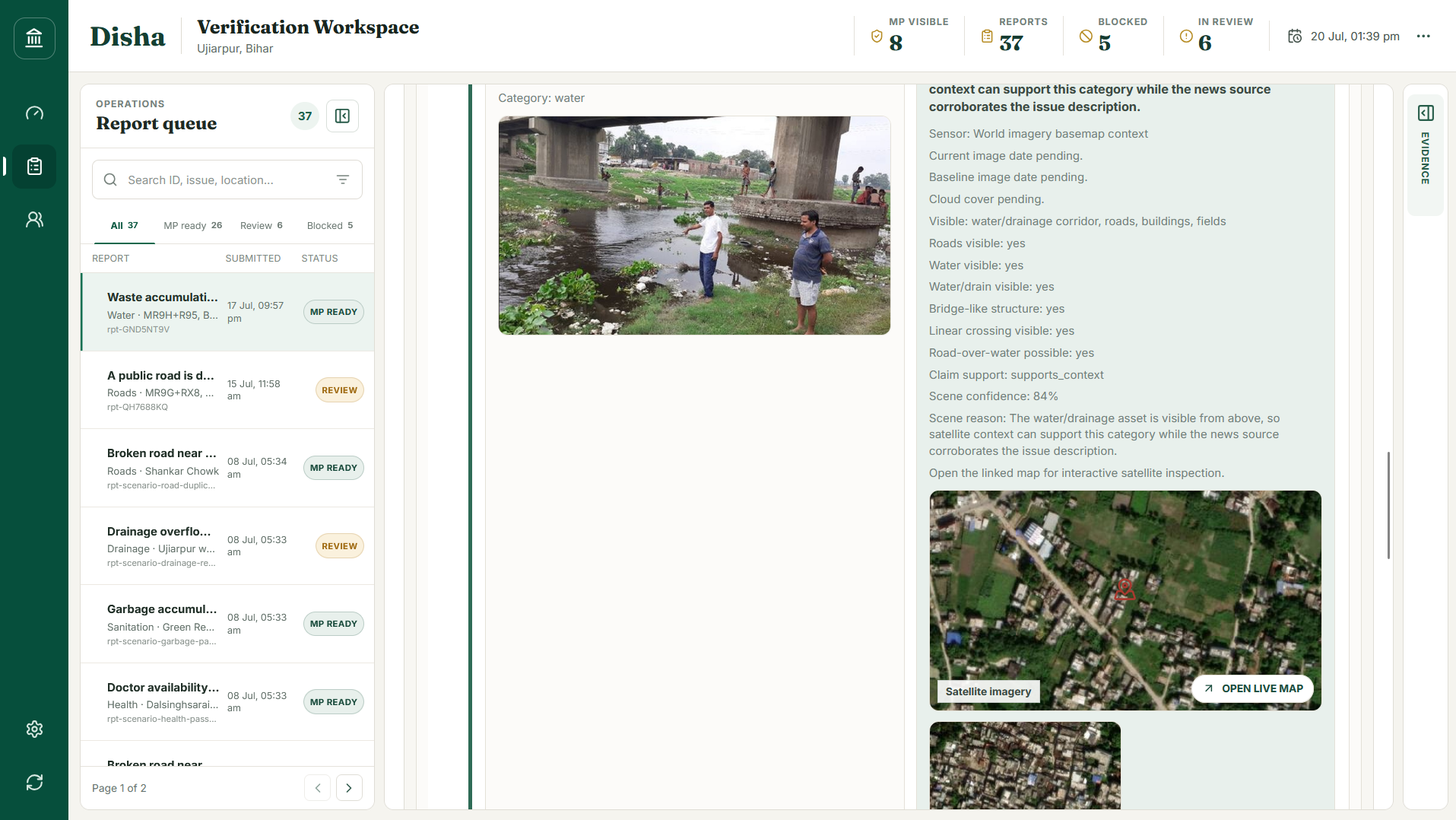
Verification process
Disha AI — Turning Citizen Voices into Development Priorities
Inspiration
In India, citizens report local problems such as damaged roads, water shortages, poor drainage, sanitation issues and inadequate public facilities through calls, WhatsApp messages, written applications and local representatives.
However, these reports are often scattered, difficult to verify and rarely compared through a fair, evidence-based process. Issues raised repeatedly or by influential groups may receive attention, while serious problems affecting remote and underserved communities can remain unnoticed.
This inspired me to build Disha AI, an AI-powered constituency development co-pilot that converts citizen reports into verified, explainable and evidence-backed priorities for Members of Parliament and their constituency teams.
Disha AI is not designed to replace elected representatives. It helps them understand community needs, compare competing development projects and make more informed decisions while keeping humans in control.
What It Does
Citizens can report local development problems through a multilingual WhatsApp bot or web platform using text, voice messages, photographs and location information.
Disha AI analyses each submission, checks whether the description, image and location are relevant, identifies duplicate reports and asks follow-up questions when important information is missing.
Related reports are grouped into a shared Community Need Theme. The system then enriches the issue with contextual evidence such as census information, maps, satellite imagery, public infrastructure data, relevant news and nearby citizen reports.
Verified issues are prioritised using an explainable framework:
[ \text{Priority} = \text{Need} \times \text{Reach} \times \text{Gap} ]
- Need measures urgency, severity and evidence strength.
- Reach estimates the people and public facilities affected.
- Gap considers whether the locality is underserved or lacks alternatives.
The MP Dashboard explains why an issue matters, how many people may be affected, what evidence supports it and why it may deserve attention. Representatives can compare two projects, review their cost, urgency, feasibility, equity and budget impact, and then accept, defer, decline or request further verification.
Citizens can also track the status and final outcome of their reports.
How I Built It
I built the citizen platform and dashboard using React and Vite, with Node.js and Express for the backend. The system uses Firebase Hosting, Google Cloud Run, Firestore and cloud storage for deployment, data and submitted media.
I integrated the WhatsApp Cloud API to make the platform accessible without requiring citizens to install another application.
The AI workflow supports text, image and voice analysis, structured information extraction, follow-up question generation, duplicate detection, contextual verification, issue grouping and explainable decision support.
I also designed the system to work with evidence sources such as maps, census data, news, satellite imagery and public datasets.
I used GPT-5.5 and GPT-5.6 as my primary development copilots while building the project. They helped me refine the idea, plan the architecture, generate and review code, debug integrations, improve prompts, identify edge cases and prepare the documentation and presentation.
I followed an iterative process: I described the feature I wanted, reviewed the generated approach, integrated it, tested it, identified failures and then improved it. I remained responsible for the product decisions, implementation, testing and final result.
Challenges I Faced
The biggest challenge was verification. A photograph alone cannot prove that an issue is genuine, recent or located where the citizen claims. Early versions could also accept unrelated images or continue without asking the most important follow-up questions.
To improve this, I designed multiple verification layers using media relevance, description consistency, location, duplicate detection, community corroboration, external evidence and human review.
Another challenge was prioritisation. The issue with the most reports is not always the most urgent or equitable. Communities with better internet access may submit more reports than remote villages. This led me to include infrastructure gaps, vulnerable populations, evidence strength and geographic equity in the ranking process.
I also faced challenges related to response time, multimodal processing, connecting several APIs and making the citizen conversation feel natural rather than like a long government form.
What I Learned
I learned that responsible civic AI requires much more than connecting a chatbot to a language model. It requires reliable data, explainable reasoning, privacy, bias awareness, uncertainty handling, auditability and human oversight.
I also learned that AI should support public officials rather than replace them. Disha AI organises evidence, identifies trade-offs and recommends priorities, but the final decision remains with the elected representative.
Most importantly, I learned that AI-assisted development still requires human ownership. GPT-5.5 and GPT-5.6 helped me develop faster, but I had to review the output, test the system, identify mistakes and decide what should actually become part of the product.
Disha AI represents my attempt to use modern AI to make public development planning in India more transparent, inclusive and evidence-driven.
Built With
- ai
- civictech
- cloud-run
- computer-vision
- conversational-ai
- decision-support
- evidence-verification
- express.js
- firebase
- firestore
- generative-ai
- geospatial-ai
- google-cloud
- google-gemini
- google-maps
- govtech
- human-in-the-loop-ai
- multimodal-ai
- node.js
- openstreetmap
- react
- vertex-ai
- vite
- voice-ai

Log in or sign up for Devpost to join the conversation.