Inspiration
All three of us are from China. When people refer to the Chinese language, they usually mean Mandarin. Chinese is not actually a language. In China, there are thousands of different dialects and languages, all spoken for different groups with different cultures and traditions. Today, more and more people choose to learn the “standard” dialect, which is Mandarin. This is causing marginalized communities to lose their languages, cultures, and traditions. We three are from different regions of China, and we all hope that our different cultures are preserved. We believe that as long as media from a culture is on the web and well-documented, the internet can preserve it forever.
What it does
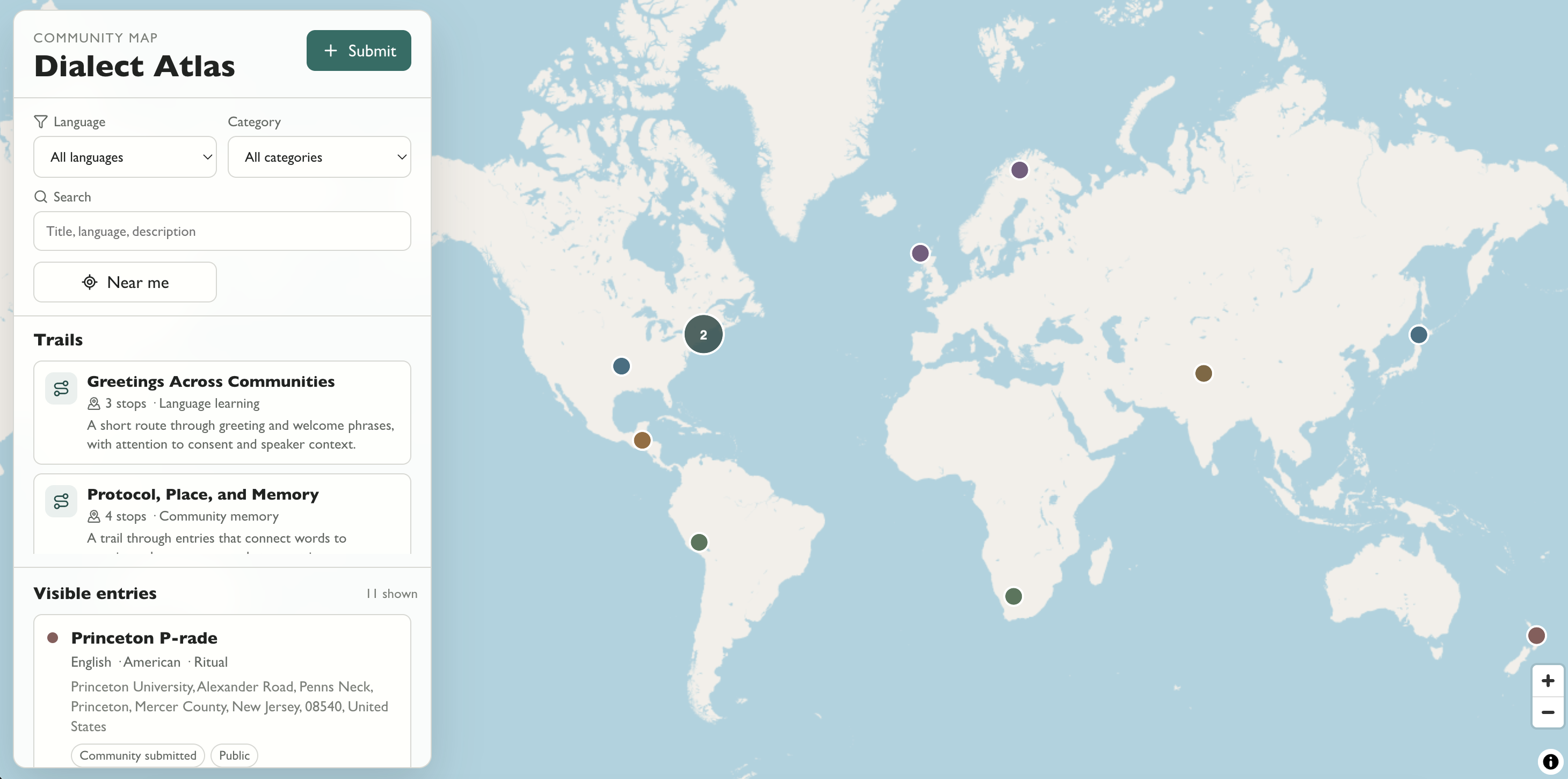
Dialect Atlas is an interactive world map for documenting languages, dialects, and cultural traditions. Community members add entries tied to a specific location, each containing a word, phrase, song, story, craft, dance, recipe, or recording. The result is a geographic record of cultural and linguistic material, organized by where it originates.
Each entry can include any type of multimedia such as audio, video, images, or text. Contributors provide details such as the language, dialect, category, and a description of the item and its context.
Beyond storage, the platform provides two analysis features. AI elaboration generates additional historical and cultural context for an entry. The AI also performs bias and source checks to flag which information is verified, which is contested, and where it comes from, so users can assess reliability rather than take generated text at face value. Unlike other softwares however, the AI features are not forced. AI is off by default and only works if you choose to use it.
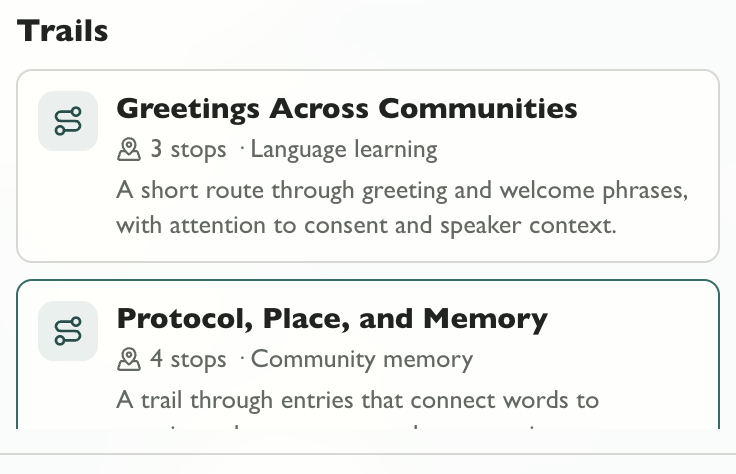
Entries can be linked into Trails: community-created sequences that connect related items, such as a song, the ritual it belongs to, and the dialect associated with it. Trails let users explore connections across entries rather than viewing them in isolation, letting our site tell more complete stories about cultures.
The platform is open to anyone, helping native speakers, researchers, and anyone documenting or exploring linguistic and cultural heritage.
How we built it
We built Dialect Atlas as a full-stack web app developed completely from scratch. The frontend is a React app written in TypeScript and bundled with Vite. The map itself is rendered with MapLibre GL JS using OpenStreetMap tiles, so there's no paid map API or key involved, ensuring that our service stays free for everyone. Markers are clustered and colored by category, and clicking one opens a detail panel with an inline HTML5 audio or video player, image, or text.
The backend is a Node.js server using Express, also in TypeScript. It exposes a small REST API (the /api/entries routes) for creating, listing, and fetching entries. Data is stored in SQLite through the Prisma ORM, with the schema written to be portable to Postgres later. Uploaded media (audio, video, images) is handled as multipart uploads, validated against a MIME-type allowlist, given safe unique filenames, and saved to local storage behind a swappable storage interface.
The AI features are powered by DeepSeek’s API. We chose DeepSeek because it provides high performance at a low cost, so our app will not become charged or cluttered with ads for features not everyone will use.
Challenges we ran into
We mainly ran into problems with our code (mainly in frontend-backend communication), but it is 2026, and those errors are easily fixed with AI agents. As a result, I feel that there will be more substance if we describe other non-technical issues. One of the biggest debates we had was about if the service should be open to everyone. This was an issue, because we wanted to prevent vandalism or fake information on the website. However, we ultimately decided to make it open to everyone to support the understanding of other cultures across the world. We decided that so long as we had good moderation like wikipedia’s there would be little to no misinformation or vandalism on the site.
Accomplishments that we're proud of
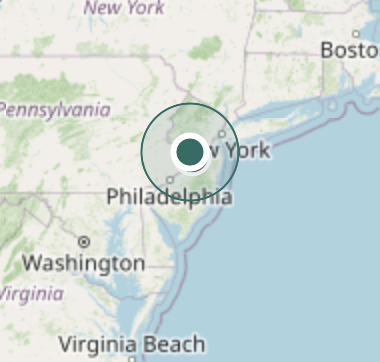
We are proud of creating a website that can spread cultural information across the world and inform people about specific niches of culture and to improve cultural appreciation across the world. We are also proud of creating a way for people to find ways to learn about their own culture by providing them with information about nearby events and information.
What we learned
We ended up being in a rush as we finished our project, next time we should prioritize finishing the project quickly but still maintaining the same quality by spending less time doing unrelated things.
What's next for Dialect Atlas
It is currently locally hosted with ngrok as a temporary way to run the website. Moving the backend to a vps and hosting the frontend on something like github pages or vercel would be a next step to our project. We also wish to add more features that allow for a more robust backend server so that nothing will ever be lost due to errors. We don’t have plans for any additional features, since we want this to be simple and accessible to everyone.
Built With
- css
- deepseekapi
- maplibre
- node.js
- openstreetmap
- sqlite
- typescript

Log in or sign up for Devpost to join the conversation.