Inspiration
Dengue outbreaks in Singapore are often managed reactively, so we wanted to explore how technology could help us see the risk before an outbreak happens, lah. We were inspired by the idea of combining real-time environmental data with existing dengue cluster information to give communities more time to prepare.
How we built it
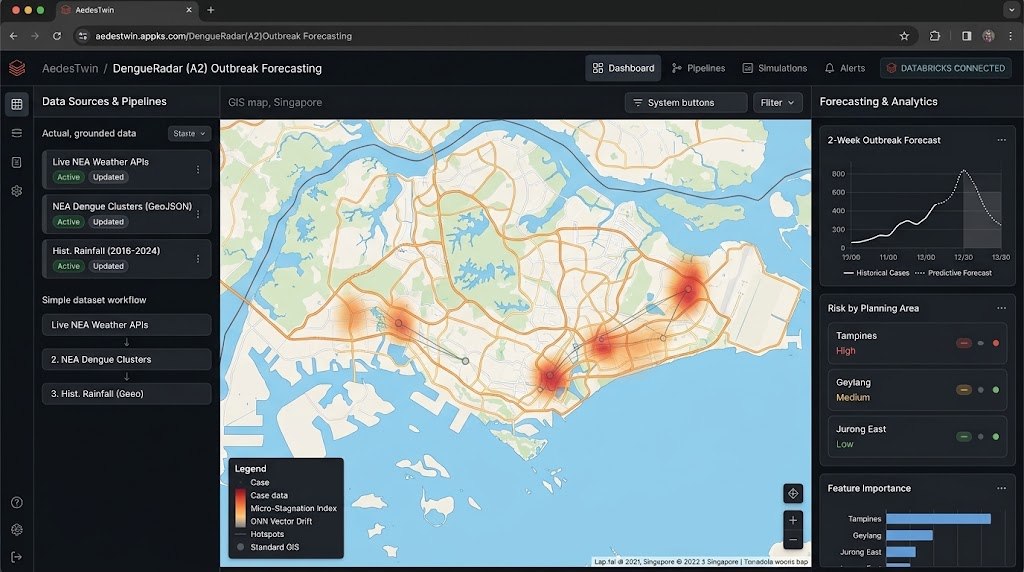
We built DengueRadar, a real-time dengue forecasting system that combines live NEA dengue clusters, rainfall, temperature, and geospatial data to predict dengue risk up to two weeks ahead, can. We introduced a Micro-Stagnation Index to estimate how rainfall and temperature conditions could affect mosquito breeding conditions across different planning areas. We then combine these environmental signals with existing dengue clusters and human movement patterns using a Graph Neural Network (GNN) to identify potential "vector drift" into neighbouring areas.
Challenges we ran into
One of our biggest challenges was combining different types of data, because weather, dengue cases, geographical areas, and human movement all have different structures and time scales, lor. We also had to make sure that our predictions were explainable rather than simply producing a risk score without showing why an area was considered high risk.
Accomplishments that we're proud of
We are proud of creating an interactive system that can visualise current dengue clusters while providing Low, Medium, and High-risk predictions for different planning areas. The system also connects environmental conditions with dengue spread, allowing users to better understand the factors behind each prediction, leh.
What we learned
We learned that building a predictive system is not just about choosing an advanced machine learning model, but also about making sure the data is reliable, meaningful, and easy to interpret, sia. We also learned how combining different data sources can provide insights that would not be possible from looking at individual datasets alone.
What's next for DengueRadar
Next, we want to improve the accuracy of our forecasts with more historical data and additional environmental factors, can. We also hope to introduce automated alerts when risk levels cross a certain threshold, allowing authorities to prioritise inspections and preventive measures before cases surge. Ultimately, DengueRadar aims to help Singapore move from reacting to dengue outbreaks to preventing them before they spread, lah.


Log in or sign up for Devpost to join the conversation.