-
-
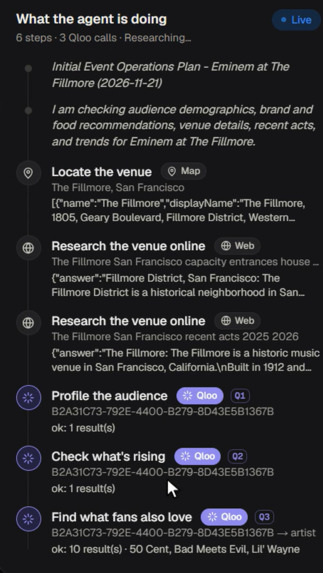
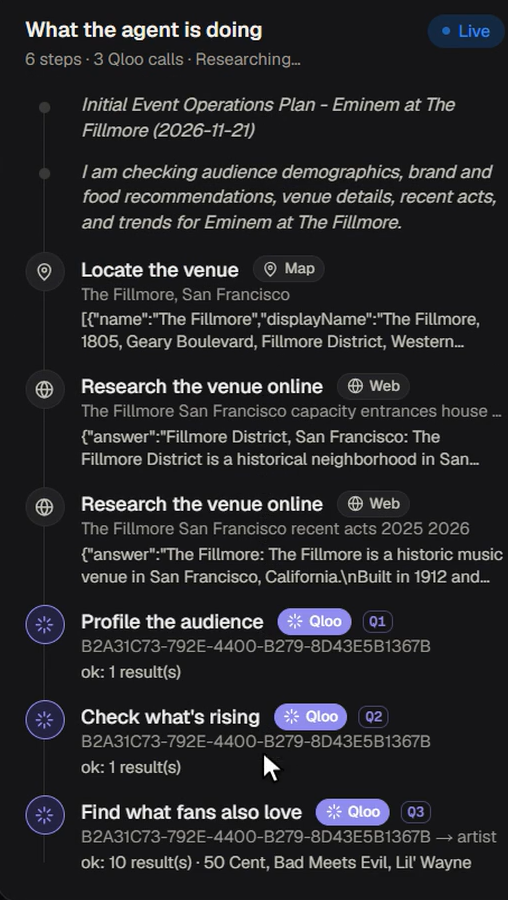
The agent at work: every step is shown live, here researching The Fillmore online (capacity, entrances, recent acts).
-
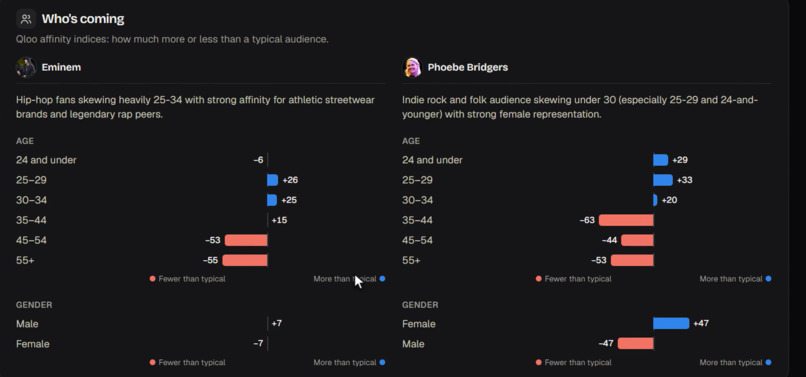
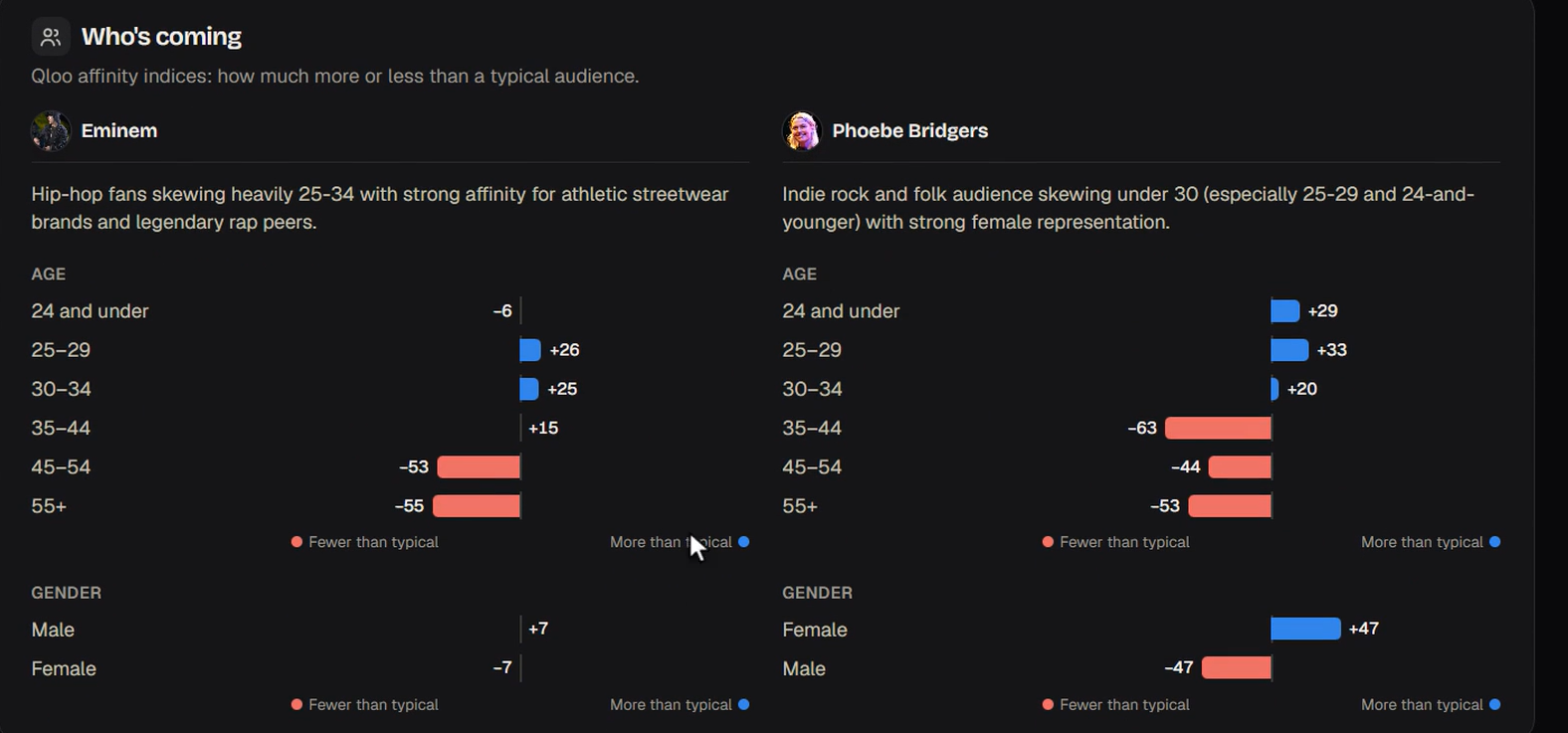
Same venue, different crowd: Qloo's age and gender profiles for Eminem vs Phoebe Bridgers at The Fillmore.
-
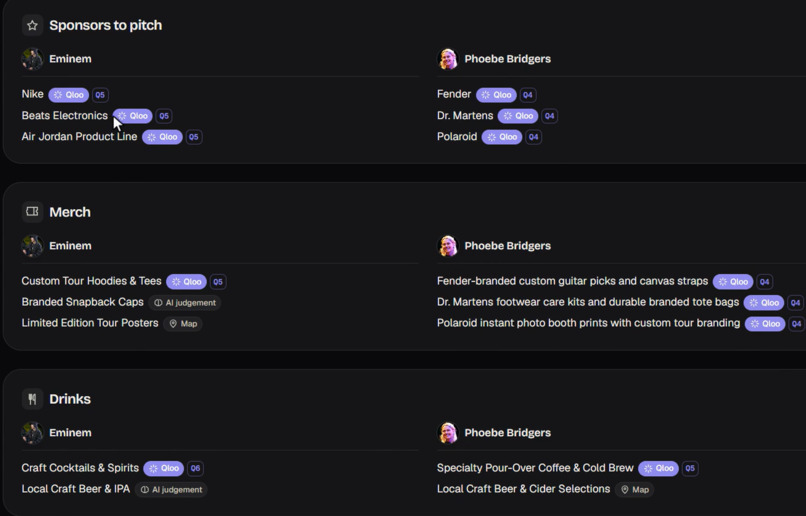
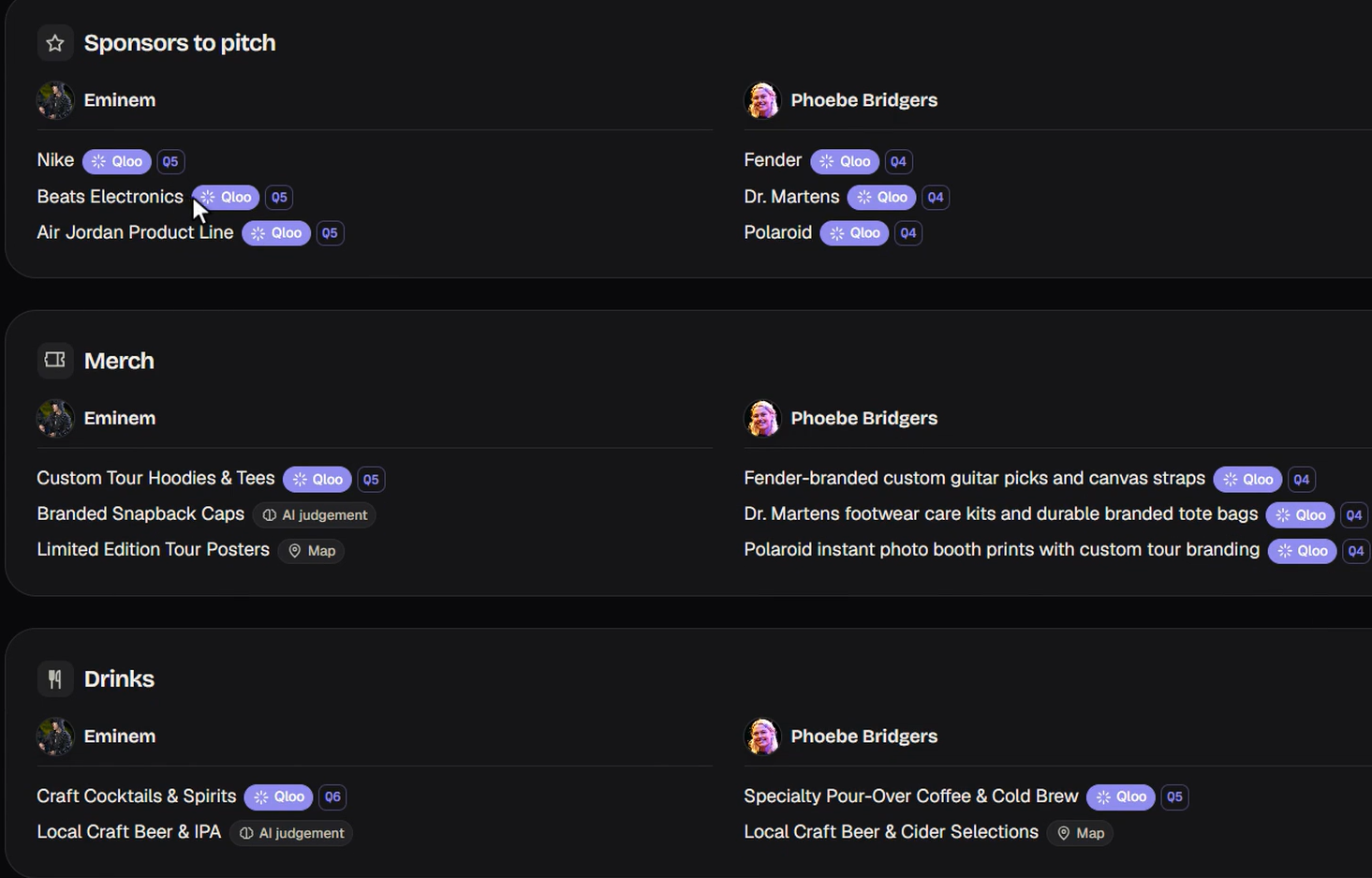
Sponsors, merch and drinks change with the crowd: Nike and Beats for Eminem; Fender, Dr. Martens and Polaroid for Phoebe Bridgers.
-
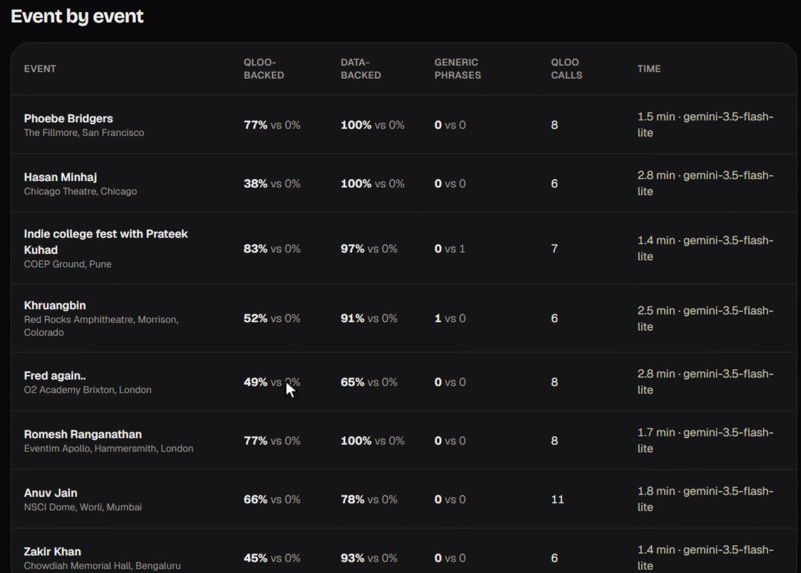
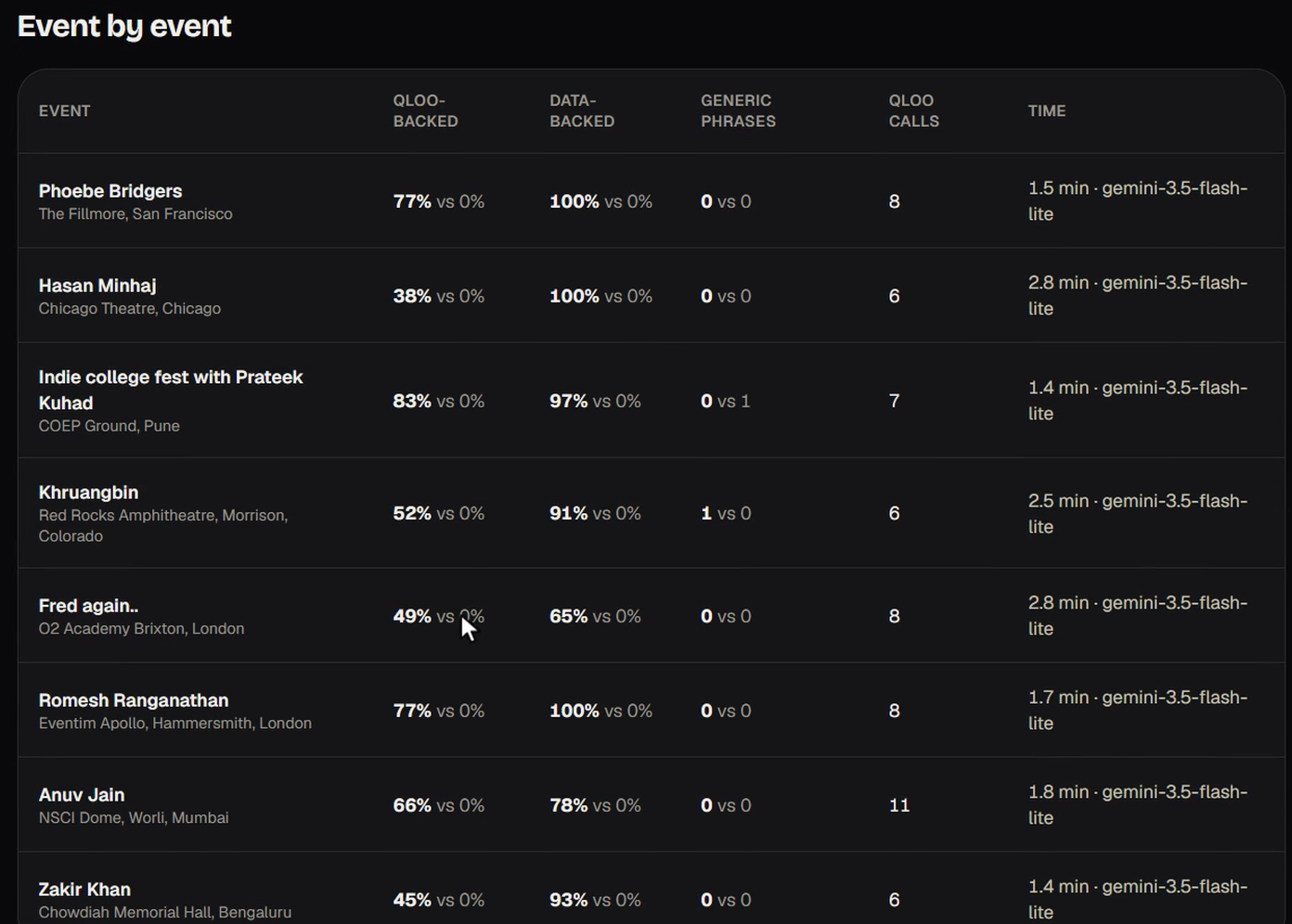
Evidence: 8 real events in the US, UK and India, each planned with and without Qloo. 61% of items Qloo-backed on average, vs 0%.
-
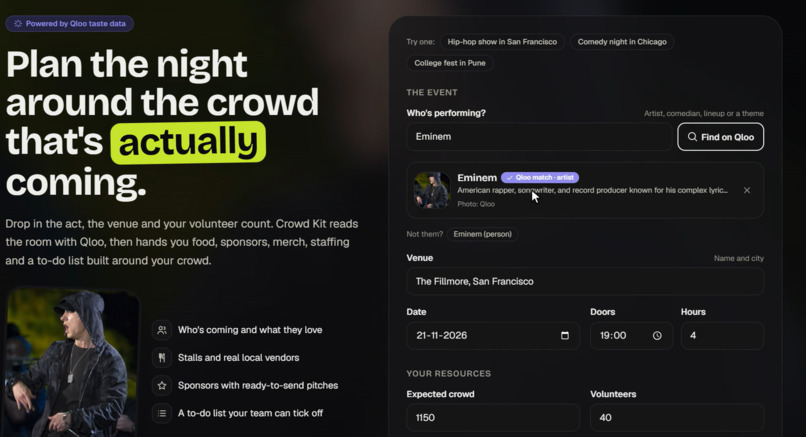
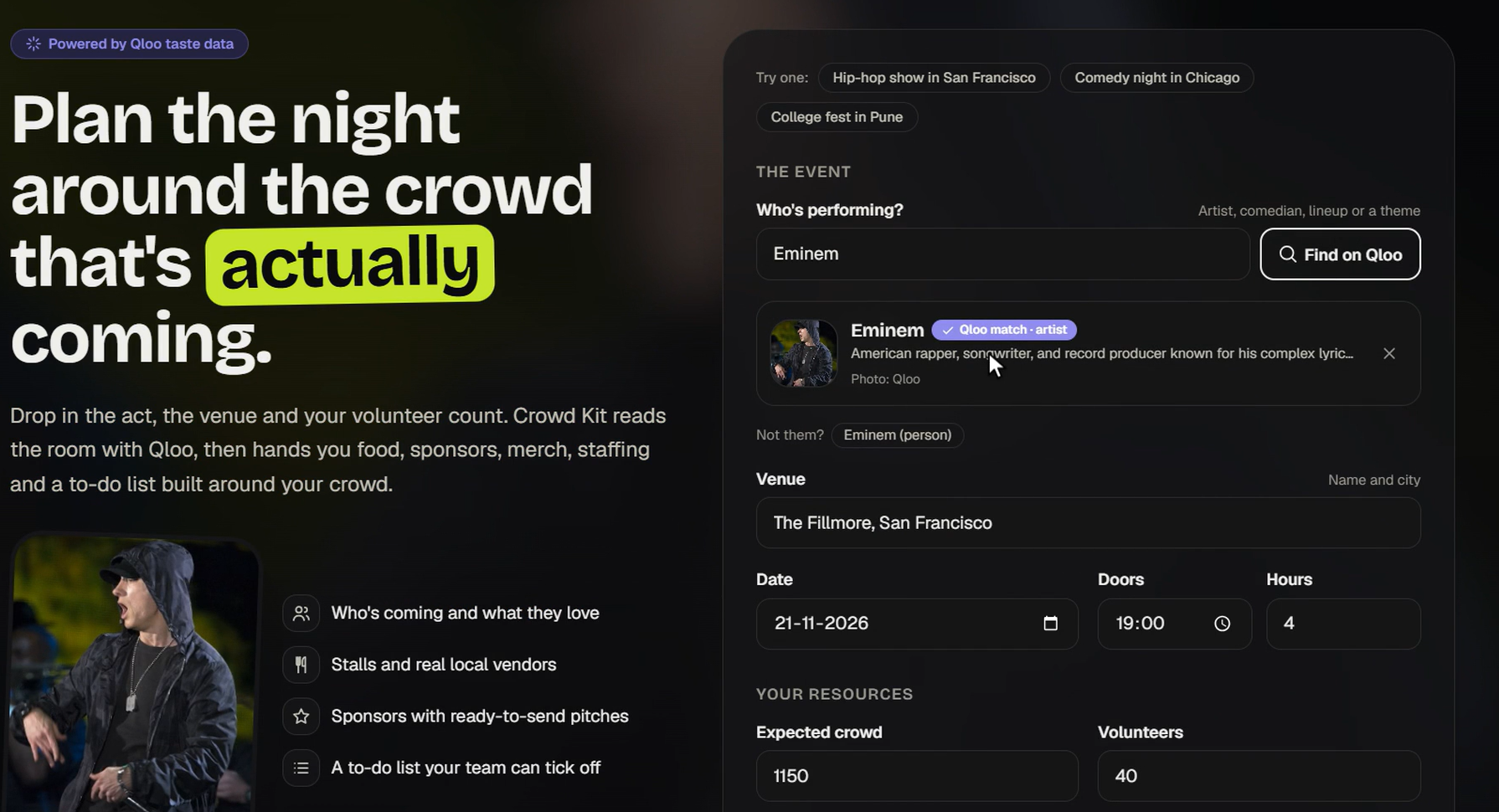
Start with the act, venue, date and crowd size. Find on Qloo confirms the exact artist before the agent plans.
-
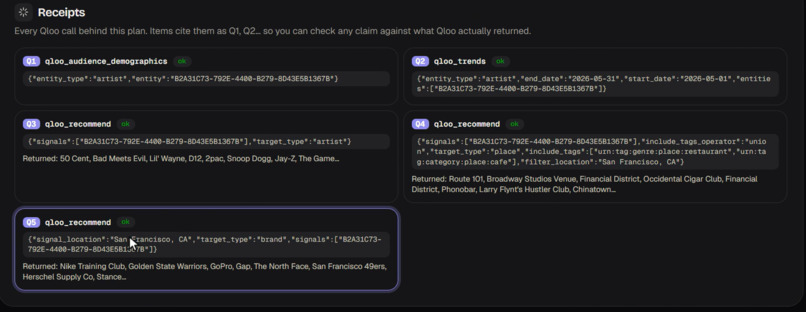
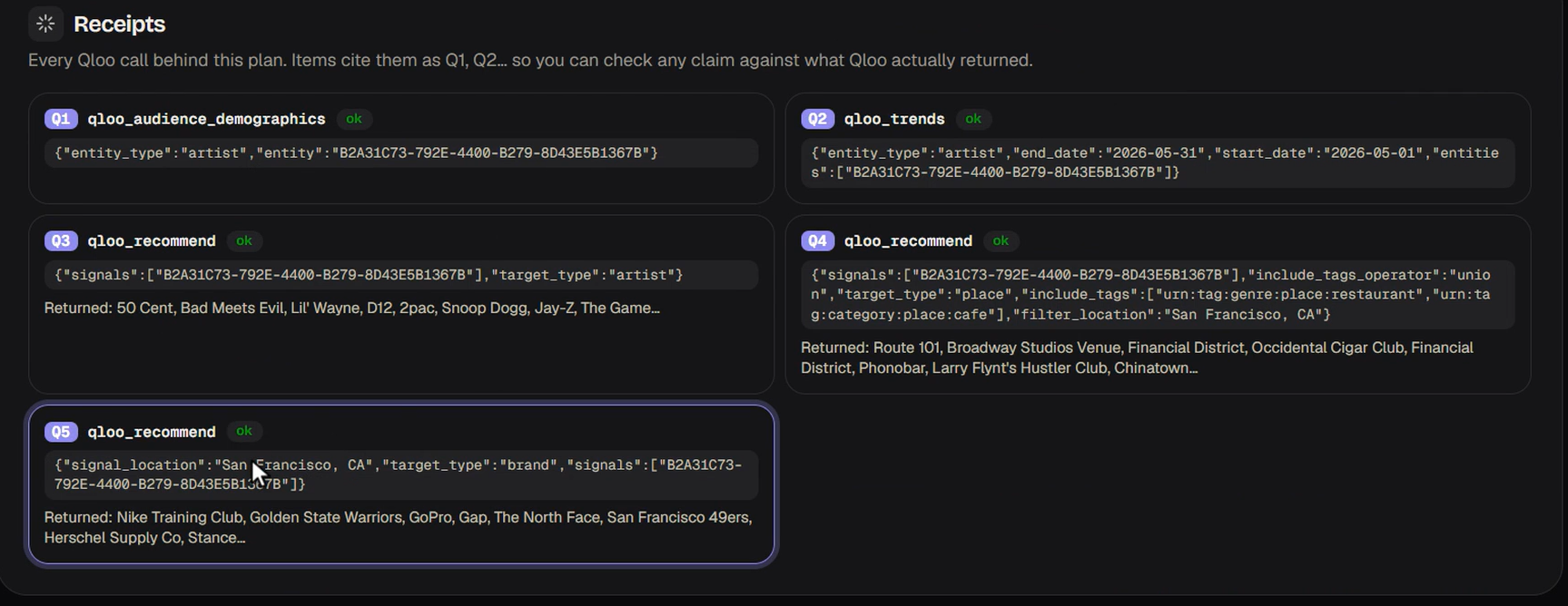
Receipts: every Qloo call behind the plan, with what was asked and what came back, so any Qloo-backed claim can be checked.
-
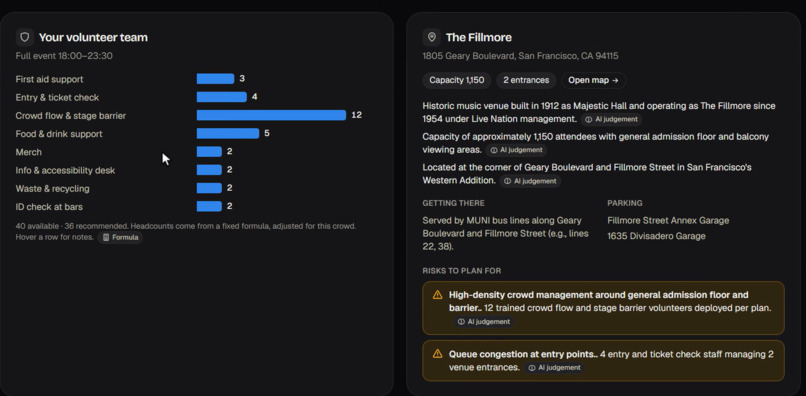
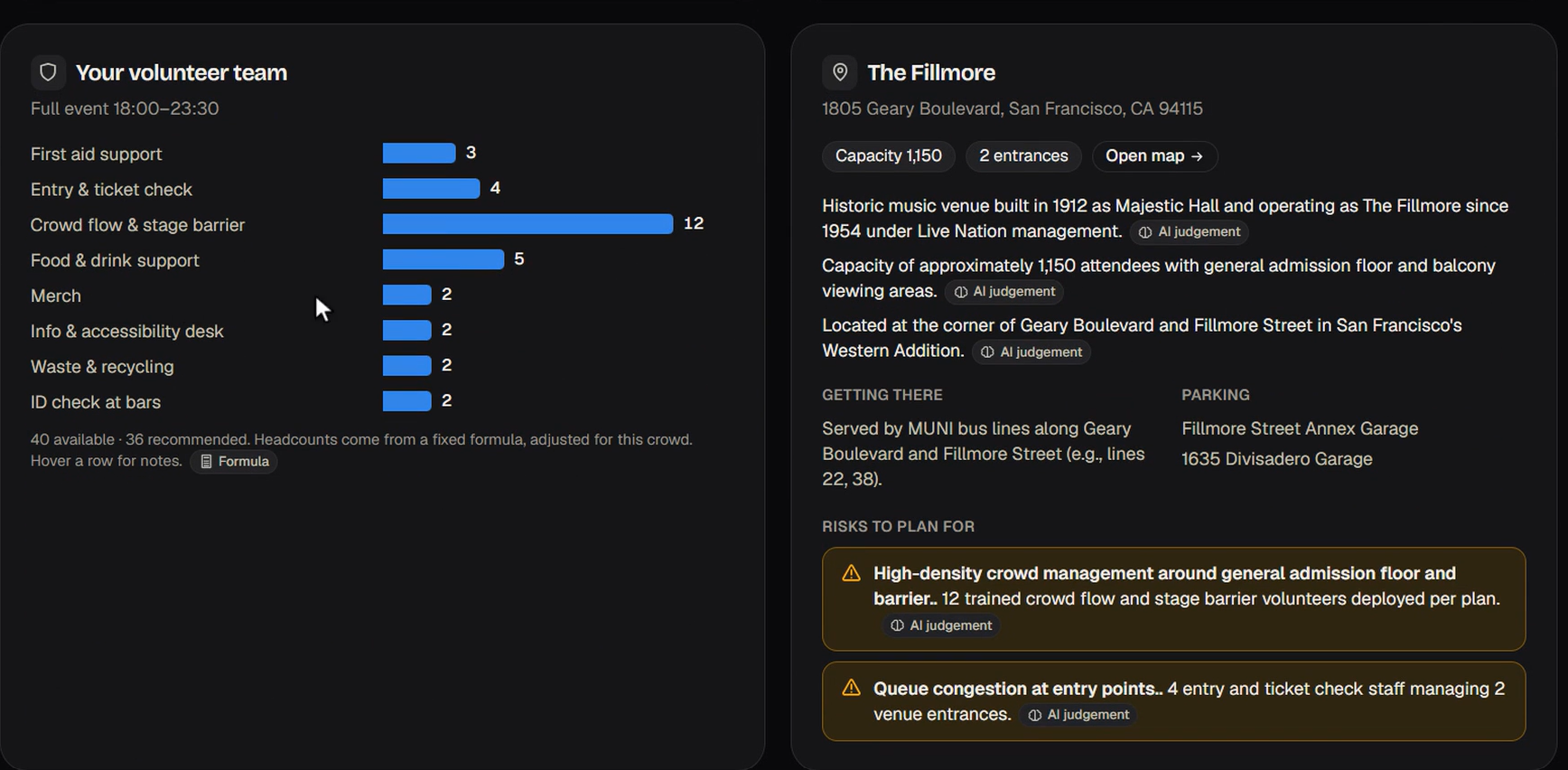
Volunteers by station from published crowd-safety guidance, plus venue facts, transit and the risks to plan for.
-
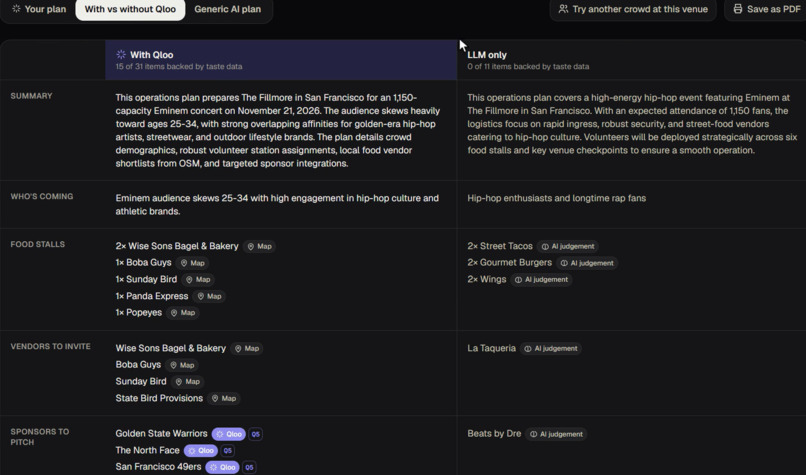
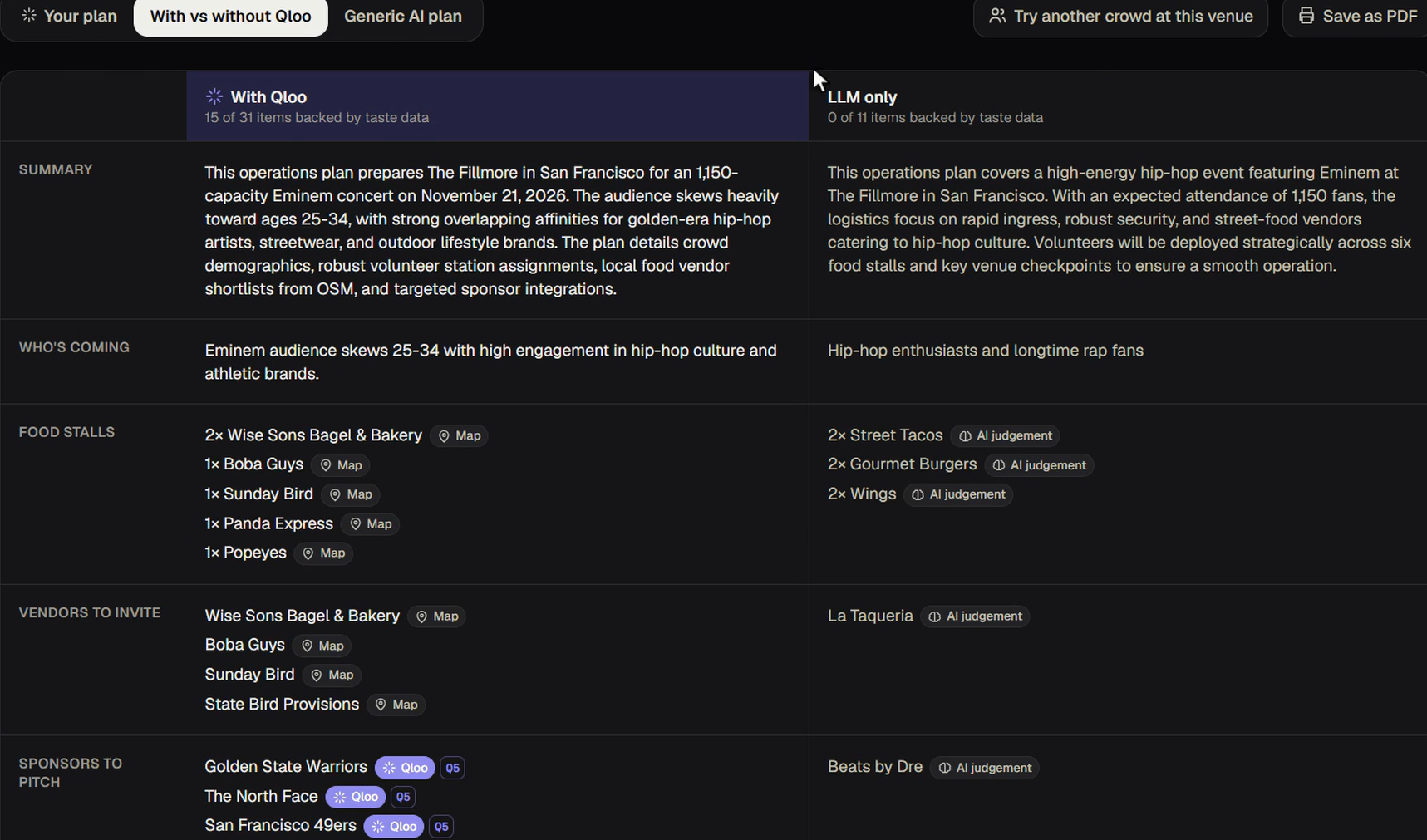
With vs without Qloo: same model, same brief. With Qloo you get named vendors and sponsors; without, generic guesses.
-
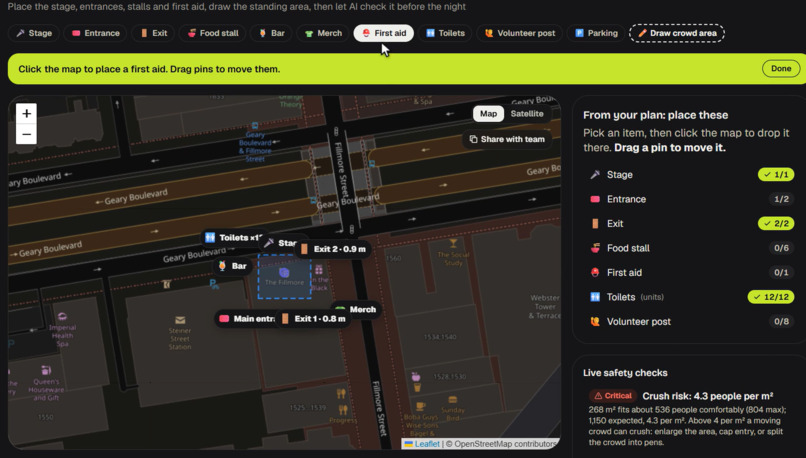
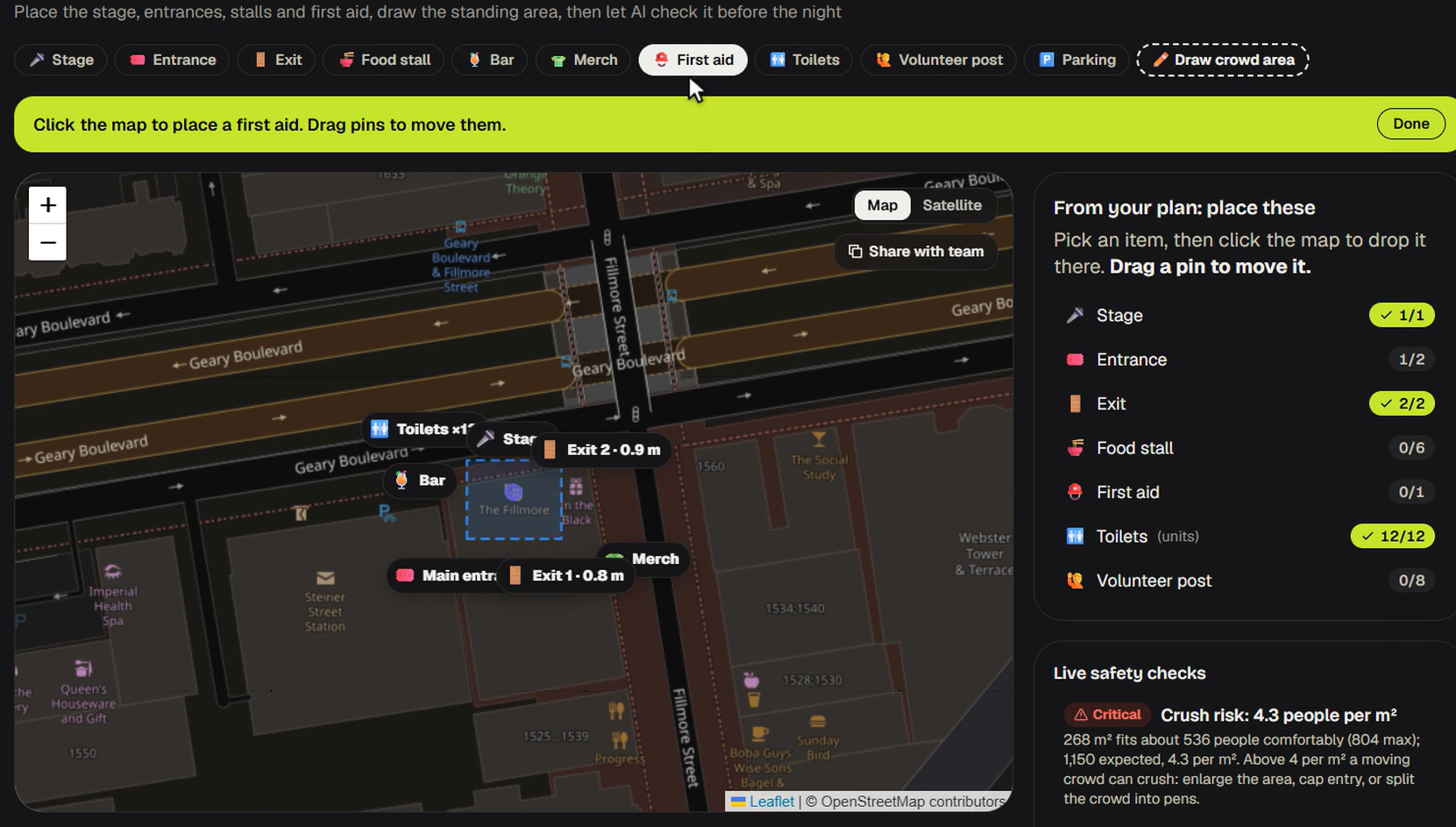
Site map: place the stage, exits, stalls and first aid on a real map, with live checks for crush risk and time to get everyone out.
-
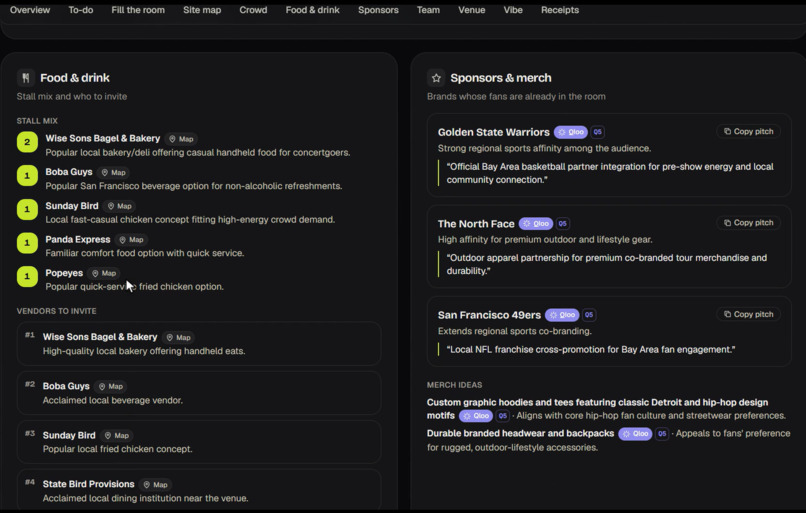
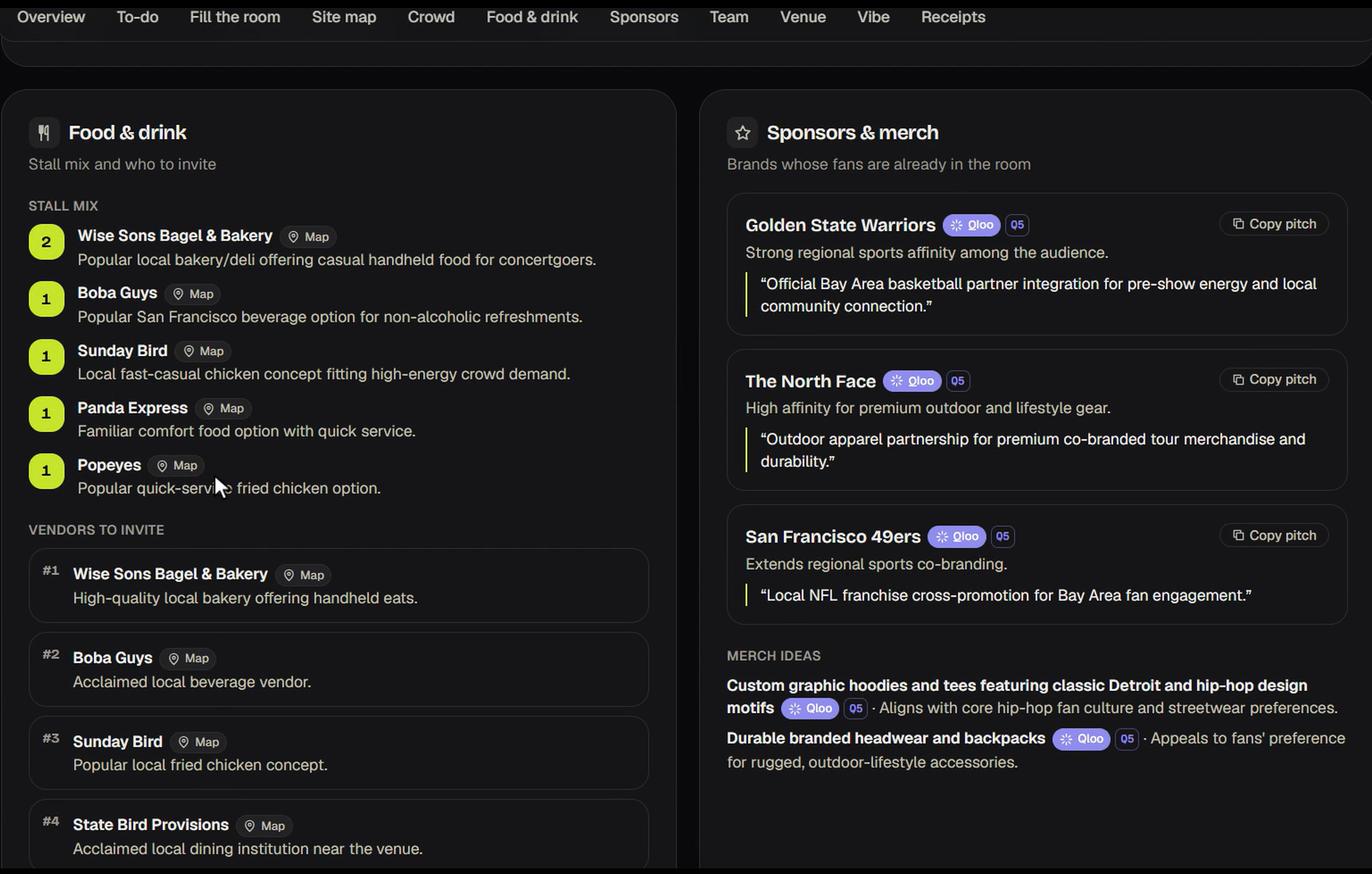
The plan: a stall mix with real nearby vendors, and sponsors whose fans are already in the room, each with a ready-to-send pitch.
Inspiration
People who run gigs, comedy nights and college fests make the same expensive calls every time: which food stalls to book, which sponsors to pitch, what merch to print, how many volunteers to put on the door, and where the stage, exits and first aid go. Most of those calls come from gut feel or "what we did last year". A stall nobody visits is wasted money, a sponsor that doesn't fit the crowd says no, and a badly laid-out site causes crushes and queues on the night.
The answer is usually already known in aggregate: people who love this act also tend to love certain foods, brands, places and artists. Qloo's taste graph holds that knowledge. We wanted to turn it into a plan an organiser can act on, not another chatbot answer.
What it does
The organiser enters the act, venue, date, expected crowd and volunteer count. Find on Qloo confirms the act (with its photo) so the agent works with the exact Qloo entity. An AI agent then researches who is coming (Qloo) and where they are going (venue facts, transit, weather) and returns a dashboard:
- Who's coming: age and gender compared with a typical audience, what fans over-index on, and how tonight's crowd differs from the venue's usual crowd.
- Food & drink: a stall mix that fits the organiser's slots and real nearby vendors, ranked for this audience.
- Sponsors & merch: brands whose fans are already in the room, each with a ready-to-send pitch.
- Volunteer team: stations and shifts from a fixed formula built on published crowd-safety guidance: the Purple Guide for first aid, the Green Guide for entry lanes and stewards, NFPA 101 for crowd managers. Safety stations are filled first when volunteers are short. Qloo's age profile sets the weights in code, not the model: a younger crowd gets more people on merch, an older crowd more at the info and accessibility desk, and each station note cites the Qloo receipt.
- To-do list: every task the plan implies, ready to tick off, with copy-pitch buttons.
- Fill the room: for shows with seats left, the neighbourhoods where this crowd stands out, local places to drop posters, podcasts to pitch, and captions written for this crowd.
- Site map: place the stage, entrances, exits, stalls, first aid and toilets on a real map, draw the standing area, and get live safety checks:
- crowd density in people per m², with a crush warning above 4 per m²;
- time to get everyone out, from each exit's width at the Green Guide planning rate (82 people per metre per minute, 8-minute limit), checked again with the widest exit blocked;
- toilet ratio, first-aid distance, and queues near entrances.
An AI layout review (optionally with a stage photo) flags crushes, blocked exits and queue clashes before the night. Share an editable copy with the team by link.
- Same venue, different crowd: pick two acts for one venue. Crowd Kit plans both nights with Qloo and shows exactly what changes: who's coming, staffing by station, food, sponsors, merch, drinks and playlist. Eminem vs Phoebe Bridgers at The Fillmore is a different crowd (male-leaning vs strongly female, far fewer over-35s for Phoebe), a different merch team (Phoebe's younger crowd gets one more), and a different sponsor list (Nike and Beats vs Fender, Dr. Martens and Polaroid). Every difference is computed in code from the two Qloo-backed plans.
Every claim shows its source (Qloo, web, map, weather, formula or AI judgement), and Qloo-backed claims link to a receipt: the exact Qloo call that produced them. A "with vs without Qloo" view runs the same brief through the same model with no tools, so you can see what the taste data changes.
How we use Qloo
All Qloo access goes through Qloo's hackathon harness (qloo mcp), which Crowd Kit starts as a local MCP server and gives to the agent as tools:
qloo_describe,qloo_find_tags: resolve the act (or a theme with no headliner) to Qloo entities; ambiguous matches are recorded as assumptions, never guessed silently.qloo_audience_demographics: age and gender as over/under-indexing, copied as returned.qloo_recommend: brands, places in the venue's city (with exact tag IDs for food places) and artists fans over-index on.qloo_compare_audiences: tonight's crowd vs the venue's regulars.qloo_rank: rank real shortlists (nearby vendors, candidate sponsors) for this audience.qloo_where_popular: neighbourhood hot spots for promotion, ranked against how busy each area is in general.qloo_trends: rising artists for the pre-show playlist.
What we learned from live calls shaped the agent: pass Qloo IDs, not names (names are ambiguous); use exact tag IDs (category words are ambiguous); locations must be "City, Region" (a neighbourhood name once resolved to Bogotá). Qloo's taste data also drives logistics: its age indices set the staffing weights in code, and the crowd profile informs the AI layout review.
Evidence: does Qloo make the plan better?
We run 8 real events twice: with Qloo, and with the same model, brief and quality bar but no tools. The events cover the US, UK and India, and music, comedy and a college fest. The numbers are published at /evidence:
- 61% vs 0% of plan items backed by Qloo taste data
- 91% vs 0% of items tied to a data source rather than the model's own say-so
- 32 vs 11.5 specific items per plan
- 183 vs 0 claims citing a Qloo receipt
The evaluation also made the agent better. It showed that a free-text audience filter made Qloo ask for clarification 36 times across the 8 events. We removed the filter, and that fell to 2.
Honesty is enforced in code: a plan is rejected if it labels a vendor, sponsor or artist "Qloo" that no Qloo call returned, or uses a source whose tool failed in that run.
How we built it
- Next.js 16 + TypeScript, one streaming API route that sends the agent's live trace and the final plan to the browser.
- Gemini (free tier) agent loop with function calling over our tools: Qloo via MCP, OpenStreetMap (geocoding, nearby places), Open-Meteo weather, web search (Gemini with Google Search grounding, falling back to Wikipedia), and a deterministic staffing formula. Every request has a time limit and falls back through several Gemini models when one is overloaded.
- Zod schemas define the plan, so the agent must return a typed, sourced plan;
submit_planvalidates it and sends errors back for the agent to fix. - Leaflet site map on OpenStreetMap tiles; layouts save in the browser and share by link, no database needed.
- Code computes, the model explains: staffing, safety checks and promo hot spots are calculated; the model writes the words.
- Deployed as one Docker container on Render (the
qlooharness is a local process, so not serverless). A server-side cache replays identical events instantly.
Challenges we ran into
- Hackathon keys and the harness: the harness defaults to Qloo's production server, which rejects hackathon keys; we point it at the hackathon server.
- Ambiguity everywhere: acts that are both an "artist" and a "person", category words with several tags, neighbourhoods resolving to the wrong country. We learned to pass exact IDs.
- Free-tier reliability: Gemini models hang or hit quotas; we added time limits, a model fallback chain and cooldowns, and the UI says what's happening.
- Free web search from a shared server: free Google Search only works on older Gemini keys, and Wikipedia rate-limits cloud servers. Searches now go one at a time, look up the venue name first, and step aside for a while when blocked, so plans never fill with failed steps; only clean runs are saved for replay.
- Keeping sources honest: a weaker model labelled invented vendors as Qloo-backed, so we added the source check in code and receipts.
- Fair comparison: the "without Qloo" baseline gets the same brief and quality bar, so the difference comes from the data, not a weaker prompt.
Accomplishments that we're proud of
- Plans where almost every line traces back to a data source, with receipts anyone can check.
- A measured, reproducible with-vs-without-Qloo comparison instead of a claim.
- A complete organiser tool: plan, to-do list, promotion, site map and safety review in one flow.
What we learned
Taste data is most useful when it decides things that cost money (which vendors, which sponsors, how many people on merch) and when every claim can be checked. Being explicit about what the data does not establish made the product more trustworthy, not less.
What's next
- Post-event feedback (did the stalls sell, how long were queues) to tune the plan.
- One-click vendor and sponsor outreach.
- Multi-day festivals with a plan per stage and day.
Known limitations
- Qloo describes aggregate audience affinities, not individual attendees; plans say "fans over-index on X", never "attendees will buy X".
- Safety checks and staffing follow published guidance where it exists and rules of thumb elsewhere; they support, never replace, a professional safety plan.
- Runs on Gemini's free tier, so a new plan usually takes 1–2 minutes and Google may use free-tier requests to improve its products; don't enter private data.
- Qloo coverage varies by act and city; comedy and smaller acts return less.
Built With
- docker
- gemini
- leaflet.js
- mcp
- next.js
- open-meteo
- openstreetmap
- qloo
- react
- render
- tailwindcss
- typescript
- zod

Log in or sign up for Devpost to join the conversation.