-
-
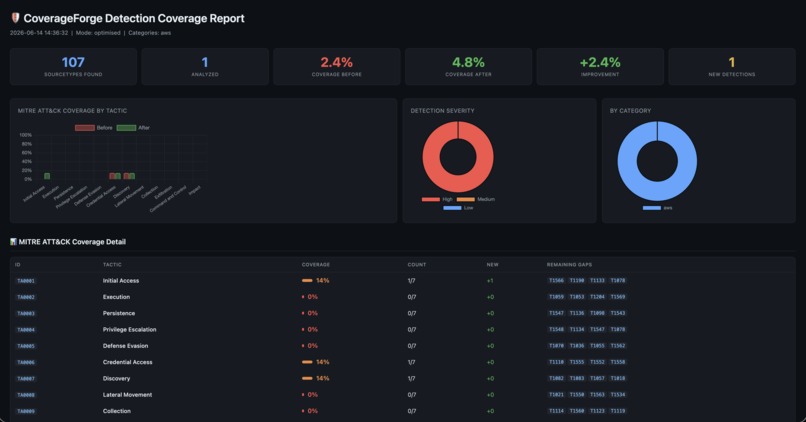
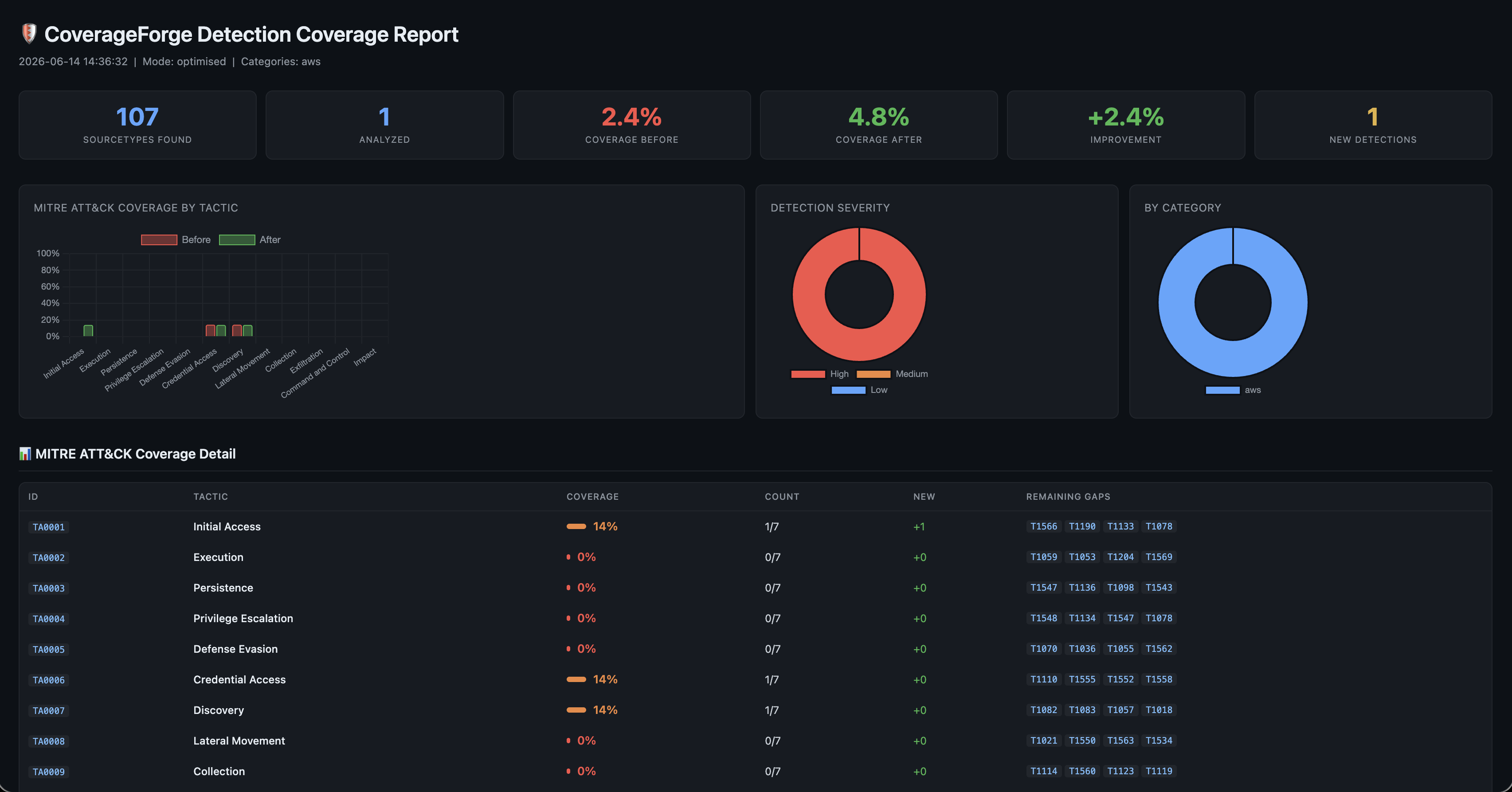
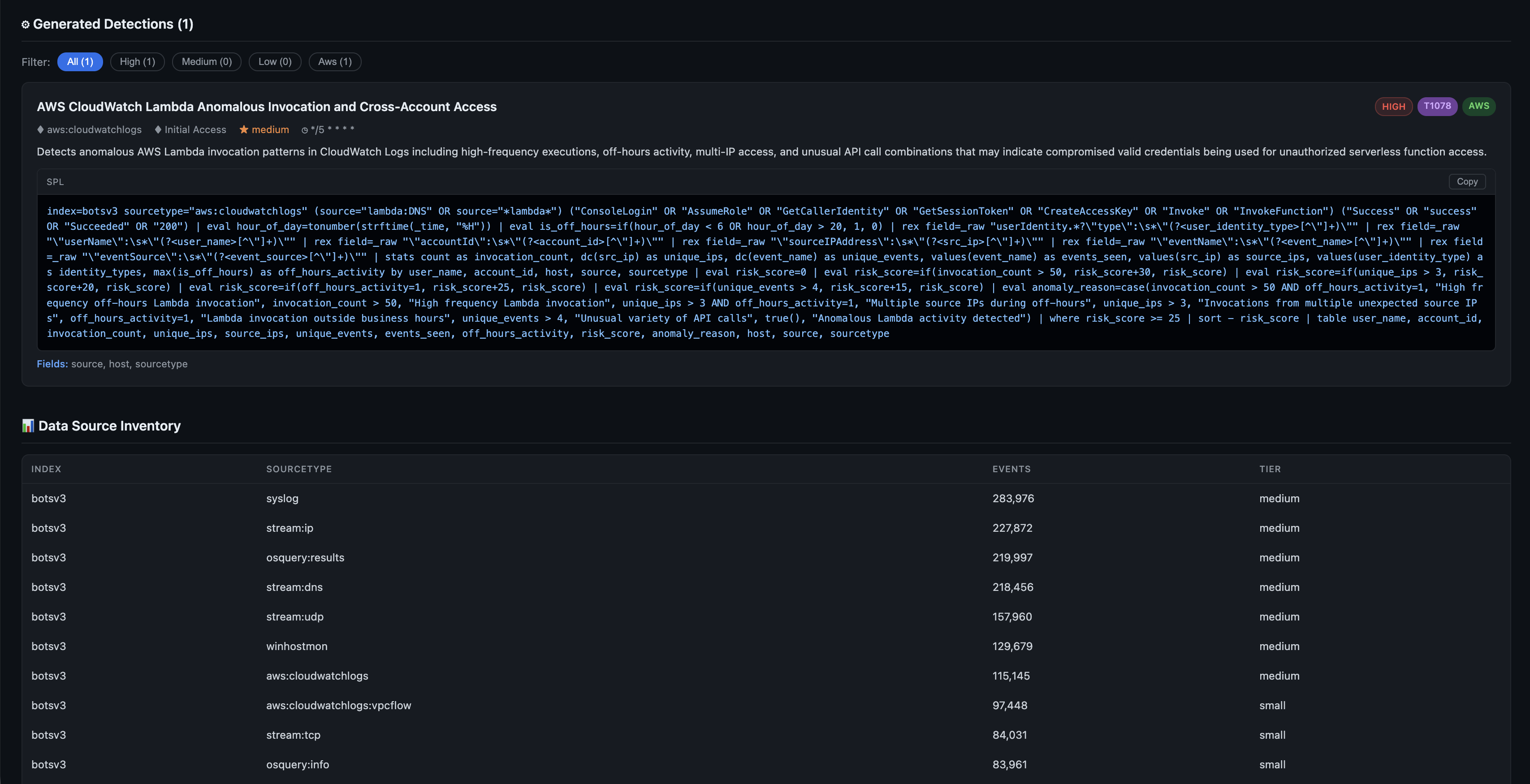
HTML Detailed Report
-
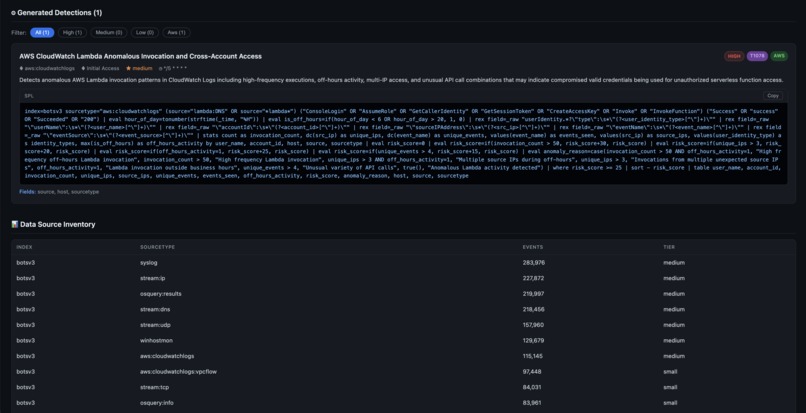
Searches Built Along with Number of Events
-
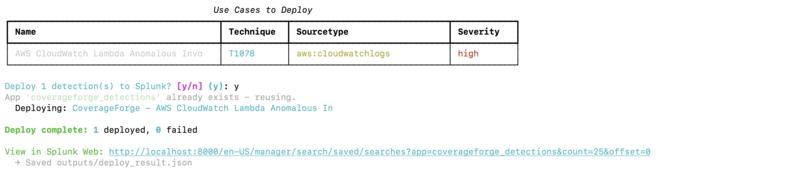
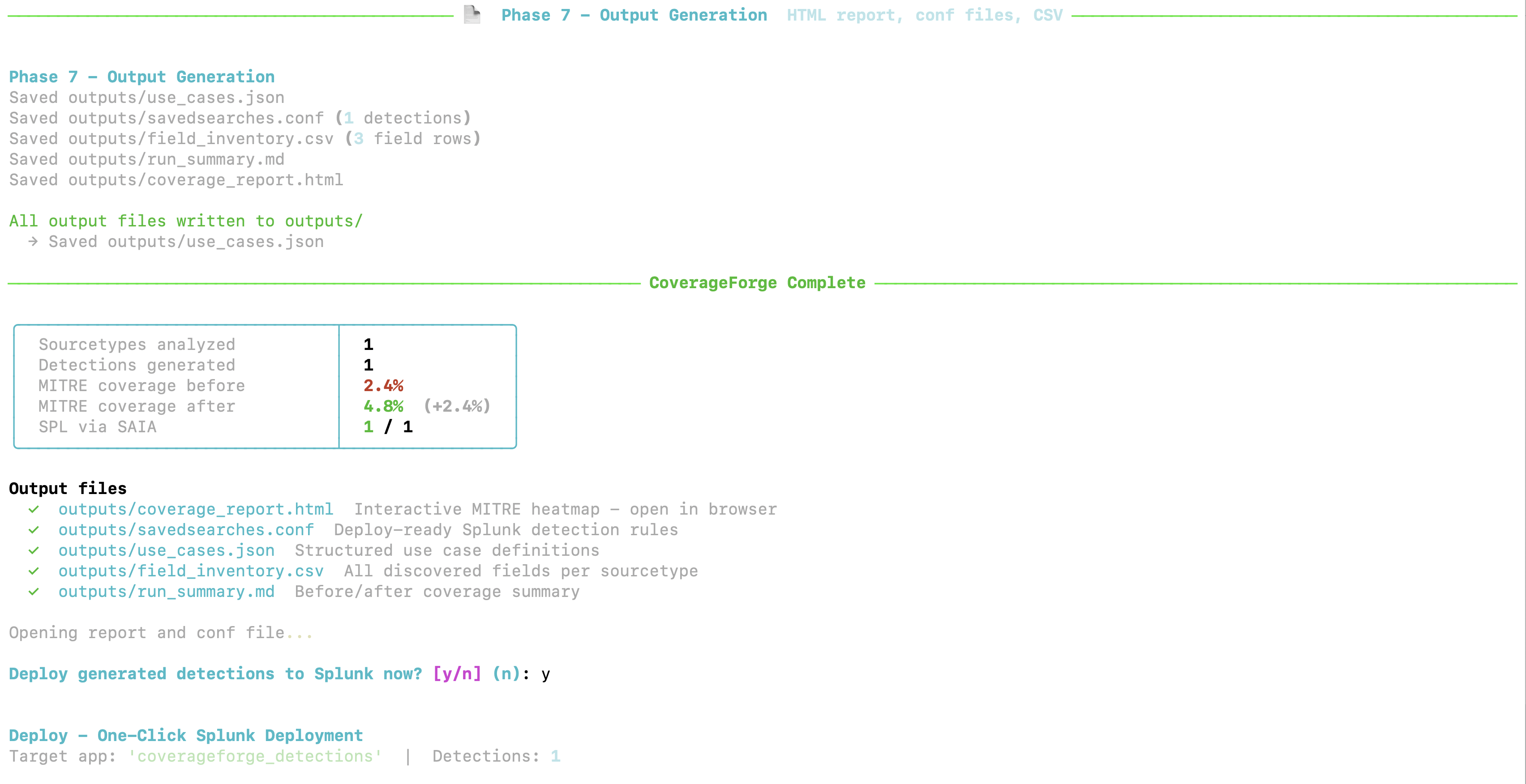
Phase 7 - Output Generation HTML report, conf files, CSV
-
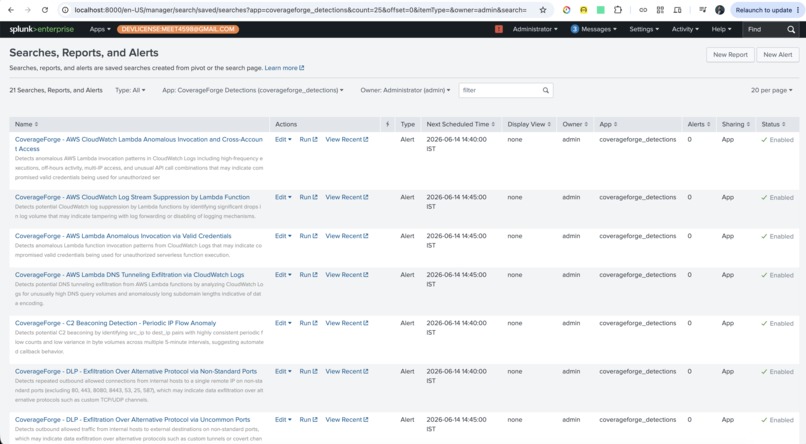
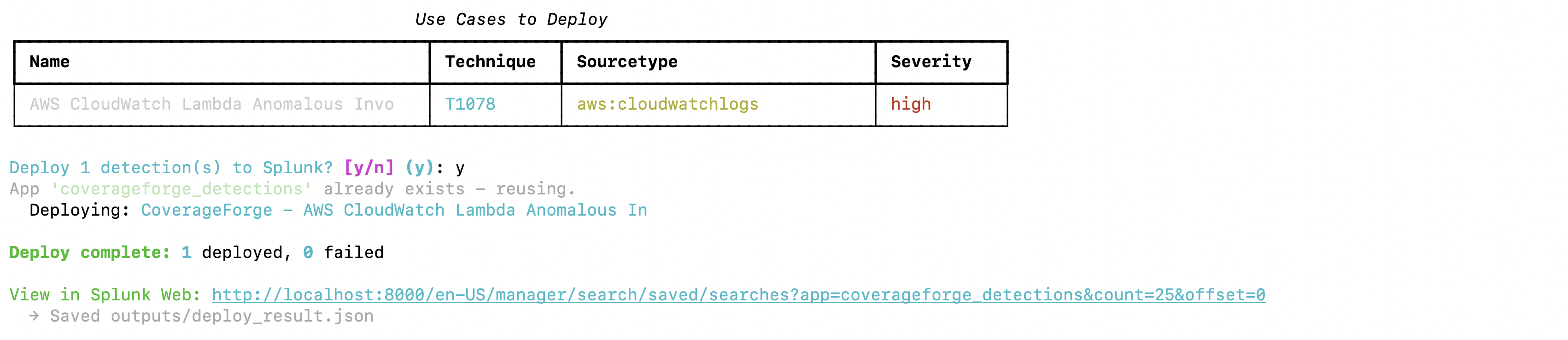
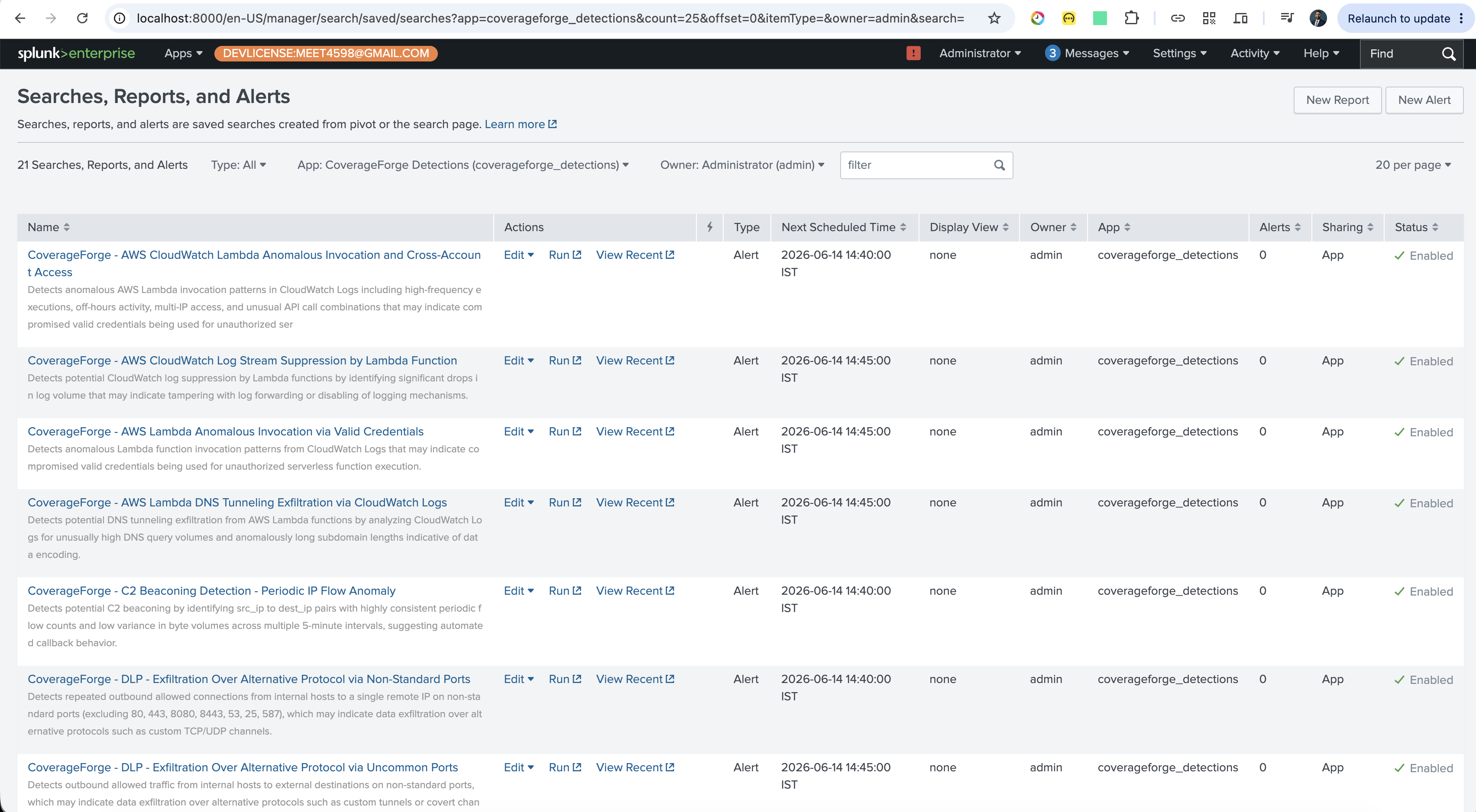
Deployed SavedSearches using Splunk Python SDK
-
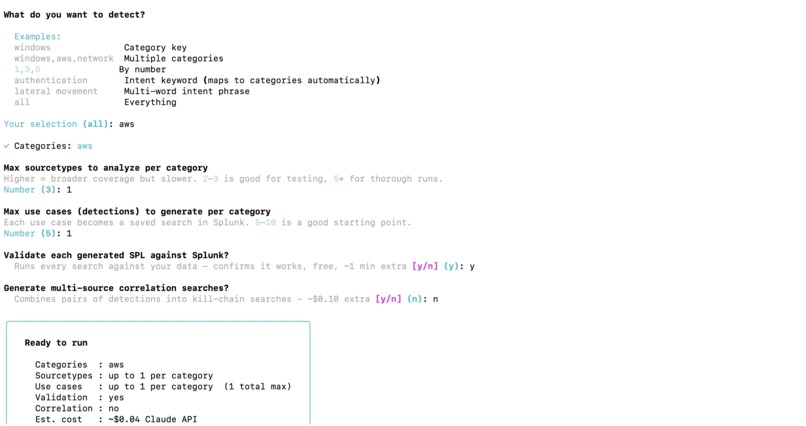
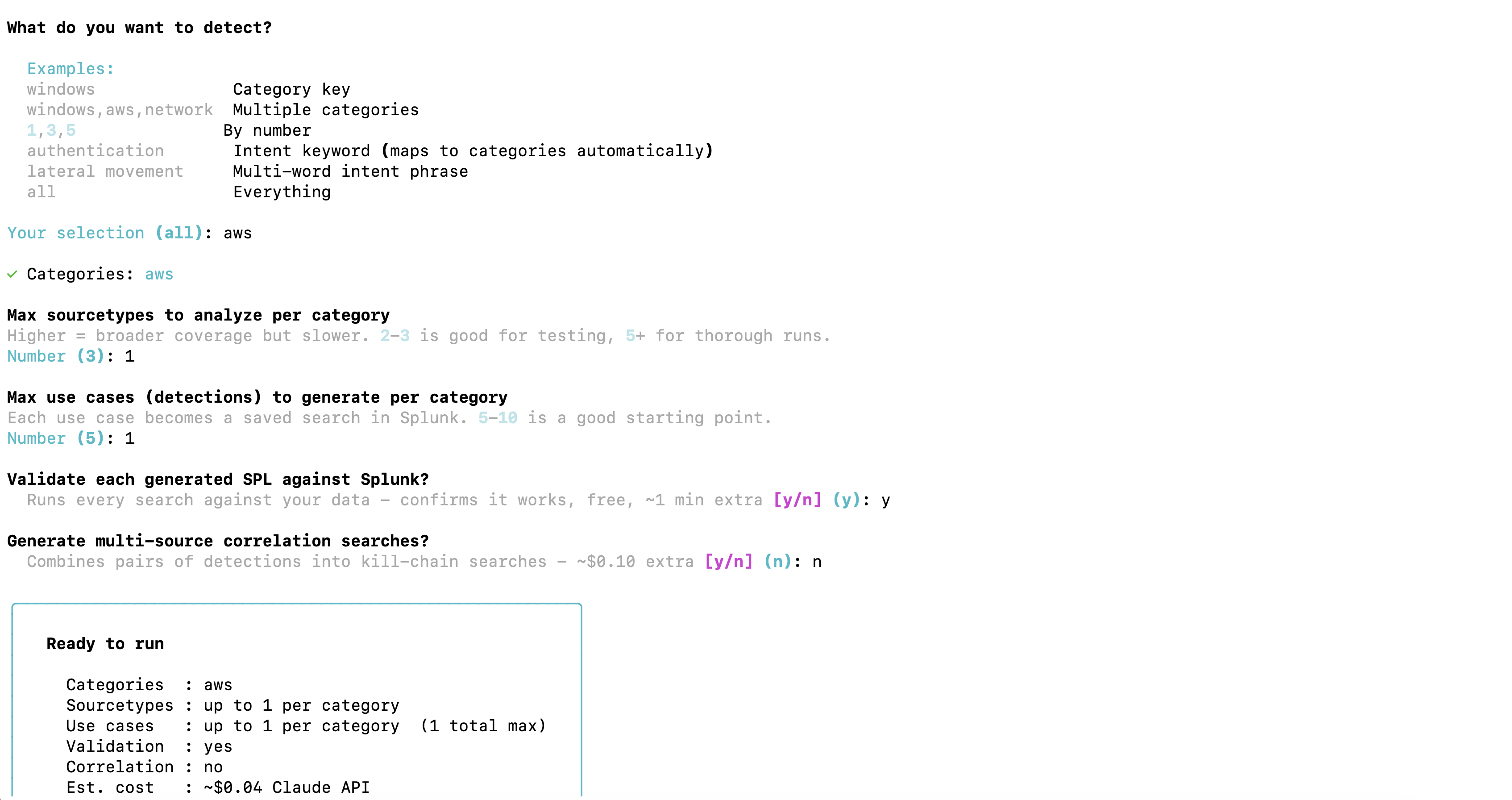
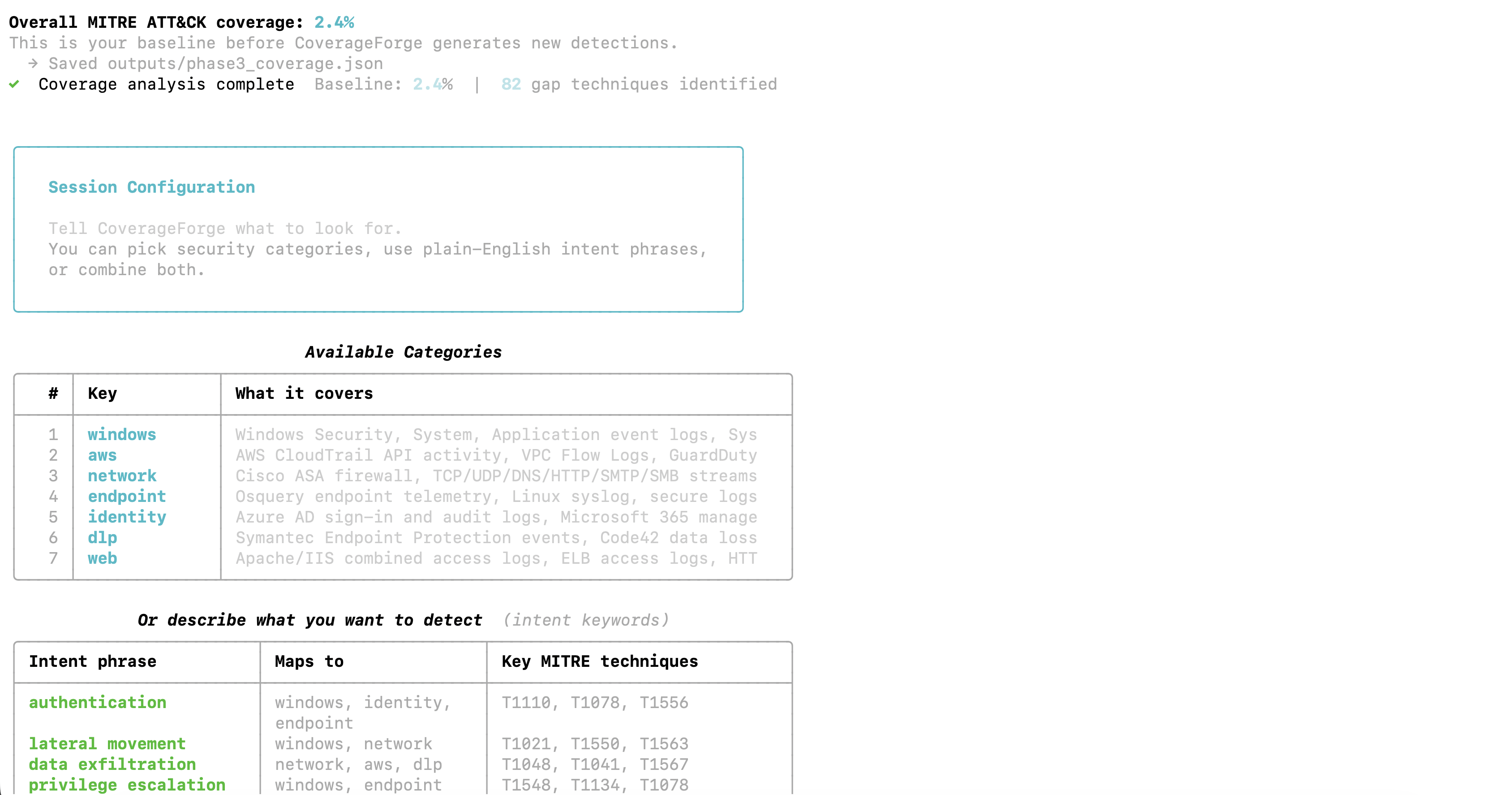
What do you want to detect?
-
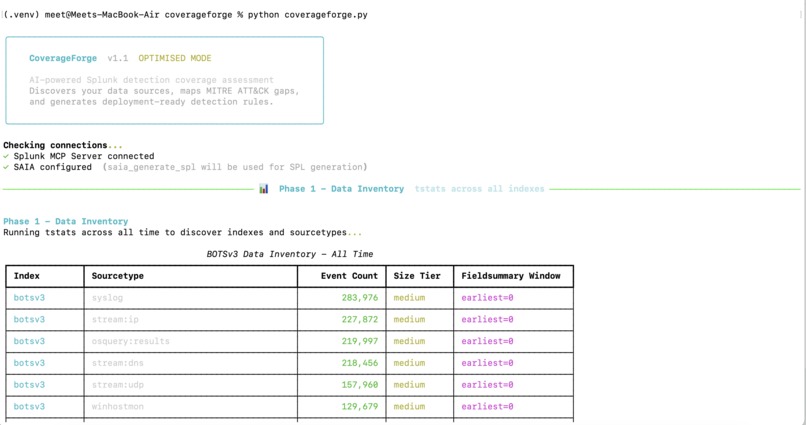
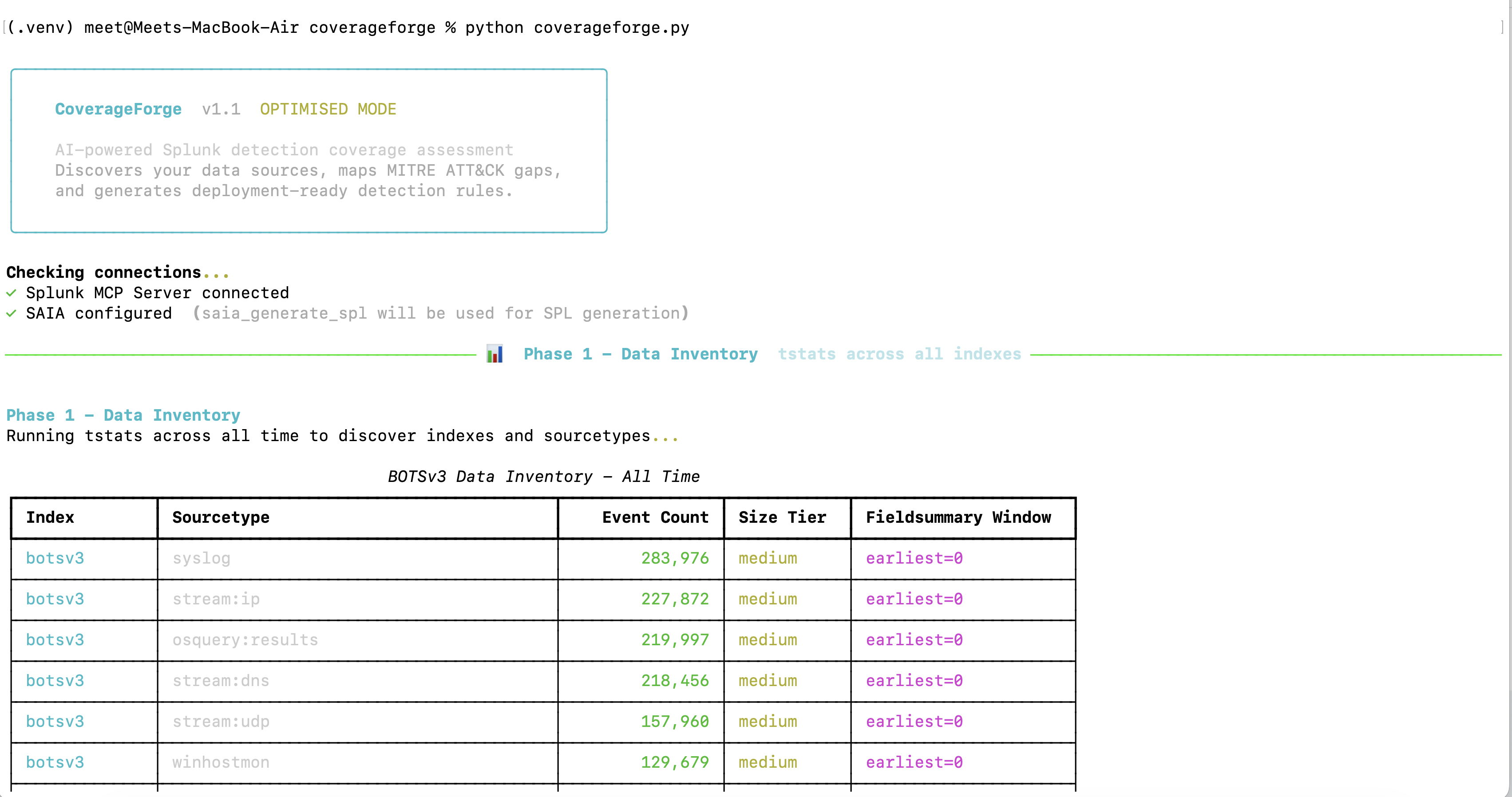
Phase 1 - Data Inventory tstats across all indexes
-
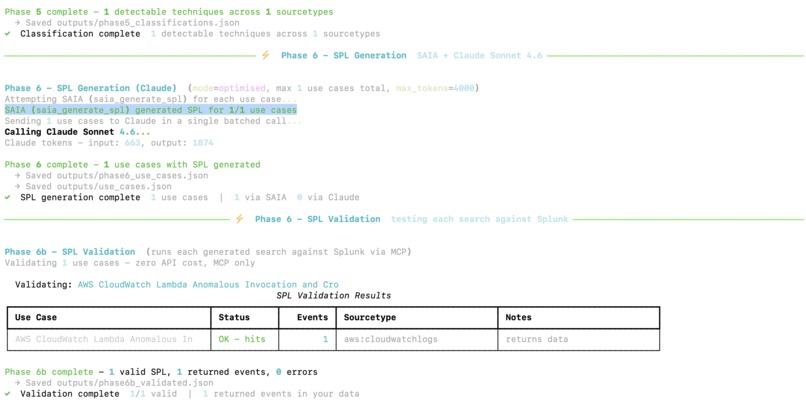
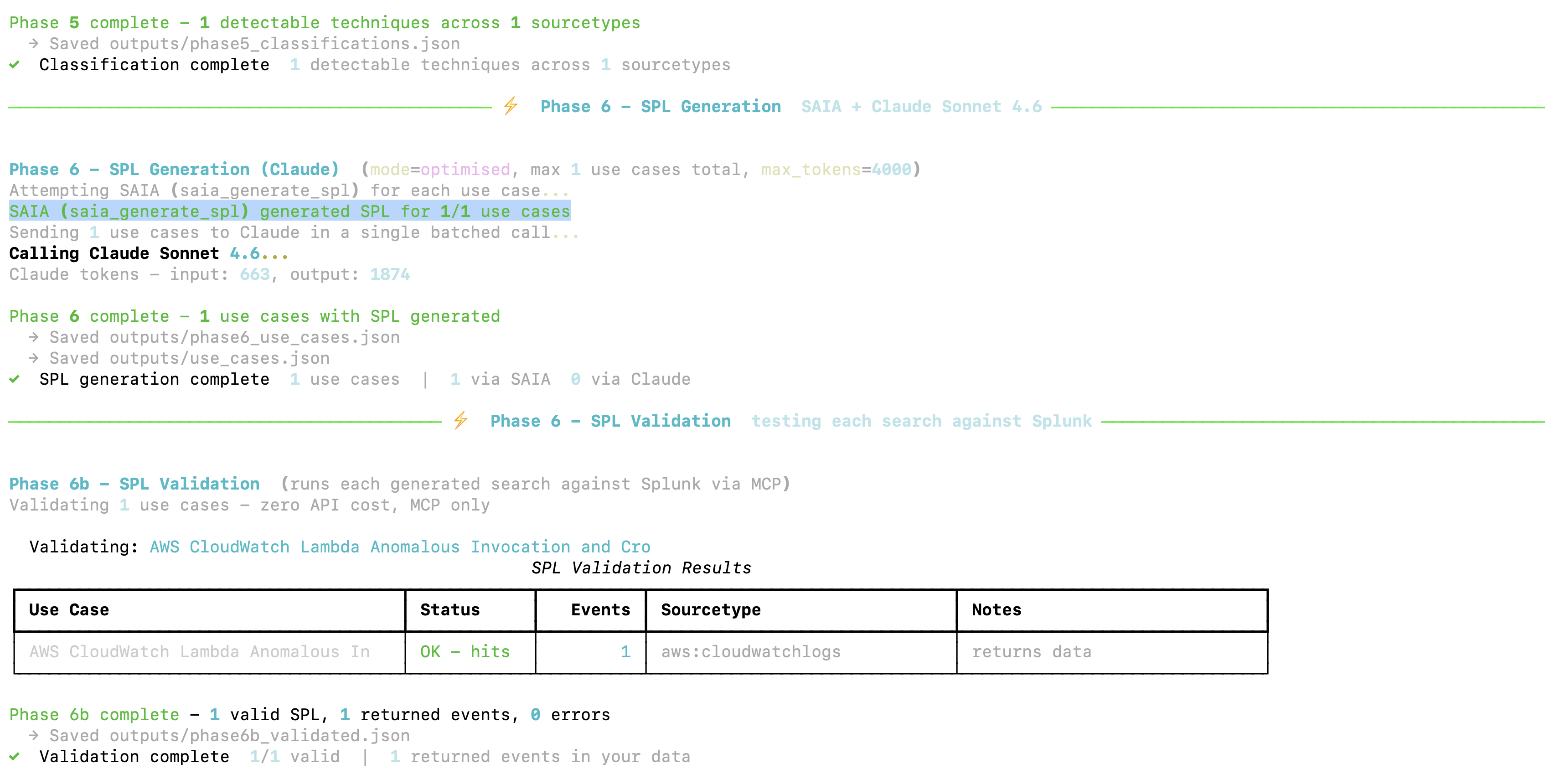
Phase 6 - SPL Generation SAIA + Claude Sonnet 4.6
-
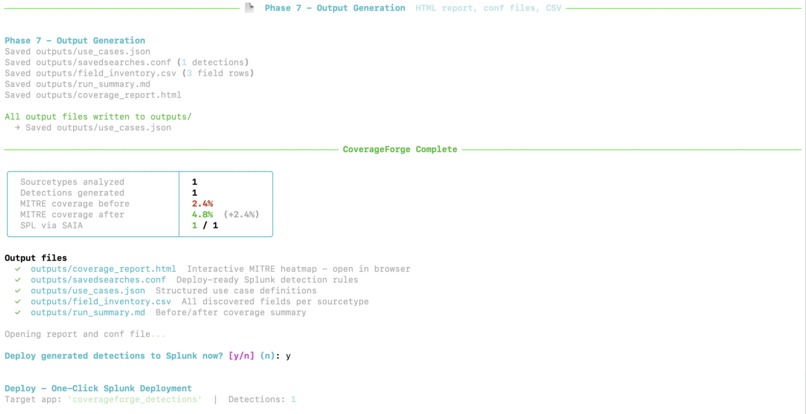
Phase 6 - SPL Validation testing each search against Splunk
-
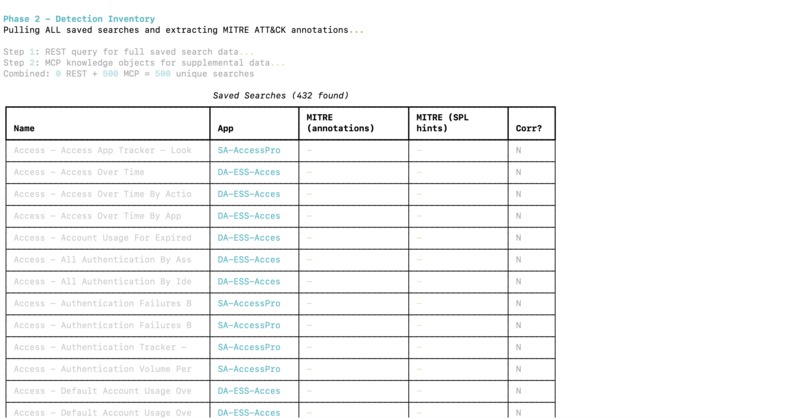
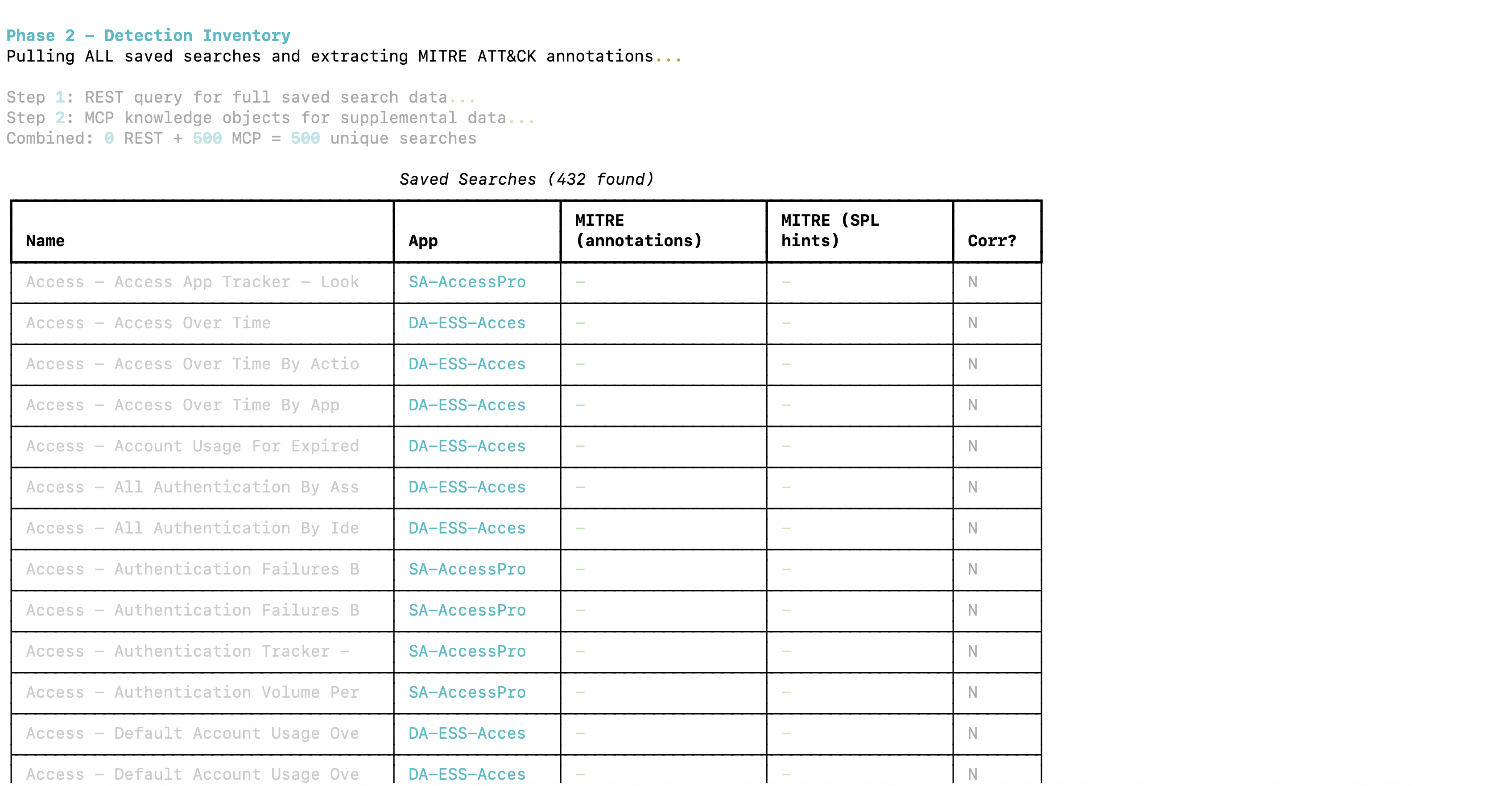
Phase 2 - Detection Inventory saved searches + MITRE annotations
-
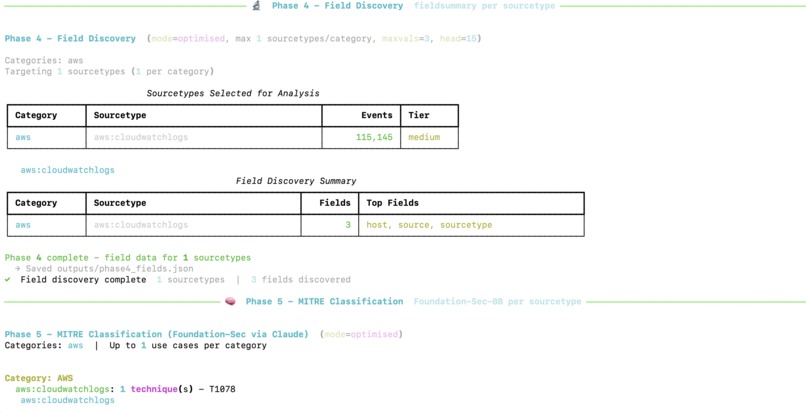
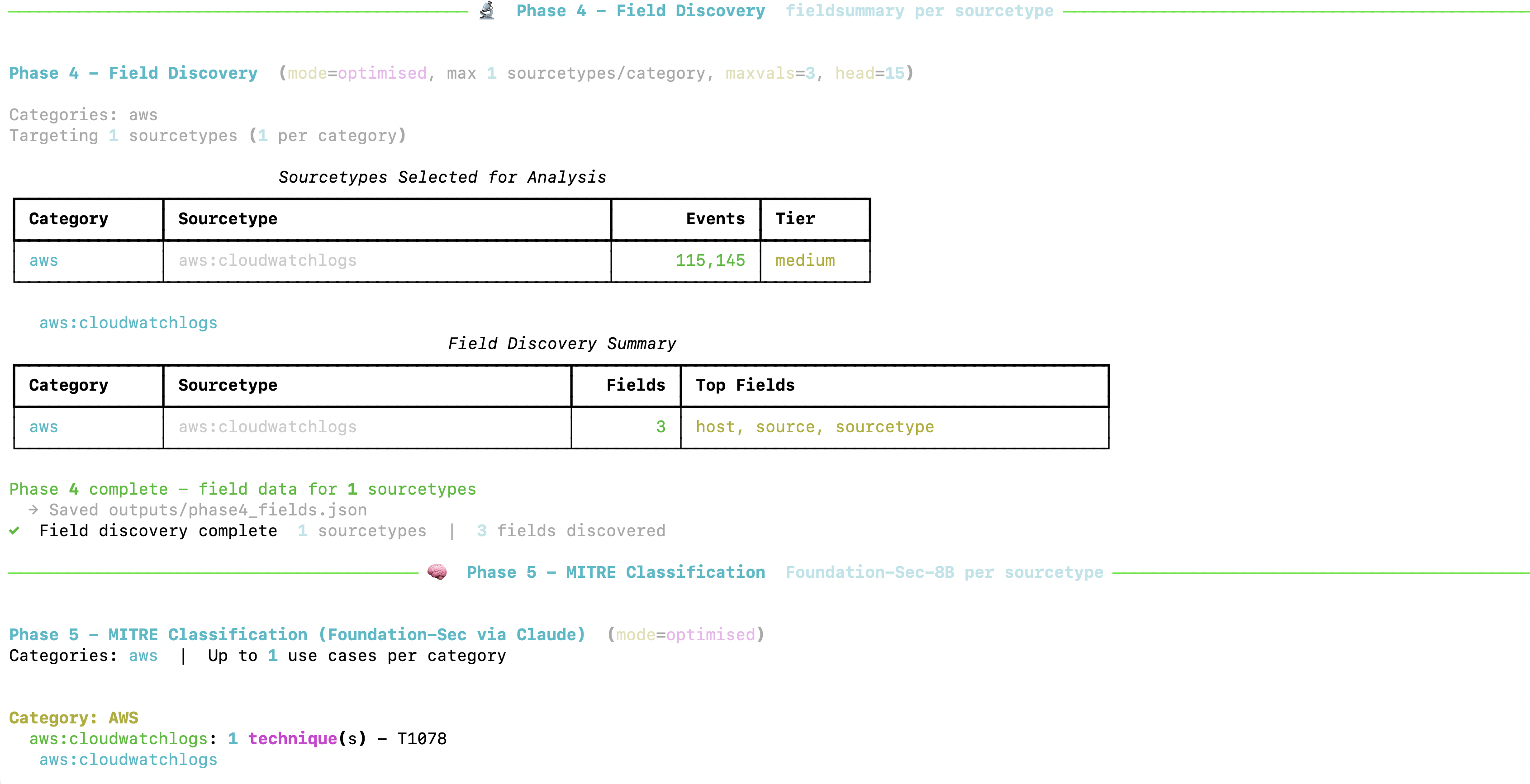
Phase 4 - Field Discovery fieldsummary per sourcetype & Phase 5 - MITRE Classification Foundation-Sec-8B per sourcetype
-
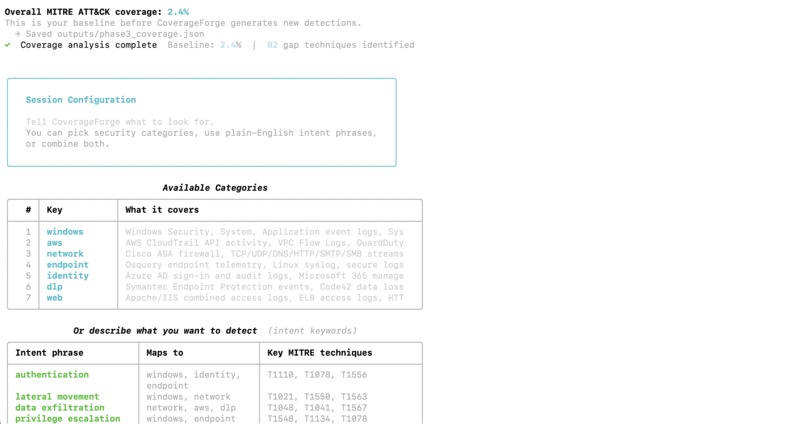
Tell CoverageForge what to look for. You can pick security categories, use plain-English intent phrases, or combine both.
The Problem
Every security team using Splunk faces the same challenge: they have data, but they don't know what attacks that data can actually detect. Mapping sourcetypes against MITRE ATT&CK, writing SPL for each gap, and deploying it to Splunk is a process that takes skilled detection engineers days - and most organizations have dozens of data sources they have never fully analyzed.
The typical workflow looks like this:
- Run
fieldsummarymanually against each sourcetype to understand available fields - Cross-reference fields against MITRE ATT&CK to figure out which techniques could be detected
- Write SPL detection searches from scratch for each identified gap
- Format each search as a
savedsearches.confstanza with MITRE annotations - Deploy to Splunk, configure severity, set cron schedules
This takes a skilled detection engineer 2-8 hours per data source. CoverageForge automates the entire lifecycle end-to-end in under 5 minutes.
What CoverageForge Does
CoverageForge is a 7-phase agentic AI pipeline that connects to your Splunk instance and handles everything automatically.
Phase 1 - Data Inventory
Uses tstats via the Splunk MCP Server to discover every indexed sourcetype and event count across all indexes.
Phase 2 - Detection Inventory
Pulls all existing saved searches via MCP and extracts MITRE ATT&CK coverage from the official action.correlationsearch.annotations field used by Splunk Enterprise Security.
Phase 3 - Gap Analysis Cross-references existing coverage against the MITRE ATT&CK Enterprise matrix (12 tactics, 84 techniques) to produce a baseline coverage percentage and gap list per tactic.
Phase 4 - Field Discovery
Runs fieldsummary per sourcetype via MCP with adaptive head limits to stay within the 60-second MCP timeout on large datasets.
Phase 5 - MITRE Classification Uses Foundation-Sec-8B (Cisco/Splunk's security-tuned AI model) to classify which attack techniques are detectable from available fields and sample values.
Phase 6 - SPL Generation
Calls Splunk AI Assistant (saia_generate_spl) via Splunk Cloud MCP for each use case. Claude Sonnet 4.6 handles descriptions, conf stanzas, and any use cases SAIA could not generate. Each use case is tagged with spl_source showing whether SAIA or Claude generated it.
Phase 6b - Validation Runs every generated SPL against real Splunk data via MCP to confirm it executes without errors and returns results.
Phase 7 - Output
Generates an interactive HTML coverage report with Chart.js visualizations, a deployment-ready savedsearches.conf, structured use_cases.json, and a field inventory CSV.
Deploy
Uses the Splunk Python SDK (splunklib.client) to create a coverageforge_detections app and deploy all generated searches directly into Splunk with one command.
Splunk AI Capabilities Used
| Capability | How Used |
|---|---|
| Splunk MCP Server | All data collection at runtime - splunk_run_query, splunk_get_knowledge_objects, splunk_get_metadata |
| Foundation-Sec-8B | MITRE ATT&CK technique classification from sourcetype field data |
| Splunk AI Assistant (SAIA) | saia_generate_spl MCP tool for SPL generation via Splunk Cloud |
| Splunk Python SDK | One-click deployment via splunklib.client with two-step app creation pattern |
Challenges
MCP timeout on large sourcetypes
The MCP Server has a 60-second hard timeout. Large sourcetypes with millions of events would exceed this during fieldsummary. Solved with adaptive head limits based on event count tiers.
SAIA response format
SAIA requires prompt as the argument key (not query), and returns SPL inside a nested structuredContent.results[0].response structure rather than as plain text. Both required significant debugging since neither is documented clearly.
Claude JSON truncation For large batches, Claude sometimes hits the token limit mid-JSON response. Built a bracket-depth parser that recovers all complete objects from a partial response so no results are silently lost.
MCP token audience claim The Splunk MCP token must be generated from inside the MCP Server app, not from Settings > Tokens. The two token types use different audience claims and produce different error messages - the root cause took hours to identify.
splunk-sdk 3.0.0 breaking change
Creating saved searches scoped to a specific app requires a two-step connect pattern: connect without app scope to create the app, then reconnect scoped to the app for saved search operations. Single-step connect causes SavedSearches.__init__() errors.
What I Learned
Detection engineering is fundamentally a data coverage problem, and AI is well-suited to solve it systematically. Foundation-Sec-8B's security domain training produces significantly better MITRE technique classifications than a general-purpose model given the same field data. SAIA generates production-quality SPL that accounts for field aliasing and edge cases that generic prompting misses. The combination of MCP for data access, Foundation-Sec for classification, SAIA for SPL, and the Python SDK for deployment creates a complete agentic loop that requires no manual steps.

Log in or sign up for Devpost to join the conversation.