Inspiration
Code often feels like a foreign language—even for people who already work with technology. Developers may understand one programming language well but still struggle when reading another, while beginners face an even greater barrier.
Code Translator was inspired by the simplicity of camera-based translation tools. We asked ourselves:
If we can point a camera at written language and understand it instantly, why should code be different?
Our goal is simple: make code easier to read, learn, and understand.
What it does
Code Translator helps people understand unfamiliar code through a simple, focused experience.
The current iOS prototype establishes the core translation workflow and the foundation for camera-based code capture.
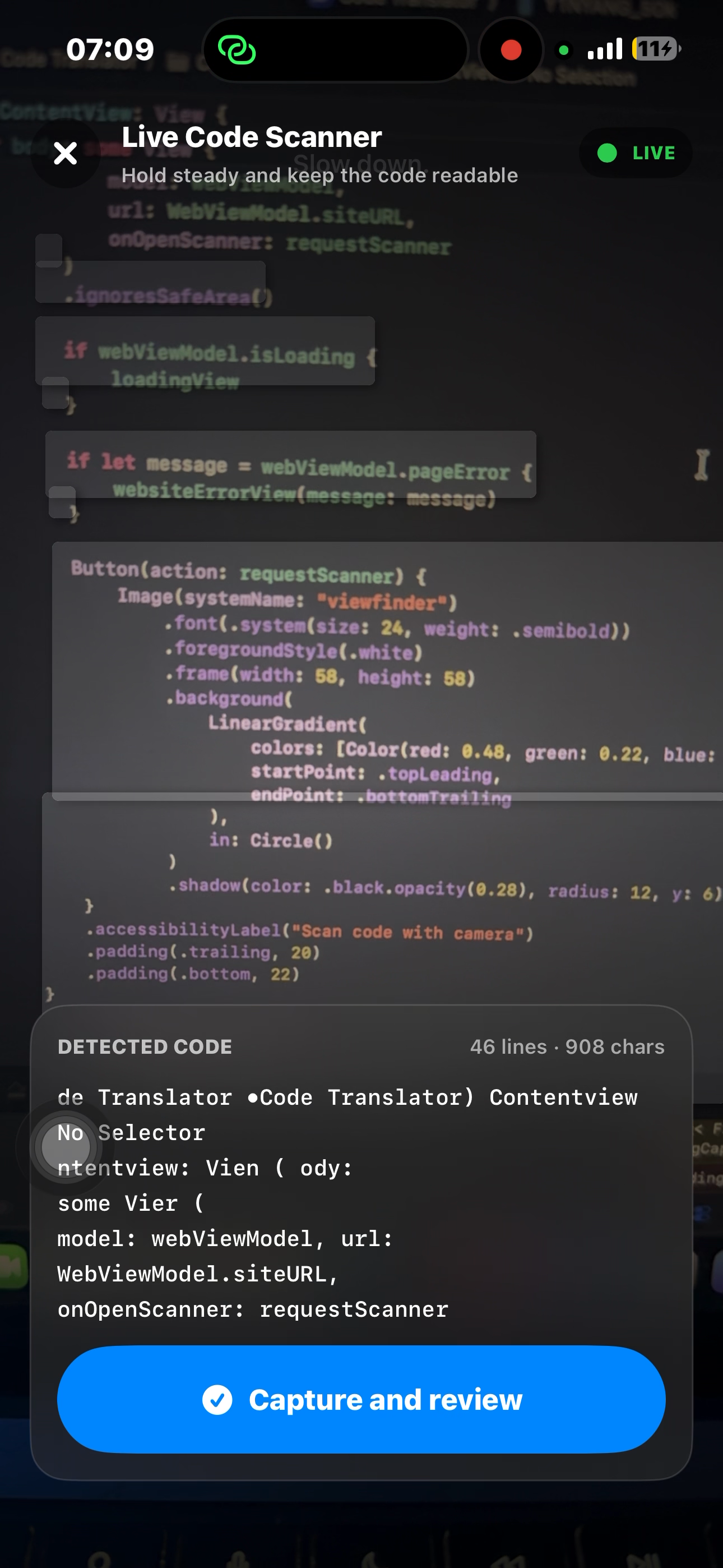
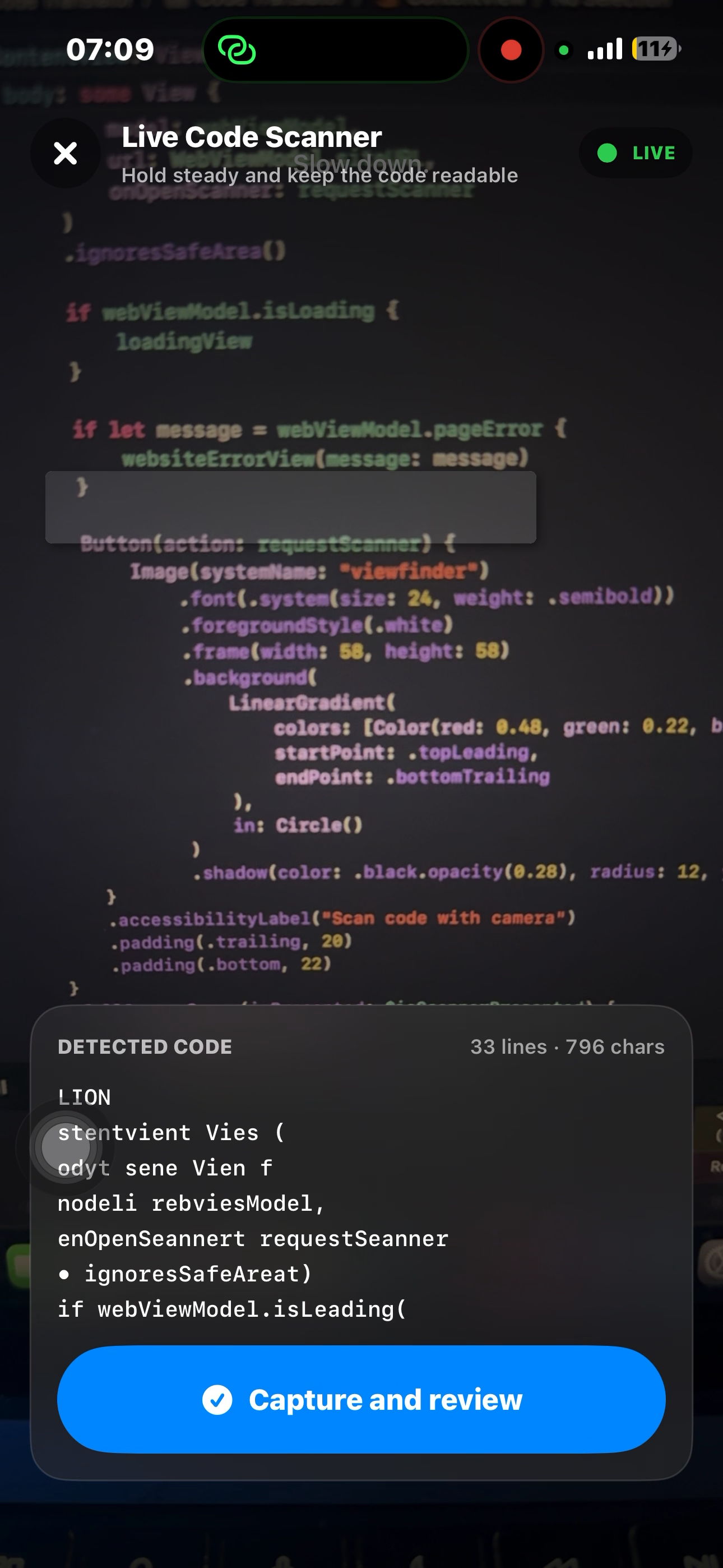
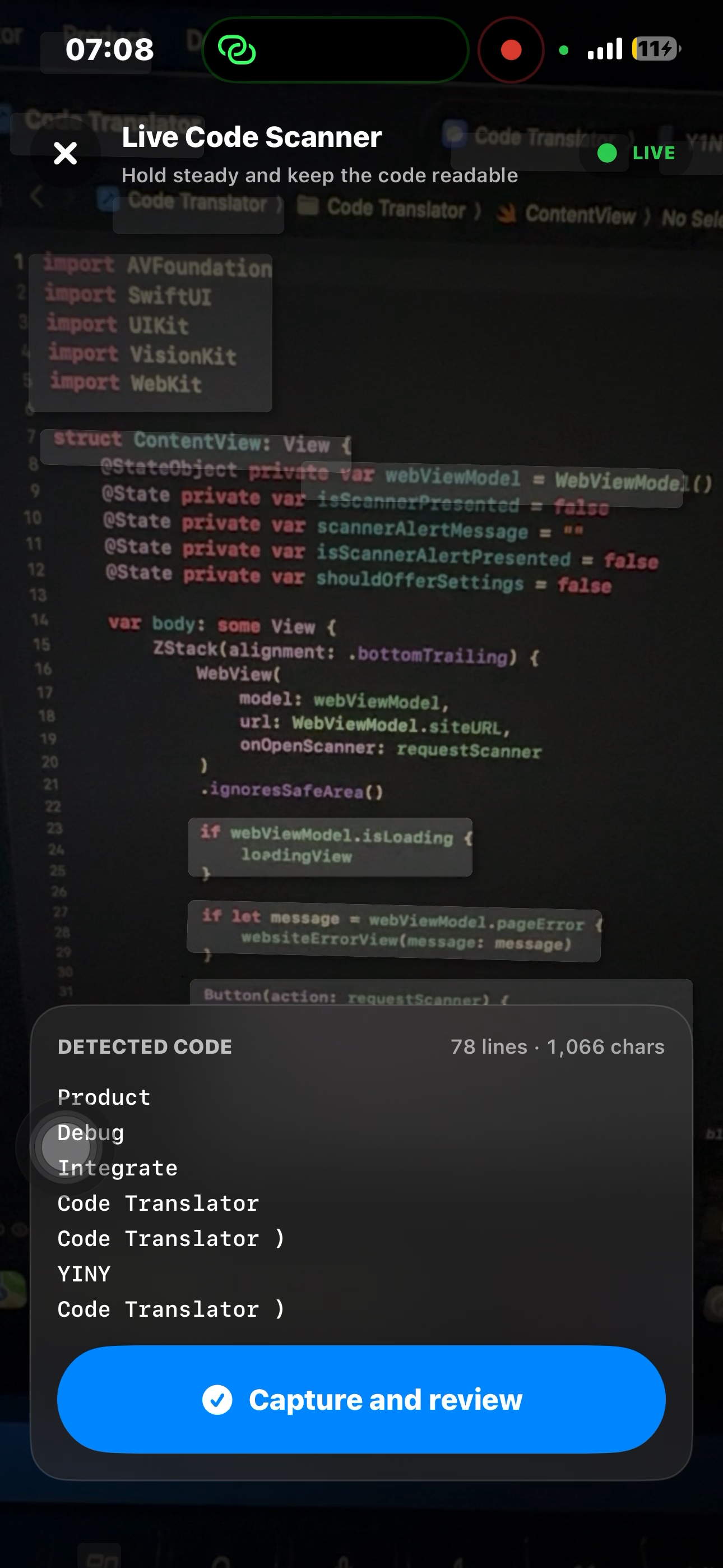
Our larger vision is real-time OCR code translation: point an iPhone camera at code displayed on another screen, in a book, inside a document, or within an error message, and see it recognized, translated, and explained directly on the device.
In simple terms:
Point your camera at code. Understand what it means.
How we built it
Code Translator was built as a solo project using SwiftUI and Xcode.
We developed it as a native iOS application and tested it on a physical iPhone—not only in the simulator. The project includes:
- A native SwiftUI interface
- Application navigation
- Camera permission handling
- The core translation workflow
- Product branding and app identity
- The structural foundation for OCR-based code capture
We deliberately kept the product focused around one question:
How can someone understand unfamiliar code with as little friction as possible?
Rather than attempting to build every possible developer feature at once, we first concentrated on establishing a usable product foundation.
Challenges we ran into
The largest challenge was turning a simple concept into a reliable real-time experience.
Camera-based code translation requires several systems to work together:
- Camera capture
- Optical character recognition
- Code detection
- Programming-language identification
- Translation and explanation
- Responsive interface updates
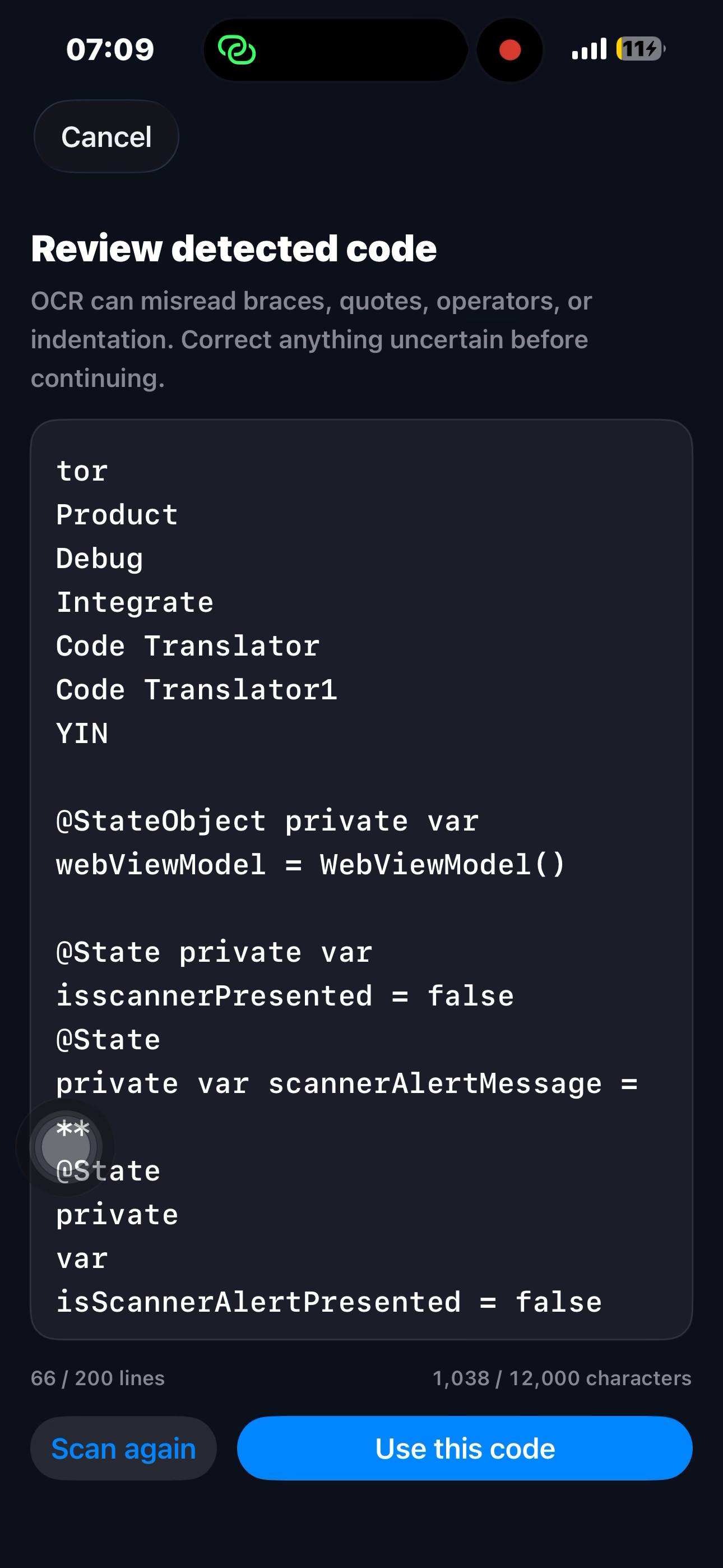
Code is also more difficult to recognize than ordinary text. A small OCR mistake involving a bracket, quotation mark, indentation, or symbol can completely change what a program means.
We also encountered practical iOS challenges, including camera permissions, differences between simulator and physical-device behavior, project configuration, and maintaining a responsive interface.
As a solo builder, another important challenge was deciding what not to build. The vision is large, but the first version still needs to remain focused, testable, and achievable.
Accomplishments that we're proud of
We are proud that Code Translator became a working native iOS prototype rather than remaining only an idea or design concept.
The application now:
- Runs on a real iPhone
- Has a clear product identity
- Demonstrates the core translation experience
- Provides a foundation for real-time OCR
- Has a focused and understandable product direction
We are especially proud that the concept can be explained in one sentence:
Point your camera at code and understand it in real time.
There is still significant work ahead, and we do not consider the product finished. However, building the initial product foundation as a solo developer was an important milestone.
What we learned
We learned that real-time AI products depend as much on speed, reliability, and interface design as they do on model quality.
A technically correct answer is not enough if users must wait too long or complete too many steps. For Code Translator to succeed, the experience must feel immediate.
We also learned that OCR for programming requires a much higher level of precision than ordinary document scanning. Missing a single character may change the meaning of the code, so the system will eventually require validation, confidence checks, and error correction.
Most importantly, we learned the value of reducing scope. Building the smallest honest version of the product made the remaining technical requirements much clearer.
What's next for Code Translator
The next major milestone is real-time OCR code translation through the iPhone camera.
The planned workflow is:
- Point the camera at code
- Detect and capture the text continuously
- Identify the programming language
- Translate or explain the code
- Display the result with minimal delay
Future improvements may include:
- Screenshot and image import
- Automatic programming-language detection
- Translation history
- Beginner-friendly explanations
- Improved code formatting
- OCR confidence indicators
- Error detection and correction
- Support for additional platforms
The long-term goal is not to replace developers or programming education. It is to remove unnecessary barriers and help more people understand the code in front of them.
Built With
- avfoundation
- chatgpt
- cloudflare
- codex
- liveocr
- stripe
- supabase
- swift
- swiftui
- visionkit
- webkit
- xcode


Log in or sign up for Devpost to join the conversation.